spreadloveandacceptance.comSee it fairly. Say it kindly.

Spread Love & Acceptance

Understanding yourself and the people you share a life with

For one person · Full version

Part One and Part Three: everything you can read and use on your own.

by Christian

Spread Love & Acceptance

For one person · Full version

Spread Love & Acceptance

Understanding yourself and the people you share a life with

For one person · Full version

by Christian

Spread Love & Acceptance
spreadloveandacceptance.com

Spread Love & Acceptance: For one person, the full version.
By Christian. Published by Spread Love & Acceptance.

This edition: October 2026. Made from the chapters at spreadloveandacceptance.com/book, where they are kept up to date.

Free to read and share. You may print, copy and share this book for personal use and for non-commercial teaching, as long as you credit “Spread Love & Acceptance, spreadloveandacceptance.com” and don’t change it or sell it.

Not therapy. This book is general education about people and relationships. It is not a diagnosis, treatment or a replacement for help from a doctor, counsellor or other trained professional, and it can’t know your situation.

If you are not safe. If you feel afraid of someone you live with, or someone controls your money, phone or movements, that is not a problem to fix with a worksheet. spreadloveandacceptance.com/safety lists free, private help. If you are in danger now, call your local emergency number.

The examples are made up. The people in the scenes and examples are invented, built from common patterns. None of them is a real person or a testimonial.

Research mentioned in the chapters is listed, with links, in the research notes at the back and at spreadloveandacceptance.com/research.

Set in Lora, Fraunces and IBM Plex Mono.

If you need help now

If you might act on thoughts of ending your life, or someone is in danger right now, call your local emergency number: 999 in the UK, 112 or 999 in Ireland, 911 in the US and Canada, 000 in Australia, 111 in New Zealand.

If you are struggling, or worried about someone else, you can talk to a trained person now. These lines are free, private and open day and night. You don’t have to be sure it is a crisis to call or text.

Where you areCall or text
United StatesCall or text 988 (the 988 Suicide & Crisis Lifeline), or chat at 988lifeline.org. You can also text HOME to 741741 (Crisis Text Line).
United KingdomCall Samaritans free on 116 123. Or text SHOUT to 85258 (Shout, a free text line).
IrelandCall Samaritans free on 116 123.
CanadaCall or text 9-8-8 (the Suicide Crisis Helpline), in English or French.
AustraliaCall Lifeline on 13 11 14, or text 0477 13 11 14.
New ZealandCall or text 1737 (Need to talk?).
Anywhere elsefindahelpline.com lists free helplines in many countries, by phone, text and chat.

For children and young people

UKChildline, 0800 1111 (free, for anyone under 19)
IrelandChildline, 1800 66 66 66 (free, for anyone up to 18)
CanadaKids Help Phone, 1-800-668-6868, or text CONNECT to 686868
AustraliaKids Helpline, 1800 55 1800 (ages 5 to 25)
New ZealandYouthline, 0800 376 633, or text 234
US988 is for every age.

If you’re worried about someone

Ask them plainly: “Are you thinking about ending your life?” Studies have found that asking does not put the idea in someone’s head, and talking about it may even ease it. Listen, stay with them if you can, and call or text one of the lines above together. Part Three, Chapter 12, page 405 says more about helping someone in a crisis, and Chapter 16, page 508 about worry, low mood and when to get help.

This book is general education, not a crisis service. The website’s tools keep what you type on your own device, so nobody there can see it or reply to it. The numbers were checked in October 2026. Numbers can change; findahelpline.com keeps an up-to-date list.

How to use this book

This is a book about seeing what is really going on, in yourself and between people, without blaming anyone, and then changing one small thing. This copy holds 20 chapters in two parts, in the full version. There is no wrong way in.

The parts

  • Part One: Self-discovery. Where you came from, who you are now and who you are becoming. You can read all of it on your own.
  • Part Three: Understanding people. How feelings, stress, trust, change, grief, groups and love work, for anyone, in any kind of relationship.

Two sizes of every chapter

Every chapter comes in a short version (about 10 to 15 minutes) and a full version with the research, more examples and more to try. This is the full version. The short version is free at spreadloveandacceptance.com/book.

Read in order, or by need

Read it front to back like any book, or start with the chapter that fits what is going on. Each chapter ends with What to remember, This connects to (the chapters that explain it or put it to use, with page numbers) and Put it to use, with codes you can scan for the matching tool.

In every chapter

  • A short scene: a made-up moment from everyday life.
  • Words you could use: sentences to say out loud.
  • Try this: one small thing to do this week.
  • Common mix-ups: easy mistakes, and what is closer to true.

The site, the program and Professor Puddles

The book has a free website with the workpapers (pages you fill in) and tools (helpers you use) that the chapters mention; the next page explains both. Nothing you type there leaves your device, and there is no account. The six-week program (spreadloveandacceptance.com/prog-01) puts Part Two to work a week at a time, and the self path does the same for Part One. Professor Puddles, the site’s friendly guide, answers questions about the book’s ideas.

Go gently

Some chapters touch hard things: grief, shame, anger, worry, trauma. Skip anything that isn’t right for today. Nothing here is a test, and nothing needs to be done all at once.

Workpapers, tools and three friends

Workpaper WP-03 Workpapers: pages you fill in

A workpaper is a page you fill in, on your own or together: a one-week log, a list of who owns which job, a short check. Each one has a number, like WP-03, and it is always called a workpaper, for example “Workpaper WP-03: One owner per job”. The blank workpapers are also at the back of this book, one page each, to copy.

Tool Tools: helpers you use on the site

A tool is an interactive helper on the website: a quiz, a calm-down timer, a card maker, or the Chat analyzer that reads a message with you. You use it and it gives you something back. It is always called a tool, for example “Tool: Chat analyzer”.

The book keeps the two apart: a workpaper and a tool never share a list. Both are free, need no account, and what you type stays on your device.

Three friends who give hints

  • Professor Puddles, the site’s cheerful raindrop professor, gives most of the hints: a thought to take with you, and the workpaper or tool that fits.
  • Tidbit, the quick, curious pup with the big smile and the collar, bounds in now and then with a playful tip.
  • Sugarfoot, the steady, gentle pup with the long soft ears and the best hugs, turns up with a calm, slow tip.

They keep to the lighter pages. Where a chapter talks about crisis, deep grief or being hurt, the pages stay quiet and plain.

Find it fast

Start with what is going on, not with chapter one. Each line points to the place in the book that helps most, and one tool to try. You can read that part on its own and stop.

Sharing the load

If this is going onReadPageTry
We each think we do more than our share.Part Three · Chapter 3 · Everyone feels like the one who sees clearly168Workpaper WP-01Who did what
We’ve just had a baby and we’re both exhausted.Part Three · Chapter 2 · Rest isn’t one thing147Workpaper WP-02How much are you carrying?
I’m caring for a parent or partner, and it’s wearing me down.Part Three · Chapter 12 · Your limits make your help last402Workpaper WP-02How much are you carrying?

Talking it through

If this is going onReadPageTry
Small things turn into big rows.Part Three · Chapter 2 · When you’re flooded141Workpaper WP-11The Calm-Down Kit
One of us goes quiet and the other pushes for an answer.Part Three · Chapter 5 · Feeling safe with someone220Workpaper WP-11The Calm-Down Kit: our pause plan
Texts and messages keep landing wrong.Part Three · Chapter 4 · Messages lose their tone194ToolChat analyzer
We need to say sorry and mend things.Part Three · Chapter 11 · A real apology373Workpaper WP-09Say it so it lands
Conflict at work, with a colleague or in a team.Part Three · Chapter 4 · Saying hard things kindly192Workpaper WP-09Say it so it lands

Knowing yourself

If this is going onReadPageTry
I can’t tell what I’m feeling.Part One · Now · When feelings are hard to name58ToolMy weather today
I’m wiped out and everything feels like too much.Part One · Now · Check your weather; one state, many words53Workpaper WP-02How much are you carrying?
ADHD: I’m overwhelmed and keep forgetting things.Part Three · Chapter 9 · ADHD, time and motivation308Tool“How to talk to me” card
I’m autistic, and people keep misreading me (or I misread them).Part One · Now · A mix-up runs both ways66Tool“How to talk to me” card
Old rules from childhood still run my reactions.Part One · Then · Write down the rulebook from home32The self path: where your lens came from
My inner critic is loud.Part Three · Chapter 7 · The critic and the soothing system264Workpaper WP-11The Calm-Down Kit
I want to change a habit, but it keeps slipping.Part One · Next · Tiny, repeatable steps87The self path, step by step

Hard seasons

If this is going onReadPageTry
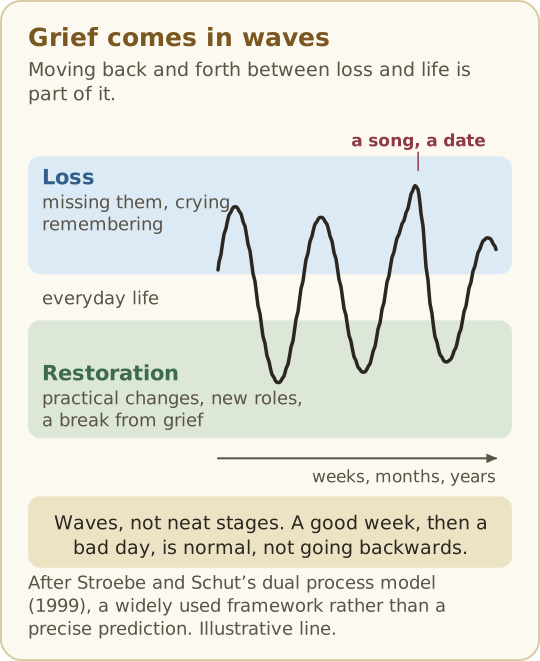
Someone I love has died.Part Three · Chapter 8 · Grief comes in waves282When you’ve lost someone
I feel lonely, or I live on my own.Part Three · Chapter 5 · Building connection from where you are224Living on your own, living well
A teenager’s anger, or I’m a teenager and I’m angry.Part Three · Chapter 13 · The hot minutes423Workpaper WP-11The Calm-Down Kit
Left out of a group, a friend group or a group chat.Part Three · Chapter 17 · Groups online, and their pull523ToolChat analyzer
Worry keeps me awake, or my mood is low.Part Three · Chapter 16 · Worry time; low mood492Workpaper WP-02How much are you carrying?
I’m thinking about ending my life, or I’m worried someone is.If you need help now5The page itself

This copy holds only part of the book, so this map lists the problems it covers. The whole book’s map has 14 more, and every chapter is free to read at spreadloveandacceptance.com/book. Each thing to try is marked as a workpaper (a page you fill in) or a tool (a helper you use on the site). All are free on the website, with nothing to sign up for; each chapter’s end has a code you can scan for them. Looking for a word rather than a problem? The index at the back lists the main ideas.

The book in two pictures

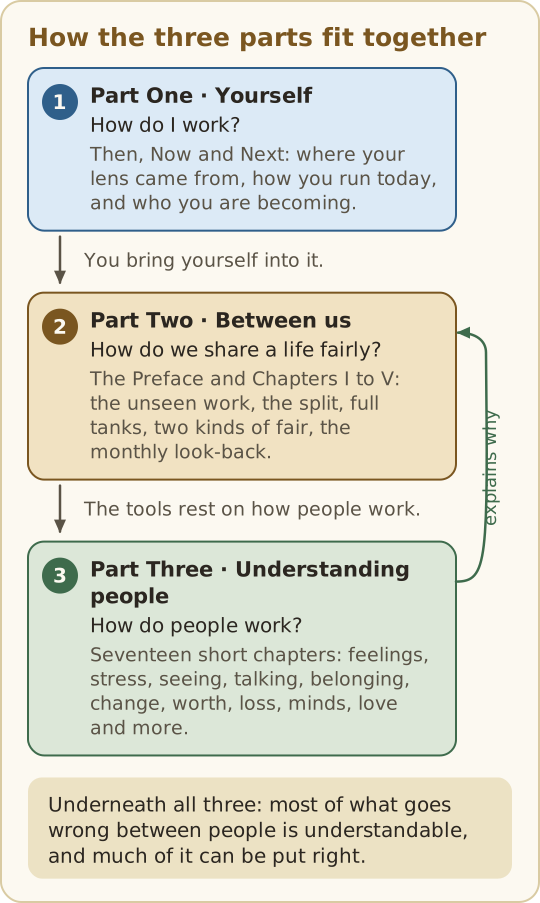
Three stacked cards: Part One, Yourself; Part Two, Between us; Part Three, Understanding people, with arrows showing how they connect.
Figure 1 How the three parts fit together: you bring yourself into every shared life, and Part Three explains why the Part Two tools work.
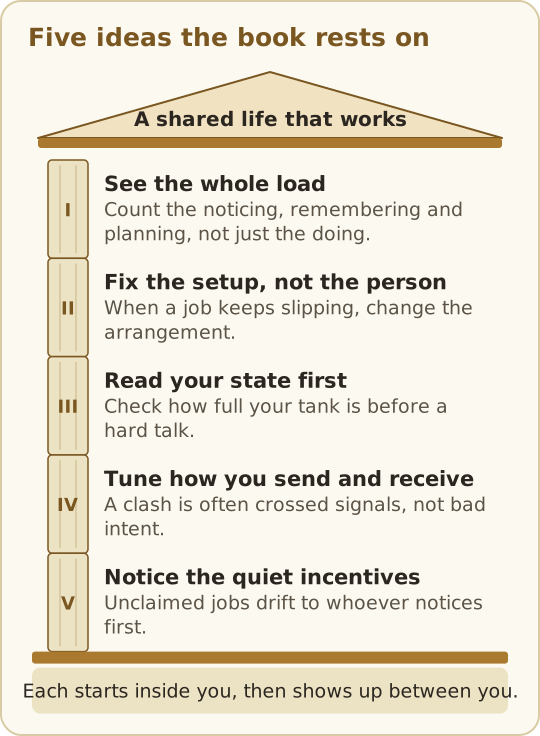
A simple building whose roof rests on five columns, one for each of the five ideas the book rests on.
Figure 2 Five ideas the whole book rests on. Each one starts inside you, then shows up between you and the people you share a life with.

The book

The Book for One Person: the full version

Part One (self-discovery) and Part Three (understanding people): everything you can read and use on your own. From Spread Love & Acceptance, in order, on one page, in the full versions. Read straight through, use your browser’s find, or print it.

Download the PDF Switch to the short versions The book’s home

About 610 minutes of reading in all. Your browser keeps your place if you come back to this page.

Part One

Self-discovery

Where you came from, who you are now and who you are becoming. You can read all of it on your own.

In this part

  1. Then Where your lens came fromKnow yourself: then, where your lens came from16
  2. Now Your wiring, weather and wordsKnow yourself: now, your wiring, your weather and your words46
  3. Next Who you are becomingKnow yourself: next, shaping who you are becoming80

Part One · Then

Know yourself: then, where your lens came from

Why you expect what you expect, and how the rules you picked up growing up still make small decisions for you today.

This is where the book begins. Part One (Then, Now and Next) is about you. Part Two (a Preface and Chapters I to V) is about the people you share a life with. Part Three (Chapters 1 to 17) is about how people work. Some printed copies hold only one or two of the parts; every chapter is free to read at spreadloveandacceptance.com/book, and the book at a glance (spreadloveandacceptance.com/book/topic-start-here) there gives a one-minute tour of the whole thing.

In short:

  • You’re not one thing. A reaction comes from your wiring (it stays), the patterns life taught you (they can soften) and today’s conditions (they pass). This part is about the patterns; Now covers the other two.
  • Your lens came from somewhere: home, school, culture, money and what you lived through. Each stage of growing up asked its own question.
  • Some old rules were learned without all the facts, and they can read other people for you: “Whoever notices, does it.”
  • Write down the rulebook from home, then choose which rules to keep.
  • The past isn’t yours to change. What you carry forward is.

Sunday, 10:15am

Your partner is still in bed and the kitchen is a mess. Before you’ve had a single thought, you feel it: “Of course. It’s always me.” Nobody said that. But in the house you grew up in, whoever noticed the mess cleaned it. That old rule just made a decision for you.

Or, living alone: Since his wife died, Ray’s house is quiet and nobody will see the dishes. He still can’t sit down until every one is done. Nobody is watching. An old rule from the home he grew up in still is.

Everything in this part is about you, and it is for you. Nothing is ever filled in about someone else, nothing is a test, and nothing you write needs to be shared. The chapters after Part One look at what happens between two people. This part goes back to the first person in every conversation.

This part looks back at growing up, so it goes gently. You can read one section and stop, and come back another day. Not every home felt calm or kind. If “they were doing their best” doesn’t fit your story, that’s okay. Take only what is useful to you and leave the rest.

Where this fits: the five big ideas

The whole program rests on five big ideas. Each one starts inside you and then shows up between you and other people. This part mostly teaches “Read your state first” and “Notice the quiet incentives”, with help from “See the whole load” and “Fix the setup, not the person”. (Borrowed from neurobiology, psychology, philosophy and behavioural science.)

  • In you: Ask whether a feeling is the size of this moment or older. Notice what you were praised or scolded for as a child still pulling on you. Holding an old rule in check is real, hidden effort.
  • Between you and others: A learned rule is part of the setup, not a flaw in anyone. Say your rules out loud, and choose shared ones.

You’re not one thing: the three layers

Most of us were never taught to take our own reactions apart. We just react, and then we either defend it (“That’s just how I am”) or blame ourselves (“What’s wrong with me?”). Neither helps much. A third way is to treat a reaction as a mix of three layers, and to ask which one is doing most of the work this time.

LayerWhat it isHow much it changesThe move
Your wiringTemperament, sensory makeup, pace, how you take in words and feelingsVery littleWork with it: build a setup that suits you
Patterns life taught youSettings left by family, culture, school, old relationships and hard experiencesOften, slowlyWork on it, kindly and in small steps
Today’s conditionsSleep, stress, hunger, the load you’re carrying, the room, the time of dayHour to hourWork around it: eat first, sleep on it, talk tomorrow

This part is about the middle layer. Now (page 48) returns to the other two. Most real reactions have some of each, so the goal is not to put every feeling in exactly one box. It is to notice which layer is carrying most of the weight. The full guide is Know your own wiring (spreadloveandacceptance.com/know-yourself-in-depth).

Patterns are the layer that can soften. Family, culture, school, old relationships, past jobs and hard experiences can leave settings behind: an alarm that goes off early, a habit of pleasing people, going quiet, bracing for the worst. They made sense once. With awareness, safety and practice, and sometimes a counsellor, many of them ease over time. Some leave a lasting sensitivity that you learn to carry and explain.

Why sorting the layers matters

Each layer needs a different response. Treat a tired day as a deep wound and you spend weeks on what sleep would ease. Treat wiring as a bad habit and you try to “fix” what only needs a better setup. Treat an old pattern as a bad day and it keeps coming back.

In different relationships

  • Two partners, Adrian and Felix: Adrian goes cold when Felix makes weekend plans without asking. When he sorts it, he finds a little wiring (he needs time to switch gears), a pattern (his father’s plans always overrode his) and a condition (it only blows up after his night shifts). Each part gets its own fix: a heads-up, one honest talk about the old feeling, and no plan-making on the morning after nights. Different hours (spreadloveandacceptance.com/different-hours) has more on shift work.
  • A parent and a teenager: A fifteen-year-old slams a door after being asked about homework. The parent’s first thought is “disrespect.” Sorting their own layers first (worn out from work, raised where answering back meant trouble), the parent waits an hour and asks a different question: “Rough day?”

Mix-ups, and how to fix them

  • “It’s all from my childhood.” Often the biggest part is today. Check sleep, food and load first, and look further back only if it keeps happening.
  • “It’s my wiring, so nothing can change.” The wiring may stay, but the setup around it can change a lot.
  • Sorting someone else’s layers for them. Sort your own, then ask about theirs. A guess about another person’s layers lands as a judgment.

If you’re the only one doing this: That is enough. Sorting your own reaction changes what you bring into the room.

Research note: Researchers have long described differences in temperament that appear early in life and stay fairly steady, such as how quickly a child adapts to change. The New York Longitudinal Study, begun by Alexander Thomas and Stella Chess in the 1950s, is a well-known early example. Twin studies suggest personality is shaped by both genes and experience. Passing conditions matter too: in lab studies, people who have missed sleep react more strongly to upsetting things. This book’s idea: splitting a reaction into exactly three layers is a thinking tool, not a scientific category system.
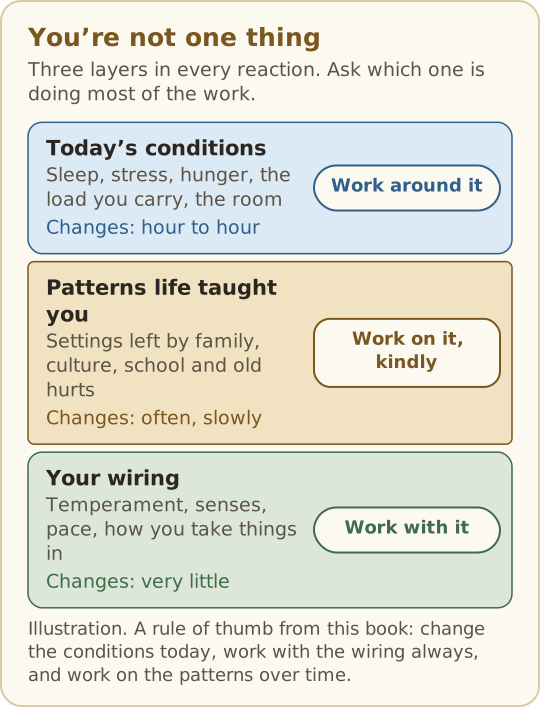
Three stacked layers: today’s conditions (work around it), patterns life taught you (work on it, kindly) and your wiring (work with it).
Figure 3 Three layers in every reaction. Each one changes at a different speed and needs a different move.

Your lens came from somewhere

Family, school, friends, culture, money at home, what you watched and what’s on your phone all taught you what to expect: of yourself, of other people, and of how a “good” partner, parent or friend behaves. Together these make up your lens. By adulthood your lens doesn’t feel like a lens. It feels like simply seeing.

Most of what the lens taught you serves you well. Some of it was right for the child you were and is out of date for the adult you are now. The old story of the cave (spreadloveandacceptance.com/learn/index-in-depth), where people who have only ever seen shadows take the shadows for the whole world, is a picture of something close to this. The site uses it for unseen work, but it also fits a rule you never chose, which can feel like simply how things are.

Where your lens came from (spreadloveandacceptance.com/growing-up) covers this at the pace of a gentle page. Its full version (spreadloveandacceptance.com/growing-up-in-depth) goes further.

Why a lens isn’t a fault

A lens is how a busy brain saves effort: expectations let you predict without working everything out from scratch. Trouble starts only when an expectation from one home is used in another without checking, and someone is judged by rules they never knew.

In different relationships

  • An interfaith couple: Amira grew up where love meant feeding people. Joseph grew up where love meant giving space. When Joseph’s mother is ill, Amira cooks for a week, and Joseph wonders why she won’t let his family rest. Same love, two lenses. Two faiths or cultures, one family (spreadloveandacceptance.com/two-faiths) has more.
  • Two business partners: One grew up where talking about money was rude, the other where it was dinner-table talk. One seems secretive, the other pushy. A set monthly money meeting takes the guesswork out. Money together (spreadloveandacceptance.com/money-together) covers money styles.

Mix-ups, and how to fix them

  • “My lens is just reality.” Ask, “How else could someone see this?” and try to name two other ways.
  • “Their lens is the problem.” Everyone has one. Talk about yours first.

If you’re the only one doing this: You can learn your own lens alone, at your own pace. You don’t need anyone else to look at theirs for yours to become clearer.

Research note: Attachment theory, begun by John Bowlby and Mary Ainsworth, describes how early care can shape what a child comes to expect from the people who matter to them. In 1987 Cindy Hazan and Phillip Shaver applied the idea to adult love. Adult attachment patterns are best seen as tendencies, not fixed types, and they can shift with new relationships and experiences. Plato’s cave is a story, not evidence. This book’s idea: calling the whole mix a “lens.”

Each stage of growing up asks its own question

Researchers call these developmental stages. The ages are rough, and people move at their own pace.

Stage (rough ages)The big question
First years (about 0 to 1)Is the world safe? Will someone come?
Toddler years (about 2 to 3)Can I do it myself?
Early childhood (about 4 to 5)Is it okay to start things and take up space?
School years (about 6 to 11)Am I capable?
Teen years (about 12 to 17)Who am I, and where do I belong?
Young adulthood (about 18 to 39)Can I be close without losing myself?
Middle adulthood (about 40 to 64)What am I building, and who am I making room for?
Later life (about 65 on)Has my life meant something, and can I make peace with it?

The answers can become understandings many people keep using as adults. We often come back to these questions at big changes, such as a move, a new job, a baby or a loss, and each time we can answer a little differently. The stages, with more detail, are on the growing-up page.

Why the questions help

Knowing the question you were busy with turns “What’s wrong with me?” into “That question never quite got answered,” which is easier to work with and blames nobody.

In different relationships

  • A grandfather and his grown-up daughter: He left school at fourteen to work. When his daughter explains the new baby’s sleep plan in detail, an old “Am I capable?” stirs and he gets gruff. Once she sees it, she asks his advice on something he knows well, like fixing the cot. See For grown-up children (spreadloveandacceptance.com/grown-up-children).
  • A partner who becomes ill: Illness in midlife can bring “Can I do it myself?” back at full volume. Accepting help can feel like being small again. Naming that helps both people. See When one of you is ill (spreadloveandacceptance.com/when-one-is-ill).
  • After a partner dies, in later life: A widow of 71 finds herself going through old photos every evening. Later life’s question, “Has my life meant something?”, has come back loudly now that the person who shared it is gone. Telling one of the old stories to a grandchild each Sunday gives the question somewhere to go. See Grief (spreadloveandacceptance.com/grief).

Mix-ups, and how to fix them

  • “I missed a stage, so I’m broken.” The questions come back at big changes, and you can answer them again.
  • “The ages are exact.” They are rough. People move at their own pace.

If you’re the only one doing this: Map your own stages privately. Nobody else needs to agree with how you read your own childhood.

Research note: The table follows Erik Erikson’s stages of psychosocial development, published in the 1950s. His framework is widely taught and useful for reflection, but it is a theory rather than a measured sequence, and later researchers see development as more varied across people and cultures. Erikson also described stages after young adulthood, about caring for the next generation and, later, making peace with the life you have lived.
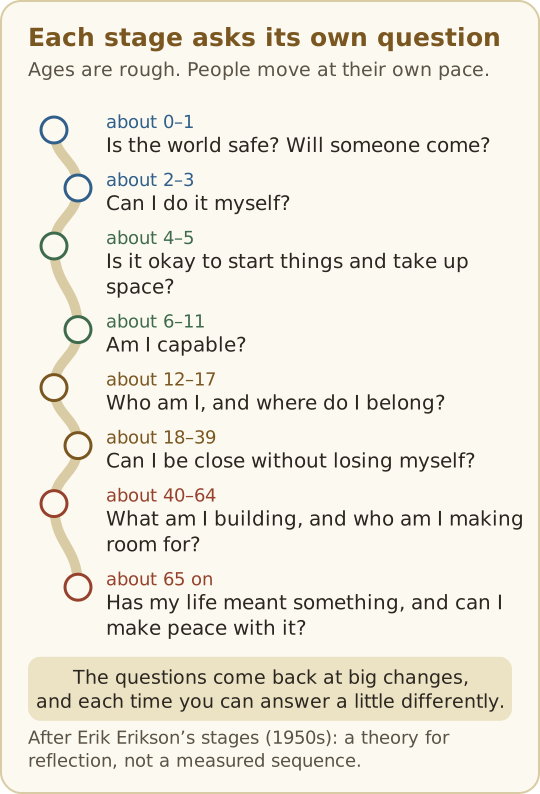
A winding path with eight stops from birth to later life, each with the question that stage of life asks.
Figure 4 Each stage of life asks its own question. The ages are rough, and the questions come back at big changes (after Erik Erikson).

When something happened matters

An experience that touches the question you were answering at the time tends to go deeper. A move at 4 is mostly about routines. A move at 14, in the middle of “Where do I belong?”, can leave a longer feeling of being the outsider. Repetition matters too, and so does what you decided it meant about you, and whether someone helped you make sense of it.

Deeper isn’t permanent. People keep learning all their lives, and a feeling that was set early can still shift with new experience. If you want the longer version, see why timing matters.

Why timing matters, and why it isn’t the whole story

Four things shape how deep an experience goes: your age, how often it happened, what you decided it meant, and whether anyone helped you make sense of it. The last is hopeful, because you can still give that to yourself, and to the young people in your life.

In different relationships

  • A grandmother raising her grandson: He was three when his mum couldn’t care for him any more. She notices he panics at goodbyes, so she builds a small goodbye ritual: the same words, the same wave, the same “I’ll be back at three.” See Foster and kinship families (spreadloveandacceptance.com/foster-and-kinship).
  • A parent coming home: A parent back from months working away finds their twelve-year-old cool and distant. The child spent those months working out where they belong without them. Patience, and small regular time together, help more than a big welcome. See Coming home after time apart (spreadloveandacceptance.com/coming-home).

Mix-ups, and how to fix them

  • “Deeper means permanent.” It means it may take more time and gentleness. People keep changing all their lives.
  • “I don’t remember it, so it can’t matter.” Some things leave a feeling without a memory. You can work with the feeling.

If you’re the only one doing this: You don’t need the people from back then to agree on what happened. Your sense of how it felt is enough to work with.

Research note: The Adverse Childhood Experiences (ACE) study, published in 1998 by Vincent Felitti, Robert Anda and colleagues, found that hard experiences in childhood were linked, on average, with more health problems in adult life. Averages don’t decide any one person’s story, and an ACE count was never meant to predict an individual. Emmy Werner’s long study of children born on the Hawaiian island of Kauai in 1955 found that many who grew up with serious hardship were doing well as adults, and a steady, caring adult was often part of the reason.

Some old answers were learned without all the facts

Some of what you believe about yourself was learned when you were a child and didn’t have all the facts. A child often can’t know what was going on for the grown-ups. They only know how it felt. As an adult, you’re allowed to look again with the full picture. Looking again doesn’t mean deciding it was all fine. Some things that hurt really were not okay.

Here are a few common ones, with a fairer adult reading. They are examples, not rules, and only you can sort your own.

The old understandingOften learned whenA fairer, adult reading
“I’m only okay when I’m useful.”Praise came mostly for helping“Helping is something I do, not the price of being loved.”
“It’s always me.”Whoever noticed the mess had to fix it“Let’s give each job one owner, by choice.”
“If they loved me, they’d know.”Stories and families where love meant mind-reading“People who love me still need to be told.”
“Quiet means angry.”Silence at home came before trouble“Quiet might mean tired. I can ask.”

In the Buddha’s story of the Second Arrow, what happened is the first arrow, and the story we add is the second. An old answer about yourself is often a second arrow that was fired long ago and is still flying.

Why children reach unfair conclusions

Young children explain the world with themselves at the centre: “If Mum is sad, I must have done something.” That is ordinary child logic. The conclusion can outlast the logic. As an adult you can add the missing facts and see it as a guess made with too little information.

In different relationships

  • On your own after a divorce: “I’m too much” comes back loudly in the quiet. Looked at again: one relationship ended. That is a loss, not a verdict on the whole of you. See On my own (spreadloveandacceptance.com/on-my-own).
  • Coming out as an adult: At twelve, a boy picked up from the world around him that “people like me are a disappointment.” At thirty-four he comes out to his family. He reads the old answer again: it was a fear he absorbed, not a fact about him. See Coming out as an adult (spreadloveandacceptance.com/coming-out).

Mix-ups, and how to fix them

  • “A fairer reading means pretending it was fine.” It doesn’t. Some things were not okay, and you can say so.
  • “Once I see it, it should stop hurting.” Seeing comes first. Feelings usually follow more slowly.
  • “I should replace it with something cheerful.” Aim for fair and true, not upbeat. A reading you don’t believe won’t help.

If you’re the only one doing this: This is private work by nature. You never need the people from back then to agree, explain or apologise for you to read the old answer again.

A note on safety: If an old answer came from someone who hurt you, and that person still has power over you, your safety comes first, before any looking back. Not safe at home? (spreadloveandacceptance.com/safety) lists free, private hotlines.

Research note: Cognitive therapy, developed by Aaron Beck from the 1960s, works with “core beliefs”: deep, often early-learned conclusions about yourself, such as being unlovable or helpless. Delivered by trained therapists, it has good evidence for depression and anxiety. The table above borrows the habit of checking a belief against the facts; it isn’t therapy. The Second Arrow comes from an early Buddhist teaching. It is a teaching story, not a study.

An old rule can read other people for you

The lens colours how you read the people you love. If silence at home meant anger, a partner’s quiet evening can feel like trouble is on the way. We also tend to blame other people’s slips on who they are (“lazy”) and our own on our day (“I was swamped”). Ask before you conclude: “When you went quiet, what was going on for you?”

It also colours what you expect without saying so. An expectation nobody said out loud can’t be agreed to, so the other person can only miss it. “If you loved me, you’d just know.” “A good partner plans the birthdays.” “Rest is earned.” “Whoever notices, does it.” Each is somebody’s family rule, not a law of nature. When two people follow two different rulebooks, each sure theirs is normal, resentment can grow without anyone doing anything wrong.

That is why the same pile of unopened post can be a to-do list to one person and proof of unfairness to another. Chapter III (spreadloveandacceptance.com/book/chapter-3-in-depth), in Part Two, calls this two true views of the same thing. The family-script angle, one of the seven angles in that chapter, is the same idea seen from the other side.

Why an old rule reads people so fast

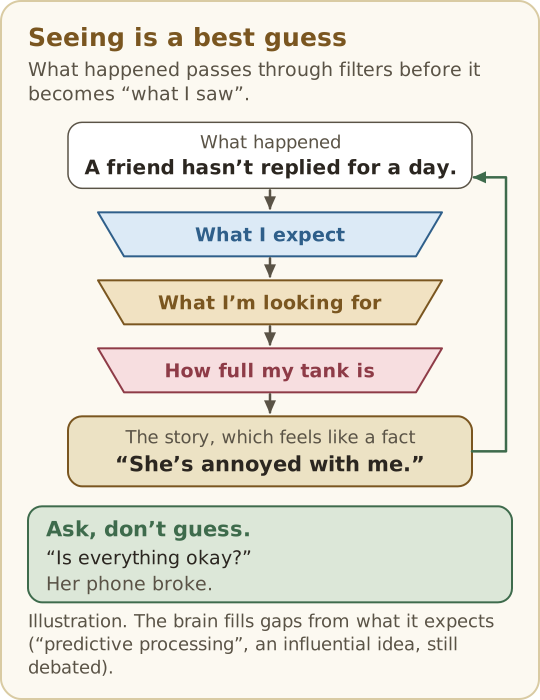
Under stress, a brain predicts with its oldest, most practised information, so an old rule can decide what someone meant before they finish. The fix isn’t to stop predicting. It is to treat the prediction as a question.

In different relationships

  • Three partners sharing a home: Noa, Ren and Ali live together. Ren grew up where whoever cooked didn’t wash up. Noa grew up where the cook cleaned as they went. Ali grew up mostly eating alone. Each assumed their own rule, and a month of sighs followed. Naming all three rules at a house meeting ended it. See More than two partners at home (spreadloveandacceptance.com/more-than-two).
  • A long-distance couple: One reads a short text as cold, because in their family short replies meant someone was upset. Agreeing that “short means busy, not upset” saves a lot of worry. See Long distance (spreadloveandacceptance.com/long-distance).
  • Separated co-parents: A father reads his ex-partner’s brief, factual messages as hostile. In her family, brief and factual was the polite way. Once he knows, the same messages read as calm. See Co-parenting (spreadloveandacceptance.com/co-parenting).

Mix-ups, and how to fix them

  • “Asking means I’m insecure.” Asking is checking. It is a skill, not a weakness.
  • “If they cared, they’d know my rule.” A rule nobody said out loud can’t be kept. Say it.
  • Naming their rule for them. “Your family obviously never talked” lands as an attack. Talk about your rules and ask about theirs.

If you’re the only one doing this: You can still ask the question and say your own rule out loud, even if the other person never names theirs: “I grew up where quiet meant angry, so I’m just checking.”

A note on safety: In some homes, silence or a look really does come before harm. If that is true for you now, your alarm isn’t an old rule misfiring. It is information, and it deserves to be taken seriously. Not safe at home? has people to talk to.

Research note: The habit of explaining other people’s behaviour by their character and our own by our circumstances has been studied since the 1960s and 70s, under names like the fundamental attribution error (Lee Ross) and the actor-observer bias (Edward Jones and Richard Nisbett). Later work found the effect varies with the situation and the culture, and a large review by Bertram Malle (2006) found the actor-observer difference much smaller than first thought. Treat it as a common tendency, not a law.

Write down the rulebook from home

Everyone grew up with an unwritten rulebook. Finish these six lines the way your childhood home would have:

  1. In my family, love looked like…
  2. When someone was upset, we…
  3. The jobs were split like this…
  4. Resting was okay when…
  5. Asking for help meant…
  6. The unforgivable thing was…

Then ask of each line: do I still want this rule? You can write them on the growing-up page, where they stay on your own device, or on paper. Some rules you will want to keep. Some you will want to change. Either is a fine answer.

Why writing it down helps

A rule you’ve never seen written feels like how things are. On paper it looks like what it is: something one family did.

In different relationships

  • Two adult brothers: They fill in the six lines separately, then compare. Same house, different rulebooks. The older wrote “The jobs were split like this: I did everything.” The younger wrote “Mum did the jobs.” Years of tension suddenly make sense.
  • A couple whose children have left home: The rules they built for raising children no longer fit a quiet house. Writing their own childhood lines again helps them see what each of them wants now. See Kids grown and gone (spreadloveandacceptance.com/empty-nest).

Mix-ups, and how to fix them

  • “I have to do all six.” One line is enough for today.
  • Reading it out to your family as a charge sheet. It is for you. If you share it, share it as information about you.

If you’re the only one doing this: It works well alone. Many people never show their rulebook to anyone and still find it changes how they react.

A note on privacy and safety: What you write on the growing-up page stays on your device. If someone at home checks your phone or your things, paper you can keep somewhere private may be safer, or you can simply think the lines through. Not safe at home? has help.

Research note: Family systems thinkers, such as Murray Bowen, described how habits and roles can pass from one generation to the next. Studies of parenting across generations find some continuity, but far from total: many people raise children quite differently from how they were raised. Expressive writing studies, begun by James Pennebaker in the 1980s, found modest benefits for some people who wrote about hard experiences, though not for everyone, and if writing stirs up too much, it is fine to stop. This book’s idea: the six rulebook lines themselves.

Filled-in example 1 The rulebook from home Nadia, on her own

Your rulebook from home

Write a few words on each line, the way the home you grew up in would have finished it. Skip any line you like. Then, for each one, ask: do I still want this rule?

1. In my family, love looked like…
Doing things. Dad fixed your bike; nobody said it.

Do I still want this rule?

  • Keep
  • Chosen: Soften
  • Drop
2. When someone was upset, we…
Went quiet and waited for it to pass.

Do I still want this rule?

  • Keep
  • Chosen: Soften
  • Drop
3. The jobs were split like this…
Mum noticed, planned and remembered. Dad did the big jobs.

Do I still want this rule?

  • Keep
  • Soften
  • Chosen: Drop
4. Resting was okay when…
Everything else was done.

Do I still want this rule?

  • Keep
  • Soften
  • Chosen: Drop
5. Asking for help meant…
You hadn’t planned well enough.

Do I still want this rule?

  • Keep
  • Soften
  • Chosen: Drop
6. The unforgivable thing was…
Breaking a promise.

Do I still want this rule?

  • Chosen: Keep
  • Soften
  • Drop

A made-up example. Names and details are invented.

You get to choose which rules to keep

A one-minute lens check helps when a reaction feels bigger than the moment. Do it once you’ve settled, not in the heat of it:

  1. Where did I learn this?
  2. How old does this feel?
  3. Is it true here, with this person, now?
  4. What would the adult me choose?

Choosing a rule on purpose is different from throwing it out. Keep the ones that still fit, and update the ones that don’t. A learned rule is part of the setup, not a flaw in you, so the move is to change the setup.

When you’re ready, and only then, you can do this with someone else. On a calm day, swap rulebooks with curiosity, not correction. Then choose your own rules on purpose: who owns which job, how upset looks in each of you, and what helps. It isn’t about deciding whose family did it right. Check-ins (spreadloveandacceptance.com/check-ins) give you a calm place to do it. When you’re ready to go on, Now (spreadloveandacceptance.com/book/self-2-now) turns to today: your wiring, your weather and your words.

Why choosing on purpose holds better

A rule picked on a calm day is easier to keep, because you know why you want it. And you don’t need to decide whether your family was right, only whether a rule suits your life now.

In different relationships

  • A couple on different shifts: A night-shift nurse grew up with “rest has to be earned,” so sleeping at noon feels lazy. She and her wife choose a new shared rule: daytime sleep is work, and it is protected. See protected sleep.
  • Two partners and a games console: One grew up where screens were for time alone, the other where playing together was family time. They choose a rule that keeps both: two evenings a week of playing together, and some time apart with no hard feelings. See Gaming and time together (spreadloveandacceptance.com/gaming-and-time-together).

Mix-ups, and how to fix them

  • “Choosing means rejecting my family.” Keep what fits. Many old rules are worth keeping.
  • Running the lens check in the middle of a row. Wait until you’ve settled. The questions don’t work on a racing heart.
  • “Shared rules means my rules win.” Put both lists on the table and choose from both.

If you’re the only one doing this: You can choose your own rules even if nobody swaps rulebooks with you. A new rule like “I ask before I assume” works alone.

A note on safety: Swapping rulebooks is for people who feel safe with each other. If you’re afraid of how someone will react, don’t do it with them. Talk with a counselor on your own instead. Not safe at home? lists free, private hotlines.

Research note: Research on “implementation intentions,” led by Peter Gollwitzer, found that deciding ahead what you’ll do in a given situation helps people act on their choices. Habit research also suggests new behaviour sticks best when it is repeated in the same situation. This book’s idea: the four-question lens check.

A worked example: the kitchen, replayed

Back to Sunday, 10:15am. Sam walks into the kitchen, sees the mess and thinks, “Of course. It’s always me.”

Without the tools: Sam starts cleaning, loudly. Alex wakes up to a closed face and a tight “Morning.” By lunch they are arguing about who does more, and neither can say how it began.

With the tools: Sam notices the thought and runs the lens check. Where did I learn this? At home, where whoever noticed, did. How old does it feel? About ten. Is it true here? Alex has not been asked, and has not said no. What would the adult Sam choose? To ask. Later, over coffee, Sam says, “I had an old rule go off in the kitchen: whoever notices does it. Could we look at who owns the kitchen jobs?” That is a conversation about a setup, not about Alex.

Two more worked examples

A visit home. Lena, 35, visits her parents with her girlfriend. Within an hour she is clearing plates and refilling drinks while everyone else sits. Her girlfriend asks, “Are you okay?” and Lena snaps. Later, she runs the lens check. Where did I learn this? As the eldest, I was the helper. How old does it feel? About twelve. Is it true here? Nobody asked me to. What would the adult me choose? To sit down for the main course and help with the washing-up after. On the next visit she tells her girlfriend the plan first, and it works.

Housemates and the noise. Kofi grew up in a big, loud family where noise meant life. His housemate Elif grew up in a small flat where quiet meant respect. Kofi’s music feels rude to Elif. Elif’s “Could you turn it down?” feels cold to Kofi. Each writes one rulebook line about noise and they swap. Then they choose a shared rule: music up until nine, headphones after, and a knock on the door is never a complaint. The room agreement (spreadloveandacceptance.com/sharing-a-room) has a fill-in for this.

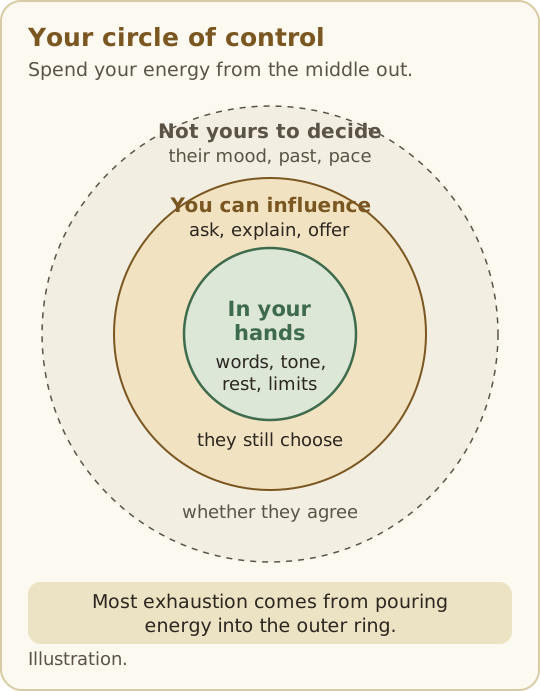
What’s in your control, then and now

Part of growing up is learning, often the hard way, which things were never yours to control. The home you grew up in, other people’s moods, what happened before you had words for it: none of that was yours to run. A lot of old rules come from trying anyway. “If I’m good enough, nobody will be upset.” “Keep the peace at any cost.” “Earn your place by giving more.” They made sense to a child. They wear an adult out.

Yours

  • Which old rules you keep, and which you retire
  • How you talk to yourself about the past
  • Your effort, your words, your limits, your rest
  • Where you spend your time and care now

Not yours

  • What happened, and who did what
  • Whether someone from back then ever understands
  • Other people’s moods, replies and choices
  • Making everyone comfortable all the time

A new rule worth keeping: match energy with energy

If one of your old rules was “give more and you’ll be safe,” here is a kinder replacement: give in proportion to what comes back. Meet warmth with warmth and effort with effort. When you notice you’re the only one calling, planning, apologising or carrying, let your side shrink back to what feels fair, and see what the other person does with the space. That protects your energy, which is the thing you need to stay kind, to rest and to show up for the people who do show up for you.

Matching energy is not keeping a cold score, going silent to punish, or pulling away the moment someone has a hard week. People’s capacity changes: illness, grief, a new baby, a rough season. Then you match their capacity, not their output, and you can choose to give more for a while, on purpose. Children and people who depend on you are different again: you give what they need. If you’re afraid of someone, none of this is about managing them, and matching energy isn’t safe with a person who frightens you: Not safe at home? has people to talk to. The question is simply whether, over time, the giving runs both ways.

In different relationships

  • Friends: You notice you start every conversation with an old school friend. You stop for a month, keep replying warmly, and see what comes back. See Always the one reaching out? (spreadloveandacceptance.com/friends)
  • A grown-up child and a parent: A mother expects a daily phone call. Her son chooses a long call on Sundays and warm texts in between, and says so kindly. See For grown-up children.
  • A carer and a partner with an illness: When one partner can give very little for a while, the other matches their capacity, not their output, and finds support of their own. See When one of you is ill.

Mix-ups, and how to fix them

  • “Matching energy means keeping score.” It means noticing balance over months, not counting favours this week.
  • “If I give less, they’ll leave.” Maybe. That is painful, and it is information too.
  • “Matching means cutting people off.” It means letting your side shrink, not slamming a door.

Research note: The split between what is and isn’t up to us comes from the Stoic teacher Epictetus, nearly two thousand years ago. Equity theory, developed by J. Stacy Adams in the 1960s and applied to close relationships by Elaine Hatfield (then Walster) and colleagues in the 1970s, found that people tend to feel uneasy in relationships that feel unbalanced, whether they give much more or receive much more. Margaret Clark and Judson Mills described how close relationships often run on care for each other’s needs rather than strict trade, which is why the idea here is balance over time, not a tally.

Try this: name three relationships. For each, jot what you give and what comes back. Where it’s badly out of balance, pick one small way to give a little less, or to ask for a little more, this month.
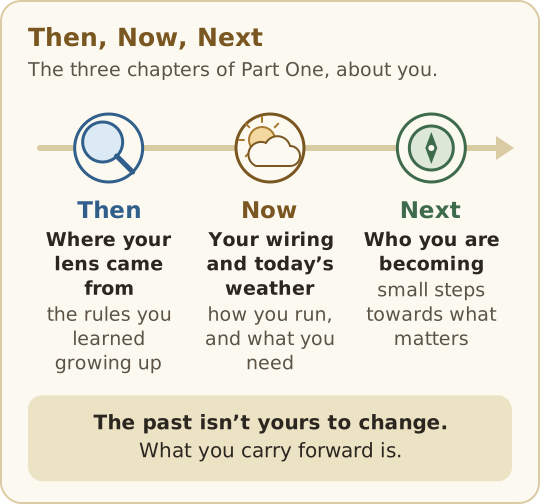
A timeline with three stops, Then, Now and Next, and the line: the past isn’t yours to change; what you carry forward is.
Figure 5 Part One in one picture: where your lens came from, how you run today, and who you are becoming. You choose what you carry forward.

You, in all your relationships

Everything in this part is about you, so it goes wherever you go. The same old rules turn up, in different clothes, in every relationship you have.

  • With yourself first: The voice you use after a mistake, and whether rest feels allowed. Old rules often speak loudest here, where nobody else hears them.
  • With a partner, or more than one: Who notices, who plans, what quiet means. Every couple brings two rulebooks, and each extra partner adds another. See More than two partners at home.
  • With friends: Who reaches out first, and how long a silence can last before it feels like an ending. See Friends.
  • With family: Old roles switch back on fast: the helper clears plates, the peacemaker smooths things over. See For grown-up children, Family rifts (spreadloveandacceptance.com/family-rifts) and Grandparents (spreadloveandacceptance.com/grandparents).
  • At work: Praised mostly for being useful? You may say yes to everything. The same lens check works at a desk.
  • With housemates: Rulebooks about mess, noise, guests and borrowing meet in a small space. See Sharing a room.
  • On your own: With nobody to bump into, old rules can run quietly for years. See On my own.

To find help for your own situation, see help by relationship (spreadloveandacceptance.com/by-relationship). If you guide others through this, For counsellors, coaches and group leaders (spreadloveandacceptance.com/for-counselors) has notes for you.

In the individual program

This part goes with Step 3 of the individual program: write the rulebook from the home you grew up in, and choose one rule you’d like to change. You can do every step on your own.

Your next step: Step 3: see where your lens came from (spreadloveandacceptance.com/self-path) · Where your lens came from · A gentle first week · The whole book on knowing yourself (spreadloveandacceptance.com/book/topic-know-yourself)

Where the thirteen fields meet in this part

This part draws on 4 of the author’s thirteen fields (the About page (spreadloveandacceptance.com/about) lists them all). Here is what each one brings, and which of the five big ideas it serves.

FieldWhat it brings hereBig idea
PsychologyThe lens you learned, the stages of growing up and the old stories we carry. Leftover patterns are easier to change once you can see them as patterns.Read your state first
NeurobiologyAn old alarm can go off before you’ve had time to think. That is a body doing its job, not a character flaw.Read your state first
PhilosophyPlato’s cave and the Second Arrow: a rule you never chose can feel like simply how things are, and an old story about yourself can keep flying long after it was fired.Notice the quiet incentives
Behavioural scienceWhat got praised or scolded taught you what to do, and the same process works the other way: repeating something new teaches a new rule.Notice the quiet incentives

How they connect

The word in brackets is the root the two fields share; the polymath page explains all seven. From the most obvious connection to the most abstract:

The body tells you when an old rule has gone off, and the questions tell you whether it still fits.

Connect any two fields yourself (spreadloveandacceptance.com/polymath) · Ask Professor Puddles how all thirteen connect (spreadloveandacceptance.com/ask)

When it goes wrong, and when it goes right

When it goes wrong, looking back turns into blame, either of the people who raised you or of yourself. Or every big reaction gets filed as an old wound, when it was really a full tank. Or an old rule is announced to a partner as a verdict (“You’re just like my mother”).

When it goes right, you notice the old rule, say so lightly (“an old rule went off”), check whether it fits here, and choose. Over a few weeks you both learn what rules each of you brought, and you start to write shared ones.

Questions people often ask

Do I have to remember my childhood for this to work?

No. You only need to notice the rule, not its origin. “Whoever notices, does it” can be examined without a single memory attached.

What if I had a hard childhood?

Then go gently and take only what is useful. Looking again doesn’t mean deciding it was all fine, and you never have to share it. If it feels heavy, stop and come back another day, or explore it with a qualified professional, if and when you want that.

Can I use this to explain my partner’s behaviour?

Not as a verdict. You can ask, gently, “When you went quiet, what was going on for you?” A guess about someone else’s history often turns into a judgment of them. The tools are for filling in about yourself.

What if most of my family’s rules were good ones?

Then keep them, gladly. This part isn’t looking for faults. Plenty of people find that most of their rulebook still fits, and that only one or two lines need an update.

What if the person I’d like to swap rulebooks with won’t do it?

That’s their choice. You can still write yours, choose your own rules and say one of them out loud as information: “I grew up where whoever noticed did it, so I’m working on asking instead.” It often makes it easier for the other person to join in later.

Where can I talk this through?

Professor Puddles, the site’s friendly chat host, can help you work out where a feeling came from before you decide what to say.

Limits and cautions

  • This part is general education. It isn’t a diagnosis, a test or therapy, and it can’t tell you what you or anyone else has.
  • The stages and their questions are a rough guide. Real lives are messier, and people move at their own pace.
  • The three layers are a thinking tool, not a scientific category system. They overlap.
  • Fill things in about yourself only. Never use what you learn about your own history to win a point, and never use someone else’s against them.
  • Research notes in this chapter describe well-known findings in plain words, and say where the evidence is limited. Notes marked “This book’s idea” are our own ways of putting things into practice, not established science.
  • Looking back can be heavy. Stop whenever you like. You never owe anyone your history.
  • If talking about any of this with someone ever feels unsafe, or you feel you can’t say no, stop and talk with a trained counselor on your own. When someone is afraid of their partner, counseling together isn’t advised. Not safe at home? lists free, private hotlines.
Contents · Open this chapter on its own page

Part One · Now

Know yourself: now, your wiring, your weather and your words

Why the same words can land differently on different days and in different people, and how to understand today’s you well enough to say what helps.

In short:

  • Today has two layers you can work with: your wiring, which stays (work with it), and today’s conditions, which pass (work around them).
  • Check your state before a hard talk. Weather, the three states, the load and the battery are different words for the same thing; “One state, many words” below shows how they line up.
  • If a feeling is hard to name, start with the body. For many people that is the normal way in, and it has a name: alexithymia.
  • Your needs and limits are information. Plan what settles you on a calm day, and say what helps in one short sentence.
  • Different isn’t wrong. A mix-up between two different minds runs both ways (the double empathy problem), so both of you adjust a little.

Sunday, 7:50pm

A friend asks, “Are you okay?” You say, “Fine.” The truth is you can’t tell whether you’re fine, tired or quietly bothered, and you couldn’t explain it to yourself, let alone to them.

Everything in this part is about you, and it is for you. Nothing is ever filled in about someone else, nothing is a test, and nothing you try needs to be shared. This part is about today: how you are built, what kind of day you are having and what you can say about both.

Where this fits: the five big ideas

The whole program rests on five big ideas. Each one starts inside you and then shows up between you and other people. This part mostly teaches “Read your state first” and “Tune how you send and receive”, with help from “See the whole load” and “Fix the setup, not the person”. (Borrowed from neurobiology, psychology and philosophy.)

  • In you: Check your state and know your wiring before you judge a reaction. Count the hidden effort, like masking (hiding or toning down how you naturally are, to fit in) or holding an old alarm down, as real load.
  • Between you and others: Change the setup, not the person. Tell people what helps, tune how you send and receive, and treat a mismatch as tuning, not a moral failing.

Today is made of two layers you can work with

A reaction has three layers: wiring, patterns life taught you and today’s conditions. Then (page 18) covered the middle layer, the patterns. This part is about the other two.

LayerWhat it isThe move
Your wiringTemperament, pace, sensory makeup, how you process words and feelings. It stays.Work with it: written plans, quiet time after work, a heads-up before changes, a visible calendar
Today’s conditionsSleep, stress, hunger, the load you’re carrying, the room, the time of day. They pass.Work around it: eat first, sleep on it, say “low-battery day,” move the talk to tomorrow

Conditions amplify the other layers. A mild wiring need (“I prefer a heads-up”) becomes a hard limit when you’re exhausted, and an old alarm that stays quiet on good days can go off at full volume on bad ones. Because conditions change fastest, they are the easiest layer to adjust, and the first place to look.

A lot of frustration comes from using the wrong move. Trying to force your wiring to change tends to wear you out. Treating a bad day as your permanent self makes a passing storm feel like the climate. A kind rule of thumb: change the conditions today, work with the wiring always, and work on the patterns over time.

The full guide, with a sorting table of common reactions, is Know your own wiring (spreadloveandacceptance.com/know-yourself-in-depth). It also covers work on it, work with it, work around it in more detail.

Why the two layers need different moves

Wiring is the climate and conditions are the weather. You dress for the climate every day, and you check the weather each morning. Expecting your climate to change wears you out, and treating a stormy afternoon as your climate makes you think less of yourself than you should.

In different relationships

  • Two partners on different shifts: Ruby works nights and Ottilie works days. Their worst arguments happen at 7am, when Ruby is ending a twelve-hour shift and Ottilie is starting her day. Neither is an angry person. They move anything important to Saturday lunch, when both are rested. See Different hours (spreadloveandacceptance.com/different-hours).
  • A grandparent minding grandchildren: A grandfather who loves his grandchildren finds himself short-tempered by four o’clock on minding days. His wiring likes quiet. His conditions are a long day and no lunch break. A sandwich at noon and a half-hour of cartoons at three change the whole afternoon. See Grandparents (spreadloveandacceptance.com/grandparents).

Mix-ups, and how to fix them

  • “If I’m tired, my feelings don’t count.” They count. Tiredness turns the volume up; it doesn’t make the feeling false. Look at it again once rested.
  • “My wiring is an excuse.” Wiring explains, and a good setup is your part. “I need a heads-up” comes with “and I’ll tell you early when plans don’t suit me.”

If you’re the only one doing this: Change your own conditions first: sleep, food, when you raise things. You don’t need anyone’s agreement to eat before a hard talk.

Research note: In lab studies, people who have missed a night’s sleep show stronger reactions to upsetting images, and studies of couples have linked a poor night’s sleep with more conflict the next day. Temperament research describes lasting differences in things like sensitivity and pace from early childhood. This book’s idea: the “work with it, work around it” moves.

Your wiring, and how you like to be spoken to

Wiring isn’t a flaw to fix. It is the lasting part of how you take in the world: your temperament, your sensory makeup, your pace, and how you handle words and feelings. You can understand it, plan around it and get support for it, through routines, tools, a better setup and, if you choose, help from a qualified professional.

Two free pages help you put it into words:

  • How you connect (spreadloveandacceptance.com/wavelength) asks a few short questions and gives you a four-letter Wave Code. Pace is Quick Spark or Slow Simmer, lens is Forest or Trees, sending is Direct or Nuanced, and receiving is Explicit or Attuned. It is a fun way to describe your preferences, not a test that measures you, and everyone uses both ends of each line sometimes. The wiring step is optional, it is self-identified, and it isn’t a diagnosis.
  • The “How to talk to me” card (spreadloveandacceptance.com/wiring-card) turns how you actually take in words into one page: what helps, what silence means for you, how a request is best phrased. A card is a simple note, not a label, and not permission to criticise. It tells someone how to send a request so it gets through. It doesn’t make them responsible for managing you, and it doesn’t mean you have to be available no matter how you feel.

When you share either one, pick a calm moment and offer it as information: “I wrote this so you don’t have to guess. Would you read it?” Invite theirs, and put the two side by side. The places where you differ are not problems. They are the best places for a short talk. Update yours when life changes, because what you need changes too.

Why it helps to describe your wiring

Most mix-ups between kind people come from mismatched settings, not from bad intent. When you can say how you take in words, other people stop guessing, and you stop being misread. A description you write yourself is also kinder than a label someone else gives you.

In different relationships

  • Housemates: One housemate says what they mean in a single line. The other reads short messages as cross. After swapping “How to talk to me” cards, the first adds a smiley face to notes, and the second stops reading tone into them. See Sharing a room (spreadloveandacceptance.com/sharing-a-room).
  • A parent and a grown-up son: She likes long talks with every detail. He likes the headline first. On calls, he asks, “Headline or the whole story?” and she laughs and gives him the headline first.
  • Business partners: One is a Quick Spark who decides in the meeting. The other is a Slow Simmer who decides overnight. They agree that big decisions always get a night’s sleep.

Mix-ups, and how to fix them

  • “My Wave Code says I’m Direct, so people should cope.” A code describes a preference. It doesn’t excuse unkindness, and it goes both ways.
  • Handing over a card in the middle of a row. Share it on a calm day, as information, and invite theirs.

If you’re the only one doing this: Write your card anyway, and use it yourself: it helps you notice what you need before a hard day. You can share one line of it when the moment is right.

A note on safety: A “How to talk to me” card is never something to fill in for someone else, or to check up on them with. If someone uses what you shared to control or mock you, that isn’t a communication mix-up. Not safe at home? (spreadloveandacceptance.com/safety) has people to talk to.

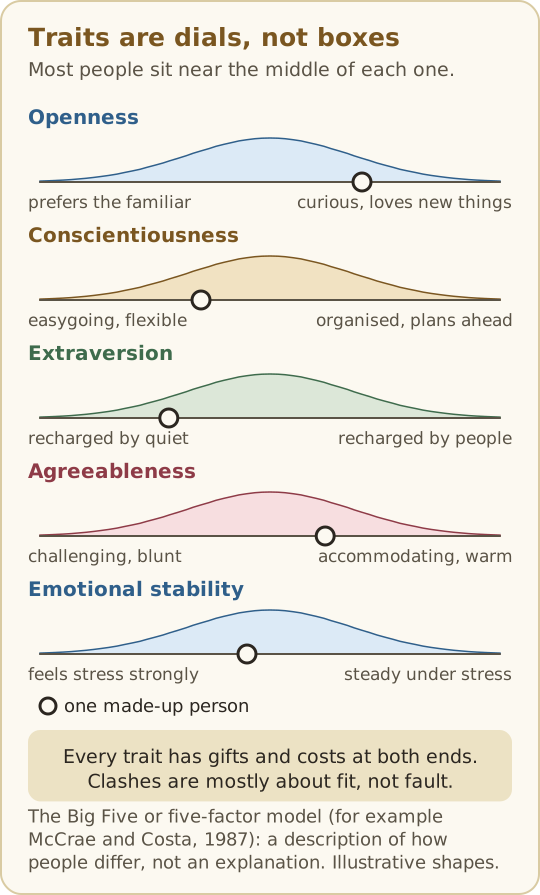
Research note: Well-studied personality research uses five broad traits (often called the Big Five), measured on scales rather than types. Type-based quizzes are less reliable as measurement. The Wave Code is not a personality test. This book’s idea: the Wave Code and the “How to talk to me” card, as conversation starters.

Filled-in example 2 “How to talk to me” card Ife, made on her own to give to a friend

Your card

Pick what is usually true for you. Add a few words where the buttons are not enough. Leave a line blank if it does not apply.

Who it’s for

  • A partner
  • Family
  • Chosen: A friend
  • Work (a manager or coworker)
Name on the card, optional
Ife

WIRING CARD · NOT A DIAGNOSIS

How I receive things best
In writing. One thing at a time.
I take words
Literally when it matters, tone when it is light.
Give me time to answer
A few minutes.
If I go quiet, it means
I’m thinking.
Please avoid
Long texts or many topics at once.
A request lands best as
The ask in the first sentence.

Applies more strictly when I am running low. Not a contract, and not a label. Change it when it stops being true.

A made-up example. Names and details are invented.

Know your load and your state before you speak

Every conversation passes through your own state first. Chapter III (spreadloveandacceptance.com/book/chapter-3-in-depth), in Part Two, is the full chapter on this, with leftover stress and this-moment stress, the three everyday states, the stress-tank score and why a full tank means “later,” not “never.” This part does not repeat them. It adds the habit of taking a reading on your own, on ordinary days, so that it is familiar by the time you need it.

  • My weather today (spreadloveandacceptance.com/quick-checks), a one-minute reading of your own conditions in weather words.
  • How much are you carrying? (spreadloveandacceptance.com/workpapers/wp-02-how-much-are-you-carrying), five quick questions about what you’re already carrying.

One state, many words

The book and its tools use several everyday pictures for one thing: how much room you have today. If you take words literally, they can look like five different measures. They aren’t. They are five ways of describing the same state, and you only ever need one of them.

The pictureWhere you meet itWhat it saysWhich way is heavier
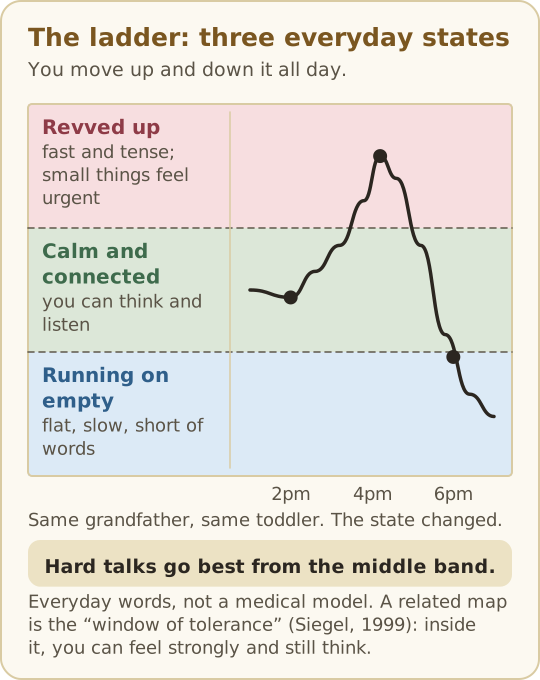
The three states (Part Three calls them the ladder)Part Three, Chapter 2; the ladder check on the siteCalm and connected · revved up · running on emptyFurther along the list
My weather today: the skyThe one-minute self-checkClear · gusty · fogged in: the same three states in sky wordsFogged in
My weather today: the pressureThe same checkLight · building · heavy: how much you were already carrying. Behind the forecast sits a rough tally from 0 to 100 that you only see if you ask for the numbers.Heavier, or a higher tally
The load (also called the stress tank)How much are you carrying?; Part Two, Chapter IIIFive answers from 0 to 4, added up and divided by 20: a score from 0 to 1A higher score
The batteryThe self path, Step 1; everyday speech (“a low-battery day”)The energy you have left: the other side of the loadA lower battery

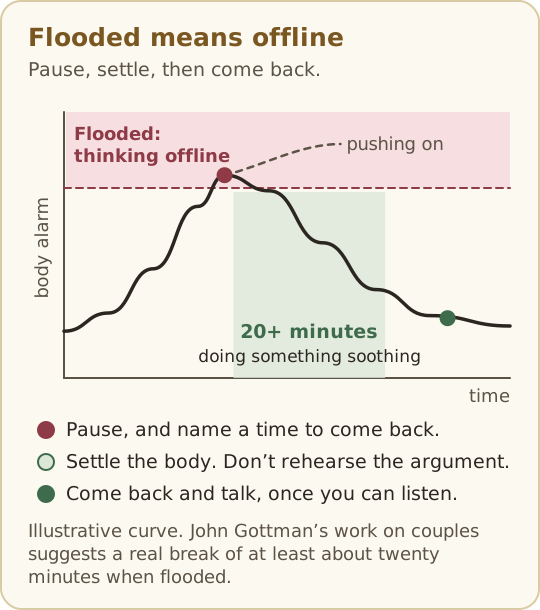
So one person at four o’clock can be gusty, revved up, carrying a load of 0.55 and on a low battery, and all four describe the same afternoon. Two more words sit beside these. Flooded isn’t a fourth state: it means so wound up that listening stops working for a while, at the far end of revved up. Leftover stress is the part of the load you brought in from earlier, before this moment started. Use whichever words suit you. Plain words are enough; the load score is only there for people who like numbers, and the book never asks you to track them all.

Because a reading is quick, it is easy to do a few mornings in a row. Patterns tend to show within a week. A tank that has stayed full for a long time can start to feel normal, and “I’m fine” can come to mean “I stopped noticing,” as Chapter III describes.

Why a reading on ordinary days helps

A reading you have practised on calm days is there when you need it on a hard one. And a reading over a week shows patterns a single day can’t, like the fact that every Thursday is gusty.

In different relationships

  • A long-distance couple: Both take a one-word weather reading before their evening call. “Fogged in” means a light, short call. “Clear” means time for the big topics. See Long distance (spreadloveandacceptance.com/long-distance).
  • A carer and a partner with an illness: The carer notices his readings have been gusty or fogged in for three weeks. That tells him he needs respite, not just a better attitude. See When one of you is ill (spreadloveandacceptance.com/when-one-is-ill) and Caregivers (spreadloveandacceptance.com/caregivers).

Mix-ups, and how to fix them

  • “A reading is a mood score for others to judge.” It is for you. Share it only if it helps.
  • “If my tank is full, I can’t talk at all.” A full tank means later, not never. Name a time and keep it.

If you’re the only one doing this: A reading only needs you. You don’t have to share it, and it still changes what you decide to say and when.

Research note: Studies on “affect labelling” (Matthew Lieberman and colleagues, 2007) found that putting a feeling into words reduced activity in the brain’s alarm areas in the lab. Lisa Feldman Barrett’s work on “emotional granularity” suggests people who can describe feelings in finer detail tend to cope with them better. Both are early, lab-based findings, not proof that a word cures a feeling.

Filled-in example 3 My weather today Joel, on his own, after a short night

Check today’s weather

The sky

  • Clear: Calm and connected
  • Chosen: Gusty: Revved up
  • Fogged in: Running on empty

Who you’ll mostly be around today

  • A partner
  • Family
  • A co-parent
  • Roommates
  • Coworkers
  • Someone I care for
  • Friends
  • Chosen: Mostly on my own

The pressure

  • Light
  • Chosen: Building
  • Heavy

Ground conditions

  • Chosen: Haven’t eaten in a while
  • Thirsty
  • In pain or unwell
  • Been still all day
  • Too much noise or light
  • Running on caffeine
  • Screens since I woke up

Last night’s sleep

  • Barely slept
  • Chosen: Short night
  • About enough
  • Properly rested

People load

  • Barely any
  • A normal amount
  • Chosen: A lot
  • Nonstop, no gaps

What’s blowing in

  • Chosen: Work
  • Money
  • Kids or caring
  • Health
  • Family
  • The house
  • One conversation
  • Something I can’t name

What would actually help in the next hour?

  • Space
  • Chosen: Food or water
  • Rest
  • Chosen: To move
  • To be heard
  • A plan
  • Company
  • Quiet
  • Someone to take something off me

Your forecast

Gusty today
Revved up · Some room today
Pace
go gently, settle first

It’s gusty. You’re revved up. That energy is useful for doing something physical, but it is poor weather for big decisions.

You said what would help is food or water and to move. Arrange that before anything else.

Overall: some room today. There is less room than usual, so spend it carefully.

If you want to send someone a line: “I’m a bit wound up today, so I’ll keep replies short. It isn’t about you.”

A made-up example. Names and details are invented.

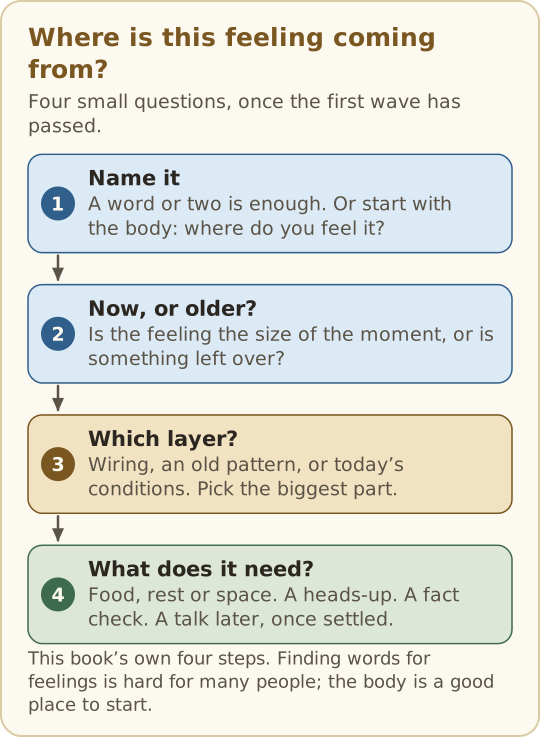
Where is this feeling coming from? A four-step self-check

When a feeling is bigger than you expected, here is a short way to sort it out. It works best once the first wave has passed a little.

  1. Name it. A word or two is enough, even a rough one: “tight and annoyed,” “flat,” “jumpy.” If words are hard to find, that’s common. Start with the body instead: where do you feel it?
  2. Is it about now, or does it feel older? Ask whether this is the size of the moment. A small thing that brings a big feeling often has something left over in it, either from earlier today or from much longer ago.
  3. Which layer is it? Wiring (“this always bothers me”), a pattern (“this reminds me of something”) or conditions (“I’d probably shrug this off after a good night’s sleep”). Usually it is a mix, so pick the biggest part.
  4. What does it need? Food, rest or space. A heads-up or a written plan. A fact check, or a slower try at a new response. Sometimes it needs a real conversation, later, when you’re both settled.

Feelings often reach the body before they reach words. A hot face and fast breathing, tight shoulders, or a heavy, foggy feeling are everyday clues about your state. Everyone’s are a little different, and they are not a medical reading of anything.

When feelings are hard to name

For some people, “What are you feeling?” is a hard question most of the time, not just on bad days. They notice a racing heart or a heavy stomach but can’t tell whether it is worry, anger, hunger or excitement. Or they simply draw a blank, and “Fine” is the honest answer to a question they can’t answer. Psychologists call this alexithymia, from the Greek for “no words for feelings”. The psychiatrist Peter Sifneos named it in the 1970s.

  • It is a trait, not an illness. Like most traits it runs from a little to a lot. It is not a diagnosis, and you don’t need a name for it to use anything here.
  • It is common, and more common in some people. A review that pooled 15 studies found high alexithymia in about half of the autistic people studied, compared with about 1 in 20 people in the comparison groups. Plenty of people who are not autistic have it too, and plenty of autistic people don’t.
  • It is often about the body’s signals. Sensing what is going on inside your body, such as a fast heart, a tight throat or hunger, is called interoception. When those signals are faint, or hard to tell apart, the feeling behind them is harder to name. Part Three, Chapter 1 (page 110) explains how feelings start in the body.
  • It isn’t a lack of feeling, or of caring. The feelings are there; the words come slowly, or not at all. Someone with alexithymia can love deeply and still answer “I don’t know” when asked how they feel.

What helps:

  • Start with the body and the facts. “Tight chest, short night, skipped lunch” is a useful reading on its own.
  • Choose between two, not from fifty. “More tired or more annoyed? Space or company?”
  • Use a picture or a number instead of a feeling word. The sky words in My weather today, the three states, or “about a 6 out of 10” all work.
  • Give it time. Many people can name a feeling an hour or a day later. “I’ll tell you tomorrow” is a real answer.
  • Write it, or type it. For some people, words come more easily on a screen or on paper than out loud.

If someone close to you finds feelings hard to name: ask either-or questions, take “I don’t know” as true rather than as a brush-off, and ask what would help rather than what they feel. “Do you want company or quiet?” is easier to answer than “How are you feeling about it?”

Why four small steps beat one big question

“What’s wrong with me?” has no useful answer. Four small questions each do have one. They slow you down just enough for the thinking part of you to catch up with the feeling part.

In different relationships

  • Friends: A friend cancels lunch for the second time. Name it: hurt, a bit rejected. Now or older? Older; you were often left out at school. Layer: pattern. Need: a fact check. You reply, “No worries. Is everything okay with you?” and learn her child has been ill. See Friends (spreadloveandacceptance.com/friends).
  • A foster carer: A foster child shouts, “You’re not my real mum!” Name it: stung. Now or older? Mostly now, and tired. Need: to stay steady and talk later. The carer says, “I’m here, and I’m not going anywhere.” See Foster and kinship families (spreadloveandacceptance.com/foster-and-kinship).

Mix-ups, and how to fix them

  • Doing the check at the peak of a feeling. Let the first wave pass. Breathe, walk, drink water, then ask.
  • “I couldn’t name it, so I failed.” Start with the body. “Tight chest” is a perfectly good first answer.

If you’re the only one doing this: All four steps happen inside you. Nobody else has to do anything for them to work.

Research note: Peter Sifneos (1973) coined the word alexithymia in a small clinical study. Elizabeth Kinnaird and colleagues (2019) pooled 15 studies and found high alexithymia in about half of autistic participants and about 5% of comparison participants, measured mostly by questionnaires people fill in about themselves. That is a reason to start with the body or a simple choice of words, not a sign the check isn’t for you. This book’s idea: the four-step self-check.

Four numbered steps: name it, now or older, which layer, what does it need.
Figure 6 A four-step self-check for a feeling that is bigger than you expected. Do it once the first wave has passed.

Plan what settles you on a calm day

The Calm-Down Kit (spreadloveandacceptance.com/wp-11) is a plan for heated moments that you make while you are calm. On an ordinary day, write down what tends to set you off and where you feel it first. Pick two calming steps. Agree with yourself on one sentence to say when you step away: how you feel, how long, and when you’ll be back. In the moment, you just follow the plan.

The kit is for you, never for them. One person uses it about themselves, and it is never something to hand to the other person. Your line always includes a time you’ll return, so a break is never mistaken for walking out. Chapter III says how to check your tank again and go back.

Why you plan it while calm

In a heated moment, the part of you that plans is the part that goes offline first. A plan made on a calm day is like a note left by a wiser you. In the moment, you only have to follow it.

In different relationships

  • Separated co-parents: A mum knows handover days make her tense. Her kit: a short walk before the handover, a scripted “Thanks, see you Sunday,” and a call to her sister afterwards. See Co-parenting (spreadloveandacceptance.com/co-parenting).
  • A teen and a parent: A fourteen-year-old and his dad each make their own kit. Both agree that “I need ten minutes” means ten minutes, not “I’m leaving.”
  • Coworkers: A nurse keeps one line ready for a heated shift: “Let me check that and come back to you in five minutes.”

Mix-ups, and how to fix them

  • Using your kit as a weapon: “Go and use your calm-down plan.” The kit is only ever for yourself.
  • Stepping away without a return time. Always add when you’ll be back, and come back on time.

If you’re the only one doing this: Make your own kit. It works whether or not anyone else has one, and it makes the moment safer for both of you.

A note on safety: A break is for calming down, not for escaping consequences or punishing someone with silence. If someone blocks you from leaving a heated room, or punishes you for stepping away, that is about safety, not technique. Not safe at home? lists free, private hotlines.

Research note: Research on “implementation intentions” (Peter Gollwitzer and Paschal Sheeran) found that deciding ahead what you’ll do in a given situation helps people follow through. John Gottman’s work with couples describes “flooding,” when the body is too stirred up to listen, and suggests breaks long enough for the body to settle, often twenty minutes or more.

Your needs, what matters to you, and what’s fair to you

A need is information. “I do better with a heads-up,” “I need an hour of quiet after work,” “I can’t take on another job this week.” These are facts about you, not demands and not complaints. Said kindly and early, they let other people plan, instead of guessing and getting it wrong.

It helps to know them before you’re asked. Knowing what matters to you (quiet, time with family, being on time, honesty, rest) also helps you tell a real limit from a passing mood. A limit that is fair to you can be stated without a fight, in three parts:

  1. What is true for you. “I’m low on battery this week.”
  2. What you can do. “I can do the groceries.”
  3. What you can offer instead, and when. “Could we look at the school forms on Sunday?”
What you notice in yourselfA kind way to say it
You like to know plans ahead“A text a few hours before really helps me. It isn’t about you.”
You’re low today“I’m low on battery. Can we talk about this tomorrow at eight?”
You’re at your limit on a job“I can’t take that one on this week. I can do this one instead.”
You need time to think“Let me think and come back to you tonight.”

Two workpapers help. Who did what (Part B) (spreadloveandacceptance.com/workpapers/wp-01-in-depth) has ready-made, kind ways to say no. Say it so it lands (spreadloveandacceptance.com/workpapers/wp-09-say-it-so-it-lands), turns a raw reaction into a fact, a feeling and an ask before you say or send anything.

This is also where the book’s later chapters meet this part. Chapter II (spreadloveandacceptance.com/book/chapter-2-in-depth) asks whether the way you share the work can last, and what you have left is part of that answer. Chapter IV (spreadloveandacceptance.com/book/chapter-4-in-depth) asks what “fair” means to each of you. Both are easier to talk about when you already know your own side, and a limit that is fair to you is not a score against anyone else.

Why needs said early go further

A need said early and plainly gives other people a chance to plan. A need held in until it bursts out tends to arrive as a complaint, and gets heard as one.

In different relationships

  • Three partners at home: Ren needs Sunday mornings alone. Said as a fact (“Sunday mornings are my reset”) it fits into the week. Before, it came out as snapping. See More than two partners at home (spreadloveandacceptance.com/more-than-two).
  • An adult child and an elderly parent: A son who visits his mother every day says, “I can come four days a week, and I’ll call on the other three.” It is honest, and it keeps him going for years instead of months.

Mix-ups, and how to fix them

  • “A limit is a punishment.” A limit is a fact about your capacity. Say it warmly and offer what you can.
  • Saying a need as a complaint about the other person. “You never give me notice” becomes “A heads-up helps me.”

Words you could use: “This is true for me right now: ___. I can ___. Could we ___ instead?”

If you’re the only one doing this: You can state a need even if the other person doesn’t state theirs. Just be ready to hear theirs when they do.

A note on safety: If stating a simple need leads to anger, threats or punishment, the problem isn’t how you said it. Not safe at home? has people to talk to.

Research note: Marshall Rosenberg’s Nonviolent Communication teaches saying an observation, a feeling, a need and a request. It is a widely used practice framework rather than a well-tested therapy. Assertiveness, saying what you want clearly while respecting others, has long been taught in skills training. This book’s idea: the three-part limit.

Being wired differently is not being wrong

Some people take in words, noise, change and feelings differently from what most social customs were designed around. That includes people who are autistic, have ADHD, are dyslexic or are highly sensitive, and many who are not sure. Nothing about that makes someone wrong. A setup that doesn’t suit you is a setup problem, so the question is how to build one that does.

  • It often has a hidden cost. Holding an old alarm down, masking, rehearsing what to say, or getting through a loud room all use real energy. This book counts it as part of your load, even when nobody sees it.
  • A mix-up usually runs both ways. When two differently wired people misread each other, each is decoding with a receiver built for their own kind of signal. The next section explains this. On the site, Wired Differently (spreadloveandacceptance.com/wired-differently-in-depth) is a full guide to fourteen kinds of wiring.
  • Don’t label anyone. This includes you. You can describe what helps without a name for it, and a name is not needed to use anything here. If you want to understand yourself more deeply, a doctor or psychologist can help, if and when you want that.

The same goes the other way. When you meet someone else’s difference, ask “What was that like for you?” and let them answer. Never fill in a “How to talk to me” card or a Wave Code for another person. That would turn a reflection tool into a way of watching someone.

A mix-up runs both ways: the double empathy problem

For a long time, research described autistic people as short on empathy or “social skills”, as if every misunderstanding between an autistic and a non-autistic person was the autistic person’s doing. In 2012 the autistic researcher Damian Milton gave a name to a different view: the double empathy problem. Empathy, he argued, runs in two directions. When two people have very different ways of communicating and of making sense of the world, each finds the other hard to read. The non-autistic person struggles to read the autistic person just as much as the other way round. It is noticed less, because most social customs were built around the non-autistic way.

There is some evidence for it. In a 2020 study, Catherine Crompton and colleagues passed a story along chains of eight people. Chains made up only of autistic people passed on as much detail as chains made up only of non-autistic people. Mixed chains lost detail faster, and the people in them reported feeling less at ease with each other. It is one careful study of one task, so it is a strong hint rather than the last word.

What it changes in practice:

  • Nobody is the broken one. In a mix-up between different minds, ask “Where did we lose each other?” rather than “What’s wrong with you?” or “What’s wrong with me?”
  • Both people adjust, a little each. The direct speaker adds a softener when it matters. The hint-reader asks “Did you mean exactly that?” before deciding what it meant.
  • Easy company is information. Many autistic people find talking with other autistic people easier. That isn’t a lack of social skill; it is a shared way of talking.
  • The idea reaches further. The same two-way gap shows up between cultures, generations, or a fast talker and a slow thinker. Part Two, Chapter I (spreadloveandacceptance.com/book/chapter-1-in-depth) calls this being out of tune: nobody has to be wrong.

Why “different, not wrong” matters

If you believe your wiring is a defect, you spend energy hiding it. If you see it as a difference, you can spend that energy on a setup that works. The same goes for the people around you.

In different relationships

  • A parent and a child with ADHD: A dad who has ADHD himself realises his daughter isn’t ignoring him; she needs one instruction at a time. He tries one instruction, then a thumbs up. See When a child has ADHD (spreadloveandacceptance.com/adhd-kids).
  • An autistic friend and a non-autistic friend: One friend says exactly what she means. The other hears hints in everything. They agree: “If I want something, I’ll ask it straight. You can take what I say at face value.”

Mix-ups, and how to fix them

  • “If I need adjustments, I’m being difficult.” Glasses aren’t difficult. Neither is a quiet room.
  • Deciding someone else is “probably autistic.” Ask what helps them instead. Labels are theirs to choose.

If you’re the only one doing this: You can build your own setup without anyone else changing: headphones, written lists, a quiet half hour.

Research note: The “double empathy problem,” described by Damian Milton in 2012, suggests that misunderstandings between autistic and non-autistic people run both ways. Studies of autistic adults (for example, Laura Hull and colleagues, 2017) describe “camouflaging,” or masking, as tiring and linked with stress. Elaine Aron’s research on “sensory processing sensitivity” describes people who take in their surroundings more deeply.

Explain yourself without over-sharing

You never owe anyone your history. Share the part that helps them help you, and keep the rest. Three short sentences cover most moments:

  • “This is how I’m wired. It won’t change, but here’s what helps.”
  • “This is an old alarm. I’m working on it, and here’s what helps in the moment.”
  • “Today’s a low-battery day.”

Offer them as information, not as rules, and ask about theirs. When you want a bit more, Know your own wiring has scripts and a guide to how much to share. And when someone else shares, ask questions, not labels.

Why less can be more

A short, clear sentence about what helps is easier to remember than a long story about why. It also protects you: your history is yours to share when you choose, with people who have earned it.

In different relationships

  • Coming out at work: A woman who has just come out to her family isn’t ready to share at work yet. When a colleague asks why she seems tired, she says, “It’s been a big month at home. I’m okay, thanks for asking.” See Coming out as an adult (spreadloveandacceptance.com/coming-out).
  • An interfaith couple at a family dinner: A husband who doesn’t drink for religious reasons says to his in-laws, “I don’t drink, but I’d love a lemonade.” No lecture needed. See Two faiths or cultures (spreadloveandacceptance.com/two-faiths).

Mix-ups, and how to fix them

  • “Being open means telling everything.” Being open means being honest about what you share, not sharing it all.
  • Explaining as a way to win. “It’s how I’m wired” starts a conversation. It doesn’t end one.

If you’re the only one doing this: Your sentences are yours to use whether or not anyone else explains themselves.

Research note: Research on self-disclosure, going back to Irwin Altman and Dalmas Taylor in the 1970s, describes closeness growing through gradual, two-way sharing. That fits the advice here: share a little, see how it is received, and share more with people who respond with care.

A worked example: the surprise dinner, replayed

Friday, 6:40pm. Alex says, “Surprise! I booked us dinner with my cousins tonight.” They meant it as a gift. Sam feels their chest tighten and hears themselves say “Great” in a flat voice.

Without the tools: Sam goes to the dinner, stays quiet and gets through it. Alex senses something is wrong and asks. Sam says, “It’s nothing,” and thinks, “What’s wrong with me?” Both end the evening unsure what happened.

With the tools: The next morning, Sam takes a minute. Name it: tight, a bit cornered. Now or older? Bigger than the moment. Which layer? Mostly wiring, a need to know plans ahead, plus a long week. What does it need? A heads-up next time, and a rested Sam. That evening Sam says, “Thank you for thinking of me. I do better with a heads-up, it’s how I’m wired. Could a text a few hours before work for both of us?” Alex says, “Easy. I didn’t know.” They try it, and agree to look again at the end of the month.

Two more worked examples

The housemate and the hoover. Tomás comes home after a twelve-hour shift and his housemate is vacuuming. He snaps, “Seriously, now?” Later, he runs the four steps. Name it: raw, prickly. Now or older? Mostly now. Layer: conditions (exhausted) and wiring (noise always bothers him). Need: quiet when he first gets in. He says, “Sorry I snapped. After long shifts I need half an hour of quiet. Could the hoover wait until seven?” His housemate says yes, and asks him to text when he is on his way home.

A grandmother and the phone. Agnes, 72, feels hurt that her grandson only sends short texts. She takes a reading. Layer: mostly wiring; she likes voices, he likes typing. She says, “I love hearing your voice. Could we have a ten-minute call on Sundays? Texts are lovely the rest of the week.” He agrees, and starts sending her voice notes too.

Your circle of control, and matching energy

Every moment has three rings. In the middle is what you control: your words, your effort, your tone, your rest, your limits and what you ask for. Around it is what you can influence but not decide: you can ask, explain, invite and offer, and the other person still chooses. Outside is what isn’t yours at all: their mood, their past, their pace, whether they agree. Most exhaustion comes from pouring energy into the outer ring.

In your hands

  • What you say, and how and when you say it
  • Doing your own jobs well
  • Saying yes, no or “not today”
  • Resting before you’re empty
  • Asking clearly for what would help

Theirs to decide

  • How your words land
  • Whether they change
  • How fast they calm down
  • What they think of you
  • Whether they say yes

Your energy is a budget

Your battery (How much are you carrying?) only holds so much. Signs you’re over-giving: quiet resentment, a silent scorecard, feeling invisible, being tired before the day starts. Those aren’t character flaws. They’re a budget running in the red.

How to match energy, kindly

  1. Notice. “I’m usually the one who plans, texts first or apologises.”
  2. Name it once, without blame. “I’ve noticed I’m often the one who starts our plans. I’d love it if you started the next one.”
  3. Adjust your side. Give the effort that’s being given: a warm reply to a warm message, a lighter touch where little comes back.
  4. See what comes back. Some people step up once there’s space. Some don’t, and that’s information too.

Matching energy means matching care and effort, never volume or meanness. If someone gets loud, you don’t have to get loud. If someone is going through something, you match their capacity, not their output, and you can choose to give more for a season, as long as it’s a choice and something refills you. With children and anyone who depends on you, you give what they need. If you’re afraid of someone, none of this is about managing them, and matching energy isn’t safe with a person who frightens you: Not safe at home? has people to talk to.

Words you could use: “I want to keep showing up for this, and I need it to go both ways.” “I can do my part. That one is yours.” “I’m low today, so I’m keeping my energy for the essentials.”

Why the circle helps

When you sort a worry into “mine” or “not mine,” you stop spending energy where it can’t do anything. That energy comes back to you for the things you can change.

In different relationships

  • A business partner: You can make sure your half of the accounts is clear and on time. You can’t make your partner do theirs. You ask once, put it in writing, and then decide what you will do if it doesn’t happen.
  • A parent of a teen: You can’t make your sixteen-year-old talk. You can be in the kitchen at the same time every evening with a snack and no questions. Many teens talk more when no one is asking.
  • Friends: You notice you always start the chat. You reply warmly but stop starting for a month. See Always the one reaching out?

Mix-ups, and how to fix them

  • “Not my circle” means “not my problem.” You can still care, offer and ask. You just stop trying to decide for them.
  • Matching energy as a cold tally. It is balance over time. In a hard season, you match capacity, not output.

If you’re the only one doing this: This section is, by its nature, something you do alone. Your circle is the part only you can act on.

Research note: The split between what is and isn’t up to us comes from the Stoic teacher Epictetus. Equity theory, from J. Stacy Adams in the 1960s and applied to close relationships by Elaine Hatfield (then Walster) and colleagues in the 1970s, found that people tend to feel uneasy when a relationship feels unbalanced either way. Studies of family carers generally link having practical and emotional support with lower strain.

Three rings: in your hands at the centre, what you can influence around it, and what is not yours to decide on the outside.
Figure 7 Your circle of control. Spend your energy from the middle out; most exhaustion comes from pouring it into the outer ring.

You, in all your relationships

Your wiring and your weather come with you into every room. Here is where they tend to show up.

  • With yourself first: Noticing “I’m low today” before you decide “I’m failing,” and planning your week to suit how you’re built.
  • With a partner, or partners: A heads-up, a quiet hour, and a better time for big talks. In a home with more than two partners, each person’s wiring adds to the mix. See More than two partners at home.
  • With friends: How you like to keep in touch, and how much you can give right now. See Friends.
  • With family: Visits that run long, noise, old roles and big gatherings. A rest planned ahead turns a retreat into a plan. See For grown-up children (spreadloveandacceptance.com/grown-up-children).
  • At work: An agenda ahead, a minute before you answer, a written follow-up.
  • With housemates: Light, noise and quiet time. See Sharing a room.
  • On different hours: Sleep at odd times is still sleep. See Different hours.
  • On your own: No one to adjust around but you, which is a chance to build a week that truly fits. See On my own (spreadloveandacceptance.com/on-my-own).

To find help for your own situation, see help by relationship (spreadloveandacceptance.com/by-relationship). If you guide others, see For counsellors, coaches and group leaders (spreadloveandacceptance.com/for-counselors).

In the individual program

This part goes with Steps 1, 2, 4 and 5 of the individual program: check your battery, get to know your wiring, plan what settles you, and find words for what you feel.

Your next step: Step 1: check your battery (spreadloveandacceptance.com/self-path) · Step 2: your wiring · Step 4: what settles you · Step 5: find the words · The whole book on knowing yourself (spreadloveandacceptance.com/book/topic-know-yourself)

Where the thirteen fields meet in this part

This part draws on 6 of the author’s thirteen fields (the About page (spreadloveandacceptance.com/about) lists them all). Here is what each one brings, and which of the five big ideas it serves.

FieldWhat it brings hereBig idea
PsychologyHow you take words in and send them out, and what helps you feel understood.Tune how you send and receive
NeurobiologyYour nervous system’s state comes before your words, and wiring is part of how you are built. Both are things to understand, not things to be ashamed of.Read your state first
PhilosophyWhat Is Up to Us: your honesty, your ask and your tone are yours, and the other person’s answer is theirs.Tune how you send and receive
Behavioural scienceSmall routines, tried on calm days, are the ones that survive a hard one: a one-minute reading, and a sentence you keep ready.Read your state first
Holistic therapiesBody first, words second. Decide on a calm day what settles you, and treat that as care, not as an extra.Read your state first
EconomicsCapacity again: managing yourself costs attention and energy that nobody sees, and a limit is a true statement about a limited supply.See the whole load

How they connect

The word in brackets is the root the two fields share; the polymath page explains all seven. From the most obvious connection to the most abstract:

The body tells you what state you’re in, and the story you tell about it decides what you do next.

Connect any two fields yourself (spreadloveandacceptance.com/polymath) · Ask Professor Puddles how all thirteen connect (spreadloveandacceptance.com/ask)

When it goes wrong, and when it goes right

When it goes wrong, “This is just how I am” becomes a way to end every conversation. Or self-knowledge turns into self-criticism: a long list of what’s wrong with you. Or someone uses a label as a weapon (“You’re obviously just anxious”) and calls it understanding.

When it goes right, you take your own reading, quietly, and say one clear sentence about what helps. You ask about theirs. Over a few weeks you both learn what each of you needs, and you start to allow for it before the hard moment, not in the middle of it.

Questions people often ask

Isn’t focusing on myself selfish?

Every conversation runs through your own state first. Knowing it makes you easier to talk with and easier to hear. The other person’s side matters just as much, and the chapters after Part One are about that.

Do I need a diagnosis to use any of this?

No. Nothing here needs one and nothing here gives one. The wiring step in How you connect is self-identified. If you would like a formal assessment, a doctor or psychologist can do one.

What if I can’t tell what I’m feeling?

That is common, and some people are wired that way (see When feelings are hard to name, above). Start with the body, or with a choice between two simple words, like “more tired or more annoyed? Space or company?” My weather today uses weather words for the same reason.

Can I use this to understand someone else?

Not as a verdict. You can ask, gently, what something was like for them, and then let them answer. A guess about someone else’s wiring often turns into a judgment of them. The tools are for filling in about yourself.

What if the people around me don’t care how I’m wired?

You can still build your own setup and say one clear sentence about what helps. Some people need to hear it more than once. If someone mocks or punishes you for a simple need, that is about them, and Not safe at home? has help if you feel afraid.

Where can I talk this through?

Professor Puddles, the site’s friendly chat host, can help you work out where a feeling came from before you decide what to say.

Limits and cautions

  • This part is general education. It isn’t a diagnosis, a test or treatment, and it can’t tell you what you or anyone else has.
  • The layers are a thinking tool, not a scientific category system. Real people are messier, and the layers overlap.
  • A Wave Code is a fun description of preferences, not a test that measures you. Everyone uses both ends of every line sometimes.
  • Fill things in about yourself only. Never sort, score or label another person, and never use what you learned about yourself to win a point.
  • Research notes in this chapter describe well-known findings in plain words, and say where the evidence is limited. Notes marked “This book’s idea” are our own ways of putting things into practice, not established science.
  • “That’s just how I am” explains a reaction. It doesn’t excuse it, and it doesn’t replace a kind repair.
  • These tools only work when each person feels free to say no, to ask for a pause, or to keep their own notes private. If talking about any of this ever feels unsafe, or you feel you can’t say no, stop and talk with a trained counselor on your own. When someone is afraid of their partner, counseling together isn’t advised. Not safe at home? lists free, private hotlines.
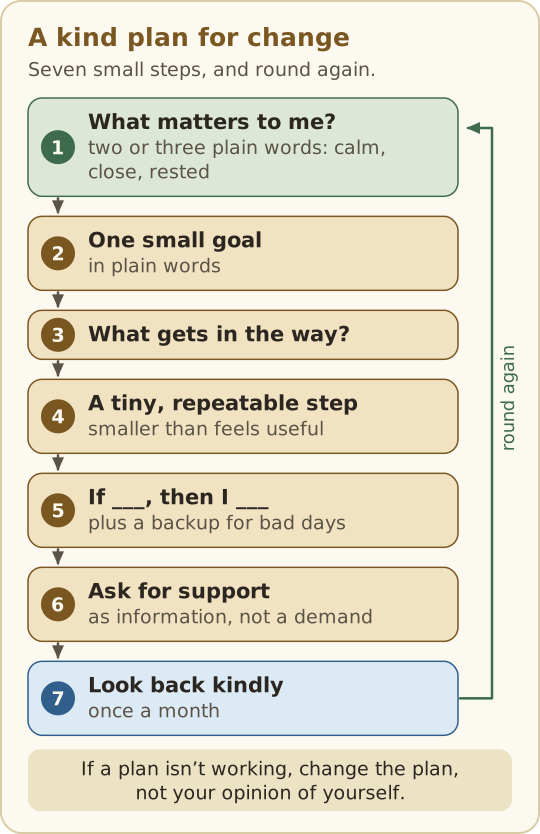
Contents · Open this chapter on its own page

Part One · Next

Know yourself: next, shaping who you are becoming

You aren’t finished, and some of who you become is up to you. This part is about choosing a direction, and building small steps that still work on a tired day.

In short:

  • Start with what matters to you, in two or three plain words, then pick one small goal you can do.
  • Make the step tiny and decide ahead: “If it’s after dinner, then I put my shoes on.”
  • Ask for support as information, and look back kindly once a month.
  • A missed day is information about the plan, not a verdict on you. Change the plan.
  • Set goals inside your circle, and spend your energy where it comes back.

Wednesday, 9:10pm

You meant to start walking after dinner. You meant to last week, too. Tonight you’re tired, the shoes are by the door, and you tell yourself you’ll begin on Monday.

Everything in this part is for you. Nothing is graded, nothing is shared unless you choose to, and every step can be made smaller or put down. It follows Then (where your lens came from) and Now (your wiring, your weather and your words), and it asks one question: given who you are, what would you like to grow towards?

Where this fits: the five big ideas

The whole program rests on five big ideas. This part mostly teaches “Fix the setup, not the person” and “Notice the quiet incentives”, with help from “Read your state first”.

  • In you: Treat your own routines as a setup you can adjust, not a character test. Notice the defaults and cues that steer you, and let the easy path be the one you want. Pick the step for the energy you really have.
  • Between you and others: Say what you’re trying and what would help, as information. Let people’s answers be theirs, and fix the setup, not the person.

Start with what matters to you

A goal built on someone else’s idea of success is hard to keep up, because nothing in you is pulling towards it. Before you pick anything, ask: what do I want my days to be like? Write two or three plain words, like calm, close to my family, steady, creative, useful, rested. They are a direction, not a score. You can’t finish “calm”, and you can’t fail at it, you can only lean towards it.

  • Look at what fills you and what drains you. How you connect (spreadloveandacceptance.com/wavelength) and Know your own wiring (spreadloveandacceptance.com/know-yourself) can help you notice. A value you keep wanting and keep skipping is worth a look in its own right.
  • Borrowed goals feel heavy. If a goal comes with “I should” and a face (a parent, a boss, a feed), look for the thing under it you do want, and aim at that.
  • Values can sit side by side. “Close to my family” and “time alone” are both allowed. Part of the work is making room for both.

Why values come before goals

A value is a direction you can walk in every day. A goal is one stop along the way. When a goal slips, a value is still there, so you don’t lose the whole plan with one bad week.

In different relationships

  • A couple whose children have left home: After twenty-six years of school runs, Moira and Clive each write two words. Moira: “useful, outdoors.” Clive: “calm, curious.” They stop arguing about how to spend Saturdays and plan one morning for each. See Kids grown and gone (spreadloveandacceptance.com/empty-nest).
  • Someone coming out in midlife: Dominic’s old goals were built around what his parents expected. His two new words, “honest” and “close,” lead to different goals: fewer late nights at work, more dinners with friends who know him. See Coming out as an adult (spreadloveandacceptance.com/coming-out).

Mix-ups, and how to fix them

  • “My values should match my partner’s.” They can differ. Shared plans can make room for both.
  • Picking the values you think you should have. Notice what you actually reach for when nobody is watching.

If you’re the only one doing this: Values are personal by definition. You can choose yours without asking anyone.

Research note: Acceptance and Commitment Therapy, developed by Steven Hayes and colleagues, uses values as a direction rather than a finish line, and has a growing body of research. Self-determination theory (Edward Deci and Richard Ryan) found that goals people choose for their own reasons tend to be kept up longer than goals driven by pressure or guilt.

Seven stepping stones from “what matters to me?” to “look back kindly”, with an arrow going round again.
Figure 8 A kind plan for change in seven small steps. If the plan isn’t working, change the plan, not your opinion of yourself.

Pick one small goal, in plain words

Just one, to begin with. Say it as something you will do, not something you hope will happen: “Walk for ten minutes after dinner,” not “get healthier.” The difference matters because your own actions are up to you. How other people respond, and how things turn out in the end, are not.

  • Describe the action, not the result. “Send one note to a friend on Sundays” is yours. “Have more friends” is a hope.
  • Keep it kind and honest. “Be the calm one” can hide a rule that you aren’t allowed to be upset. Ask whether the goal leaves room for you to be a person.
  • One at a time. Attention is limited, so one small goal that sticks beats five big ones that all wobble. Add a second when the first feels ordinary.

Why an action beats a hope

A hope depends on things you can’t control. An action depends on you. Writing a goal as an action also makes it clear when you have done it, which is quietly encouraging.

In different relationships

  • Students in halls: A first-year student wants “to get on better with my flatmate.” As an action: “Ask her once a week if anything in the flat is bothering her.” See Sharing a room (spreadloveandacceptance.com/sharing-a-room).
  • Two partners and money: “Stop fighting about money” is a hope. “Bring the bank statement to our Sunday check-in” is an action. See Money together (spreadloveandacceptance.com/money-together).
  • A team leader: “Be a better boss” becomes “Thank one person by name each Friday.”

Mix-ups, and how to fix them

  • Five goals at once. Pick one. Add a second when the first feels ordinary.
  • A goal that is secretly a rule about feelings. “Never get annoyed” isn’t an action. “Take a breath before I answer” is.

If you’re the only one doing this: Your action is yours. It doesn’t need anyone’s agreement to start.

Research note: Goal-setting research by Edwin Locke and Gary Latham found that specific goals usually lead to better performance than vague ones like “do your best.” Later work suggests that for new or complex skills, goals about learning and doing tend to help more than goals about results.

Name what gets in the way

When a step keeps slipping, the useful question is not “what’s wrong with me?” but “what is in the way?” Use what you learned in Then (spreadloveandacceptance.com/book/self-1-then) and Now (spreadloveandacceptance.com/book/self-2-now). It is usually one of three things:

  • Your wiring. A plan that ignores how you’re built was built for someone else. If you hate mornings, a six a.m. plan is a poor fit, however good the goal.
  • An old rule. “Rest has to be earned.” “Don’t make a fuss.” Rules from growing up can quietly veto a step you chose. Notice the rule, then decide whether you still want it.
  • Today’s conditions. A tired evening, a hard week, a house full of noise. These change, and the plan can change with them.

Then change the arrangement, never yourself: move the step to the morning, put the shoes by the bed, shorten it to two minutes. That is “Fix the setup, not the person”, applied to you.

Why “what’s in the way” is the kind question

“What’s wrong with me?” makes you the problem. “What’s in the way?” makes the setup the problem, and setups can be changed today.

In different relationships

  • A shift worker: Dwayne’s rota changes every week, so “every evening” never works. He ties his run to “my first day off” instead, and it sticks. See Different hours (spreadloveandacceptance.com/different-hours).
  • A parent of a child with ADHD: A mum keeps planning calm mornings that fall apart. The setup: shoes, bags and coats are in three rooms. One hook by the door changes the morning. See When a child has ADHD (spreadloveandacceptance.com/adhd-kids).

Mix-ups, and how to fix them

  • Blaming willpower. Willpower is the least reliable part of any plan. Change the setup first.
  • Missing the old rule. If a step keeps slipping for no clear reason, ask whether some old rule is quietly saying no.

If you’re the only one doing this: You can change your own setup alone: where things are, when you do them, how big the step is.

Research note: Research by Wendy Wood and others suggests that much everyday behaviour is driven by habits cued by our surroundings, not by moment-to-moment decisions. That is why changing the surroundings often works better than trying harder.

Make the step tiny, and repeatable

Small enough to survive your worst week. “Put my shoes on” counts, and it often leads to the walk. Two ideas help:

  • Tie it to something you already do. After brushing my teeth. After the kettle clicks. After I sit down for lunch. An existing habit is a handle for a new one.
  • Small and often beats big and rare. This is the same idea as the 90-second daily check-in in Chapter I (spreadloveandacceptance.com/book/chapter-1-in-depth) of Part Two. Ten-minute start (spreadloveandacceptance.com/start-in-10-minutes) shows how small a whole path can be.

Make the helpful thing the easy thing, too. Put the book on the pillow, the water on the desk, the phone in another room. These small defaults do quiet work, which is “Notice the quiet incentives” on your side.

Why tiny works

A tiny step survives bad weeks, and a habit that survives bad weeks is the one that lasts. Tiny steps also leave room to grow: two minutes often turns into ten on a good day.

In different relationships

  • On your own after a breakup: Aoife wants to rebuild her social life. Her tiny step: one message to one friend every Sunday. Six weeks later she has three regular coffee dates. See On my own (spreadloveandacceptance.com/on-my-own).
  • A grandparent and a grandchild far away: A grandfather wants to be closer to his granddaughter who lives abroad. Tiny step: one photo and one line every Friday. See Long distance (spreadloveandacceptance.com/long-distance).

Mix-ups, and how to fix them

  • “Tiny doesn’t count.” Tiny is how big things start, and it is often all a hard week allows.
  • Growing the step too fast. Grow it only when the small version feels ordinary.

If you’re the only one doing this: Tiny steps are yours alone. Nobody else needs to notice them for them to work.

Research note: A study by Phillippa Lally and colleagues (2010) followed people forming a new daily habit. On average it took about two months for the habit to feel automatic, with a very wide range from person to person, and missing a single day did not undo progress. BJ Fogg’s “Tiny Habits” is a popular method built on starting very small; it is a practical approach rather than a tested treatment.

Decide ahead with a simple if-then

“If it’s after dinner, then I put my shoes on.” Deciding ahead means one less decision on a tired day. It is the same idea as the Calm-Down Kit (spreadloveandacceptance.com/wp-11), which you make while you are calm so that you don’t have to invent it in the middle of a hard moment.

  • Write it in the plain form: “If ___, then I ___.” Pick a cue you’ll definitely meet, and an action you’ll definitely be able to do.
  • Plan for the bad day, too: “If I’m too tired to walk, then I stretch for two minutes.” A smaller backup keeps the habit alive.
  • If a plan isn’t working, that’s information about the plan. Change the cue, the size or the time. Don’t change your opinion of yourself.

Why deciding ahead helps

Every decision costs a little energy. An if-then makes the decision once, on a good day, so a tired you only has to follow it.

In different relationships

  • Separated co-parents: Before handovers, Tanya’s if-then is: “If I pull up outside, then I take three slow breaths before I open the door.” Her son notices she seems calmer. See Co-parenting (spreadloveandacceptance.com/co-parenting).
  • An interfaith family: “If a holiday invitation comes in, then we talk about it together before either of us says yes.” It ends a year of double-booked festivals. See Two faiths or cultures (spreadloveandacceptance.com/two-faiths).

Mix-ups, and how to fix them

  • A cue that doesn’t happen every day. Choose one that does: the kettle, the front door, brushing your teeth.
  • No backup plan. Add a smaller version for bad days: “If I’m too tired, then I stretch for two minutes.”

If you’re the only one doing this: An if-then lives in your head. You can set one up today without telling anyone.

Research note: A large review of many studies by Peter Gollwitzer and Paschal Sheeran (2006) found that if-then plans, which they called implementation intentions, helped people follow through on goals, on average, by a meaningful amount.

Filled-in example 4 The Calm-Down Kit, just for me Nell, on her own

The Calm-Down Kit

Your name
Nell
Date
11 October 2026

Part A: What tends to start it

What tends to start itHow it shows up in my body first
A long message from my sister late at nightTight chest, typing fast
Plans changed with no warningJaw, hot face

Part A: My two defaults

First default
Walking it out
Second, if the first isn’t available
Asymmetric breathing (4 in, 6 out)

Part A: My pause line

In my words
I’m at capacity. I’m going to step away for twenty minutes, and I’ll answer properly after that.

My pause plan (yours to share, if you like)

My pause word or signal
“Back in a bit”
The shortest break I take
20 minutes
How I set the time to come back
I text a time, the same day
The first sentence when I come back
“Thanks for waiting. I can think straight now.”

Part B: In the moment

Say your pause word or line, then do your first calming step. Nothing in this kit works by cold, pain or shock, and none of it is treatment.

Part C: Coming back

TimeWhat I didHow I feel now
9:40 pmWalking it outStill hot
10:05 pmAsymmetric breathing (4 in, 6 out)Settled enough

Where that leaves you

Next
Settled enough: pick things back up, at the time you named. When you come back, start with one small, simple task, like putting the dishes away.
Next small action
Reply to my sister’s message, one line
If you put it off: when you’ll pick it back up
Tomorrow after lunch

✓ I’m going with this

A made-up example. Names and details are invented.

Ask for support, as information

Tell one person what you’re trying and what would help: “I’m trying to walk after dinner. Could you ask me about it on Sunday?” It isn’t a demand, they can say no, and you don’t need their agreement to start.

  • Say what you want, not what they did wrong. “Could you not mention the snacks?” works better than a speech.
  • Let their answer be theirs. If they say not now, you’ve learned something, and you can ask someone else or do it alone.
  • Some goals are better with a professional. Health, money, a hard stretch in life, or anything that feels bigger than a small step can deserve a doctor, counsellor or coach. Asking for one is a sensible step, if and when you want it.

Why a specific ask works better

A vague “I’m trying to be healthier” leaves people unsure what to do. A specific ask (“Could you ask me on Sunday?”) gives them an easy yes or an easy no, and either answer is useful.

In different relationships

  • A carer for a partner after a stroke: Maria asks her brother, “Could you sit with Bernard on Thursday afternoons so I can swim?” He says yes to every other Thursday, which is still a lot. See When one of you is ill (spreadloveandacceptance.com/when-one-is-ill).
  • Coworkers: A new manager asks a trusted colleague, “If I talk over people in meetings, could you give me a nod?”
  • Kinship carers: A grandmother raising her grandson asks the school for a short weekly note, so she isn’t guessing about homework. See Foster and kinship families (spreadloveandacceptance.com/foster-and-kinship).

Mix-ups, and how to fix them

  • Announcing a goal to everyone. Ask one person for one specific thing instead.
  • Treating a “no” as rejection. A no is information about their week, not your worth.

Words you could use: “I’m trying ___. Would you be up for ___? It’s fine to say no.”

If you’re the only one doing this: You don’t need support to start. If nobody can help right now, your tiny step and your if-then still work.

A note on safety: Support is something you ask for, not something someone takes. If a partner or family member uses your goal to watch, check or control you, for example your food, money or phone, that isn’t support. Not safe at home? (spreadloveandacceptance.com/safety) has free, private help.

Research note: Studies by Peter Gollwitzer and colleagues (2009) found that publicly announcing some kinds of goals, ones about who you want to be, sometimes made people put in less effort, as if the announcement itself felt like progress. A specific request for help is different from an announcement.

Look back kindly once a month

This mirrors Chapter V, the monthly look-back (spreadloveandacceptance.com/book/chapter-5-in-depth) in Part Two, pointed at yourself. Once a month, take ten minutes with a cup of tea and ask three questions:

  1. What went well? Even something small. Name it.
  2. What kept slipping? Without blame. Just notice.
  3. Was the gap in the plan, in how much I have right now, or just a one-off week? A plan gap is fixed by changing the plan. A low-energy season is fixed by shrinking the step. A one-off week needs nothing at all.

Then choose what to try next month. You don’t add up old misses, and you don’t carry a score from one month to the next. The look-back fixes the arrangement, never the person.

Why monthly, and why kindly

A month is long enough to see a pattern and short enough to change course before a small problem grows. Kindness keeps you coming back to the look-back. A look-back that feels like a trial gets skipped.

In different relationships

  • Housemates: Two flatmates each do their own look-back, then share one line: “The bins went well; the bathroom kept slipping.” They swap who owns the bathroom.
  • A parent and a teenager: A sixteen-year-old and her mum each look back on their own goals once a month over hot chocolate. It is never about grading each other.

Mix-ups, and how to fix them

  • Counting misses from last month. Each month starts fresh.
  • Only looking at what went wrong. Start with what went well. It shows what to keep.

If you’re the only one doing this: You can look back on your own goals alone, and it still works.

Research note: A review of many studies by Benjamin Harkin and colleagues (2016) found that keeping track of progress helps people reach their goals, especially when it is written down. Research by Hengchen Dai, Katherine Milkman and Jason Riis (2014) found that people are more likely to start goals at “fresh starts” like a new week or a new month, which is one reason the first of the month works well.

Kindness to yourself is part of the plan

A plan that needs you to be harsh with yourself is built on what Buddhist teachers call a “second arrow”: first something happens (you skip a day), then you add a story about what it means (you’re hopeless). The story is the part you can leave out.

  • A missed day is information. It tells you something about the setup.
  • Rest is part of the plan, not a prize for finishing. Small repeated acts work like rhythms, and rhythms include quiet.
  • You can shrink a goal, change it or drop it. Nothing here is required, and you can stop any time.
  • Be as fair to yourself as you would be to a friend who told you the same thing.

Why kindness works better than a stick

Harshness can feel like it should work, but it mostly makes people hide their misses, including from themselves. Kindness keeps the facts in view, which is what a good plan needs.

In different relationships

  • A teenager and a grandmother: A sixteen-year-old misses three nights of revision and says, “I’m useless.” His grandmother asks, “What would you tell your best friend?” He shrinks the goal to twenty minutes.
  • Two partners: One partner has a goal to drink less. On a slip, the other says, “One night isn’t the whole plan. What would help next time?” not “You promised.”

Mix-ups, and how to fix them

  • “Being kind to myself means letting myself off.” It means telling yourself the truth gently, then choosing the next step.
  • Kindness only after success. Kindness matters most after a miss.

If you’re the only one doing this: Your inner voice is the one relationship nobody else can change for you. It is a good place to practice.

Research note: Kristin Neff’s research describes self-compassion as treating yourself as you would a friend. A 2012 study by Juliana Breines and Serena Chen found that people encouraged to be self-compassionate after a failure were more motivated to improve, not less.

A worked example: the walk that kept slipping

Asha wants to feel stronger. What matters: steady and outdoors. One small goal: walk for ten minutes after dinner. After a week she has walked once. Instead of deciding she’s lazy, she asks what got in the way.

Wiring: evenings are her lowest energy. Old rule: “I don’t get to rest until the kitchen is done.” Conditions: a long week. She changes the arrangement: shoes by the front door, the walk moves to just after she gets home, and the if-then is “If I turn the key in the door, then I put my shoes back on and walk to the corner.” She tells her sister, who agrees to ask on Sunday. On the first of the month she looks back: four walks, two skipped weeks, one clear lesson. Nothing went wrong. She knows which part of the setup to change.

Two more worked examples

The handover. Tanya and her ex share their son, and handovers on Sunday evenings keep turning tense. What matters: calm and kind. One goal: be steady at handovers. What’s in the way: a long Sunday, and an old rule that says “stand your ground.” Tiny step and if-then: “If I pull up outside, then I take three breaths and say only ‘Thanks, see you Friday.’” She asks a friend to text her afterwards. At the end of the month: three calm handovers out of four. She keeps the plan.

The coworker who never speaks up. Tunde, a junior engineer, wants to share ideas in meetings. What’s in the way: wiring (he thinks best on paper) and an old rule (“children should be seen and not heard”). Tiny step: read the agenda the day before and write one comment. If-then: “If the meeting reaches my topic, then I read my note.” His manager starts asking him first, because his notes are good.

Plan inside your circle, and budget your energy

Goals stall for a simple reason: they quietly depend on someone else. “My partner will help more” is a hope. “I’ll ask once, kindly, on Sunday, and suggest one job” is a plan, because every part of it is yours to do. Rewrite each goal until the next step is something you can do whatever anyone else decides.

Outside your circle

  • “They’ll appreciate me more.”
  • “We won’t argue about money.”
  • “My boss will notice my work.”

Inside your circle

  • “I’ll name one thing I’d love thanks for, once.”
  • “I’ll bring the budget to a calm Sunday check-in.”
  • “I’ll send a short weekly note of what I finished.”

Budget your energy like it matters, because it does

Make a quick list of what drains you and what refills you. Then plan your week so the refills come first, not last. Spend more energy on the people and plans that give back: the friend who calls you too, the project that leaves you proud, the habit that leaves you lighter. Spend less on what only takes. That is matching energy with energy, and it’s how a plan survives a hard month.

It isn’t a reason to drop anyone in a rough season. When someone close to you can’t give right now, you match their capacity, and you choose, on purpose, to carry a little more for a while. The monthly look-back is a good time to ask: is this still a choice, and is anything refilling me?

Why a goal inside your circle is a stronger goal

A goal that depends on someone else can be ruined by them. A goal inside your circle can only be ruined by you not doing it, and you can always shrink it.

In different relationships

  • Adult siblings after a rift: “My brother will forgive me” is outside your circle. “I’ll write him one short, honest letter and not chase a reply” is inside. See Reaching out (spreadloveandacceptance.com/family-rifts) and I’m not ready.
  • A home with more than two partners: “They’ll all agree on a chore rota” is a hope. “I’ll bring a draft to Sunday’s house meeting” is a plan. See More than two partners at home (spreadloveandacceptance.com/more-than-two).

Mix-ups, and how to fix them

  • Rewriting other people into your plan. “I’ll ask” is yours. “They’ll say yes” isn’t.
  • Treating energy-matching as revenge. It is about protecting your battery, not making a point.

If you’re the only one doing this: This whole section is about what you can do alone. Start there.

Research note: The Stoic teacher Epictetus taught that some things are up to us and some aren’t. Stress researchers Richard Lazarus and Susan Folkman described coping as a mix of acting on the parts of a problem you can change and finding ways to live with the parts you can’t. Susan Nolen-Hoeksema’s research linked going over and over a problem (rumination) with more distress.

Try this: take your one small goal and check each step. If a step needs someone else to change, rewrite it as something you can do. Then add one refill to your week before the first hard task.

You, in all your relationships

A goal for yourself almost always touches other people. These are the places it tends to show up.

  • With yourself first: Rest, health, a hobby you dropped, a kinder inner voice. These are goals too, and often the ones everything else rests on.
  • With a partner, or partners: One small habit you offer, not one you demand. See Gaming and time together (spreadloveandacceptance.com/gaming-and-time-together) and More than two partners at home.
  • With friends: One message a week, one plan a month. See Friends (spreadloveandacceptance.com/friends).
  • With family: A regular call, a visit you can keep up, or a first step after years apart. See Family rifts and For grown-up children (spreadloveandacceptance.com/grown-up-children).
  • At work: One comment per meeting, one clear handover note, one “no” said kindly.
  • With money: One small habit you can keep yourself. See Money together.
  • After time apart: Coming home means new routines for everyone. See Coming home (spreadloveandacceptance.com/coming-home).
  • On your own: A week built around what fills you up. See On my own.

To find help for your own situation, see help by relationship (spreadloveandacceptance.com/by-relationship). If you guide others, see For counsellors, coaches and group leaders (spreadloveandacceptance.com/for-counselors).

In the individual program

This part goes with the end of the individual program: a gentle first week, then the Individual package, which turns your workpapers into a report written just for you.

Your next step: A gentle first week (spreadloveandacceptance.com/self-path) · The Individual package and your report · All six steps · The whole book on knowing yourself (spreadloveandacceptance.com/book/topic-know-yourself)

Filled-in example 5 The self path, step by step Sam, on their own, two weeks in

The path, step by step

The six steps
StepWhere it’s at
Check your batteryDone ✓
Get to know your wiringDone ✓
See where your lens came fromDone ✓
Plan what settles youNot yet
Find words for what you feelNot yet
Practice kind ways to say noNot yet

Come back gently, once a week

Pick a day and a time, and add a ten-minute reminder to your own calendar. It repeats every week and just says “10 minutes for me”.

Day
Sunday
Time
7:30 pm

What happens next

The next step is Plan what settles you: the Calm-Down Kit. Three steps done is three steps done; the rest will still be here next week.

A made-up example. Names and details are invented.

Where the thirteen fields meet in this part

This part draws on 6 of the author’s thirteen fields (the About page (spreadloveandacceptance.com/about) lists them all). Here is what each one brings, and which of the five big ideas it serves.

FieldWhat it brings hereBig idea
Behavioural scienceHabits beat willpower, especially when you’re tired. Cues and defaults steer us more than intentions do.Notice the quiet incentives
PsychologyWhat matters to you, and what you tell yourself when a day goes wrong.Tune how you send and receive
PhilosophyWhat Is Up to Us: your actions are, results aren’t. Aristotle’s idea that we become what we repeatedly do.Tune how you send and receive
BusinessA small, regular review catches problems while they are small.Fix the setup, not the person
EconomicsAttention is limited, so one small goal beats five big ones.See the whole load
Holistic therapiesSmall repeated acts are rhythms, and rest is part of the rhythm.Read your state first

How they connect

From the most obvious connection to the most abstract:

The polymath way (spreadloveandacceptance.com/polymath) · Ask Professor Puddles how all thirteen connect (spreadloveandacceptance.com/ask)

When it goes wrong, and when it goes right

When it goes wrong, a goal turns into a stick: a big target, a streak you’re afraid to break, a tally of every miss. Or the plan ignores how you’re built, so every day feels like failing at someone else’s plan. Or you ask someone for support and then treat their reply as a verdict.

When it goes right, you have two plain words for what matters, one small step that fits your energy, an if-then for the evenings you don’t feel like it, and a kind look-back each month. You change the setup when something slips, and you keep your opinion of yourself out of it.

Questions people often ask

Isn’t this just self-improvement with a gentler voice?

It has a different starting point. Self-improvement often begins with what’s wrong with you. This begins with who you are (Then and Now) and asks what you’d like to lean towards. Nothing needs fixing about you. The arrangement can change.

What if I don’t know what matters to me?

That’s common, and it can change with seasons. Start with what you notice yourself wanting more of, or what you envy in a quiet way. Two plain words are enough, and you can swap them any time.

How do I keep going when motivation drops?

Plan for it. Shrink the step, use the if-then, and treat low motivation as information about the day, not about you. Often the right move is to do the two-minute version.

What if my goal involves other people?

Aim your goal at your own actions (“I will ask once, calmly”) and let the other person’s response be theirs. If it is a goal you share, the chapters after Part One are about doing it together.

What if my goal is about leaving a relationship?

That is a big decision, and it deserves care and support. If you feel afraid of the other person, plan with a trained advocate rather than on your own. Not safe at home? lists free, private hotlines.
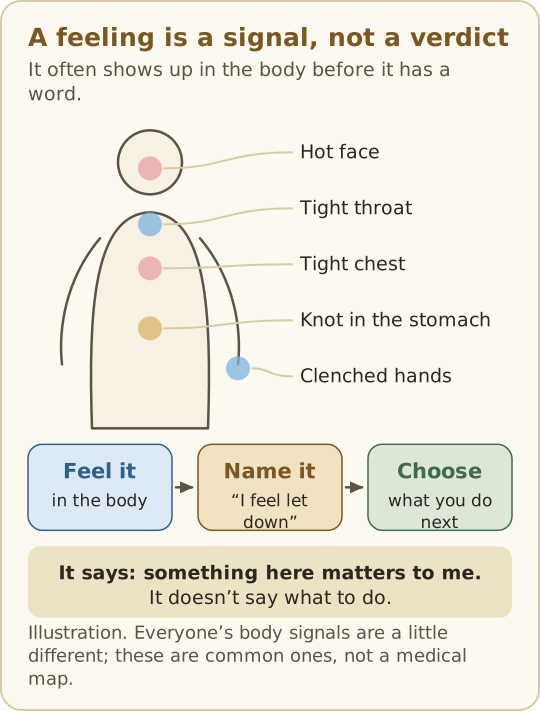
Where can I talk this through?

Professor Puddles, the site’s friendly chat host, can help you turn a vague wish into one small step.

Limits and cautions

  • This part is general education. It isn’t therapy, coaching or medical advice, and it can’t promise any result.
  • Goals about your health, money, work or a hard stretch in life may deserve a qualified professional. There is no shame in asking for one.
  • If a goal ever starts to feel like a weight, shrink it or put it down. Nothing here is required.
  • Nothing you write needs to be shared. Keep your notes private if you like.
  • Research notes in this chapter describe well-known findings in plain words, and say where the evidence is limited. Notes marked “This book’s idea” are our own ways of putting things into practice, not established science.
  • If thinking about a goal leaves you feeling hopeless or unsafe, stop and talk with a trained counsellor or a doctor.

Try this: Write two plain words for what matters to you right now. Write one small goal as something you will do, the tiniest first step, and one if-then: “If ___, then I ___.” Put a ten-minute look-back on the calendar for a month from now.

Your self-discovery path → How you connect: the style quiz → Ten-minute start → Chapter V: the monthly look-back → (spreadloveandacceptance.com/book/chapter-5) Part Two begins with the Preface → (spreadloveandacceptance.com/book/preface-in-depth)

Contents · Open this chapter on its own page

Part Three

Understanding people

How feelings, stress, trust, change, grief, groups and love work, for anyone, in any kind of relationship.

In this part

  1. Chapter 1 How feelings workHow feelings work: signals, the body, and naming what you feel106
  2. Chapter 2 Stress and the nervous systemStress and the nervous system: the ladder, flooding, rest and recovery132
  3. Chapter 3 How we see each otherHow we see each other: perception, bias, and the stories we tell157
  4. Chapter 4 How communication worksHow communication works: meaning, listening, repair and messages180
  5. Chapter 5 Attachment, trust and belongingAttachment, trust and belonging208
  6. Chapter 6 Habits and changeHabits and change: why change is hard and how small steps work233
  7. Chapter 7 Self-worth, shame and self-compassionSelf-worth, shame and self-compassion256
  8. Chapter 8 Loss, grief and big life changesLoss, grief and big life changes279
  9. Chapter 9 Minds that work differentlyMinds that work differently302
  10. Chapter 10 Values, meaning and a good lifeValues, meaning and a good life: what philosophy offers everyday life338
  11. Chapter 11 Healing after hurtHealing after hurt: repair, forgiveness, and when to get help364
  12. Chapter 12 Helping others wellHelping others well: support without fixing, boundaries, and not burning out392
  13. Chapter 13 AngerAnger: what it’s for and what to do with it417
  14. Chapter 14 Personality, temperament and changePersonality, temperament and change across life442
  15. Chapter 15 Closeness and loveCloseness and love: being known, at every age463
  16. Chapter 16 Worry, low mood and traumaWorry, low mood and trauma485
  17. Chapter 17 Groups, influence and cultureFitting in: groups, influence and culture510

Part Three · Chapter 1

How feelings work: signals, the body, and naming what you feel

What feelings are for, where they start, and why putting a name to one can make it easier to carry. For anyone: on your own, at home, with friends, at work or out in the world.

In short:

  • A feeling is a signal, not a verdict. It says “something here matters to me.” It doesn’t say what to do.
  • Feelings start in the body. A tight chest or a hot face often comes before the word for it.
  • Naming helps. “I feel let down” is easier to hold than a big, nameless rush.
  • Feeling it isn’t doing it. You can let a feeling be there and still choose what you do next.

Why the tools work: this chapter explains the thinking behind these tools from earlier in the book.

  • My weather today and the daily check-in (Part One, Now (page 46); Part Two, Chapter I (spreadloveandacceptance.com/book/chapter-1-in-depth)) ask for one word about how you are. Naming a feeling turns its volume down a little, and a daily word catches feelings while they are still small. Big idea: read your state first.
  • Say it so it lands (Part Two, Chapter IV (spreadloveandacceptance.com/book/chapter-4-in-depth)) asks for a feeling, not a verdict. “I felt let down” is easier to hear than “you never care.” Big idea: tune how you send and receive.

Thursday, 4:50pm

A message from your manager: “Got a minute tomorrow?” Your stomach drops. By the time you get home you have snapped at the cat, skipped dinner and replayed every mistake from the last month. Nobody has said anything bad. Your body heard “trouble” before you had a single clear thought.

Part Three of this book is about how people work. Not just couples, and not just homes: you on your own, your family, your friends, the people you work with and the strangers you pass. It starts with feelings, because almost everything else runs through them. How we talk, how we judge each other, how we cope with stress and how we heal all depend on what we feel and what we do with it.

The aim is education first and self-help second. Each section explains how something works, then offers a few things to try. You can read one section and stop.

How this chapter is built: three lenses

Each idea is looked at in three ways, then brought together:

  • Psychology: what researchers have found, named honestly, with a note where the evidence is thin, mixed or debated.
  • Philosophy: what thinkers and traditions have said about the same question, in plain paraphrase. People were thinking hard about feelings long before anyone had a brain scanner.
  • Through an autistic lens: how the idea can look from an autistic point of view. This is a perspective, not a list of problems. Autistic people often notice things about feelings that everyone can learn from: the value of saying things plainly, the role of the senses, and how much a predictable day matters. Not every autistic person is the same, and nothing here is a way to diagnose anyone.

Where something is this book’s idea rather than established research, it says so.

A feeling is a signal, not a verdict

A feeling is a fast message about something that matters to you. It arrives before careful thought because, for most of human history, speed kept people alive. You didn’t have time to reason about the rustle in the grass. You had time to feel afraid and move.

Each common feeling has a rough job. Fear points at possible danger. Anger points at something in the way, or something that seems unfair. Sadness points at a loss. Disgust points at something to keep out. Guilt points at a rule you think you broke. Joy and interest point at things worth moving towards. These are rough sketches, not laws, and the same feeling can do several jobs.

A signal can be right about the theme and wrong about the details. A smoke alarm is right that there is smoke. It can’t tell burnt toast from a house fire. Feelings are like that. Jealousy can be right that a friendship matters to you and wrong that your friend is leaving.

Psychology

Charles Darwin’s The Expression of the Emotions in Man and Animals (1872) treated emotions as useful, inherited reactions shared with other animals. Later, Nico Frijda described emotions as “action readiness”: a feeling gets the body ready to do something, such as approach, avoid, fight or freeze. Many modern “appraisal” theories, including work by Richard Lazarus and Klaus Scherer, say an emotion starts with a fast, often unconscious judgement about whether something matters to your goals.

Norbert Schwarz and Gerald Clore (1983) showed something about feelings as information. People phoned on sunny days rated their lives as more satisfying than people phoned on rainy days, unless the interviewer first mentioned the weather. Once people noticed where their mood came from, they stopped using it as information about their life. Later, much larger studies found the weather effect on life satisfaction to be very small, so treat this as an illustration of the idea rather than a strong finding. The idea itself, that we use our feelings as evidence, is widely accepted.

Researchers still disagree about exactly what an emotion is. That debate comes up again in the next section.

Philosophy

The Chinese philosopher Mencius argued that people are born with “sprouts” of goodness. His example: anyone who suddenly saw a small child about to fall into a well would feel alarm and concern, before any thought of reward or reputation. For Mencius, that feeling is a signal of what we care about, and it can be grown.

The Stoics of ancient Greece and Rome were more suspicious of strong emotions, which they saw as mistaken judgements. Yet even they described “first movements”: the involuntary jolt, the flush or the start, that happens before we agree with it. Seneca wrote that even the wisest person feels these. What matters, for the Stoics, is whether we then agree with the story the jolt tells.

In our own time, Martha Nussbaum has argued that emotions are a kind of judgement about what is important to our lives. Grief, on this view, is not a malfunction. It is how we register that someone mattered.

Through an autistic lens

Many autistic people describe feelings arriving differently: sometimes later, sometimes all at once, sometimes as body sensations before they have a name. A feeling may be strong and still hard to read. Treating a feeling as a signal to check, rather than a verdict to obey, fits this well. It invites the question “What is this about?” instead of the demand “Explain yourself.”

Autistic people are also often told their feelings are wrong for the situation: too big, too small, or about the “wrong” thing, like a change of routine or a sound. Seen as signals, those feelings make sense. Distress at a sudden change is a signal that predictability matters to that person’s nervous system. It deserves to be taken seriously, not argued away.

Thoughts you could try: “This is a signal that something matters. What is it?” “Is this the fire, or the toast?”

Feelings start in the body

Very often, the body moves first: a racing heart, a hot face, a lump in the throat, a heavy chest, a churning stomach. The brain then works out what those sensations mean, using what is going on around you and what you have learned. That is why hunger can feel like irritation, a hangover can feel like dread, and a near miss in traffic can leave you snappy for an hour.

Psychology

In 1884 the psychologist and philosopher William James asked a famous question: do we run because we are afraid, or are we afraid because we run? He argued that the feeling of an emotion is, in large part, our sense of the body’s changes. Carl Lange made a similar argument around the same time. Their view was challenged by Walter Cannon and others, who pointed out that different emotions can share very similar body states.

In 1962, Stanley Schachter and Jerome Singer proposed that an emotion has two parts: body arousal, plus a label we give it based on the situation. Their famous experiment has not replicated well, but the broad idea lives on. Donald Dutton and Arthur Aron’s 1974 “wobbly bridge” study suggested that people can mistake the arousal of fear for attraction. It too is debated, and is best treated as an interesting example.

Today, the study of interoception, the sense of what is happening inside your body, is a growing field. Bud Craig and others have described how signals from the heart, gut and lungs reach brain areas such as the insula. Lisa Feldman Barrett’s theory of constructed emotion goes further. It says the brain is always predicting what the body needs, and builds emotions by making sense of body sensations with concepts it has learned. Others, in the tradition of Paul Ekman, argue for a small set of more built-in basic emotions. In a well-known study, Ekman and Friesen (1971) found that people in a remote community in Papua New Guinea, who had seen little Western media, mostly matched short emotion stories to the same facial expressions that Western people chose. The debate is real and unfinished. What both sides accept is that body and feeling are tightly linked.

Philosophy

Baruch Spinoza, writing in the 1600s, refused to split mind and body into two separate things. For him, an “affect” was a change in the body’s power to act, and at the same time the idea of that change. A feeling, on this view, is the body and the mind telling the same story.

Buddhist teaching on mindfulness lists “feelings” (in Pali, vedanā) as one of four foundations to pay attention to. Here “feeling” means the basic tone of an experience, pleasant, unpleasant or neither, noticed in the body before any story is added. The practice is simply to notice that tone, moment by moment.

Through an autistic lens

Interoception varies from person to person, and many autistic people describe it as working differently for them. Some notice hunger, thirst, pain or a racing heart very strongly. Others barely notice them until they are extreme. Research on interoception in autistic people, including work by Sarah Garfinkel, Rebecca Brewer and colleagues, has produced mixed findings, and it seems to vary a lot from person to person. If the body’s signals are muted or hard to read, a feeling may seem to arrive “out of nowhere.” If they are very loud, ordinary sensations can feel overwhelming.

Sensory load matters too. A bright, noisy supermarket can fill the body with alarm that then looks like an emotion, such as irritability or panic, when it is really sensory overload. A practical lesson for everyone: before deciding what a feeling means, check the body and the surroundings. Is it loud? Bright? Am I hungry, cold, in pain, tired?

Thoughts you could try: “Where is this in my body?” “What’s around me right now: noise, light, crowds?” “When did I last eat, drink or rest?”

A simple figure with five places feelings often show up first, and three steps: feel it, name it, choose.
Figure 9 A feeling is a signal, not a verdict. It often shows up in the body first; naming it helps you choose what to do next.
Filled-in example 6 My weather today Esme, 29, at 4:50pm, after “Got a minute tomorrow?” from her manager

Check today’s weather

The sky

  • Clear: Calm and connected
  • Chosen: Gusty: Revved up
  • Fogged in: Running on empty

Who you’ll mostly be around today

  • A partner
  • Family
  • A co-parent
  • Roommates
  • Chosen: Coworkers
  • Someone I care for
  • Friends
  • Mostly on my own

The pressure

  • Light
  • Chosen: Building
  • Heavy

Ground conditions

  • Chosen: Haven’t eaten in a while
  • Thirsty
  • In pain or unwell
  • Been still all day
  • Too much noise or light
  • Chosen: Running on caffeine
  • Screens since I woke up

Last night’s sleep

  • Barely slept
  • Short night
  • Chosen: About enough
  • Properly rested

People load

  • Barely any
  • Chosen: A normal amount
  • A lot
  • Nonstop, no gaps

What’s blowing in

  • Work
  • Money
  • Kids or caring
  • Health
  • Family
  • The house
  • Chosen: One conversation
  • Something I can’t name

What would actually help in the next hour?

  • Space
  • Food or water
  • Rest
  • To move
  • Chosen: To be heard
  • Chosen: A plan
  • Company
  • Quiet
  • Someone to take something off me

Your forecast

Gusty today
Revved up · Some room today
Talk window
wait about 20 minutes

It’s gusty. You’re revved up. That energy is useful for doing something physical, but it is poor weather for deciding anything about another person.

The ground underneath: you haven’t eaten in a while and you’re running on caffeine. That isn’t a side note. It’s likely a big part of why today feels the way it does, and it’s easier to change than character is.

Blowing in: one conversation. Weather from one front tends to land on whoever is nearest, often someone who had nothing to do with it. Worth saying out loud before it does.

You said what would help is a plan and to be heard. Arrange that before anything else.

If you want to send someone a line: “I don’t need it solved. I just need you to hear this for a few minutes first.”

A made-up example. Names and details are invented. Esme ate something, then rang her sister to be heard. She didn’t reply to the message until the morning.

Naming a feeling helps you hold it

A feeling without a name can feel like weather that fills the whole sky. Putting it into words gives it edges. Once it has edges, you can look at it, tell someone about it, and decide what to do.

Psychology

Matthew Lieberman and colleagues (2007) found that when people labelled the emotion in a picture of an angry or scared face, activity in the amygdala, a brain area involved in alarm, went down compared with other tasks. They called this affect labelling. A later review by Jared Torre and Lieberman (2018) gathered evidence that naming feelings can work as a quiet form of emotion regulation, often without people realising it is helping. In one study, led by Katharina Kircanski with Lieberman and Michelle Craske (2012), people afraid of spiders who described their fear in words while near a spider later showed less body arousal than people who had tried to talk themselves out of the fear.

James Pennebaker’s research on expressive writing, from the 1980s onwards, found that writing about difficult experiences for short sessions was linked with small benefits for some people. The effects are modest and vary, and writing about very raw trauma alone isn’t right for everyone.

A note on limits: most of these studies are done in labs, with pictures and short tasks. Naming isn’t magic, and it doesn’t make a feeling vanish. It tends to make a feeling a little more manageable.

Philosophy

Spinoza made a claim that sounds very modern. He argued that a feeling which overwhelms us loses some of its grip once we form a clear and distinct idea of it. Understanding a feeling, for him, was a kind of freedom.

Many traditions use naming in practice. Some meditation teachers suggest “noting”: quietly naming what is present, such as “worry, worry” or “hearing, hearing,” then letting it go. The aim is not to argue with the feeling, but to see it clearly.

Through an autistic lens

Alexithymia means finding it hard to identify and describe your own feelings. It is not a diagnosis, and it is found in many people, autistic or not. Reviews have found it is much more common among autistic people than in the general population, though far from universal. Geoffrey Bird and Richard Cook’s “alexithymia hypothesis” (2013) suggests that some differences in recognising emotions, which used to be blamed on autism itself, may be better explained by alexithymia.

So “just name it” isn’t always simple. But naming can take many forms. A number (“I’m at a seven”), a colour, a traffic light, a body description (“my chest is tight and my hands are buzzy”), a written note, or a chart of feeling words to point at are all real names. Writing can be easier than speaking. Taking time can be easier than answering on the spot. Many autistic people find that precise, concrete descriptions work better than broad labels, and that is a strength, not a workaround.

Words you could use: “I think what I’m feeling is…” “I don’t have the word yet, but my body feels like…” “I’m at about a six out of ten.”

More words, better tools

“Bad,” “stressed” and “fine” cover a huge range of feelings. Splitting them into finer words is like having more than one tool in the box. “Disappointed” suggests talking about hopes. “Overwhelmed” suggests taking something off the pile. “Lonely” suggests reaching out. “Ashamed” suggests self-kindness. The finer the word, the clearer the next step.

Psychology

Lisa Feldman Barrett and colleagues call this emotional granularity, or emotion differentiation. In studies where people rated their feelings several times a day, those who used finer distinctions for negative feelings tended to have more ways of coping with them. A review by Todd Kashdan, Barrett and Patrick McKnight (2015) linked low granularity with a range of difficulties, such as more binge drinking or more aggression after being hurt, in some studies. Most of this research is correlational, so it can’t prove that learning more words causes better coping. Early studies trying to teach granularity are promising but small.

Philosophy

The ancient Stoics built detailed lists of emotions. They grouped them into four families, roughly distress, fear, craving and delight, and then divided each family into many kinds, such as envy, pity, grief and worry under distress. Their aim was to understand each passion well enough to see the judgement inside it.

Aristotle took a different view of what to do with feelings, but he also valued precision. He argued that good character means feeling the right thing, towards the right person, to the right degree, at the right time. You can only aim that precisely if you can tell your feelings apart.

Through an autistic lens

Some autistic people have a very precise, detailed way of describing inner experience, even if standard emotion words don’t fit well. “I feel like the volume on everything has been turned up” or “I’m at forty percent battery” can be more exact than “I’m stressed.” That is granularity, just in a different vocabulary.

Shared, agreed words help everyone. A family or team can agree a small set of words or numbers and what each one means: “Amber means I can talk but I need it short.” Explicit, literal agreements like this reduce guessing, which is one of the biggest sources of misunderstanding between people who are wired differently.

Words you could use: “It’s less angry and more let down.” “I’m not sad exactly, I’m lonely.” “Can we agree what ‘I’m fine’ means between us?”

Feelings come in layers

The feeling on top isn’t always the first one that came. Anger often sits on top of hurt or fear, because anger feels stronger and less exposed. Irritation can sit on top of tiredness. Numbness can sit on top of something too big to feel all at once.

We also have feelings about our feelings. Being ashamed of crying. Scared of our own anger. Guilty for feeling relief. These second-layer feelings can hurt more than the first, and they often come from what we were taught growing up about which feelings were allowed.

Psychology

Leslie Greenberg’s emotion-focused therapy distinguishes primary emotions (the first, direct response, such as sadness at a loss) from secondary emotions (reactions to that first feeling, or covers for it, such as anger that hides hurt). In that approach, getting to the primary feeling is often what helps.

John Gottman, Lynn Katz and Carole Hooven (1996) studied what they called parents’ meta-emotion philosophy: how parents feel and think about emotions themselves. Parents who saw a child’s sadness or anger as a chance to connect and teach, rather than something to dismiss, tended to have children who later handled feelings more easily. See helping kids name big feelings (spreadloveandacceptance.com/parents).

Research on thought suppression, starting with Daniel Wegner’s “white bear” studies (1987), found that trying hard not to think of something can make it come back more. Acceptance-based approaches, such as acceptance and commitment therapy, build on the idea that making room for a feeling often makes it easier to live with than fighting it.

Philosophy

A Buddhist teaching called the Second Arrow (spreadloveandacceptance.com/learn/index-in-depth) says that when we are hurt, we are struck by one arrow. Then we often shoot a second arrow at ourselves: blame, worry, “why does this always happen to me?” The first arrow may be unavoidable. The second is the one we can learn to put down.

Friedrich Nietzsche, in a very different spirit, warned that feelings we are not allowed to express don’t disappear. He described how resentment, pushed down, can turn into something bitter that shapes a whole outlook. You don’t have to share his wider philosophy to find the warning useful.

Through an autistic lens

Many autistic people have spent years being told that their reactions were “too much,” or adjusting their faces and voices to seem fine. This is often called masking. Over time, it can add a heavy second layer to every feeling: not just “I’m overwhelmed,” but “I’m not allowed to be overwhelmed.” Naming that second layer, and letting the first feeling be valid, can be a big relief.

Anxiety about a possible meltdown can also become its own layer, making overload more likely. Plans made on a calm day (where to go, what to say, what helps) can take some of the fear out of the second layer. That idea is useful for anyone who dreads their own big feelings.

Thoughts you could try: “What might be under this?” “I’m allowed to feel this. I don’t need a second arrow.”

Feelings rise and pass like waves; moods are weather

An emotion usually has a shape: it rises, peaks and settles. If you keep feeding it with the same thoughts, it can keep going. If you let it run its course without adding to it, it often fades sooner than you expect.

Moods are different. They are longer, lower-level states that colour everything, often without a clear cause. A low mood makes neutral things look negative. A good mood makes the same things look fine. Many big decisions get made in moods, not facts.

Psychology

Philippe Verduyn and colleagues asked people how long their emotions lasted. Durations varied hugely. Sadness tended to last longest, and feelings like surprise, fear and shame were among the shortest. Emotions linked to something important, and emotions people kept thinking about (rumination), lasted longer. This supports a practical idea: going over and over something can keep a feeling going.

“Urge surfing,” from G. Alan Marlatt’s work on relapse prevention, teaches people to notice an urge rise and fall like a wave without acting on it. Mindfulness-based approaches use similar ideas. The evidence for mindfulness is real but more modest than its popularity suggests, and it doesn’t suit everyone.

Recovery groups often use the word HALT: hungry, angry, lonely, tired. It isn’t a research tool, but it names four states that make every feeling louder.

Philosophy

Impermanence (in Pali, anicca) is a core Buddhist teaching: everything that arises passes away, including every feeling. The Greek philosopher Heraclitus made a similar point with his image of a river you can’t step into twice. Marcus Aurelius, the Stoic emperor, often reminded himself in his private notebook how quickly things change and pass. None of these thinkers meant that feelings don’t matter. They meant that no feeling is the final word.

Through an autistic lens

Some autistic people find that feelings, especially after overload, take longer to settle, and that switching from one emotional state to another is hard, much as switching tasks can be. Recovery may need quiet, time alone, a familiar activity or a special interest, rather than more talking. Pressure to “be over it” can make it last longer.

Routines can help here. A predictable day lowers the background load, so waves are smaller and pass more easily. That is true for many people, autistic or not.

Thoughts you could try: “This is a wave. It will peak and pass.” “Is this about now, or is a mood colouring everything?” “No big decisions at the top of a wave.”

Feelings spread between people

We catch each other’s feelings: a tense voice tightens our chest, a laugh makes us smile. This is part of how people bond and stay in step. It also means stress can move through a home, a classroom or a team without anyone saying a word. Caring about someone’s feeling doesn’t mean you have to feel all of it.

Psychology

Elaine Hatfield, John Cacioppo and Richard Rapson described emotional contagion in the early 1990s: people tend to mimic each other’s faces, voices and postures, and that mimicry can shift their own feelings. Studies of moods spreading through social networks, such as work by Nicholas Christakis and James Fowler, are interesting but debated, because it is hard to separate catching a feeling from simply sharing the same surroundings.

Psychologists also separate empathy (feeling with someone) from compassion (caring about their suffering and wanting to help). Research by Tania Singer and Olga Klimecki suggests that compassion training may protect people from distress better than practising empathic feeling alone. This matters for anyone who supports others, which is the subject of a later chapter.

Philosophy

David Hume compared people to strings tuned alike: when one moves, the others move with it. Adam Smith, in The Theory of Moral Sentiments (1759), described sympathy as our ability to imagine ourselves into another person’s situation, and argued it was central to moral life. Both saw shared feeling as the glue of society, not a weakness.

Through an autistic lens

There is an old stereotype that autistic people lack empathy. Many autistic people describe the opposite: absorbing others’ feelings so strongly that it becomes overwhelming. Others say they may not read a feeling from a face or a tone, but care deeply once they know. Both are forms of caring. The double empathy problem, described by Damian Milton (2012), points out that misunderstandings between autistic and non-autistic people run in both directions. Non-autistic people often misread autistic feelings too.

A useful lesson for everyone: saying a feeling plainly (“I’m worried, not angry”) works better than hoping it is caught correctly. Contagion is fast but not precise. Words are slower and clearer.

Thoughts you could try: “Is this mine, or did I pick it up?” “I can stand beside their storm without standing in it.”

Feeling it isn’t the same as doing it

Every feeling comes with an urge. Anger wants to push. Fear wants to run or check. Shame wants to hide. Sadness wants to withdraw. The feeling itself isn’t chosen. What you do with the urge is more open, especially with practice and a calm-day plan.

There are two common traps. One is pushing feelings down so hard that they leak out sideways later. The other is acting on every urge straight away, which can hurt people and leave you with regrets. The path between them is: let the feeling be there, name it, and then choose the action.

Psychology

James Gross’s process model (spreadloveandacceptance.com/library/emotions) describes points where people can shape an emotion: choosing or changing the situation, shifting attention, rethinking what it means (reappraisal), or changing how they respond. Gross and Oliver John (2003) found that people who habitually used reappraisal tended to do better on wellbeing measures than people who habitually hid their feelings (suppression). Later work found the costs of suppression vary between cultures, so “always express” is not a universal rule.

Brad Bushman (2002) found that hitting a punching bag while thinking about the person who angered you tended to increase anger and aggression, not release it. “Venting” in that sense doesn’t seem to drain anger. Calming the body, waiting, and then talking about it tends to work better.

Philosophy

Seneca, in On Anger, argued that the best remedy for anger is delay: give the first wave time to pass before you act. Aristotle, as above, thought anger could be right, if it was felt towards the right person, for the right reason, in the right amount. Put together, they offer a balanced idea: some anger is fair, and waiting helps you find out which kind this is.

Through an autistic lens

A meltdown is not a choice or a tantrum. It is an involuntary response to overwhelm, and so is a shutdown, which can look like going quiet or “switching off.” Neither is the same as acting on an urge. They are what happens when the nervous system has had too much. What helps is less input, fewer demands and more time, not reasoning or consequences in the moment.

Many autistic people also use actions that settle the body, such as rocking, flapping, humming, pacing or holding something with a good texture. This is often called stimming. It is a healthy way of doing something with a feeling, and it deserves respect, not correction. For everyone, the lesson is that there are many safe actions between “hold it in” and “let it out on someone.”

Words you could use: “I’m feeling a lot. I’m going to take ten minutes before I reply.” “I’m not ignoring you. I’m letting this settle so I answer well.”

A note on safety: Feelings explain behaviour. They never excuse harm. “I was angry” is a reason to look at your anger, not a reason someone else has to live in fear. If you are afraid of someone’s anger, or of your own, Not safe at home? (spreadloveandacceptance.com/safety) has free, private help.

When feelings weren’t talked about

Many people grew up in homes where feelings were private. “Don’t make a fuss.” “Big boys don’t cry.” “We just got on with it.” This is especially common for men, for older generations, and in some families and cultures, where keeping feelings to yourself is a sign of strength, dignity or respect. If that is you, nothing in this chapter is a criticism. You learned a way of living that made sense where you were. The question is only whether it still helps you now, especially in hard times such as illness or bereavement.

Psychology

Psychologists use the word alexithymia for difficulty identifying and describing one’s own feelings. In a review of 41 samples, Levant and colleagues (2009) found that men scored slightly higher than women on average, but the difference was small: there was far more overlap than difference. Ronald Levant has argued that much of this is learned, because many boys were taught to hide vulnerable feelings like sadness and fear, and he called the pattern “normative male alexithymia.” Culture plays a part too. In a study across 23 countries, Matsumoto, Yoo and Nakagawa (2008) found that people in cultures that placed more value on social order and hierarchy tended to report holding their feelings in more. So holding back is partly a habit a whole community shares, not just a personal quirk.

Care is not only spoken. Many people show love mainly through practical help: fixing, driving, cooking, providing, turning up. That is real care, and the people around them often know it. Words can be added to it slowly. Short, plain sentences are enough, and writing can be easier than speaking. An early experiment by Pennebaker and Beall (1986), in which students wrote privately about difficult experiences, started decades of research on writing as a way to work through feelings, and many people find writing easier than talking.

Philosophy

Many traditions have valued emotional restraint. In the Confucian Analects, Confucius praises an old poem for being joyful without excess and sorrowful without harm: feeling fully, but in proportion. The Stoics, too, admired steadiness. Neither tradition asked people to feel nothing. They asked people to hold their feelings well. Aristotle, writing about friendship, said a true friend wishes good things for the other for the other’s own sake, and acts on it. On that view, much quiet, practical care is friendship at its best.

Through an autistic lens

Many autistic people also show care mainly by doing: solving a problem, sharing useful information, remembering exact details. Some also find feelings hard to name (see Naming a feeling). An adult who was never told they were autistic may have spent a lifetime being called “cold” when they were feeling a great deal, without the words for it. Whatever the reason, the same tools help: body words, numbers, plain short sentences, and writing instead of speaking.

Words you could use, for yourself: “I wasn’t brought up to say this, but I miss her.” “I’m not good with words for this. It’s been a hard week.” “I don’t know what to call it. I just feel heavy.” “I’m not one for talking, but I wanted you to know I’m proud of you.”

Words you could use, for someone like this: “I know you show it by doing. I see it, and thank you.” “You don’t have to say much. I’m here.”

Putting it together

Here is the whole chapter as one short sequence. It is this book’s idea, a way of joining the research above into something easy to remember, not a tested method:

  1. Notice the body. Where is it? Hot, tight, heavy, buzzing? Check the basics: hungry, tired, in pain, overloaded?
  2. Name it, roughly. A word, a number, a colour. A guess is fine.
  3. Look underneath. Is there another feeling under this one? Am I adding a second arrow?
  4. Ask what it’s pointing at. What matters to me here? Is the signal about the fire, or the toast?
  5. Choose the next action. Wait, move, ask, explain, rest or reach out. Not every feeling needs an action at all.

The three lenses agree more than they differ. Psychology says feelings are fast, bodily, partly constructed signals that become easier to handle when named. Philosophy, from Mencius and the Stoics to Spinoza and the Buddhist teachers, says feelings tell us what we value, that understanding them gives us some freedom, and that none of them is permanent. The autistic lens adds that people sense and express feelings in different ways, that the senses and predictability matter, and that being plain and explicit about feelings helps everyone.

Worked examples

On your own: the Sunday evening dread

Bettina lives alone and feels a heavy dread every Sunday evening. She used to call it “I hate my life.” Using the sequence, she notices a tight throat and restless legs; names it as “dread, about a six”; looks underneath and finds loneliness as well as worry about Monday; and sees that it points at two things: a hard week ahead, and an empty weekend behind. Her actions: lay out Monday’s first task on Sunday afternoon, and book one call with a friend each Sunday. The dread is smaller, and it no longer says “my life.” See On my own (spreadloveandacceptance.com/on-my-own).

Partners: the anger that was fear

Rhodri gets angry whenever Tamsin drives fast. They argue about speed limits. One evening, calm, Rhodri says: “I think under the anger I’m scared. My cousin was in a crash.” Tamsin slows down without being asked twice. The argument was never about rules. It was about a fear that had been wearing anger’s coat.

Parent and child: naming, not fixing

Seven-year-old Kian sobs because his tower fell. His mum’s first urge is “It’s only blocks.” Instead she says, “You’re so disappointed. You worked hard on that.” He nods, cries a little longer, and rebuilds it. She didn’t fix anything. She gave the feeling a name and a place. See For parents.

Coworkers: contagion in a team

A small team notices that Monday meetings always feel tense. They try one change: anyone can start by giving a number from one to five for how they are, with no explanation needed. When the manager says “two today, nothing to do with any of you,” the team stops reading her flat face as disapproval. Feelings spread less when they are named. See At work (spreadloveandacceptance.com/work).

Autistic and non-autistic housemates

Riya, who is autistic, goes silent and leaves the room when the kitchen gets loud during a party. Her housemate Finn reads it as sulking and feels hurt. Later they agree a plain signal: Riya says or texts “too loud, back soon,” and Finn knows it is about noise, not him. Riya feels less pressure to hide her overload, and Finn feels less rejected. Both were reading each other carefully, just differently. See Neurodivergent relationships (spreadloveandacceptance.com/neurodivergent-relationships).

Friends: the second arrow

After a friend forgets her birthday, Mabel feels hurt, then ashamed of being hurt (“it’s childish to care”). The shame makes her go quiet, which the friend notices and worries about. When Mabel drops the second arrow and simply says “I was a bit hurt you forgot,” her friend apologises and they make a plan. See Friends (spreadloveandacceptance.com/friends).

Exercises

  1. Three body check-ins a day. At three set times, such as breakfast, lunch and dinner, ask: “What does my body feel like?” Write one line. After a week, look for patterns.
  2. One finer word. Each time you notice “bad,” “stressed” or “fine,” find one more exact word. Keep a list of the words that fit you best.
  3. Your own scale. Make a five-point scale for yourself, in words, numbers or colours, with what each point feels like in your body and what helps at that point. Share it with one person if you like.
  4. Under the top layer. Next time you feel angry or irritated, ask, “Is there hurt, fear or tiredness underneath?” Write the answer down, even if you share it with nobody.
  5. Wait before acting. Choose one urge you often act on too fast, such as a sharp text or a quick yes. For one week, wait ten minutes first and notice what changes.
  6. A family or team feeling word list. Agree three to five shared words or numbers and exactly what they mean, so nobody has to guess.

Questions people often ask

Isn’t it self-indulgent to focus on feelings?

Not really. Feelings drive what people do, whether we look at them or not. Understanding them usually makes people kinder and more careful with each other, not more self-absorbed.

What if I truly can’t tell what I feel?

Start with the body and with simple scales. “Something unpleasant, about a seven, in my chest” is a good answer. Some people always find naming hard, and that is a difference to work with, not a failure. A counsellor can help if it is getting in the way.

Should I always say what I feel?

No. Naming it to yourself is almost always useful. Saying it to others depends on the person, the setting and your safety. You get to choose what to share.

Can I change what I feel?

Not directly, in the moment. You can change things around a feeling: your situation, your attention, how you read what happened, and your body’s state. Over time, those changes often change the feelings too.

My partner says my feelings are “wrong.” Are they?

A feeling can be based on a misunderstanding, and it is fair to check the facts together. But a feeling itself isn’t right or wrong. If someone regularly tells you that what you feel, see or remember isn’t real, and you start to doubt yourself, take that seriously. Signs to look out for may help.

Are feelings the same in every culture?

Not exactly. Some feelings seem common across many cultures, but cultures differ in which feelings they name, which ones they encourage showing, and what the body language looks like. That is another reason to ask rather than assume.

When to get more help

Big feelings are part of life. It may be time to talk to a doctor, counsellor, psychologist or other trained professional if a low, numb, anxious or angry feeling stays most days for two weeks or more; if feelings are stopping you from sleeping, eating, working or seeing people; if you are relying on alcohol, drugs or other things to stop feeling; or if you are having thoughts of harming yourself. If you are in danger now, contact your local emergency number or a crisis line straight away.

If you feel afraid of someone you live with or are close to, that fear is an important signal. Not safe at home? lists free, private help. This chapter is general education, not diagnosis or therapy.

More for your situation

Contents · Open this chapter on its own page

Part Three · Chapter 2

Stress and the nervous system: the ladder, flooding, rest and recovery

What stress does to your body and your mind, why kind people say things they don’t mean when they are flooded, and the kinds of rest that actually help you recover.

In short:

  • Stress is your body getting ready for a demand. A little helps. Too much, for too long, wears you down.
  • Three everyday states: calm and connected, revved up, and running on empty. Each one changes how you think and hear.
  • Flooded means offline. When stress is very high, listening and careful thinking get much harder. Pause, settle, then come back.
  • Rest is a skill. Different kinds of tired need different kinds of rest.

Why the tools work: this chapter explains the thinking behind these tools from earlier in the book.

  • How much are you carrying? and the stress tank (Part Two, Chapter III (spreadloveandacceptance.com/book/chapter-3-in-depth)) work because stress adds up from many small loads. A full tank makes small things feel big, so you check the tank before you judge the moment. Big idea: read your state first.
  • The Calm-Down Kit (Part One, Now (page 46)) settles the body before any words, because a flooded body can’t think or listen. Its “come back at a set time” rule stops a pause looking like walking out.
  • The setup score (Part Two, Chapter II (spreadloveandacceptance.com/book/chapter-2-in-depth)) counts stress as well as hours, because a split that looks fair on paper can still leave one person running on empty.

Monday, 7:52am

The bus is late, the kids can’t find a shoe, and your phone buzzes with a work message. Your partner says, “Have you seen my keys?” and you hear yourself snap, “I’m not your secretary!” A second later you think, “Where did that come from?” It came from a body that was already full.

Chapter 1 looked at feelings: fast signals about what matters. This chapter looks at the system that carries them, your nervous system, and what happens to it under pressure. Stress explains a lot of behaviour that otherwise looks like bad character: the snap, the shutdown, the friend who cancels, the colleague who can’t take in a simple point. Understanding it makes people, including you, easier to forgive and easier to help.

As in every chapter of Part Three, each idea is looked at through three lenses: psychology (named research, with its limits), philosophy (thinkers and traditions, in plain paraphrase) and an autistic lens (a perspective, not a deficit; not every autistic person is the same, and nothing here diagnoses anyone), with an ADHD lens where it matters most. Then the chapter pulls it together, with worked examples, exercises and questions. Where something is this book’s idea, it says so.

Stress is your body getting ready

When something needs dealing with, the body prepares. Stress hormones such as adrenaline and cortisol rise. The heart beats faster, breathing quickens, blood moves to the big muscles, digestion slows and attention narrows onto the problem. In short bursts this is useful. It is why you can catch a falling child, give a speech or hit a deadline.

The same system becomes a problem when it stays switched on. A zebra that escapes a lion calms down quickly. Humans can keep the alarm running for weeks by worrying about the lion, remembering the lion, and checking their phone for messages about the lion.

Psychology

Walter Cannon described the “fight or flight” response in the early twentieth century. Hans Selye, from the 1930s, described a general pattern of response to stress, which he saw as moving from alarm, to resistance, to exhaustion if the stress went on. Later researchers added freeze to fight and flight, and Shelley Taylor and colleagues (2000) proposed “tend and befriend”: under stress, many people, perhaps especially women, also move to protect others and seek company. Robert Sapolsky’s book Why Zebras Don’t Get Ulcers made the point about humans keeping stress going with thought and memory, which is the picture used above.

Researchers generally agree that short-term stress responses are adaptive and that long-lasting, unrelieved stress is linked with poorer physical and mental health. The details, such as exactly how much and through which pathways, are still being studied.

Philosophy

The ancient Greek philosopher Epicurus is often misread as recommending luxury. In fact he aimed at ataraxia, a calm freedom from disturbance, and thought the way there was through simple pleasures, friendship and letting go of needless fears. For him, a good life wasn’t free of all effort. It was free of unnecessary alarm.

Through an autistic lens

For many autistic people, the alarm can be set off by things others barely notice: a buzzing light, a scratchy label, an unexpected change of plan, a room full of overlapping voices. The body’s response is just as real as if the trigger were a lion. Calling it “overreacting” misses the point. The nervous system is reacting to a real load, even if that load is invisible to someone else. Taking the trigger seriously, and lowering it where you can, is often the quickest way to calm.

Thoughts you could try: “My body is getting ready. That’s its job.” “The emergency is over. I can show my body it’s over.”

Stress depends on what you have to meet it

Stress isn’t simply “a lot happening.” It grows when a demand looks bigger than what you have to meet it: time, energy, money, sleep, skills, information or help. Change either side and the stress changes. That is why support can shrink stress without changing the task, and why a small task can feel impossible on an empty day.

Psychology

Richard Lazarus and Susan Folkman’s appraisal model (1984) is still one of the most influential accounts. In a first appraisal, you judge whether something matters and whether it threatens you. In a second, you judge whether you can cope. Stress comes from the balance between the two. Work psychology has a similar idea, the job demands-resources model from Arnold Bakker and Evangelia Demerouti: high demands are more manageable when resources such as control, support and feedback are high.

Researchers including Jim Blascovich and Wendy Berry Mendes distinguish a challenge state (I can meet this) from a threat state (this may be too much). Studies by Jeremy Jamieson and colleagues suggest that telling people their racing heart can help them perform may shift them towards a challenge state and, in some studies, improve performance. These effects are real but not huge, and they don’t remove real overload.

You may also have heard of the Yerkes-Dodson law, which says performance rises with arousal up to a point and then falls. The original 1908 study was on mice. The idea that “a bit of pressure helps, too much hurts” is a useful rough picture, not a precise law.

Philosophy

The Stoic teacher Epictetus taught that people are disturbed not by things themselves, but by their judgements about things. He also taught the dichotomy of control (spreadloveandacceptance.com/learn/index-in-depth): some things are up to us (our judgements, our choices) and some are not (other people, the weather, the past). Peace comes from putting effort where it can make a difference.

Read fairly, this isn’t “it’s all in your head.” Epictetus had been enslaved, and knew real hardship. The point is that how we read a situation is one of the few levers we always have, alongside changing the situation where we can.

Through an autistic lens

Many demands are invisible. Processing spoken words in a noisy room, filtering out background sounds, tracking unwritten social rules and keeping up a “normal” face all take energy. For many autistic people, those background demands are high every day, so less is left for everything else.

Uncertainty is a demand too. Research has linked intolerance of uncertainty with anxiety in many people, and it seems especially important for many autistic people. A clear plan, a heads-up about changes, and knowing exactly what is expected are resources: they reduce the demand side directly. Christine Miserandino’s “spoon theory” (2003), written about living with lupus and now used widely by disabled and neurodivergent people, puts it simply: each person starts the day with a certain number of spoons, and every task costs some.

Words you could use: “It’s not the task. I don’t have much left today.” “Could you tell me the plan ahead of time? It helps me a lot.”

The ladder: three everyday states

This book uses three plain words for how your body is running, on what it calls the Nervous System Ladder (spreadloveandacceptance.com/quick-checks):

  • Calm and connected: breathing is easy, you can think and listen, and hard things can be heard.
  • Revved up: tense and fast. Small things feel urgent or personal. Pace speeds up and tone sharpens.
  • Running on empty: flat and slow. Words are harder to find and replies get short.

Everyone moves up and down this ladder many times a day. The ladder is this book’s idea: everyday words to help you guess your state, not a medical model or a measurement.

Psychology

The three words are loosely inspired by Stephen Porges’s polyvagal theory (1994 onwards), which links calm social engagement, fight-or-flight and shutdown to different parts of the nervous system. It is popular in therapy, but many of its physiological and evolutionary claims are disputed by other researchers, including Paul Grossman. That is why this book uses the words only as everyday labels.

A related idea with fewer claims is the window of tolerance (spreadloveandacceptance.com/library/stress), a phrase from psychiatrist Dan Siegel (1999). Inside the window, you can handle feelings and think. Above it (hyperarousal) you are flooded and reactive. Below it (hypoarousal) you are numb or shut down. Therapists use it as a map, not a lab finding.

Philosophy

A well-known Buddhist story tells of a monk named Sona, who had been a musician. He was pushing himself so hard in practice that he was ready to give up. The Buddha asked him whether a lute plays well when its strings are too tight, or too loose. Neither, said Sona: only when they are tuned just right. Practice, the Buddha said, is the same. Aristotle’s idea of virtue as a middle point between too much and too little makes a similar point. The aim isn’t zero tension. It is the right tension for the moment.

Through an autistic lens

Many autistic people describe two ends of the ladder that others may not see clearly. At the top, a meltdown: an involuntary loss of control when overwhelm is too great. At the bottom, a shutdown: going quiet, losing speech, being unable to move or respond. A shutdown can look calm from the outside. It isn’t. Treating a quiet, frozen person as “fine” can push them further down.

There is also a long-term version of running on empty. Autistic burnout, described by Dora Raymaker and colleagues (2020) from autistic adults’ own accounts, involves long-lasting exhaustion, loss of skills and lower tolerance for sensory input, often after long periods of masking and overload. It is different from work burnout, though they can overlap, and it needs real rest and fewer demands, not more effort.

Words you could use: “I’m revved up. Give me ten minutes.” “I’m running on empty. Can this wait until the morning?” “I’ve gone quiet because I’m overloaded, not because I’m angry.”

Three bands, revved up, calm and connected, and running on empty, with a line showing one afternoon moving through them.
Figure 10 The ladder: three everyday states. You move up and down it all day; hard talks go best from the middle band.
Filled-in example 7 The ladder (the sky, in My weather today) Mike, who cares for his wife, Ann

The sky

Pick the one closest to true right now. This is a reading of you, never of anyone else.

The sky

  • Clear: Calm and connected
  • Gusty: Revved up
  • Chosen: Fogged in: Running on empty

Who you’ll mostly be around today

  • A partner
  • Family
  • A co-parent
  • Roommates
  • Coworkers
  • Chosen: Someone I care for
  • Friends
  • Mostly on my own

The pressure

  • Light
  • Building
  • Chosen: Heavy

Last night’s sleep

  • Chosen: Barely slept
  • Short night
  • About enough
  • Properly rested

What’s blowing in

  • Work
  • Money
  • Chosen: Kids or caring
  • Chosen: Health
  • Family
  • The house
  • One conversation
  • Something I can’t name

What would actually help in the next hour?

  • Space
  • Food or water
  • Chosen: Rest
  • To move
  • To be heard
  • A plan
  • Company
  • Quiet
  • Chosen: Someone to take something off me

Your forecast

Fogged in today
Running on empty · Very little room today
Talk window
another day is kinder

You were already carrying a heavy day before this. Treat the size of your reaction as a reading on the day, not on whoever is in front of you.

Between you and the person you care for today: do the essentials kindly and let the rest go. If anyone can cover one thing today, ask them.

If you need to say something now: “I’m at the end of what I can carry today. Could you take [one thing] off me?”

A made-up example. Names and details are invented. A heavy reading is information about a day, not a failing in a person.

When you’re flooded, thinking goes offline

At high stress, the body goes into full alarm. Careful thinking, listening, holding two ideas at once and seeing the other side all get much harder. Many people call this being flooded. You may say things you don’t mean, repeat the same point, freeze, or just want to escape. It isn’t a failure of character. It is a body that needs to come down before the talk can go anywhere good.

Psychology

John Gottman’s research on couples described flooding (spreadloveandacceptance.com/library/relationships): during conflict, some partners became so physically aroused, with a fast heart rate and stress hormones, that they could no longer take in what was said. His work suggested taking a real break, often at least twenty minutes, and doing something soothing rather than rehearsing the argument. Neuroscientist Amy Arnsten (2009) reviewed evidence that high stress weakens the functioning of the prefrontal cortex, the part of the brain most involved in planning and flexible thinking, while strengthening more habitual responses. Popular phrases like “amygdala hijack,” from Daniel Goleman, are simpler than the science but point at the same thing.

Philosophy

Plato, in the Phaedrus, pictured the soul as a charioteer driving two horses, one calm and one wild. When the wild horse bolts, the charioteer can’t steer until it slows. Seneca’s advice for anger was simple: delay. Give the first rush time to pass before you speak or act. Both describe what flooding feels like from the inside, centuries before anyone measured a heart rate.

Through an autistic lens

For someone in a meltdown, questions, explanations, eye contact, touch and even kind words can add to the load. What usually helps is less: less talk, less light, less noise, fewer people, and more time. Afterwards, many autistic people find it easier to talk about what happened in writing, or side by side rather than face to face. This is good advice for anyone who has been flooded: come back to the topic when calm, in the format that works for you.

Meltdowns are also not manipulation or a tantrum. They are not aimed at anyone. Responding with consequences or arguments in the moment tends to make things worse. Planning on a calm day, together, tends to make them less frequent.

Words you could use: “I’m too flooded to listen well. Can we stop for twenty minutes and come back at four?” “I’ll come back to this. I need it quiet for a bit.”

A note on safety: Anyone can call a pause, and nobody should be followed, blocked from leaving or punished for it. If a “pause” is used to punish with days of silence, or if you are afraid of what happens when someone is flooded, that is a safety issue, not a stress one. Signs to look out for (spreadloveandacceptance.com/safety).

A curve of body alarm that crosses a “flooded” line, then comes down during a break of twenty minutes or more; a dashed line shows pushing on keeps it high.
Figure 11 Flooded means offline. Pause and name a time to come back, settle the body for at least twenty minutes, then talk. Illustrative curve.

Stress adds up, like a tank filling

Stress from different places pours into the same tank. A bad night’s sleep, a hard meeting, a crowded train, a money worry and a sharp text all add up. By evening, a tiny thing tips it over. The last drop gets the blame, but the tank was nearly full already.

Psychology

Bruce McEwen and Eliot Stellar (1993) introduced the idea of allostatic load: the wear and tear on the body from repeated or long-lasting stress responses. In a classic study, Allen Kanner, Richard Lazarus and colleagues (1981) found that everyday hassles were related to health symptoms at least as strongly as major life events. Small things count.

Stress also spills over. Rena Repetti’s studies of air traffic controllers (1989) found that after high-workload days, they tended to be more withdrawn with their families. Niall Bolger and colleagues found stress could also cross from one partner to the other. Sleep matters too: research from Matthew Walker’s lab (2007) found that after a night without sleep, the brain’s alarm centre reacted much more strongly to upsetting pictures. Part Two’s Chapter III turns this into a simple self-check.

Philosophy

There is a well-known Zen story about a professor who visits a teacher to learn about Zen, then talks without pause about his own ideas. The teacher pours him tea and keeps pouring as the cup overflows. “Like this cup,” he says, “you are full. How can I show you anything until you empty it?” The story is about opinions, but it fits stress too: a full cup can’t take in even something good.

Seneca described a habit, borrowed from the philosopher Sextius, of reviewing each day at bedtime: what went well, what went badly, what to do differently. Done gently, an evening review is a way of emptying the cup before sleep rather than carrying it into tomorrow.

Through an autistic lens

Masking, the effort of hiding autistic traits to fit in, fills the tank fast. Laura Hull and colleagues (2017) described how autistic adults experience this “camouflaging”: many said it was exhausting and left them drained afterwards. Many parents of autistic children notice that a child who seemed fine at school falls apart as soon as they get home. Some parents call this “after-school restraint collapse.” It isn’t a research term, but it describes the tank well: the child held it together all day, and home is the safe place to let it out.

The lesson for everyone: when someone falls apart over something small, ask what filled the tank, not why they’re making a fuss about the last drop.

Through an ADHD lens

Life with ADHD often adds a hidden layer to the tank: the constant effort of keeping track, the cost of lost keys and missed messages, and the low hum of worry about what you might have forgotten. So the tank can be fairly full before the day has properly started. Strong feelings can also be harder to bring back down once they rise: a review by Shaw and colleagues (2014) found this is common in ADHD at every age. Moving the remembering out of your head (a shared list, alarms with labels, one place for keys) empties part of the tank every day. Planning hard conversations for a time of day when your focus and energy are usually better helps too.

Words you could use: “My tank was full before you said a word. That wasn’t about you.” “You don’t have to explain. Want a quiet hour first?”

Settle the body first

You can’t argue a body out of alarm. You can help it come down, and the thinking tends to follow. Things that often help include slow breathing with long out-breaths, moving (a walk, stairs, shaking out your arms), cold water on the face, steady pressure, a familiar sound, and leaving a loud or crowded space. Different things work for different people, and what works on one day may not on another.

Psychology

A systematic review by Andrea Zaccaro and colleagues (2018) found that slow breathing, around six breaths a minute, was linked with signs of relaxation and calmer mood, though many studies were small. A 2023 study led by Melis Yilmaz Balban found that a few minutes a day of breathing with long out-breaths improved mood a little more than mindfulness meditation over a month; it was one study, and the differences were modest. Physical activity has a large body of research behind it for mood and stress. Progressive muscle relaxation, developed by Edmund Jacobson in the early twentieth century, teaches people to tense and release muscle groups. Dialectical behaviour therapy, developed by Marsha Linehan, includes quick body-based skills such as changing temperature and intense exercise for moments of very high distress.

None of these is a cure-all. Their value is practical: they give you something to do with your body when your mind is too loud to think.

Philosophy

The Vietnamese Zen teacher Thich Nhat Hanh taught breathing as a way of coming home to the present moment: breathing in, knowing you are breathing in; breathing out, knowing you are breathing out. He meant it as a practice anyone could use, washing dishes or walking, not only on a cushion. Taoist writing, such as the Tao Te Ching, often praises softness and stillness, like water that finds its level, over force.

Through an autistic lens

Some popular calming advice doesn’t suit everyone. For some autistic people, and others who are very aware or unaware of their body’s signals, focusing on the breath can increase anxiety rather than reduce it. Alternatives that often help include deep pressure (a weighted blanket, a firm hug if wanted, lying under cushions), rhythmic movement such as rocking or swinging, stimming, chewing, humming, a special interest, or simply cutting input with headphones, sunglasses or a dim room. Research on some of these, such as weighted blankets, is still limited, but many people find them helpful, and they are safe to try.

The underlying lesson is universal: there is no single right way to settle. The right way is the one that works for your body. Find yours on a calm day.

Thoughts you could try: “Body first, words second.” “What has helped me settle before? Can I do one of those now?”

Rest isn’t one thing

Being off work isn’t the same as recovering. Scrolling may feel like rest while keeping your brain busy. Socialising may restore one person and drain another. Real recovery comes in different kinds, and different kinds of tired need different kinds of rest.

Psychology

Sabine Sonnentag and Charlotte Fritz (2007) described four recovery experiences linked with feeling restored after work: psychological detachment (switching off from work in your head), relaxation, mastery (doing something absorbing or challenging that you enjoy, like learning a skill) and control (choosing how you spend your own time). Sleep is the foundation under all of them; a large body of research links poor sleep with worse mood and stronger stress reactions. Rachel and Stephen Kaplan’s attention restoration theory (spreadloveandacceptance.com/library/calm) suggests time in nature can help tired attention recover, though effect sizes vary.

The idea that introverts are drained by socialising and extraverts energised is popular but simpler than the evidence. Studies that track people through the day, such as work by Sointu Leikas and Ville-Juhani Ilmarinen (2017), have found many people feel good during social time and more tired a few hours later. Your own experience is the best guide.

Philosophy

The Jewish philosopher Abraham Joshua Heschel, in The Sabbath (1951), described the weekly day of rest as something like a sanctuary built in time rather than space: a day not for producing, but for being. The Catholic philosopher Josef Pieper argued in Leisure: The Basis of Culture (1948) that true leisure isn’t just a break to make us better workers. It is an open, receptive state that makes room for wonder. Bertrand Russell, in his essay “In Praise of Idleness” (1932), argued that a society working less would be happier and kinder. Across very different traditions, rest is treated as part of a good life, not a reward for finishing it.

Through an autistic lens

Many autistic people describe monotropism: attention that tends to go deep into a few things at a time (explained in full in Chapter 9 (page 314)). For many autistic people, time spent deep in a special interest is one of the most restoring kinds of rest: a state of flow, not an escape. Interrupting it can be costly, so planned transitions help.

Other common forms of autistic rest include time alone, a predictable routine, low-sensory spaces, and being with someone without having to talk (sometimes called parallel play, even for adults). None of these is antisocial. They are ways of refilling the tank, and many non-autistic people need them too.

Words you could use: “I need quiet rest tonight, not people rest. It’s not about you.” “Can we be in the same room, but not talk for a bit?”

Stress is easier to carry when it’s shared

Nervous systems affect each other. A calm voice, a steady presence or a familiar person nearby can help someone else settle. A tense, rushed person can unsettle a whole room. Saying your state out loud helps others read you right, and sharing stress well is a skill: it lets someone stand beside you without making them carry it all.

Psychology

In a well-known study, James Coan, Hillary Schaefer and Richard Davidson (2006) found that women facing the threat of a mild electric shock showed less threat-related brain activity when holding their husband’s hand, especially in happier marriages. It was a small study, but it fits a wider body of research on co-regulation: people, from infancy onwards, help each other’s bodies settle. Edward Tronick’s “still face” studies (1970s onwards) showed how quickly babies become distressed when a parent’s face goes blank and unresponsive, and how they recover when connection returns.

Guy Bodenmann’s research on dyadic coping found that couples who tell each other about their stress and help each other cope tend to be more satisfied. It applies well beyond couples: friends, families and teams also cope better together than alone.

Philosophy

The Southern African idea of Ubuntu is often summed up in a Nguni saying usually translated as “a person is a person through other persons.” It holds that we become ourselves through our relationships, so care is shared, not private. Epicurus, too, ranked friendship among the greatest sources of a calm and happy life.

Through an autistic lens

Co-regulation doesn’t have to mean talking, eye contact or hugs. For many autistic people, the most calming presence is a quiet one: someone nearby, doing their own thing, not asking questions. Touch can be soothing for some and overwhelming for others, so ask. Clear, explicit signals for state, such as a colour, a number or a card on the fridge, can replace guessing for everyone in a home or team.

Going off alone to settle is also a form of regulation, not rejection. Agreeing on this ahead of time (“If I go to my room, I’m resetting, not upset with you”) can save a lot of hurt on both sides. It is the double empathy idea again: both people are reading carefully, in different ways, and plain words close the gap.

Words you could use: “I’m stressed, and it’s not about you.” “Do you want help, company or space?” “If I go quiet tonight, I’m resetting, not upset.”

Sleep and stress feed each other

Stress and sleep run in a loop. A worried mind and a revved-up body make it harder to fall asleep and stay asleep. A short or broken night then lowers the threshold for stress the next day: small things feel bigger, and patience runs out sooner. Seeing the loop is the first step to loosening it.

Psychology

In a brain-imaging study, Yoo and colleagues (2007) found that after a night without sleep, the amygdala (part of the brain’s alarm system) reacted more strongly to negative pictures and was less connected to the front of the brain, which helps keep reactions in proportion. Sleep also shapes how people get along. In a daily study, Gordon and Chen (2014) found that people reported more conflict with their partner after nights of poor sleep, and that conflicts were resolved best when both partners had slept well. In experiments by Ben Simon and Walker (2018), people who had missed a night’s sleep kept an approaching person at a greater distance and felt lonelier; the researchers also reported that rested people who briefly watched them felt lonelier themselves. These are mostly studies of one bad night or short periods; long-term sleep problems are more complicated, and are worth raising with a doctor, because effective help exists.

Practical points follow from this. Avoid hard conversations when either person is exhausted (“Can we talk after we’ve slept?”). Notice when a bad mood might be a bad night. And treat a wind-down routine (the same few calm steps before bed, in the same order) as part of stress care, not a luxury. See sleep and mood in the library.

Philosophy

In Shakespeare’s Macbeth, sleep is the thing “that knits up the ravell’d sleave of care”: the mender of a mind worn ragged by worry. Many traditions treat rest at night as part of a good life, not a reward for finishing everything. The Stoic habit of reviewing the day each evening, then setting it down, was partly a way of not carrying the day into the night.

Through an autistic lens

Many autistic and ADHD people describe long-standing sleep difficulties: a mind that won’t switch off, a body clock that runs later than other people’s, or a bedroom that is too bright, noisy or scratchy to settle in. Sensory changes (blackout blinds, earplugs, the right bedding, a weighted blanket for those who like pressure) can matter as much as any routine. A predictable wind-down can help too. If sleep problems are long-lasting, a doctor who understands neurodivergence can help look at options.

Words you could use: “I slept badly. If I’m short today, that’s why, and it’s not about you.” “Can we talk about this after we’ve both slept?”

Putting it together

Here is the chapter as a short sequence. It is this book’s idea, a way of joining the ideas above, not a tested method:

  1. Check the rung. Calm, revved up or running on empty? Flooded?
  2. Check the tank. How full was I before this? What filled it?
  3. Settle the body first. Use something you know works for you.
  4. Look at both sides of the balance. What is being asked of me, and what could add to what I have: time, help, information, rest?
  5. Say your state. One sentence, so the people around you don’t have to guess.
  6. Plan real recovery. Match the rest to the kind of tired.

The three lenses agree on the big picture. Psychology shows that stress is a body-and-mind response shaped by how we read demands and resources, that it adds up, and that it narrows thinking at the top of the curve. Philosophy, from Epictetus and the Buddha to Heschel and Ubuntu, says the aim isn’t to remove all tension, but to tune it, to put effort where it counts, to rest as part of a good life, and to carry hard things together. The autistic lens adds that many demands are invisible, that predictability and sensory comfort are real resources, that shutdown is not calm, and that there are many valid ways to settle and rest.

Worked examples

On your own: the Sunday scroll

Liam spends every Sunday on the sofa scrolling and still feels exhausted on Monday. Using the recovery types, he sees he gets almost no detachment (work emails on his phone), no mastery and no real relaxation. He moves work email off his phone for weekends and starts an hour of guitar on Sunday afternoons. Mondays feel lighter. Nothing about his job changed. His recovery did.

Partners: the snap at the door

Paula comes home from long shifts and snaps at Jonty’s first question. They agree a twenty-minute landing time: no questions, no news, just a drink and a shower. Then they check in. Jonty stops taking the snap personally, and Paula stops snapping. See Different hours (spreadloveandacceptance.com/different-hours).

Parent and autistic child: after school

Every day, ten-year-old Benji melts down within half an hour of getting home. His dad used to ask about his day straight away. Now there is a quiet snack, headphones and Lego for forty minutes, with no questions. The meltdowns become rarer. Benji talks about his day later, when he is ready, often at bedtime. See Neurodivergent families (spreadloveandacceptance.com/neurodivergent-relationships).

Coworkers: the flooded meeting

In a project review, Naomi’s voice speeds up and she starts repeating herself. Her colleague notices and says, “Let’s take ten and come back at half past.” After a coffee and a walk, Naomi hears the feedback and agrees with most of it. Pushing on would have cost them both an afternoon. See At work (spreadloveandacceptance.com/work).

Friends: the cancelled plan

Tash has cancelled on Megan three times. Megan is hurt and nearly gives up. Then she sends: “No pressure at all. Would a short walk be easier than dinner?” Tash replies that she has been running on empty for weeks caring for her mum, and a walk sounds perfect. Lowering the demand kept the friendship. See Friends (spreadloveandacceptance.com/friends) and Caregivers (spreadloveandacceptance.com/caregivers).

Housemates: the tank and the dishes

Gabe and Cal used to argue about dishes every Thursday. They realise Thursday is the day both have the longest work hours. They move the dishes job to Saturday morning. The dishes didn’t change. The tank did. See Sharing a room (spreadloveandacceptance.com/sharing-a-room).

Exercises

  1. Find your flood signs. Think back to the last time you said something you regretted. What did your body feel like just before? Write down two or three signs to watch for.
  2. Map a day’s tank. At bedtime, list what filled your tank today, including small things like noise, waiting or hunger, and what emptied it.
  3. Build a settle list. On a calm day, list three things that help your body come down, and three that make it worse. Keep it somewhere easy to find, or build it into the Calm-Down Kit (spreadloveandacceptance.com/wp-11).
  4. Match your rest. For one week, before resting, ask: body-tired, brain-tired, people-tired or feelings-tired? Choose a rest that matches, and notice the difference.
  5. Agree a pause. With someone you live or work with, agree a pause word and that the person who pauses names a time to come back.
  6. Say your state. For three days, tell one person your state each evening in one sentence, and ask theirs.

Questions people often ask

Is some stress good for you?

Short, manageable stress that you recover from can help you rise to a challenge and grow. The problem is stress that is too big, too constant, or with no recovery.

How do I know if I’m burnt out or just tired?

Ordinary tiredness lifts after good rest. Burnout tends to last, even after a holiday, and often comes with feeling detached, cynical or ineffective. If rest isn’t helping after several weeks, it is worth talking to a doctor or counsellor.

My partner always needs to “take space.” Is that avoiding me?

Not necessarily. Many people genuinely need time to come down before they can talk well. The fair version is: take the space, and say when you’ll come back. If space is used to punish, or a promised return never comes, talk about that pattern. One wants to talk now, one needs space (spreadloveandacceptance.com/pursue-withdraw) has more.

Breathing exercises make me more anxious. Is something wrong with me?

No. That is a common experience. Try movement, pressure, cold water, music or reducing input instead. There is no single right way to settle.

Can I help someone who is in a meltdown or shutdown?

Usually by doing less: lower the noise and light, stop asking questions, keep others away, stay nearby if they want that, and wait. Talk about it later, if they want to, in a way that suits them.

Isn’t this just making excuses for bad behaviour?

Understanding why someone snapped isn’t the same as saying it was fine. Stress explains behaviour; it doesn’t excuse harm. The point is to reduce the conditions that make harm more likely, and to repair when it happens.

When to get more help

It may be time to see a doctor, counsellor or other trained professional if you have felt exhausted, dread-filled or numb most days for several weeks, even after rest; if you can’t sleep, or never feel rested; if you have physical symptoms that worry you (always get chest pain checked straight away); if you are relying on alcohol, drugs or other habits to cope; or if you feel you can’t go on, or have thoughts of harming yourself. If you are in danger now, contact your local emergency number or a crisis line.

Stress that comes from being afraid of someone, such as what they will do, or whether you are allowed to leave or say no, isn’t ordinary stress. Not safe at home? lists free, private help. This chapter is general education, not medical advice or diagnosis.

More for your situation

Contents · Open this chapter on its own page

Part Three · Chapter 3

How we see each other: perception, bias, and the stories we tell

Why two people can watch the same moment and come away with two different stories, and how to see others, and yourself, a little more fairly.

In short:

  • Seeing is a best guess. Your brain fills in a lot of what you think you see and hear.
  • We fill gaps with stories, and the story often feels like a fact.
  • We judge ourselves by our reasons and others by their actions. That gap causes a lot of hurt.
  • Ask, don’t guess. Asking is kinder and more accurate than reading minds.

Why the tools work: this chapter explains the thinking behind these tools from earlier in the book.

  • Who did what (the Preface to Part Two (spreadloveandacceptance.com/book/preface-in-depth)) works because everyone sees their own effort more clearly than other people’s. Two honest guesses of “I do about 60%” can add up to more than 100%. Writing it down replaces two best guesses with one shared page. Big idea: see the whole load.
  • Rewind the talk: see their side (Part Two, Chapter III (spreadloveandacceptance.com/book/chapter-3-in-depth)) slows down a habit everyone has: judging ourselves by our reasons and other people by their actions.
  • The Chat analyzer (also called the Signal Translator) follows this chapter’s last idea: ask, don’t guess.

Wednesday, 12:15pm

You wave at a coworker across the canteen. She looks straight through you and walks off. All afternoon you wonder what you did. At four, she messages: “Sorry I didn’t stop, I’d just had a call about my dad.” She never saw you. The whole story was yours.

Chapters 1 and 2 looked inward, at feelings and stress. This chapter looks outward: at how we see other people, and how they see us. Most everyday hurt between people isn’t caused by cruelty. It is caused by two honest people seeing the same moment differently, each sure they are seeing it as it is.

As in the rest of Part Three, each idea is looked at through three lenses: psychology (named research, with its limits), philosophy (thinkers and traditions, in plain paraphrase) and an autistic lens (a perspective, not a deficit; not every autistic person is the same, and nothing here diagnoses anyone), with an ADHD lens where it matters most. Then it all comes together, with worked examples, exercises and questions. Where something is this book’s idea, it says so.

Seeing is a best guess

It feels as if your eyes work like a camera and your ears like a microphone. They don’t. They take in patchy, noisy information, and the brain fills in the rest from what it expects. You have a blind spot in each eye that you never notice, because the brain paints over it. You “hear” whole words in a noisy room from fragments. Most of the time these guesses are excellent. But they mean that seeing is partly expecting, and two people with different expectations can honestly see different things.

Psychology

In the nineteenth century, Hermann von Helmholtz described perception as “unconscious inference”: the brain drawing quick conclusions from incomplete evidence. Modern predictive processing theories, associated with researchers such as Karl Friston and Andy Clark, develop this idea: the brain constantly predicts what it will sense and updates when the predictions are wrong. Anil Seth has argued that conscious perception is a kind of controlled guess, held in check by the senses. These are influential frameworks, not settled facts, and researchers argue about how much they explain.

A famous everyday example came in 2015, when a photo of a dress split the internet: some people saw it as blue and black, others as white and gold. Research by Pascal Wallisch and others suggested that people’s brains made different assumptions about the lighting in the photo. Same pixels, different guesses.

Philosophy

Immanuel Kant argued in the eighteenth century that we never know the world purely as it is in itself. We know it as it appears to us, shaped by the way our minds organise experience, such as in space, time and cause. Long before him, Plato’s allegory of the cave (spreadloveandacceptance.com/learn/index-in-depth) described prisoners who took shadows on a wall for the whole of reality. Both point to the same humility: what seems obvious to us is partly our own making.

Through an autistic lens

Some researchers, including Elizabeth Pellicano and David Burr (2012), have suggested that autistic perception may lean less on prior expectations and more on incoming detail, so that the world is experienced more “as it is.” Others, such as Rebecca Lawson, Geraint Rees and Karl Friston, have offered different versions of the idea, and the research is still debated. If something like this is true for some people, it has two sides. It can mean noticing details, patterns and changes others miss, and being less fooled by expectation. It can also mean more unfiltered input, which is tiring.

Either way, it is a useful reminder for everyone. The “normal” way of seeing is one way of seeing, with its own blind spots. Someone who sees differently may be seeing something real that you are filtering out.

Thoughts you could try: “This is what I see. It might not be all there is.” “What else could this be?”

What happened passes through three filters, expectation, attention and mood, and comes out as a story; a side path says ask, don’t guess.
Figure 12 Seeing is a best guess. The story that comes out feels like a fact; asking is kinder and more accurate than reading minds.

You see what you’re looking for

Attention is like a torch in a dark room. What it lights up, you see clearly. What it misses can stay invisible, even when it is right in front of you. If you are looking for signs that someone is careless, every forgotten thing glows and every kindness stays in the dark.

Psychology

In Daniel Simons and Christopher Chabris’s well-known study (1999), people counting basketball passes in a video often failed to notice a person in a gorilla suit walking through the middle of the scene. Arien Mack and Irvin Rock called this inattentional blindness. In another study, by Simons and Daniel Levin (1998), a stranger asking for directions was swapped for a different person mid-conversation, while a door was carried between them. Many people didn’t notice the switch. This is called change blindness.

These findings don’t mean people are careless. They show that attention is limited and selective by design. We can only see a small part of what is there, and our goals and expectations choose which part.

Philosophy

William James wrote that our experience is made of what we agree to attend to. The French philosopher Simone Weil went further: she described attention, real, patient attention to another person, as one of the rarest and purest forms of generosity. In both views, where we point our attention isn’t neutral. It shapes the world we live in and the people we are able to see.

Through an autistic lens

Autistic attention often goes deep and narrow, focused strongly on a few things at a time (the theory of monotropism; see Chapter 9 (page 314)). A monotropic person might miss a passing facial expression while noticing a detail of the conversation that everyone else missed. A more spread-out, “polytropic” attention might catch the face and miss the detail. Neither is the correct way to attend. Each has its own gorillas.

A practical lesson: if something matters, say it plainly rather than relying on someone noticing it. And if someone is deeply focused, give them a moment to surface before expecting full attention. That helps everyone, not only autistic people.

Through an ADHD lens

ADHD is less a lack of attention than attention that is harder to steer. It tends to be pulled towards what is new, interesting or urgent, and it can also lock on hard (sometimes called hyperfocus). So a person with ADHD may truly not have seen the full bin, or heard a request made while they were absorbed in something else. Not seeing isn’t the same as not caring. Two simple habits help both sides: get attention before you ask (“Have you got a sec?”), and put requests in writing.

Thoughts you could try: “What might I be missing?” “If I were looking for the opposite, what would I see?”

We fill the gaps with stories, and memory is a retelling

When we don’t know why someone did something, the mind supplies a reason almost instantly. A late reply means anger. A short email means disapproval. A partner’s sigh means disappointment. The story arrives with the force of a fact. We rarely notice we made it up.

Memory works in a similar way. We don’t replay a recording. We rebuild the event each time, with help from what we now know and feel. That is why two honest people can remember the same evening very differently, and why “That’s not what happened!” arguments are so hard to win.

Psychology

Richard Nisbett and Timothy Wilson (1977) found that people often gave confident explanations for their own choices that didn’t match what actually influenced them. Michael Gazzaniga’s research with split-brain patients led him to describe an “interpreter” in the brain that creates explanations for actions, even when it doesn’t know their real cause.

On memory, Frederic Bartlett (1932) showed that people retelling an unfamiliar story gradually reshaped it to fit their own expectations. Elizabeth Loftus and John Palmer (1974) found that people who were asked how fast cars were going when they “smashed” into each other gave higher speed estimates, and were later more likely to falsely remember broken glass, than people asked about cars that “hit” each other. One word changed the memory.

Cognitive therapy, developed by Aaron Beck, names a common trap: mind-reading (spreadloveandacceptance.com/library/thinking), assuming you know what others think, usually something negative about you. The researcher and writer Brené Brown popularised a simple phrase for catching it: “The story I’m telling myself is…”

Philosophy

The parable of the blind men and the elephant, told in Jain, Buddhist and Hindu traditions, describes people touching one part of an elephant each, the trunk, the leg, the ear, and each insisting the elephant is like a snake, a tree or a fan. Each has real evidence. Each is wrong about the whole. Jain philosophy built a whole teaching, anekāntavāda or “many-sidedness,” on this idea: truth has many sides, and any single view is partial.

Through an autistic lens

Many autistic people prefer to ask rather than infer, because guessing hidden meanings is tiring and often wrong. They may also give plain, story-free statements, such as “I’m not upset, I’m tired,” and expect them to be taken at face value. That is a gift to everyone: it removes the gap that stories fill.

Stories also run the other way. Non-autistic people often write stories about autistic behaviour: “He won’t look at me, so he must be hiding something.” “She didn’t say hello, so she’s rude.” Those stories feel like facts too. The kinder and more accurate move is the same in both directions: ask, and believe the answer.

Words you could use: “The story I’m telling myself is that you’re upset with me. Is that right?” “We might be remembering this differently, and that’s okay. What do you remember?”

We judge ourselves by our reasons, and others by their actions

When you snap, you know about the bad night, the pain in your back and the worrying phone call. When someone else snaps, you mostly see the snap. So it’s easy to explain your own behaviour by your situation, and other people’s by their character. “I was stressed.” “They’re rude.”

Psychology

Lee Ross (1977) named this the fundamental attribution error: the tendency to underestimate situations and overestimate personality when explaining what others do. In an early study by Edward Jones and Victor Harris (1967), people read essays supporting or opposing Fidel Castro. Even when told the writers had been assigned their side, readers still tended to think the essays reflected the writers’ true views.

Jones and Richard Nisbett (1971) proposed an actor-observer difference: we explain our own actions by situations and others’ by traits. Later, a large review by Bertram Malle (2006) found much less support for this simple version than expected, so it is best seen as a tendency in some situations rather than a rule. Michael Morris and Kaiping Peng (1994) found that newspapers in the United States and China explained the same crimes differently, with Chinese reports giving more weight to situations, a sign that culture shapes how we explain behaviour.

Philosophy

Zhuangzi’s Empty Boat: a man is furious when a boat bumps his, until he sees it is empty. With nobody to blame, his anger goes. Marcus Aurelius often reminded himself, in his private notes, that when someone behaves badly they are acting on their own idea of what is good or necessary, and that understanding this leaves less room for anger. Neither thinker said behaviour doesn’t matter. They said: look at what drove it before deciding what it means.

Through an autistic lens

Autistic people are often judged by their actions in exactly this way. Research by Noah Sasson and colleagues (2017) found that non-autistic observers formed less favourable first impressions of autistic people from brief video clips, often within seconds, even though impressions improved when observers read transcripts of what they had actually said. Flat expression, little eye contact, honesty without softening or an unusual tone can be read as coldness, rudeness or even dishonesty, when they are simply a different way of being.

The fair correction is the same one this section suggests for everyone: before deciding that someone’s behaviour reveals their character, ask what else could explain it, including how they are wired.

Thoughts you could try: “What might be going on for them that I can’t see?” “If I had done this, what would my reason be?”

Quick shortcuts can lead us astray

The brain uses shortcuts to save effort. Most are helpful: you don’t want to think hard about every face on the street. But some lead to unfair judgements, and they are hard to spot from the inside. Having them doesn’t make anyone a bad person. Ignoring them can lead to unfairness.

Psychology

Amos Tversky and Daniel Kahneman’s research on heuristics, rules of thumb for judging under uncertainty, started a large field of study. Kahneman’s book Thinking, Fast and Slow (2011) popularised the idea of a fast, intuitive mode and a slower, effortful one. Some well-known examples:

  • Confirmation bias: noticing and remembering what fits what we already believe. Raymond Nickerson’s 1998 review called it one of the most common problems in human reasoning.
  • Negativity bias: bad events tend to weigh more than good ones. Roy Baumeister and colleagues’ review, “Bad Is Stronger Than Good” (2001), gathered evidence across many areas of life.
  • The halo effect: one good trait, such as looks or confidence, colouring how we judge everything else, first described by Edward Thorndike (1920).
  • Stereotypes and implicit bias: quick associations about groups. Anthony Greenwald and colleagues’ Implicit Association Test (1998) made this famous. How well such tests predict real behaviour is strongly debated, and some studies found that changing scores on these tests didn’t reliably change behaviour. That a lot of quick judgements about groups happen without conscious choice is widely accepted.

Some famous findings in this area, especially on subtle “priming,” have not replicated well, which is a good reason to be modest about any single study.

Philosophy

Francis Bacon, in Novum Organum (1620), described four “idols” that mislead the mind. Idols of the tribe: errors common to all humans, such as seeing patterns that aren’t there. Idols of the cave: errors from our own upbringing and temperament. Idols of the marketplace: errors that come from words and how we use them. Idols of the theatre: errors from systems and dogmas we have absorbed. Four hundred years later, it is still a useful checklist for your own thinking.

Through an autistic lens

A few studies, such as work by Benedetto De Martino and colleagues (2008), have suggested that autistic people may be less swayed by how a choice is framed, making more consistent decisions whether it is described as a gain or a loss. The evidence is limited, and it doesn’t apply to every person, but it hints that some biases are less universal than they seem.

Autistic people also know a lot about being on the receiving end of stereotypes: that they lack empathy, that they are all mathematical, or that they are all like a character in a film. Those stereotypes show clearly how a shortcut about a group can hide every real person in it.

Thoughts you could try: “Am I looking for proof of what I already think?” “Would I judge this the same way if someone I like had done it?”

Everyone feels like the one who sees clearly

Most of us quietly assume that we see the world as it is. So when someone disagrees, there seem to be only three options: they don’t have the facts, they aren’t thinking clearly, or they are biased. The other person is thinking the same about us. Each person can see the other’s lens, but not their own.

Psychology

Lee Ross and Andrew Ward (1996) called this naive realism. Emily Pronin, Daniel Lin and Ross (2002) described a related bias blind spot: people readily see biases in others while rating themselves as less biased than average. A classic study by Albert Hastorf and Hadley Cantril (1954), “They Saw a Game,” asked students from two universities to watch the same rough football match. Each side saw the other team committing more fouls. They weren’t lying. They were watching different games.

Philosophy

In a famous exchange, Zhuangzi and his friend Huizi watch fish in a river. Zhuangzi says the fish are happy. Huizi asks how he can know, since he isn’t a fish. Zhuangzi replies: how do you know I don’t know, since you aren’t me? The story playfully shows how hard it is to step outside your own point of view, and how much we still manage to know about each other.

Friedrich Nietzsche argued for perspectivism: there is no view from nowhere, only views from somewhere, and seeing more means gathering more perspectives, not finding one perfect one.

Through an autistic lens

The double empathy problem (spreadloveandacceptance.com/library/wiring), described by Damian Milton (2012), is naive realism applied to neurotypes. For a long time, autistic social differences were described only as deficits, measured against non-autistic norms. Milton pointed out that misunderstanding runs both ways: non-autistic people also struggle to read autistic people. A study led by Catherine Crompton (2020) found that information passed along a chain of people was shared about as well among autistic people as among non-autistic people, but less well in mixed chains. The problem was the mismatch, not one side.

For everyone, the lesson is that “the normal way to see it” is usually just the majority way. Majority isn’t the same as correct.

Words you could use: “I think we’re both seeing this from where we stand. Can you tell me how it looks from yours?”

“Us” and “them” changes what we see

People sort themselves into groups quickly, over big things like faith, politics or nationality, and over tiny things like which team, which shift or which side of the office. Once there is an “us” and a “them,” perception shifts. Our group looks varied and full of individuals. The other group looks “all the same.” We give our own side the benefit of the doubt and hold the other to a harder standard.

Psychology

Henri Tajfel’s minimal group experiments in the early 1970s found that people sorted into groups on trivial grounds, such as which painter they preferred, still tended to favour their own group. Tajfel and John Turner’s social identity theory (1979) explained this through how much of our sense of self comes from groups. George Quattrone and Edward Jones (1980) described the out-group homogeneity effect: seeing other groups as more alike than our own. Muzafer Sherif’s “Robbers Cave” summer camp study (1954) is often told as a story of group conflict and repair, but later research, including by Gina Perry, has raised serious questions about how it was run.

The good news is well supported. Gordon Allport’s contact hypothesis (1954) proposed that spending time with members of other groups, especially as equals, working together, with support from those in charge, reduces prejudice. A large review by Thomas Pettigrew and Linda Tropp (2006) found that contact was generally linked with less prejudice, across many kinds of groups.

Philosophy

The Stoic Hierocles pictured each person at the centre of a set of circles: self, family, neighbours, fellow citizens, all of humanity. He suggested drawing the outer circles in, treating more distant people a little more like near ones. Martin Buber distinguished seeing someone as an “It”, a type or a means, from meeting them as a “Thou”, a whole person. “Them” is almost always an It. Real meeting turns it back into a person.

Through an autistic lens

Autistic people often know what it is like to be the out-group: judged as a type, measured against someone else’s normal. The neurodiversity movement, with the term usually credited to the sociologist Judy Singer in the late 1990s, reframed autism and other differences as part of natural human variety rather than only as disorders. Autistic communities, spaces and friendships, where people share a way of communicating, are often described as a huge relief.

The out-group effect also works on autism itself. “Autistic people are all like this” is exactly the kind of judgement this section describes. The saying from autistic communities, “if you’ve met one autistic person, you’ve met one autistic person,” is a good antidote for every group.

Thoughts you could try: “Would I say this about one of ‘us’?” “Who in that group do I actually know, as a person?”

Ask, don’t guess: seeing more fairly

If perception is a guess, attention is a torch, and stories fill the gaps, what helps? Not trying harder to read minds. Asking. Curiosity is the most reliable tool we have for seeing other people as they are.

Psychology

Tal Eyal, Mary Steffel and Nicholas Epley (2018) ran a series of experiments testing whether imagining another person’s perspective made people more accurate about what that person thought or felt. It generally didn’t. What did help was perspective getting: actually asking the person and listening to the answer. Epley’s book Mindwise (2014) explores why we are less good at reading minds than we think. William Ickes, who studied empathic accuracy, found that even close partners and friends are often only modestly accurate at guessing each other’s thoughts.

Carl Rogers, a founder of person-centred therapy, emphasised listening with real curiosity and checking understanding by reflecting it back. That idea underlies many modern listening skills.

Philosophy

Socrates was known for saying, in effect, that his wisdom lay in knowing that he didn’t know. Iris Murdoch, in The Sovereignty of Good (1970), argued that moral life is mostly a matter of attention: learning to look at another person justly and lovingly, seeing them as they really are rather than through our own fears and fantasies. For Murdoch, this patient, fair looking was the heart of goodness, more than big moral choices.

Through an autistic lens

Asking directly is something many autistic people already value, and are sometimes criticised for: “Why do you ask so many questions?” Yet it is exactly what the research recommends. Plain questions, plain answers and believing what people say about themselves reduce misunderstanding for everyone.

Some autistic people find open questions (“How are you?”) harder than specific ones (“Was today busy or quiet?”). Others need time to answer, or prefer to answer in writing. Asking well includes asking in a way the other person can answer.

Words you could use: “Can I check what you meant?” “What was going on for you?” “I might have this wrong. How did it look from your side?”

Filled-in example 8 Chat analyzer (also called the Signal Translator) Zoe, texting her oldest friend, who moved abroad

Chat analyzer

Mode

  • Chosen: I’m about to send this
  • Someone sent me this
Type your sentence
You always cancel on me last minute. Can we pick a time for a call on Sunday?
Relationship
Friends
Channel
Text / chat

The read

How it may land for most listeners
Some words may hurt. How it may sound: sharp in places.
What stands out
The word “always” (words like “always” and “never” leave no room for the times it went fine).
A clearer way to say it
Lately it’s felt like you cancel on me last minute. Can we pick a time for a call on Sunday?
What changed, and why
always → lately it’s felt like. “Always” and “never” erase every exception, so the listener argues the exception.

A made-up example. Names and details are invented. The ask stayed; only the word that would start an argument changed.

Putting it together

Here is the chapter as a short sequence for any moment when someone’s behaviour bothers you. It is this book’s idea, joining the research above, not a tested method:

  1. Notice the story. “The story I’m telling myself is…”
  2. Find two more. Think of two other explanations, at least one about their situation, not their character.
  3. Check your torch. What have I been looking for? What might I have missed?
  4. Check your state. Stress and tiredness make stories darker. See the ladder (page 137).
  5. Ask. A short, curious question, in a way they can answer.
  6. Believe the answer, and keep your own eyes open. Take what they say seriously. If a pattern of hurt keeps happening, that matters too.

The three lenses fit together. Psychology shows that perception is an active guess, attention is selective, memory is rebuilt, explanations are biased towards character, and everyone feels like the realist. Philosophy, from Plato and Kant to Zhuangzi, the Jain thinkers, Bacon and Murdoch, has long taught humility about our own view and patient attention to others. The autistic lens shows that the majority way of seeing is one way among several, that misunderstanding runs both ways, and that plain, direct asking is one of the best tools anyone has.

Worked examples

On your own: the story about yourself

After a job rejection, Omar thinks, “I always fail at interviews.” Using the sequence, he notices the story, finds two others (“that company had two hundred applicants”; “I got a second interview last time”), and sees that his torch only lights up failures. He asks for feedback. It is mostly about one missing skill, which he can learn.

Partners: the sigh

Every time Desmond sighs at dinner, Fern hears “I’m disappointed in you.” One night Fern asks. Desmond is surprised: he sighs when he’s tired and his back hurts. For two years, Fern had been answering a story Desmond never told. See Part Two, Chapter I (spreadloveandacceptance.com/book/chapter-1).

Parent and teenager: the label

Carol’s daughter was “the difficult one” from age three. When Carol starts noting one cooperative thing each day, she is shocked how many she had missed. Her daughter notices the change before Carol says anything. See For teens (spreadloveandacceptance.com/teens) and For parents (spreadloveandacceptance.com/parents).

Coworkers across neurotypes

A new engineer, who is autistic, answers questions very directly and rarely makes small talk. A colleague decides he is arrogant. After a project together, she learns he is warm, funny in writing, and simply prefers getting to the point. She asks how he likes feedback; he says “in writing, as plainly as you like.” Their work gets faster. See Autistic at work (spreadloveandacceptance.com/work).

Adult siblings: two memories

Lydia and Lee remember their parents’ divorce completely differently. Each thinks the other is rewriting history. When they agree that both memories can be true, from two ages and two places in the family, the fight softens into a long, sad, honest talk. See Family rifts (spreadloveandacceptance.com/family-rifts).

Friends: the group chat

Nia notices her old school friends have made plans without her, again. Her first story is “they’ve dropped me.” Her second and third are “they assumed I’m busy since the baby” and “nobody’s organising anything, it just happens in another chat.” She messages one friend: “I’d love to be asked, even if I can’t always come.” The friend is mortified. They had been trying not to pressure her. See Friends: after a new baby (spreadloveandacceptance.com/friends).

Community: the new neighbours

A residents’ group grumbles that “the new families don’t join in.” Someone knocks on doors with a simple question: “What would make it easier to come?” The answers are about timing and childcare, not unwillingness. The next meeting moves to Saturday morning, with a play corner.

Exercises

  1. Three stories. Next time someone upsets you, write the story you’re telling yourself, then two other possible stories. Notice how your feeling changes.
  2. The kindness log. For one week, note one kind or helpful thing a person you’re struggling with does each day. It retrains the torch.
  3. Explain their side. In a disagreement, explain the other person’s view until they say, “Yes, that’s it.” Only then give yours.
  4. Swap a guess for a question. Once a day, catch yourself guessing what someone thinks, and ask instead.
  5. Bacon’s idols. Pick one strong opinion you hold about a person or group. Ask: which idol might be at work here? Human nature, my own history, the words I use, or a system I absorbed?
  6. One person, not a group. Have one real conversation this month with someone from a group you tend to see as “them.” Ask about their life, not their opinions.

Questions people often ask

If everyone’s perception is a guess, is anything true?

Yes. Perception is a guess, but usually a very good one, and we can check it against other people, records and evidence. The point isn’t that nothing is real. It is that our certainty should come with some humility.

Isn’t giving people the benefit of the doubt naive?

Checking the story before you decide isn’t the same as believing everything. If someone keeps doing the same hurtful thing after it has been named, that is a pattern, not a misreading, and it deserves to be taken seriously.

Someone keeps telling me I’m remembering things wrong. Should I doubt myself?

Memory really is rebuilt, and honest people do remember differently. But if one person regularly tells you that what you saw, heard or remember didn’t happen, and you find yourself confused about your own mind, that can be a form of control. Keep your own notes, talk to someone you trust, and see Signs to look out for (spreadloveandacceptance.com/safety).

Can I get rid of my biases?

Probably not entirely, and there is little good evidence for quick fixes. What helps is slowing down for important judgements, asking more, seeking out different people, and setting up fair processes, like clear criteria at work, so that shortcuts matter less.

How do I ask without sounding accusing?

Start with yourself: “I might have this wrong…” Keep it short and curious. “When you left early, I wondered if something was up. Was it?” is different from “Why did you storm out?”

Is it unkind to notice that someone’s view comes from their background?

Not if you apply the same idea to yourself. “You only think that because of how you were raised” is a weapon. “We were both raised with different rules, so of course we see this differently” is an opening. The difference is whether your own lens is on the table too.

What if I ask and they won’t say?

That is their choice. You can say, “Okay. If you want to tell me later, I’m here,” and hold your story lightly in the meantime. Not knowing is uncomfortable, but it is more honest than a made-up certainty.

When to get more help

It may help to talk to a counsellor, psychologist or other trained professional if you often feel that others are against you, find it very hard to trust anyone, keep getting stuck in the same painful stories about yourself, or notice that misunderstandings are damaging important relationships again and again. These patterns are common, understandable and often change with support.

Seeing others fairly should never cost you trust in your own experience. If you feel afraid of someone, or are often told your perceptions aren’t real, Not safe at home? lists free, private help. This chapter is general education, not diagnosis or therapy.

More for your situation

Contents · Open this chapter on its own page

Part Three · Chapter 4

How communication works: meaning, listening, repair and messages

Talking feels simple, because we do it all day. But every message has to travel from one mind to another, and a lot can change on the way. This chapter explains how that journey works, and what helps a message arrive the way you meant it.

In short:

  • Meaning is made between two people. What you say and what they hear can be different, and nobody has to be wrong.
  • Every message says two things: the words, and what they seem to say about the two of you.
  • Check, don’t guess. A short question saves a long misunderstanding.
  • Mix-ups are normal. Repair is the skill. And small talk is allowed to be short.

Why the tools work: this chapter explains the thinking behind these tools from earlier in the book.

  • Say it so it lands (Part Two, Chapter IV (spreadloveandacceptance.com/book/chapter-4-in-depth)) uses fact, feeling and one clear ask, because every message carries the content and a second message about the relationship. Big idea: tune how you send and receive.
  • The 90-second daily check-in and “go back in with a clear sentence” (Part Two, Chapter I (spreadloveandacceptance.com/book/chapter-1-in-depth)) work because mix-ups are normal. Small, frequent repairs keep you in tune better than rare big talks.
  • The Chat analyzer’s whole-conversation view (once called the Conversation Reader) shows where a written conversation lost its tone, because messages lose tone on the way.

Thursday, 8:15am

“Can you call me when you’re free?” Ana meant: no rush, I have a small question about the weekend. Her brother read it on the bus and spent the whole ride wondering who was ill. Nobody did anything wrong. The message just arrived carrying something it was never meant to carry.

We talk so much that it feels like the easiest thing we do. Yet most of the hurt between people, at home, with friends, at work and with strangers, travels through words, tone and silence. This chapter looks at how communication actually works: how a meaning gets from one mind to another, where it gets bent on the way, and what helps it arrive.

Each section looks at one idea through three lenses. Psychology tells us what researchers have found, and where the evidence is thin. Philosophy shows how thinkers across many traditions have wrestled with the same questions. Through an autistic lens looks at each idea from the point of view of autistic people, whose experience often makes the hidden rules of communication easier to see. It is offered as a perspective, not a diagnosis, and every autistic person is different.

Ideas marked This book’s idea: are our own ways of putting things into practice, not established science.

Meaning is made between two people

It is tempting to think of a message like a parcel: I pack my meaning into words, send them, and you unpack the same meaning at your end. Real communication is more like a sketch passed between two people. I draw the outline. You fill in the colours, using your own mood, memories, expectations and what you know about me. If our paints are similar, the picture matches. If they aren’t, we can end up looking at two different pictures and both feel sure we are right.

Psychology

In 1948 the engineer Claude Shannon described communication as a sender, a channel and a receiver, with “noise” that can scramble the signal on the way. It was a model for telephone lines, not people, but it gave later researchers a useful picture: something can be lost between sending and receiving, even when both ends work perfectly.

Human communication adds a lot more noise than a phone line. Thomas Gilovich, Kenneth Savitsky and Victoria Medvec (1998) described the illusion of transparency: we tend to believe our feelings and intentions are more visible to others than they really are. So the sender assumes the warmth was obvious, and the receiver never saw it. Communication researchers often sum this up as the difference between intent (what I meant) and impact (how it landed). Both are real, and neither cancels the other.

Philosophy

The philosopher Paul Grice (in lectures from 1967, published in 1975) noticed that we mean far more than we say. If I ask “Is there a petrol station near here?” and you reply “There’s one round the corner,” I assume it’s open, because I assume you’re being helpful. Grice called this the cooperative principle: listeners expect speakers to say enough, say what’s true, stay relevant and be clear, and they read hidden meanings (he called them implicatures) by assuming all that. Much of everyday meaning lives in this unspoken layer.

Ludwig Wittgenstein, in his later work, argued that the meaning of a word is found in how it is used, inside a shared way of life, rather than in a fixed dictionary definition. Two people from different families, workplaces or cultures may be playing slightly different “language games” with the same words. Neither is wrong. They just learned the game in different places.

Through an autistic lens

Many autistic people describe communicating more literally and explicitly: saying what they mean and taking words at face value. From this angle, the hidden layer Grice described is not always “obvious.” It is a set of unwritten rules that many people learn without noticing. Autistic experience makes those rules visible, and it raises a fair question: why do we expect each other to decode meanings nobody actually said?

Explicit communication is not a lesser form. It can be clearer, kinder and fairer, because it doesn’t ask the listener to guess. Many non-autistic people find they communicate better with everyone when they borrow a little of this clarity.

Words you could use: “I want to say this plainly, so nothing gets lost: ...” “What did you take from what I just said?”

Every message says two things

Every message carries some content (a fact, a request, a question) and also says something about the relationship: how I see you, how I see us, what I think I’m owed. “Have you called your mother?” is a question. It can also say “I’m checking up on you,” or “I care about your family,” depending on the history between the two people.

Psychology

Paul Watzlawick, Janet Beavin Bavelas and Don Jackson, in Pragmatics of Human Communication (1967), put this into two well-known ideas. First, “one cannot not communicate”: even silence or looking away sends a message. Second, every message has a content level and a relationship level, and the relationship level tells the listener how to read the content. Their work came from studying families in therapy and is a framework more than a tested law, but it has shaped family therapy and communication teaching for decades.

The German psychologist Friedemann Schulz von Thun (1981) took this further with his “four sides” of a message: the facts, what the speaker reveals about themselves, what it says about the relationship, and what the speaker wants the listener to do. He suggested listeners also have “four ears,” and many of us habitually listen with one ear more than the others. Someone who listens mainly with the relationship ear may hear criticism in a simple fact.

John Gottman’s research on couples describes “perpetual problems”: many repeated arguments are not really about the topic but about deeper needs such as respect, freedom or security. The dishes are the content. Feeling taken for granted is the relationship layer.

Philosophy

The philosopher J. L. Austin, in How to Do Things with Words (1962), pointed out that many sentences don’t just describe the world, they do something: promise, warn, apologise, invite. “I’ll be home by six” is a small promise, and breaking it is felt as a broken promise, not a wrong fact. Seeing what a sentence is doing helps explain why a “neutral” remark can feel like a blow.

Through an autistic lens

An autistic person may mean only the content layer: “The bin is full” means the bin is full. If the listener hears “and you should have emptied it,” a clash follows that the speaker never intended. The reverse also happens: an autistic listener may answer the content (“Yes, I called her”) and miss that the question was really about worry. Naming both layers out loud helps everyone. It turns a hidden layer into something you can simply talk about.

Words you could use: “I’m only talking about the bin, not about you.” “I don’t think this is really about the dishes. I think I’ve been feeling taken for granted.”

Three speech bubbles: what was said, what was meant, and what was heard, ending with a check question.
Figure 13 Every message says two things: the words, and what they seem to say about the two of you. Check, don’t guess.

Listening is something you do

Hearing happens to you. Listening is work you choose to do: following what someone means, noticing the feeling under it, and showing them you got it. It is harder than it sounds, because a part of us is always getting ready to answer.

Psychology

Carl Rogers believed people grow when they feel deeply understood. With Richard Farson he wrote the essay Active Listening (1957), describing listening for the whole meaning (content and feeling), reflecting it back, and holding back judgement. Later studies give a mixed but encouraging picture. Harry Weger and colleagues (2014) found that people felt more understood when their listener used active listening responses, though other effects were small. Gottman’s research with newly married couples (1998) found that formal paraphrasing was rare in real arguments and didn’t predict how marriages went, which suggests that the attitude of interest matters more than a fixed technique.

Researchers on social support also describe a common mismatch: one person wants comfort and the other offers solutions. Neither is bad. But advice given before someone feels heard is often experienced as “you’re not listening.”

Philosophy

The French philosopher Simone Weil wrote that attention is one of the rarest and purest forms of generosity. For her, real attention meant setting yourself aside for a moment so that the other person can be fully present to you. Martin Buber made a related distinction in I and Thou (1923): we can relate to someone as an “It,” a thing to be handled, or as a “Thou,” a whole person met in the moment. Listening to reply often treats the speaker as an It. See I and Thou (spreadloveandacceptance.com/learn/index-in-depth) in the site’s stories from philosophy.

Through an autistic lens

Listening doesn’t always look the way people expect. Many autistic people find eye contact uncomfortable or distracting, and listen better while looking away, walking side by side, doodling or fidgeting. Some need a little more time to process before replying, so a pause is thinking, not ignoring. Some ask more clarifying questions because they want to get it exactly right. None of this is poor listening. The useful question is not “Does it look like listening?” but “Does the other person end up feeling understood?”

Words you could use: “I listen better if I’m not looking at you. I’m still with you.” “Do you want me to help solve it, or just hear it?”

Check, don’t guess

Once you know something, it is surprisingly hard to imagine not knowing it. So we leave out steps, assume the other person can see what we see, and fill gaps in what they say with our own guesses. Checking feels slow. Guessing feels efficient, until it goes wrong.

Psychology

Economists Colin Camerer, George Loewenstein and Martin Weber (1989) coined the term curse of knowledge for this difficulty. In a well-known study, Elizabeth Newton (1990) asked people to tap the rhythm of a famous song on a table while a listener tried to name it. The tappers, who could “hear” the tune in their heads, expected listeners to get far more right than they did. The tune was obvious to the tapper and almost invisible to the listener.

Kenneth Savitsky, Boaz Keysar, Nicholas Epley and colleagues (2011) found a closeness-communication bias: people overestimated how well they understood friends and spouses, and in some tests did no better with them than with strangers. Closeness makes us feel understood, and that feeling makes us check less. Psychologists also describe “mind reading” as a common thinking trap: being sure you know what someone thinks without asking. See Mind reading (spreadloveandacceptance.com/library/thinking) in the library.

Philosophy

Socrates was famous for asking simple questions about things everyone thought they already understood, and for admitting what he did not know. That stance, “I may not understand this yet,” is the heart of checking. Hans-Georg Gadamer, in Truth and Method (1960), described understanding as a “fusion of horizons”: each person sees from their own horizon, and understanding happens when the two are brought together through conversation, not when one simply absorbs the other.

Through an autistic lens

Asking direct questions is sometimes treated as awkward, as if a socially skilled person would “just know.” Many autistic people ask because they don’t want to guess wrong, and that is a strength. Explicit questions leave less room for hidden hurt. At home and at work, it helps to make checking normal for everyone, so nobody has to feel singled out for asking. A team that says “Let’s confirm who’s doing what by when” is borrowing an autistic-friendly habit that helps every mind.

This book’s idea: Three quick checks cover most mix-ups: What do you mean? When do you mean? And how much does it matter? The second and third are where many crossed wires hide.

Words you could use: “Before I answer, can I check what you mean?” “Is this a today thing or a this-month thing?” “On a scale of ‘nice to have’ to ‘really matters,’ where is this?”

Saying hard things kindly

Hard conversations are where communication matters most and where it is most likely to go wrong. Our bodies get tense, our words come out sharper, and the other person braces. How the talk starts often decides how it goes.

Psychology

Sybil Carrère and John Gottman (1999) found that the way a couple’s conflict conversation began, especially whether it opened harshly, was closely linked to how the rest of it went. Gottman distinguishes a complaint (about a specific action) from criticism (an attack on the person’s character). “The bins weren’t taken out” is a complaint. “You never help” is a criticism. Complaints can be heard. Criticism tends to start defence, and defence tends to start more criticism. See Complaints versus criticism (spreadloveandacceptance.com/library/communication).

Thomas Gordon’s “I-messages” (1970) and Marshall Rosenberg’s Nonviolent Communication (observations, feelings, needs, requests) offer gentle structures. Research on both is limited and mixed: some studies find I-statements are heard as less hostile, others find tone and context matter more than the pronoun. They are best seen as helpful scaffolding rather than magic words.

State matters too. When people are very upset, their heart rate rises and listening gets much harder. Gottman called this “flooding.” A short break to calm down, with a clear time to return, often helps more than pushing on.

Philosophy

Aristotle, in the Nicomachean Ethics, wrote that anyone can get angry, but being angry with the right person, to the right degree, at the right time, for the right reason and in the right way is not easy. He did not ask us to have no anger. He asked us to use it well. Buddhist teaching on “right speech” asks similar questions before speaking: is it true, is it helpful, is it kind, and is this the right time? You don’t need to be Buddhist to find those four questions useful before a hard talk.

Through an autistic lens

Many autistic people prefer to raise hard things directly and specifically, which can work beautifully with the complaint-not-criticism idea. Clashes come when directness is heard as harshness, or when the other person hints and the autistic person misses it. Scripts and written notes can help someone plan a hard talk in advance, especially when speaking under stress is difficult. Some people find it easier to start a hard topic in writing and then talk once both have read it. That isn’t avoidance. It’s choosing the channel where you communicate best.

This book’s idea: A simple shape for most hard things: what happened, how I feel, what I’d like. It is a plain-language cousin of the structures above, and it’s in Say it so it lands (spreadloveandacceptance.com/workpapers/wp-09-say-it-so-it-lands).

Words you could use: “There’s something I’d like to talk about. Is now okay, or later today?” “What happened was... I felt... Could we...?”

Three blocks, what happened, how I feel, what I’d like, each with an example sentence, and a crossed-out criticism.
Figure 14 Say it so it lands: what happened, how I feel, what I’d like. A complaint about an action can be heard; a criticism of the person starts a defence.

Giving and receiving feedback

Feedback is a hard thing said on purpose, often between people of unequal power. Done well, it helps. Done badly, it can make things worse. In a large review of feedback studies, Kluger and DeNisi (1996) found that feedback improved performance on average, but in more than a third of cases it made performance worse, especially when it drew attention to the person rather than the task.

Giving it

  • Talk about the work, not the person. “The report had three figures wrong” helps. “You’re careless” doesn’t.
  • Be specific, and recent. One example from this week beats a list from the past year.
  • Say what good looks like, and ask what would help them get there.
  • Ask before you assume. “What got in the way?” often finds a setup problem: unclear deadlines, two people owning the same job, too much at once.
  • Don’t save it up. Small, regular feedback is easier to hear than one big annual verdict. Praise counts as feedback too.

Receiving it

  • Expect the body to react. A hot face or a sinking stomach is normal. You don’t have to answer straight away: “Thank you. Can I think about this and come back to you tomorrow?”
  • Separate what you heard from what it meant. “The figures were wrong” is a fact to check. “I’m useless” is a story you added. Chapter 7 (page 264) has a filled-in example of turning that story round.
  • Ask for one example and one next step. Vague feedback is hard to act on.

A performance conversation

A made-up example. Rowan manages Celeste, whose project updates have been late three weeks running. He books twenty minutes, not five at the end of a meeting, and starts with the facts: “The last three Friday updates came on Monday. That left the client chasing me.” Then he asks, “What’s been getting in the way?” Celeste, who had been bracing for a telling-off, explains she has been covering a colleague’s accounts since he went off sick. Rowan hadn’t known. They agree she hands two accounts back, the update moves to Monday mornings, and they check in a month. Rowan writes it down and sends it to her the same day, so they both remember the same thing.

Words you could use: Giving: “Can I give you some feedback on the report? I want it to be useful, so stop me if it isn’t clear.” Receiving: “Thanks for telling me. Can you give me one example, so I know exactly what to change?”

If feedback is regularly used to humiliate someone, or a performance process is being used to push someone out unfairly, that isn’t a communication problem to fix with better phrasing. Keep notes, and talk to HR, a union or an employment adviser.

Mix-ups are normal; repair is the skill

If you watch real conversations closely, they are full of small breakdowns: a word misheard, a joke that doesn’t land, a pause read the wrong way. Good communicators aren’t people who never miss. They are people who notice and mend quickly.

Psychology

Researchers who study recorded conversations, such as Emanuel Schegloff, Gail Jefferson and Harvey Sacks (1977), found that “repair” is built into ordinary talk. People constantly correct themselves (“on Tuesday, sorry, Wednesday”) and each other (“You mean the blue one?”), and speakers usually prefer to fix their own slips when given a moment.

Ed Tronick’s research on parents and babies, including his famous “still face” studies, suggests that even loving parent and baby pairs drift in and out of sync often, and that the repeated experience of mismatch followed by repair helps babies learn that relationships can survive disruption. In couples, Gottman describes “repair attempts” (a joke, a touch, “Can we start over?”) and found that whether these are made, and accepted, matters a great deal in how conflicts go. See Repair attempts (spreadloveandacceptance.com/library/relationships).

Philosophy

Hannah Arendt, in The Human Condition (1958), noted that we can’t undo what we’ve done or said. She saw two human powers that make living together possible anyway: forgiveness, which releases us from the past, and promising, which gives some stability to the future. A small repair (“I’m sorry, that came out wrong; I’ll try again”) uses both in miniature. The Japanese craft of kintsugi, mending broken pottery with gold, is often used as a picture of the same thought: a mended thing can carry its history with dignity.

Through an autistic lens

Repair is easier when it’s explicit. “Wait, I think I misunderstood” is clear and easy to accept. Hints, like a cool tone that’s meant to signal “you upset me,” can be hard for some autistic people to read, so the repair never starts. Many autistic people also describe masking: hiding confusion to seem socially smooth, which makes it hard to say “I didn’t follow.” Shutdowns and meltdowns are not a refusal to repair; they are an overloaded nervous system. Repair can come later, in writing, after rest. A home or team where anyone can say “I lost the thread” without embarrassment is safer for everyone.

Words you could use: “I think I got that wrong. Can I try again?” “I’m too overloaded to talk now. Can I message you tonight?”

Messages lose their tone

Much of life now runs on texts, chats and email. They’re quick and easy to send, and they lose most of what helps meaning travel: a face, a voice, a pause, a smile.

Psychology

Justin Kruger, Nicholas Epley and colleagues (2005) found that people writing emails were too confident that their tone, such as sarcasm or seriousness, would be read correctly. Readers often got it wrong, while the writers could “hear” their own tone clearly. Richard Daft and Robert Lengel’s media richness theory (1986) suggested that richer channels (face to face, then voice, then text) suit messages that are complicated or emotionally loaded. Research on it is mixed, but the everyday advice holds up: the more tender or complex the message, the richer the channel it may need.

Small details carry meaning in text. One study by Danielle Gunraj and colleagues (2016) found that one-word text replies ending in a full stop were rated as slightly less sincere than the same replies without one. Conventions like this vary by age, group and culture, which is exactly why they get misread.

Philosophy

In Plato’s Phaedrus, Socrates worries about writing. A written text, he says, can’t answer when you question it; it keeps saying the same thing, and when it’s misunderstood it can’t defend itself. Two thousand years later, anyone who has watched a short message be misread knows the feeling. The answer isn’t to stop writing. It’s to remember that a written message can’t explain itself, so you may need to explain it.

Through an autistic lens

Many autistic people prefer text. It gives time to process and to think about a reply, it removes the need to read faces and voices in real time, and it leaves a record to check later. That can make text the clearest, calmest channel for them, not the weakest. At the same time, vague or very short messages (“We need to talk”) can cause a lot of worry. Agreeing on simple conventions helps: say whether a message is urgent, say when you need a reply, and say if a short reply is just short.

This book’s idea: The “grumpy voice” check: before sending something tricky, read it out loud in the grumpiest voice you can. If it can sound harsh, add a warm word, a reason or a time frame. The Chat analyzer (spreadloveandacceptance.com/signal-translator) does a similar check on your device.

Words you could use: “Not urgent, reply whenever.” “I’m short on time, so this is brief, not cross.” “Can we talk about this on the phone? Text isn’t doing it justice.”

Filled-in example 9 Chat analyzer: a whole conversation (once called the Conversation Reader) Dana and Raj, coworkers on the same project

Chat analyzer: paste a conversation

01 Paste the conversation

Dana: Did the slides go to the client?
Raj: Not yet, still waiting on the numbers from finance
Dana: I needed them by 10. This always happens.
Raj: I can't make finance go faster.
Dana: Forget it. I'll do it myself.

02 Which one is you?

  • Chosen: Dana (3 messages)
  • Raj (2 messages)

03 The read

What happened
Ends shut down. 5 messages: 3 from you, 2 from Raj. The words don’t make it clear what it’s mostly about, so the Reader won’t guess. It starts calm. There’s no one big turn, but some tension creeps in. By the end someone has pulled back. That isn’t the same as calm: it can mean they’re overwhelmed, or hurt.
Your part · always / never
I said “This always happens”, and that isn’t fair: it isn’t every time. What I meant was: [one recent time, and how it felt].

04 Check your reply before you send it

Your reply
Sorry, that last line wasn’t fair. When the numbers weren’t in by 10, I felt worried about the client. Could you ask finance for them by 9 next time? I’ll chase them with you.

The check

✓ Says what you need or how it landed · ✓ Makes one clear ask · ✓ No verdicts, always/never, dismissals, sarcasm, jabs, comparisons or shutting the door · ✓ Stays on one topic

Nothing in the wording is likely to add heat. Read it once more as if you were them, then send it when you’re calm.

A made-up example. Names and details are invented. The Reader looks at one side’s part without blaming anyone.

Different styles aren’t wrong styles

People differ in how direct they are, how fast they talk, whether they overlap or wait their turn, how much they say with words and how much with silence. These styles come from families, cultures, languages and different kinds of minds. A clash between two styles usually feels like a clash between two people. Often it’s a translation problem.

Psychology

The anthropologist Edward T. Hall (1976) described high-context and low-context communication. In high-context settings, much of the meaning is in the relationship, tone and setting. In low-context settings, more of it is in the exact words. Linguist Deborah Tannen studied conversations among friends (1984) and described styles she called “high-involvement” (fast, overlapping, enthusiastic) and “high-considerateness” (slower, with more space). What feels warm and engaged to one style can feel like being interrupted to the other. These are broad patterns, not boxes: individuals vary a lot within any culture or family.

Damian Milton (2012) described the double empathy problem: when autistic and non-autistic people misunderstand each other, the difficulty runs both ways, rather than being an autistic deficit. Research supports this. Catherine Crompton and colleagues (2020) found that information passed along chains of autistic people was shared as well as along chains of non-autistic people, with more loss in mixed chains. Elizabeth Sheppard and colleagues (2016) found that non-autistic observers had more trouble reading the facial reactions of autistic people than those of other non-autistic people. See The double empathy problem (spreadloveandacceptance.com/library/wiring).

Philosophy

Wittgenstein’s idea that language lives inside “forms of life” fits here: each family, workplace and culture has its own ways of speaking, and none is the one true way. The Confucian tradition put great weight on fitting your words to the relationship and the situation, while many modern Western settings prize plain speaking. Both carry wisdom. Learning a second style doesn’t mean giving up your first.

Through an autistic lens

Autistic communication is a style, with its own strengths: honesty, clarity, deep focus on a topic, and less interest in hidden games. Problems often arise not because the style is wrong, but because only one style is treated as normal. The fairest approach is two-way: each person says how they communicate best, and each meets the other partway. A “How to talk to me” card (spreadloveandacceptance.com/wiring-card) (one page on how you communicate) can make this easier to share, at home or at work.

Words you could use: “I’m quite direct. If I sound blunt, please ask before assuming I’m cross.” “I take things literally, so please say exactly what you need.” “In my family we talk over each other. Tell me if I’m doing it.”

Small talk and social scripts

Small talk is the light, everyday talk about the weather, the weekend, the traffic or the queue. Some people find it easy and pleasant. Many find it baffling or exhausting. Knowing what it is for, and having a few ready-made lines, can make it much easier, and keeping it short is allowed.

Psychology

In 1923 the anthropologist Bronisław Malinowski coined the phrase “phatic communion” for talk whose main job is social rather than informational: “Lovely day” doesn’t tell anyone about the weather, it says “I see you, and we’re on friendly terms.” Small exchanges like this matter more than people expect. Sandstrom and Dunn (2014) found that people who had a short, friendly chat with a coffee-shop barista felt more belonging and a better mood than people who kept the exchange purely efficient. Epley and Schroeder (2014) asked commuters to talk to a stranger, or to keep to themselves; the talkers reported a more pleasant journey, even though most people had predicted the opposite.

Small talk also drains many people, and for understandable reasons. Its rules are unwritten (how long, which topics, how to end), so it involves a lot of guessing. For people who are anxious, shy, speaking a second language or autistic, that guessing uses real energy. Ready-made lines, often called social scripts, take some of the guesswork out: one line to open, one follow-up question, one line to close. And small talk is not the only road to connection. Kardas, Kumar and Epley (2022) found that people expected deeper conversations with strangers to be more awkward than they turned out to be; people generally enjoyed them, and felt more connected, more than they predicted.

This book’s idea: Open, one more, close. Have one line ready for each step. Open: “Morning! How’s your week been?” One more: “Oh, how was that?” Close: “Lovely to see you, I’d better get on.” Three lines are enough for most school gates, lifts, kitchens and queues.

Philosophy

The sociologist Erving Goffman, in Interaction Ritual (1967), described everyday exchanges as small rituals that help people protect each other’s “face”: their sense of being respected. A greeting, a “How are you?”, a goodbye are ritual moves that keep the social world running smoothly. Confucian thought, much earlier, valued li, ritual propriety: the small, shared forms of courtesy that express respect and hold communities together. On both views, small talk isn’t meaningless. Its meaning is in the doing, not the words.

Through an autistic lens

Many autistic people describe small talk as confusing, pointless or tiring: why ask “How are you?” if you don’t want to know? Many prefer to talk about something real, or to share an interest in depth (sometimes called info-dumping), which can be a warm way of connecting. Scripts can be a useful tool, used where they help and dropped where they don’t. It is fair to say what suits you: “I’m not great at chit-chat, but I’d love to hear about your garden.” Others can help by asking clear questions and by not reading a short reply as rudeness. Using scripts all day to seem “normal” can become a form of masking, which is tiring (see Chapter 9 (spreadloveandacceptance.com/book/understanding-9-minds)), so it’s worth finding places where you don’t need them.

Words you could use: To open: “Morning! How’s your week been?” To keep going: “Oh, how was that?” To close: “I’ll let you get on. Have a good day.” To opt out kindly: “I’m not great at chit-chat, but it’s really nice to see you.”

Putting it together

Seen together, these ideas tell one story. A meaning starts in one mind. It is packed into words, tone and timing. It travels through a channel that may strip some of that away. It arrives in another mind that is tired or calm, hopeful or braced, and that mind builds its own meaning from what arrives. The message carries content and something about the relationship. Each person brings their own style, culture and wiring.

With that many steps, mix-ups are not a sign that something is broken. They are what communication is like. The skills that help are humble ones:

  • Send clearly: say what you mean, when you mean it and how much it matters.
  • Receive generously: listen to understand before replying, and assume a mix-up before assuming bad intent.
  • Check often: especially with the people you know best.
  • Repair quickly: small, early, out loud.
  • Choose the channel: text for facts, voice or face to face for feelings, writing first if that’s how someone communicates best.
  • Translate, don’t rank: different styles are different, not worse.

And one thing these skills can’t do: they can’t make a relationship safe if someone is using words to control or frighten you. That isn’t a communication gap, and better phrasing is not the answer. See Limits, safety and more help.

Worked examples

On your own: the voice in your head

Gus drops a glass and hears himself think, “Useless. Can’t do anything right.” He notices the two layers: the content is “I dropped a glass.” The relationship layer, with himself, is harsh. He tries a repair: “I dropped a glass. I’m tired. I’ll sweep it up.” It sounds small, but the way we talk to ourselves sets the tone for how we hear others.

Partners: the late dinner

Mira texts “Dinner’s cold.” Jon reads anger and replies defensively. Mira meant “I’m sad we didn’t eat together.” When they talk that evening, Jon asks, “Was that about the food or about us?” Mira says, “About us. I miss our dinners.” They agree that late-running days get a message by five, and that Mira will say the feeling, not just the fact.

Parent and teenager: “Whatever”

Every time Barry asks his son about school, he gets “Whatever.” He tries listening instead of asking: sitting in the car, eyes on the road, no questions. After a few trips his son starts talking. Side-by-side, low-pressure settings often help teenagers (and many autistic people) talk more easily than face-to-face questions.

Coworkers: the quiet objection

In a team meeting, Roshni stays silent while a plan is agreed. Afterwards she messages her manager saying she has concerns. He feels blindsided. They agree that he’ll ask “What could go wrong with this?” before decisions, and that she can send thoughts in writing after the meeting. Her style isn’t wrong; the meeting just didn’t have a door for it. See At work (spreadloveandacceptance.com/work).

Housemates: the fridge note

A note says “WHOSE IS THIS???” on a mouldy container. The housemate who owns it feels shamed. In the house meeting, they agree on a kinder system: a “use soon” shelf and a weekly clear-out. The content got sorted, and so did the relationship layer. See Sharing a room (spreadloveandacceptance.com/sharing-a-room).

Friends across styles

Jess, who is autistic, tells her friend Mel, “I didn’t enjoy the party. It was too loud.” Mel hears rejection of her party. Later Jess explains: “I meant the noise, not you. I loved that you invited me.” Mel says, “Next time I’ll tell you if it’s a big one, and we can do coffee instead.” Both styles got translated, and the friendship got stronger. See Friends (spreadloveandacceptance.com/friends).

A stranger on the phone

On a long call to an energy company, Dolores feels her voice getting sharp. She says, “I’m frustrated with the situation, not with you.” The call handler softens, and the problem is fixed faster. Separating the content (the bill) from the relationship (this person, today) works with strangers too.

Exercises

  1. Two layers. Think of a recent small argument. Write down what it was about (content) and what it seemed to say about the relationship. Which layer was the real sticking point?
  2. Say it back. In three conversations this week, say back what you heard before you reply. Notice what changes, in them and in you.
  3. Check one meaning a day. For a week, ask one “what do you mean by...?” or “by when?” question each day, ideally with someone you know well.
  4. Draft before you need it. Write a what-happened, how-I-feel, what-I’d-like sentence about something small. Practising on small things makes the shape easier to use on big ones.
  5. The grumpy voice test. Before sending three tricky messages, read them aloud in a grumpy voice. Adjust one word each time. (This book’s idea)
  6. Your style sentence. Finish this: “I communicate best when...” Share it with one person, and ask for theirs. A “How to talk to me” card can help.
  7. Notice a repair. Each day, notice one repair, yours or someone else’s: “Sorry, I meant...,” “Let me try again.” Repairs are everywhere once you look.

When it goes wrong, and when it goes right

When it goes wrong, each person is sure their meaning was obvious. One hears criticism in a fact; the other hears an overreaction in a feeling. Both defend what they meant instead of asking what was heard. The talk moves to texts, where tone gets thinner, and by the end both people are arguing about the argument. Next time the topic comes up, both are already braced.

When it goes right, someone notices early: “I think we’ve got crossed wires.” One person says back what they heard. The other corrects it gently. Someone names the relationship layer (“I think this is about feeling left out, not the calendar”). If it’s getting heated, they pause and agree a time to come back. Afterwards, one of them sends a short, warm message. Nobody had to be perfect. They just kept repairing.

Most real conversations sit somewhere in between, and that’s fine. Every small check or repair you make shifts the next conversation a little towards the second picture.

Questions people often ask

Isn’t it exhausting to check everything?

You don’t need to check everything, only the things that matter or that have gone wrong before. Over time, checking becomes quick and natural, and it saves far more time than it costs.

What if the other person won’t listen?

You can only do your part: say it clearly, listen well, repair when you can. If someone never listens, it may be worth asking why, at a calm moment, or getting help from a counsellor. If refusing to listen is part of a pattern of control, see Not safe at home? (spreadloveandacceptance.com/safety)

Is it okay to prefer text for hard conversations?

Yes, for many people it’s the clearest channel, especially autistic people and anyone who needs time to think. Agree on it together, keep messages kind and specific, and move to a call if two messages in a row go badly.

I’m autistic and people say I’m rude. What can I do?

Being direct isn’t rude, but it can be heard that way by people who expect hints. It can help to tell people your style up front, and to add a warm word where it costs you little. You shouldn’t have to mask all the time. Communication is two-way, and the other person can learn your style too. See Wired Differently (spreadloveandacceptance.com/wired-differently).

What if we speak different first languages?

Then checking matters even more, and humour, idioms and indirect requests are easy to miss. Keep sentences simple, check meanings kindly, and assume good intent first. Two faiths or cultures, one family (spreadloveandacceptance.com/two-faiths) has more.

Why do I communicate well at work but badly at home?

At work, roles and expectations are clearer, and we’re often on our best behaviour. At home we’re tired, the history is longer, and the relationship layer is louder, because these people matter most. The closeness-communication bias also means we check less with those we love. Bringing a little “work clarity” home (clear asks, clear times) can help.

Can I talk it through with someone first?

Yes. Professor Puddles (spreadloveandacceptance.com/ask), the site’s friendly chat host, can help you find a calm first sentence. For bigger or long-running problems, a counsellor can help too.

Limits, safety and more help

  • This chapter is general education about how people tend to communicate. It isn’t therapy, and it can’t know your situation.
  • Research on communication is often based on particular groups (many studies use couples or students in a few countries), and some popular methods have a thin evidence base. Where we know that, we’ve said so.
  • Better communication can’t fix a relationship where one person is controlling, frightening or hurting the other. If you’re afraid, you don’t owe anyone a perfectly phrased conversation. Not safe at home? lists free, private help, and signs to look out for may help.
  • If speaking, hearing or understanding is hard for you every day, a doctor, speech and language therapist, audiologist or counsellor can help. If you’re struggling right now, start with Upset right now (spreadloveandacceptance.com/upset-right-now).

To practise, try Rewind the talk (spreadloveandacceptance.com/carrier-wave-decoder) on one conversation that went wrong, or Say it so it lands for the sentence you go back in with. The library’s talking and listening page has more on each idea.

Contents · Open this chapter on its own page

Part Three · Chapter 5

Attachment, trust and belonging

Why we need each other, how the bonds we had early on shape what we expect today, and how trust and belonging are built, lost and rebuilt, one small moment at a time.

In short:

  • Belonging is a basic need. Feeling lonely or left out is a signal, like hunger, not a flaw.
  • Early bonds set expectations, not a sentence. What we learned about being cared for can soften and change.
  • Trust grows in small moments. Doing what you said, again and again, matters more than big gestures.
  • You can start small. One friendly exchange, one kept promise, one kind word to yourself.

Why the tools work: this chapter explains the thinking behind these tools from earlier in the book.

  • One owner per job (Part Two, Chapter IV (spreadloveandacceptance.com/book/chapter-4-in-depth)) works because trust is built from small promises kept. A named owner turns a vague hope (“someone will do it”) into a promise others can rely on. Big idea: fix the setup, not the person.
  • The monthly look-back (Part Two, Chapter V (spreadloveandacceptance.com/book/chapter-5-in-depth)) is “not a review of either person”. Feeling safe with someone is what lets people say what went wrong without bracing for blame.

Sunday, 9:30pm

Kai sent a long message to a friend at lunchtime. It’s been read, but there’s no reply. By evening, Kai has gone from “she’s busy” to “she’s annoyed with me” to “nobody really likes me.” The friend, meanwhile, is at her nephew’s birthday, phone in a coat pocket. One silence, two very different nights.

Why can one unanswered message ruin an evening? Why do some people reach for closeness when they’re scared, while others pull away? Why does trust take years to build and moments to break? This chapter is about the deep human need to belong: where it comes from, how it shapes the way we love and work and live together, and what helps when it hurts.

Each section looks at one idea through three lenses. Psychology tells us what researchers have found, and where the evidence is limited. Philosophy shows how thinkers from many traditions have understood the same questions. Through an autistic lens looks at each idea from the point of view of autistic people. It is a perspective, not a diagnosis, and it often shows that “normal” ways of belonging are only one way among several.

Ideas marked This book’s idea: are our own ways of putting things into practice, not established science.

Belonging is a basic need

We are not built to be alone. For most of human history, being cut off from the group was dangerous. It makes sense, then, that being left out still feels alarming, and that connection feels like relief. Loneliness is not a character flaw. It is a signal, like hunger or thirst, pointing at a need.

Psychology

Roy Baumeister and Mark Leary (1995) reviewed a large body of research and argued that the “need to belong” is a fundamental human motivation: people need frequent, pleasant contact with a few others, inside relationships that feel stable and caring. John Cacioppo, who studied loneliness for decades, described it as a biological alarm, like hunger, that tells us our social connections are running low.

Connection also matters for health. A large review by Julianne Holt-Lunstad, Timothy Smith and Bradley Layton (2010) found that people with stronger social relationships were more likely to survive over the years the studies followed them. Studies like these show links, not proof that one causes the other, but the pattern is strong and has been found many times. Research on exclusion by Kipling Williams and colleagues (2000) found that even being left out of a simple online ball-tossing game by strangers lowered people’s mood and sense of belonging. We are sensitive to exclusion, even when it shouldn’t matter.

Philosophy

Aristotle described human beings as naturally social and political animals. In the Politics, he suggested that someone who truly needs no community would have to be either a beast or a god. Many African philosophies express a related idea through ubuntu, often summed up in a Nguni saying usually translated as “a person is a person through other persons.” On this view, we don’t first become ourselves and then join others. We become ourselves through others.

Through an autistic lens

Autistic people need belonging too, though it may look different. Some prefer a few deep friendships to a wide circle. Some connect best through shared interests, or by being in the same room doing different things (“parallel company”). Social time can use a lot of energy, so needing to recharge alone is not the same as not wanting people. A common myth says autistic people don’t want connection. Many autistic adults describe the opposite: wanting it very much, and being hurt by repeated exclusion. Loneliness, here, is often about a lack of acceptance, not a lack of desire.

Thoughts you could try: “My loneliness is a signal, not a verdict.” “I can want people and also need time alone.”

Early bonds teach us what to expect

From our earliest days, we learn from the people who care for us. Do they come when I cry? Can I explore and come back? Is it safe to need someone? The answers become quiet expectations we carry into later relationships: a kind of map of how people tend to respond.

Psychology

The psychiatrist John Bowlby developed attachment theory from the 1950s onwards. He argued that babies are born with a drive to stay close to a caregiver, who serves as a safe haven when they’re frightened and a secure base from which to explore. Mary Ainsworth studied this in her “Strange Situation” research, watching how toddlers reacted when a parent left a room and came back. She described secure patterns, where children were upset but easily comforted, and insecure ones, where children clung anxiously or seemed not to seek comfort. Later, Mary Main and Judith Solomon (1990) added a “disorganised” pattern seen when children seemed frightened or confused about the caregiver.

Attachment theory is one of the best-studied ideas in psychology, but it has limits. Much of the early research came from Western, middle-class families. Researchers such as Heidi Keller have pointed out that in many cultures children are raised by several caregivers, and “good” care looks different. Early patterns also predict later relationships only moderately. They are an influence, not a destiny.

Philosophy

Philosophers in the tradition known as the ethics of care, such as Nel Noddings, Virginia Held and Eva Feder Kittay, start from a fact many older theories ignored: every human being begins life completely dependent on others, and most of us will be dependent again, through illness or old age. Kittay reminds us that everyone is “some mother’s child,” cared for by someone. On this view, dependence isn’t a weakness to grow out of. It’s the ground of human life, and caring well for each other is one of the most important things we do.

Through an autistic lens

Autistic children form deep attachments to their caregivers. A review by Anna Rutgers and colleagues (2004) found that in the studies using the Strange Situation, about half of the autistic children were securely attached to their parents. On average they were secure less often than other children, but that difference disappeared among children without an additional intellectual disability. Attachment may simply be shown differently: a child may seek comfort through a favourite object, a routine or a parent’s familiar presence, rather than through hugs or eye contact. Tests built around typical behaviours can miss this. For autistic adults looking back, it can help to know that feeling “different” as a child, or misunderstood, can shape expectations as much as how loving a family was. Both can be true at once.

Words you could use: (to a child) “Whenever you need me, I’ll come.” (to yourself) “I learned to expect this as a child. I can learn something new now.”

Patterns, not boxes

As adults, we bring our maps into friendships, partnerships and even work. Under stress, some of us reach harder for closeness and reassurance. Some of us pull back and handle things alone. Most of us do a mix, depending on the person and the day.

Psychology

Cindy Hazan and Phillip Shaver (1987) suggested that adult romantic relationships draw on the same attachment system as childhood bonds. Later research, such as work by Kelly Brennan, Catherine Clark and Shaver (1998), found that adult attachment is best described along two dimensions: anxiety (worry about being rejected or left) and avoidance (discomfort with closeness and depending on others). Studies by R. Chris Fraley and colleagues suggest these are scales, not separate types: people sit somewhere along each one, rather than fitting neatly into “anxious,” “avoidant” or “secure.”

These patterns can change. Researchers talk about “earned security”: adults who had difficult early relationships but became more secure through supportive relationships, therapy or reflection. When an anxious and an avoidant pattern meet, a common cycle forms: one pursues, the other withdraws, and each move makes the other’s stronger. See When one talks and one goes quiet (spreadloveandacceptance.com/pursue-withdraw).

Philosophy

Arthur Schopenhauer told a parable about porcupines on a cold day. They huddle together for warmth, but their quills prick each other, so they move apart, get cold, and come together again, until they find a distance where they are warm enough and hurt little. Every relationship is a search for that distance, and two people’s comfortable distances may differ. See The porcupines (spreadloveandacceptance.com/learn/index-in-depth) in the site’s stories from philosophy.

It is worth noting that Buddhist teaching about “attachment” means something different from attachment theory. In Buddhism, the problem is clinging: grasping at things to stay the same when everything changes. That is not the same as loving someone or depending on them. You can love deeply while holding the relationship with open hands.

Through an autistic lens

It is easy to misread autistic behaviour as attachment insecurity. Repeated checking (“Are we still meeting at six?”) may come from a need for certainty and clear plans, not fear of being left. Going quiet after a busy day may be recovering from sensory or social overload, not avoiding closeness. Before applying a label, it helps to ask what the behaviour is for. A partner who says “I need certainty about plans” or “I need a quiet hour to recharge” is giving useful information, not showing an insecure style. See Intolerance of uncertainty (spreadloveandacceptance.com/library/wiring) in the library.

Words you could use: “When I go quiet, I’m recharging, not leaving. I’ll come back by eight.” “When I check plans, I’m not doubting you. Certainty just helps me relax.”

A square field with avoidance across and anxiety up, dots spread across it, and an arrow showing that a person’s place can shift.
Figure 15 Attachment as two scales, not four boxes: worry about being left, and unease with closeness. Everyone sits somewhere, and can move. Dots are illustrative.
Two boxes in a loop: one person reaches harder, the other pulls back, each move making the other’s stronger.
Figure 16 When one reaches and one pulls back. Nobody is the villain; the way out is to soften the reaching and to say when you’ll come back.
Filled-in example 10 Our pause plan Imani and Kwame, married ten years

Our pause plan

Fill this in together on a calm day, or fill it in yourself and send it to your partner to change.

Our pause word or sentence
“Pause. I’ll be back at …”, with a hand on the heart
Shortest break, so our bodies can settle
30 minutes
Whoever pauses names a clock time to come back, no later than
the same evening
If one of us can’t come back on time
Send one text with a new time. No silence.
The first sentence when we come back
“I’m back. You first: what do you most want me to hear?”

Your plan, ready to send

Our pause plan

Pause word: “Pause. I’ll be back at …”, with a hand on the heart

Shortest break: 30 minutes

Return time: whoever pauses names a clock time, no later than the same evening

If one of us can’t come back on time: Send one text with a new time. No silence.

When we come back, we start with: “I’m back. You first: what do you most want me to hear?”

A made-up example. Names and details are invented. For relationships where everyone feels safe.

Trust is built in small moments

Trust is the belief that someone will act with care towards you, especially when you’re vulnerable. It isn’t usually built by grand gestures, but by small, ordinary moments that add up: a promise kept, a message answered, a secret held.

Psychology

John Rempel, John Holmes and Mark Zanna (1985) described trust in close relationships as growing in stages: first predictability (I can tell what you’ll do), then dependability (I can rely on you), and finally faith (I feel secure in your care, even when I can’t be sure). John Gottman’s research describes “bids for connection”: small reaches like a comment, a question or a touch. Partners who more often “turned towards” these bids, rather than away from them, tended to stay together and feel happier. Gottman calls the small choices “sliding door moments”: each one is tiny, but together they build trust or wear it down. See Bids for connection (spreadloveandacceptance.com/library/relationships) and Turning towards (spreadloveandacceptance.com/turning-toward).

At work, Amy Edmondson’s research on psychological safety (1999) found that teams learned and improved more when people felt safe to admit mistakes and speak up. That kind of trust is built the same way: by how leaders and teammates respond, again and again, to small risks.

Philosophy

The philosopher Annette Baier (1986) described trust as accepting that we are vulnerable to someone else’s goodwill. When we trust, we let someone hold something we care about, and we rely on them not to harm it. That’s why betrayal hurts so much: it isn’t just a broken plan, it’s a misused vulnerability. Onora O’Neill, in her 2002 Reith Lectures, argued that the goal shouldn’t be simply “more trust.” It should be trust placed wisely, in people and institutions that show themselves to be trustworthy. The question isn’t “Do I trust?” but “Is this person showing they can be trusted?”

Through an autistic lens

For many autistic people, trust is closely tied to honesty and predictability. Saying what you mean and doing what you said can matter more than warmth of manner. Vague promises (“We’ll see,” “Maybe later”) can feel unsettling, while clear ones (“I’ll call on Thursday at seven”) build security. Many autistic people are also very honest, sometimes to their own cost, and can find it hard to understand white lies or hidden agendas. Being trustworthy to an autistic friend, partner or colleague often simply means being clear, being consistent, and telling the truth kindly.

This book’s idea: “Say it, do it, show it”: say what you’ll do, do it, and if you can’t, show where it’s at before the deadline. That last step, flagging early, builds as much trust as doing the thing.

Words you could use: “I’m going to be late with this. Here’s where it’s at, and here’s when you’ll have it.” “I’ll call you on Thursday at seven.”

Feeling safe with someone calms the body

When we’re stressed, the presence of someone we trust can calm our body as well as our mind. This is one of the deepest gifts of close relationships, and it’s something we can offer others too.

Psychology

In a well-known study, James Coan, Hillary Schaefer and Richard Davidson (2006) asked married women to lie in a brain scanner while facing the threat of a mild electric shock. When they held their husband’s hand, brain areas linked to threat responded less than when they held a stranger’s hand or no hand, and the effect was stronger for women in happier marriages. It was a small study, but it fits a wider idea Coan calls social baseline theory: our brains expect to have trusted others nearby, and they work harder when we’re alone.

Researchers also describe co-regulation: people settling each other’s stress through voice, presence and touch. It starts between parents and babies and continues all through life. One calm person can help a whole room calm down. See Co-regulation (spreadloveandacceptance.com/library/stress) in the library.

Philosophy

The ancient Greek philosopher Epicurus thought friendship was one of the greatest goods of a happy life. He made a striking point: we don’t so much need our friends’ help as the confidence that their help is there if we need it. That’s the secure base in a single thought. Knowing someone will come is often enough to let us face hard things alone.

Through an autistic lens

Co-regulation looks different for different people. For some autistic people, a hug when they’re overwhelmed is the last thing that helps; touch, eye contact or talking can add to an overload. A quiet, calm person nearby, dimmer lights, fewer words, or simply sending a message (“I’m here when you’re ready”) can be the safe haven instead. “Body doubling,” doing tasks alongside someone, is another form of company many autistic and ADHD people find steadying. The question is never “What would help me?” but “What helps you?”

Words you could use: “Do you want company, quiet, or both?” “Would a hug help, or would you rather I just sat here?”

Fitting in isn’t belonging

We belong to more than one person. We belong to families, friendship groups, teams, faiths, neighbourhoods, online communities. Groups can give us identity, support and purpose. They can also pressure us to hide who we are.

Psychology

Henri Tajfel and John Turner’s social identity theory (1979) describes how part of our sense of self comes from the groups we belong to, and how easily we favour “us” over “them,” even when groups are formed on trivial grounds. That can bring warmth and loyalty, and also exclusion. The researcher Brené Brown, drawing on her interview studies, made a distinction many people find useful: fitting in means changing yourself to be accepted, while belonging means being accepted as you are. Her research is qualitative rather than experimental, but the distinction rings true for many.

Edmondson’s psychological safety research shows that groups where people can speak up, ask questions and admit mistakes tend to work better and learn more. Belonging, in this sense, isn’t only a nice feeling. It helps groups think.

Philosophy

The ubuntu tradition sees community as the setting in which people become fully human, but it also asks a lot of communities: to include, to share, and to repair harm rather than cast people out. Many religious and philosophical traditions hold a similar tension between belonging to a group and staying true to yourself. Simone Weil, in The Need for Roots (1949), argued that having roots in a community is one of the most important and least recognised needs of the human soul.

Through an autistic lens

Many autistic people describe masking or camouflaging: hiding autistic traits to fit in, such as forcing eye contact, rehearsing small talk or suppressing stimming. Research by Laura Hull and colleagues (2017) and others has found that long-term masking is often exhausting and linked with poorer wellbeing. In other words, fitting in can come at a real cost. By contrast, studies of autistic people spending time with other autistic people, such as interviews by Catherine Crompton and colleagues (2020), describe a sense of ease, of not having to translate. Belonging, for anyone, grows where it’s safe to stop pretending. Groups can help by making differences normal: offering quiet spaces, written agendas and several ways to take part. See Masking and neurodiversity at work (spreadloveandacceptance.com/work).

Words you could use: “Is there a way to join in that suits you better?” “You don’t have to do small talk with me.”

Rebuilding broken trust

Trust can break in big ways (an affair, a betrayed secret, a lie about money) or through a slow pile-up of small let-downs. Either way, it rarely comes back with one conversation. It returns, if it returns, through words that are matched by actions over time.

Psychology

Roy Lewicki, Beth Polin and Robert Lount (2016) studied which parts of an apology people found most effective. Acknowledging responsibility came first, followed by an offer to repair the harm. Explaining, expressing regret and promising to change helped less on their own. Research on forgiveness, by Everett Worthington and others, distinguishes forgiveness (letting go of resentment, which can happen inside one person) from reconciliation (rebuilding the relationship, which needs both people and safety). You can forgive without trusting again.

Couple therapists, including the Gottmans, describe rebuilding trust after a serious betrayal in stages: taking full responsibility, rebuilding understanding, and then slowly restoring closeness. Evidence for specific programmes is still limited, but most approaches agree on one thing: the person who broke trust carries the work of being consistent, and the person who was hurt sets the pace.

Philosophy

The Jewish tradition of teshuvah, often translated as “return” or “repentance,” describes a path of recognising the harm, feeling real regret, putting things right with the person hurt, and changing. The medieval philosopher Maimonides wrote that complete teshuvah is shown when a person faces the same situation again and chooses differently. That is a useful test for any apology: not how sorry it sounds, but what happens next time.

Through an autistic lens

Explicit, specific repair often works best: “Here’s exactly what I did. Here’s exactly what I’ll do differently. Here’s how you’ll know.” Vague apologies (“Sorry if you were upset”) can feel especially hollow to someone who values honesty. Some autistic people find it easier to apologise, or to receive an apology, in writing, with time to process. On the other side, an autistic person who has been hurt may need to know precisely what will change before they can trust again. That isn’t unforgiving. It’s needing the information that makes trust possible.

Words you could use: “I did this. It hurt you. Here’s what I’ll do from now on. Take all the time you need.” See How to apologise so it counts (spreadloveandacceptance.com/apology-languages).

Building connection from where you are

If you feel alone, advice like “put yourself out there” can feel impossible. But connection isn’t one big leap. It grows from small, repeated contact, and some of the smallest forms of contact matter more than we think.

Psychology

Nicholas Epley and Juliana Schroeder (2014) asked commuters to talk to a stranger on their train or to sit in silence. People expected talking to be unpleasant, but those who talked reported a more positive journey. Gillian Sandstrom and Elizabeth Dunn (2014) found that people who had a brief friendly exchange with a barista felt more connected and in a better mood than those who kept it purely efficient. These “weak ties” (acquaintances, neighbours, regulars) add up to a real sense of belonging. See Weak ties (spreadloveandacceptance.com/library/connection).

Friendships take time. Jeffrey Hall (2019) found that moving from acquaintance to friend, and from friend to close friend, takes many hours spent together. That’s encouraging in a way: if you don’t have close friends yet, it may simply be that you haven’t yet had the hours, not that something is wrong with you.

Philosophy

Aristotle described three kinds of friendship: those based on usefulness, those based on pleasure, and those based on caring about each other’s good character. He thought the third kind was rarest and best, and that it takes time; people must, as he put it, eat salt together. But he didn’t dismiss the other two. Friendly colleagues and fun acquaintances are real goods too. See Aristotle on friendship.

Through an autistic lens

Connection doesn’t have to come from parties or small talk. Many autistic people find their people through shared interests: a hobby group, a game, an online forum, a volunteer role. Sharing a deep interest (“info-dumping”) is, for many autistic people, a way of offering friendship. Online friendships are real friendships. Autistic-led communities, which have grown since the early 1990s, have given many people their first experience of being understood without translating. If mainstream social life has felt hard, it may be that you haven’t yet found the right setting, not that you can’t connect.

This book’s idea: The “three circles” check: once a week, notice one contact in each circle: someone close, someone friendly, and someone you barely know. If one circle is empty, make it your small step for next week.

Words you could use: “I’d love to hear more about that.” “Would you like to come along next week?” “I’m better at messaging than calling. Can we keep in touch that way?”

Putting it together

Belonging is a need, not a luxury. We learn our first lessons about it from the people who cared for us, and those lessons become maps we carry into later life. Under stress, our maps may tell us to reach harder or to pull away. Trust grows from small moments, kept promises and turning towards each other. Feeling safe with someone calms the body. Groups can offer belonging, or only ask us to fit in. And when trust breaks, it can sometimes be rebuilt, slowly, with actions that match words.

A few threads run through all of it:

  • Your patterns made sense once. Reaching harder, or pulling away, were ways of coping. You can keep what helps and update what doesn’t.
  • Small and steady beats big and rare. Trust and belonging are built from ordinary moments.
  • Ask what it’s for. Before labelling someone’s behaviour, ask what it does for them: reassurance, rest, certainty, safety.
  • Belonging, not fitting in. Look for places where you, and others, can stop pretending.
  • Safety comes first. Attachment never excuses control. Trust should go to people who show themselves trustworthy.

Worked examples

On your own: the unanswered message

Back to Kai. Kai notices the spiral: “busy” to “annoyed” to “nobody likes me.” Kai recognises the old map (“people leave if I’m too much”) and tries a different reading: “She’s probably busy. I can check tomorrow.” Kai texts a different friend about a film and goes to bed. The next morning, the first friend replies: “Sorry! Nephew’s party. Loved your message.”

Partners: the pursue-withdraw dance

When Sara is worried, she wants to talk. When Ade is worried, he goes quiet. Each reaction makes the other stronger. They learn to name it: “I’m pursuing.” “I’m withdrawing.” Ade agrees to say when he’ll come back. Sara agrees to wait. Over months, the dance gets shorter. See When one talks and one goes quiet.

Parent and child: the new school

Seven-year-old Noor is clingy at the school gate after a move. Her dad resists the urge to say “Don’t be silly.” He says, “New places feel scary. I’ll be right here at three.” He’s there at three every day. By week three, she runs in. A secure base makes exploring possible.

Coworkers: the new manager

A new manager wants to build trust fast. Instead of a big speech, she does three small things: she answers every message within a day, she says “I don’t know, let me find out” when she doesn’t know, and she thanks people for raising problems. Six months later, her team brings her issues early. See At work.

Friends: the friend who always cancels

Elliot feels hurt when his friend cancels a third time. Instead of drifting, he asks: “Is something making it hard to meet? I miss you.” His friend admits she’s exhausted from caring for her mum. They switch to short walks near her home. The friendship survives. See Friends (spreadloveandacceptance.com/friends).

Teenagers: left out of the group chat

Ezra is 16. On Saturday he sees a photo: his three closest friends at the cinema. Then he realises there is a group chat he isn’t in. His stomach drops, and for the rest of the day he feels sick and stupid. That reaction isn’t an overreaction. In a brain-scan study by Eisenberger, Lieberman and Williams (2003), being left out of a simple online ball game raised activity in a brain area also involved in the distress of physical pain. And in online studies by Williams and colleagues (2000), being ignored even by strangers on a screen lowered people’s sense of belonging.

His first urge is to post something sharp under the photo. He doesn’t. He waits until Monday and messages the one friend he is closest to: “Saw the cinema pic. Bit gutted not to be asked. Did I do something?” The answer surprises him: “No! You’ve been at football every weekend, we thought you’d say no.” That part was a misunderstanding, and it gets fixed. Another part isn’t. One of the three has been drifting for months, and that friendship is quietly ending. That is a real loss too, and it’s allowed to hurt.

Words you could use, as a teenager: “Bit gutted not to be asked. Did something happen?” “I’d like to come next time, even if I can’t always make it.” “I miss how we used to be. Are we okay?”

Not every friendship lasts, and many change most between 13 and 18. If being left out is happening on purpose, again and again, or comes with put-downs, that is being picked on, not drifting apart. Chapter 17 (page 523) has more on group chats and being picked on.

Housemates and community: the newcomer

A student from overseas, Lin, feels invisible in her shared house. A housemate starts a Sunday “everyone brings one thing” dinner. Lin brings dumplings and teaches two housemates to fold them. Belonging grew from one shared, repeated ritual.

An autistic adult finding their people

For years, Lowri masked at work and felt lonely at parties. She joins an online group about trains, her lifelong interest, then a local meetup. “It’s the first time I’ve not had to translate myself,” she says. She still finds parties hard. She no longer thinks the problem is her.

Exercises

  1. Your safe base. Write about one person who was a safe base for you at any age. What did they do? Is there anyone you could be that person for?
  2. Your pattern under stress. Think of the last time you felt unsure of someone. Did you reach out, pull back, or both? What were you hoping would happen?
  3. Turn towards three bids. For a week, notice small reaches from others (a comment, a look, a message) and turn towards three of them each day.
  4. Keep three small promises. Make three small, specific promises this week, and keep them. Notice how it feels.
  5. The three circles. Each week, have one contact with someone close, someone friendly and someone you barely know. (This book’s idea)
  6. Where can you be yourself? List the places and people where you can stop pretending. How could you spend more time there?
  7. Ask what helps. Ask one person you care about: “When you’re stressed, what helps most: company, quiet, words, or something else?”

When it goes wrong, and when it goes right

When it goes wrong, an old map takes over. One person reaches harder for reassurance; the other feels crowded and pulls further away. Small let-downs are never named, so trust wears thin without anyone noticing. In groups, people mask and hide mistakes. Loneliness grows quietly, and each person decides the problem is them.

When it goes right, people notice their patterns and say them out loud. Promises are small and kept. When trust slips, it’s repaired early and specifically. Groups make room for different ways of joining in. Someone who feels lonely takes one small step, and someone else notices and opens the door a little wider.

Helping someone else with belonging

If someone you care about feels lonely, left out or unable to trust, the most useful things are often the quietest. Be reliable: turn up when you said, reply when you can, and say when you can’t. Keep inviting without pressure, because people who feel on the edge may need several invitations before they can say yes. Listen to their experience of loneliness before offering solutions, and resist the urge to label them (“you’re so avoidant”). In groups, notice who is on the edge and make one small opening for them: ask their view, sit next to them, explain the in-jokes. And if their loneliness comes with hopelessness, gently encourage them to talk to a doctor or counsellor, and stay with them while they do.

Words you could use: “I’m glad you told me.” “No pressure at all, but there’s a seat for you on Friday.”

Questions people often ask

Can my attachment style really change?

Yes. Research on “earned security” shows that people who started with insecure patterns can become more secure, especially through steady relationships, reflection and sometimes therapy. Change is usually gradual.

Should I take an attachment style quiz?

Quizzes can be a starting point for reflection, but they’re snapshots, and many online ones aren’t based on research. Use them for curiosity, not as a label. Remember that patterns vary between relationships.

My partner is very jealous. Is that just anxious attachment?

Feeling insecure is human, and so is asking for reassurance, or for something out of care for the relationship. That is not control. But checking your phone without agreement, controlling who you see or punishing you for time apart isn’t explained away by attachment. Those take away your freedom, and that is control. See signs to look out for (spreadloveandacceptance.com/safety) and Not safe at home?

I’m autistic and I don’t want lots of friends. Is something wrong?

No. Many people, autistic or not, are content with a few close connections. What matters is whether your need for connection is met in a way that suits you, not how many people you know.

How long does it take to rebuild trust?

There’s no set time. It depends on how deep the hurt was, how consistent the other person is, and your own pace. If you feel pressured to “be over it,” that pressure is itself worth talking about.

Can you feel lonely even with people around you?

Yes, and it’s very common. Loneliness is about the gap between the connection you have and the connection you need, not the number of people nearby. You can feel lonely in a busy office, a full family home or a long relationship, often because you don’t feel truly seen. Naming that gently to one person (“I’ve been feeling a bit far from you lately”) is often the first step back.

What if I’ve never felt like I belong anywhere?

That is painful, and more common than people say. It may help to look for smaller, interest-based groups, or to talk with a counsellor. And it’s worth remembering: not having found your place yet is not proof that there isn’t one.

Limits, safety and more help

  • This chapter is general education. It isn’t therapy, and attachment ideas shouldn’t be used to diagnose yourself or anyone else.
  • Much attachment research comes from particular cultures and family types. Caring well looks different around the world.
  • Attachment patterns never excuse controlling, frightening or hurtful behaviour. If you’re afraid of someone close to you, Not safe at home? lists free, private help.
  • If loneliness comes with hopelessness or thoughts of not wanting to live, please reach out to a doctor, a crisis line or emergency services now. Upset right now (spreadloveandacceptance.com/upset-right-now) can help you take the first step.
  • A counsellor or therapist can help if fear of closeness or of being left keeps hurting your relationships.

The library’s relationships and connection pages have more on each idea.

Contents · Open this chapter on its own page

Part Three · Chapter 6

Habits and change: why change is hard and how small steps work

Why it’s so hard to change, even when we really want to, and what actually helps: small steps, a kinder setup, patience with slips, and remembering that other people’s change belongs to them.

In short:

  • Change is hard for good reasons. Habits save effort, so the old way is always the easy way.
  • Small and set up beats big and willpower. Make the first step tiny and change the setup around you.
  • Slips are part of change. A missed day is information about the plan, not proof about you.
  • Other people’s change is theirs. You can support it. You can’t force it.

Why the tools work: this chapter explains the thinking behind these tools from earlier in the book.

  • One small step a week (the six-week program; Part One, Next (page 80)) works because change that lasts starts smaller than feels useful, and an if-then plan does the deciding ahead of time.
  • The setup score and One owner per job (Part Two, Chapter II (spreadloveandacceptance.com/book/chapter-2-in-depth); Part Two, Chapter IV (spreadloveandacceptance.com/book/chapter-4-in-depth)) change the setup instead of asking for more willpower. Habits follow cues and easy paths. Big ideas: fix the setup, not the person and notice the quiet incentives.
  • What keeps coming back? (Part Two, Chapter V (spreadloveandacceptance.com/book/chapter-5-in-depth)) treats a repeat as information, not failure, because slips are a normal part of change.

Monday, 7:05am

The plan was a walk before work. The trainers are by the door. But the phone is in your hand, and somehow it’s 7:40 and you’re scrolling with cold coffee. By evening, a quiet voice says: “See? You never stick to anything.” That voice is wrong. You aren’t weak. You’ve met a habit.

Almost everyone has something they’d like to change: a habit, a reaction, a way of speaking to the people they love. And almost everyone has found that wanting to change is not the same as changing. This chapter explains why, drawing on what researchers have learned about habits and motivation, and then turns to what actually helps.

Each section looks at one idea through three lenses. Psychology tells us what researchers have found, and where findings are weaker than popular books suggest. Philosophy shows how thinkers have wrestled with habit, willpower and character for thousands of years. Through an autistic lens looks at change from the point of view of autistic people, for whom routines often matter deeply. Where it matters most, an ADHD lens does the same for people with ADHD. It is a perspective, not a diagnosis, and it sheds light on how everyone experiences change.

Ideas marked This book’s idea: are our own ways of putting things into practice, not established science.

Change is hard for good reasons

Our brains are built to save effort. Anything we do often in the same situation gradually becomes automatic, so we can do it without thinking and save our attention for something else. That’s a gift: imagine having to decide, every morning, how to brush your teeth. It’s also why change is hard. The old way is fast, easy and familiar. The new way is slow and takes effort, every time, until it isn’t new any more.

Psychology

Wendy Wood and colleagues (2002) asked people to keep diaries of what they did and thought throughout the day. Roughly four in ten everyday actions were done almost daily, in the same place, often while people were thinking about something else. Much of daily life, in other words, runs on habit. Neuroscientists such as Ann Graybiel have described how repeated actions get “chunked” in brain circuits so that a whole sequence can run from a single trigger.

Other forces protect the status quo too. William Samuelson and Richard Zeckhauser (1988) described a status quo bias: people tend to stick with the current option, even when a change would serve them better. Daniel Kahneman and Amos Tversky’s research on loss aversion suggests losses tend to feel bigger than equal gains, so what we’d give up by changing can loom larger than what we’d gain. None of this means change is impossible. It means difficulty is normal, not a sign of weak character.

Philosophy

Aristotle argued in the Nicomachean Ethics that character is built through habit: we become fair by doing fair things, and brave by doing brave things. Virtue, for him, was a settled disposition formed by practice, not a feeling or a one-off decision. (The popular line “We are what we repeatedly do” sums up his view well, but it was written by the historian Will Durant, not by Aristotle.) The hopeful side of his view is that if habits made us, new habits can remake us.

Through an autistic lens

Many autistic people rely on routines to make the world predictable and manageable. Routines reduce the number of decisions, lower uncertainty and save energy for everything else. From the outside, this is sometimes called “rigidity.” From the inside, it’s often regulation: a routine is a way of staying steady. Unexpected change can cost a great deal of energy and cause real distress. This lens is useful for everyone: change always costs something, and some people pay more. Respecting that cost, with warning, explanation and time to adjust, is not indulgence. It’s good sense.

Thoughts you could try: “This is hard because it’s a habit, not because I’m weak.” “Change costs me energy. I’ll plan for that.”

Habits run on cues

Most habits follow a simple pattern: a cue (a time, a place, a feeling, a person, or the action just before) sets off a routine, and some reward, often small and quick, keeps it going. Over time, the cue alone is enough. That’s why you can find yourself doing something before you’ve decided to.

Psychology

David Neal, Wendy Wood and colleagues (2011) gave people popcorn at a cinema, some of it fresh and some a week old. People who habitually ate popcorn at the cinema ate about as much of the stale popcorn as the fresh, while others ate less of the stale. In a meeting room, without the cinema cues, the habitual eaters ate less stale popcorn too. The setting was driving the behaviour more than the taste. Research like this suggests that habits are triggered by context, and that changing the context can loosen them.

The “cue, routine, reward” loop was popularised by the journalist Charles Duhigg. It’s a helpful simplification of a more complex research picture, but the core idea, that context triggers habits, is well supported. See Habits and cues (spreadloveandacceptance.com/library/motivation).

Philosophy

The philosopher and psychologist William James wrote a famous chapter on “Habit” in his Principles of Psychology (1890). He called habit the great flywheel of society, keeping people in their grooves. His advice for building a new habit was to start with as strong a commitment as possible and never allow an exception until the habit was rooted. Modern research has softened that last point: missing once seems to matter less than he feared (see Slips). But his central insight holds: habits are the scaffolding of a life, so it is worth choosing them on purpose.

Through an autistic lens

Explicit cues can be very helpful: a visual schedule, a timer, an alarm with a label, a note on the door. Many autistic people describe deep, single-track focus (monotropism; see Chapter 9 (page 314)). Deep focus is a strength, and it can make switching from one task to another harder. Some also describe autistic inertia: difficulty starting, stopping or changing activity, even when they want to. A clear, gentle cue to leave the “tunnel,” with time to finish, often works better than a sudden demand. See Monotropism (spreadloveandacceptance.com/library/wiring) and Autistic inertia.

Thoughts you could try: “What happened just before I did that?” “What was it giving me: comfort, relief, a break?”

A loop of three circles: cue, routine, reward.
Figure 17 Habits run on cues. Over time the cue alone is enough, so change the setup, not just your willpower.

Start smaller than feels useful

When we decide to change, we often aim big: run every day, never shout, clear the whole house. Big goals feel inspiring, but they need a good day to do, and most days aren’t good days. Tiny steps are easy enough to do even when you’re tired. That’s what lets them repeat, and repetition is what builds a habit.

Psychology

Phillippa Lally and colleagues (2010) followed people trying to build a new daily habit. On average it took about two months for the behaviour to feel automatic, with a very wide range from person to person, from a few weeks to most of a year. Simpler behaviours became automatic faster. Peter Gollwitzer’s research on implementation intentions (1999), plans in the form “When X happens, I will do Y,” found that people who made such plans were more likely to act on their goals. A review by Gollwitzer and Paschal Sheeran (2006) found the effect was reliable across many studies. See If-then plans.

The behaviour scientist B. J. Fogg popularised “tiny habits,” attaching a very small action to an existing routine. It fits well with the research above, though the tiny-habits method itself has been studied less formally.

Philosophy

The Tao Te Ching, traditionally attributed to Laozi, says that a tree you can barely reach around grows from a tiny shoot, and a journey of a thousand miles begins beneath your feet. Big things are made of small ones. The Japanese idea of kaizen, continuous small improvement, brought a similar idea into modern workplaces. Neither asks for heroic leaps. Both trust the steady accumulation of small steps.

Through an autistic lens

Many autistic people find vague goals (“be healthier,” “keep your room tidy”) hard to act on, because it isn’t clear what to actually do. Concrete, specific steps (“put the books on the shelf,” “drink one glass of water after brushing teeth”) are clearer for everyone. Changing one thing at a time also helps, because each change uses energy. For ADHD minds, which often run on interest and urgency, making a tiny step more interesting (music, a game, doing it with someone) can matter as much as making it small.

This book’s idea: The “tired-day version”: for any change, decide the smallest version you can still do on your worst day. One push-up. One sentence in the journal. One kind word. On hard days, the tired-day version counts in full.

Words you could use: “After I put the kettle on, I’ll...” “What’s the tired-day version of this?”

Three rising curves that level off, reaching 95 percent of their own plateau at about 18, 66 and 254 days; a small dip shows a missed day is not a reset.
Figure 18 How long a new habit takes to feel automatic: about two months on average, with a very wide range. Illustrative shapes based on Lally and colleagues (2010).
Filled-in example 11 Your done list Bernie, 71, living on his own

Your done list

Write down one small thing that went right, however small.

A small win
Went to the Thursday quiz with Rita and Joe
Who it was with
With a friend

This week: 4 small wins

Went to the Thursday quiz with Rita and Joe · Thu, Oct 8 · With a friend

Cleared one shelf in the spare room · Wed, Oct 7

Rang my brother back · Tue, Oct 6 · With family

Walked to the post office instead of driving · Mon, Oct 5

A made-up example. Names and details are invented. A done list is for encouragement, not proving who does more.

Change the setup, not just your willpower

We tend to believe change is a battle of willpower. But willpower is unreliable: it fades when we’re tired, hungry, stressed or unwell, which is exactly when old habits are strongest. Our surroundings, on the other hand, are there every day. Shaping them is one of the most effective things we can do.

Psychology

Roy Baumeister’s theory of “ego depletion” (1998) suggested that self-control works like a muscle that tires with use. It was very influential, but a large replication project led by Martin Hagger (2016), run across many labs, found an effect close to zero. The idea is now debated. Meanwhile, research by Wilhelm Hofmann and colleagues (2012) found that people who score high on self-control seem to report fewer temptations in daily life, perhaps because they set up their lives to avoid them, rather than resisting more often.

Richard Thaler and Cass Sunstein’s work on “nudges” (2008) showed how small changes in how choices are presented, such as which option is the default or which food is placed first, can shift behaviour. Wood’s habit research points the same way: add a little friction to the old habit (put it out of reach, add a step) and remove friction from the new one (put it in sight, get it ready).

Philosophy

In Homer’s Odyssey, Ulysses wants to hear the Sirens’ song without steering his ship onto the rocks. He doesn’t trust his willpower. Instead, he has his crew tie him to the mast and plug their own ears with wax. The philosopher Jon Elster (1979) used this story to explore precommitment: wise people sometimes bind their future selves, knowing their in-the-moment selves will be weak. That isn’t failure. It’s knowing yourself.

Through an autistic lens

The setup includes the sensory environment: light, noise, textures, smells, clutter. A habit that keeps failing might be failing because the space is overwhelming, not because the person isn’t trying. Lowering demands, reducing noise or changing lighting can make room for new habits. This fits a broader principle that runs through this book: fix the setup, not the person. It’s fairer, and it usually works better.

Through an ADHD lens

Plans that run on willpower and memory tend to fail first for people with ADHD, which is why changing the setup matters even more. What tends to help: make the cue impossible to miss (the bin bag hung on the door handle, an alarm with a label, not just a beep); do the step the moment the cue appears, before anything else catches your attention; make the reward come now, not next month (music while you clean, a tick on the fridge); and expect novelty to wear off, so swap the method every few weeks rather than blaming yourself. Doing a boring job alongside someone else, even on a video call, helps many people start. For lighter ways to use the book’s chore tools, see Chapter 9 (page 325).

Words you could use: “What could we change about the setup so this gets easier?” “Let’s make the right thing the easy thing.”

Being in two minds is normal

Most of us are in two minds about our habits. We want to change, and we also don’t, because the old habit does something for us. Recognising both sides isn’t weakness. It’s honest. And it often unlocks change better than pushing harder against ourselves.

Psychology

William Miller and Stephen Rollnick developed motivational interviewing, a way of talking about change that treats mixed feelings (ambivalence) as normal. Rather than arguing for change, which tends to make people argue back, the helper draws out the person’s own reasons. It has good evidence for some areas, such as reducing drinking, and more mixed evidence for others. James Prochaska and Carlo DiClemente’s stages of change model (from the early 1980s) describes moving from not thinking about change, to considering it, to preparing, acting and maintaining. The model is widely used, but researchers have questioned whether people really move through neat stages. It’s best seen as a rough map. See Stages of change.

Edward Deci and Richard Ryan’s self-determination theory suggests that change lasts longer when people feel autonomy (it’s my choice), competence (I can do this) and relatedness (I’m connected to others). Pressure tends to undermine all three. See Self-determination theory.

Philosophy

Ancient Greek philosophers debated akrasia, or weakness of will: knowing what’s best and doing something else. In Plato’s Protagoras, Socrates argues that nobody knowingly chooses what’s worse, so apparent weakness must be a kind of ignorance. Aristotle disagreed, saying people really can know better and still act against it, swept along by desire. Augustine, in his Confessions, admitted praying, as a young man, to be made good, but not yet. Being in two minds is an old and deeply human experience.

Through an autistic lens

Many autistic people, and many non-autistic people, find that pressure to change triggers strong resistance or anxiety, even for changes they want. Some describe intense anxiety around demands. Offering choices, explaining the reason for a change, and letting the person shape it all help. Autonomy isn’t a nice extra here. It’s often the thing that makes change possible at all.

Thoughts you could try: “What does the old habit give me?” “What would make this change worth it to me?”

Slips are part of change

Almost no one changes in a straight line. People slip, restart, slip again and gradually slip less. The slip itself is rarely the problem. The thought that follows it often is: “I’ve ruined it, so I might as well give up.”

Psychology

In Lally’s habit study, missing a single day didn’t meaningfully set back progress. Alan Marlatt and Judith Gordon’s work on relapse prevention (1985) described the abstinence violation effect: after breaking a rule, people often feel guilt and a sense of total failure, which makes a full relapse more likely. Dieting researchers have described a similar “what-the-hell” effect: one biscuit becomes the whole packet because the day is “ruined.”

Kindness helps. Juliana Breines and Serena Chen (2012) found that people encouraged to think about a past mistake with self-compassion were more motivated to improve and to avoid repeating it than those encouraged simply to boost their self-esteem. Self-compassion isn’t letting yourself off the hook. It makes it easier to look honestly at what went wrong. See Self-compassion (spreadloveandacceptance.com/library/connection).

Philosophy

The Stoic philosopher Seneca described reviewing each day before sleep: what did I do well, where did I fall short, what will I do differently? He described doing it gently, more like a fair judge than a harsh one, pardoning himself this time and resolving to do better. Meditation traditions teach something similar: when your mind wanders, you notice and return to the breath without scolding. The return, not the wandering, is the practice.

Through an autistic lens

Many autistic adults describe autistic burnout, a period of deep exhaustion after long stretches of stress and masking, in which skills and routines that usually work can temporarily slip. Research led by Dora Raymaker (2020) helped describe it. In burnout, slipping isn’t failure. It’s a sign the system needs rest. A plan for change should include low-energy versions and permission to pause. All-or-nothing thinking also catches many people; planning in advance what “partly” looks like can help.

Thoughts you could try: “A slip is a moment, not a verdict.” “What made today harder? What can I plan for next time?”

Change that fits who you want to be

Changes made only because someone else wants them, or out of shame, tend to be fragile. Changes that connect to what we care about, and to the kind of person we want to be, have deeper roots. Each small action becomes a piece of evidence: “I’m someone who does this.”

Psychology

Daryl Bem’s self-perception theory (1972) suggested that we partly learn who we are by watching what we do, much as we would learn about someone else. Do something a few times, and you start to see yourself as that kind of person. Christopher Bryan and colleagues (2011) found that asking people about “being a voter” rather than “voting” increased turnout in their studies, though later attempts to repeat it had mixed results. Acceptance and Commitment Therapy, developed by Steven Hayes and colleagues, puts values at the centre: choosing actions that move towards what matters to you, even when they’re uncomfortable. See Values.

Philosophy

Jean-Paul Sartre argued that “existence precedes essence”: we aren’t born with a fixed nature but make ourselves through our choices. That can feel daunting, and freeing. The Confucian philosopher Xunzi compared self-cultivation to straightening wood with steam and a frame: our raw nature is shaped by practice, ritual and learning. Both views agree: who you are is not fixed. You are, in part, what you keep choosing.

Through an autistic lens

Change should never mean trying to become less yourself. For many autistic people, the most meaningful change is the reverse: unmasking, letting themselves stim, saying no to draining social events, and building a life that fits their mind. That is real change too. A good test for any change is: does this help me live more as myself, or does it ask me to hide? Changes that fit who you are tend to last. Changes that require constant pretending tend to cost too much.

Thoughts you could try: “This matters to me because...” “Does this change help me be more myself, or less?”

Supporting change in others

Many of us want other people to change: a partner who’s always late, a parent who drinks too much, a teenager glued to a screen, a colleague who never replies. It is natural, and often well meant. But other people’s change belongs to them. We can influence it, support it and ask for what we need. We can’t make it happen.

Psychology

Research on “social control” in relationships, such as by Megan Lewis and Karen Rook (1999), found that when partners try to control each other’s health habits, it can sometimes lead to change, but it often comes with resentment and distress. Niall Bolger and colleagues (2000) found that support was sometimes most helpful when the person receiving it hardly noticed it, perhaps because it didn’t make them feel less capable. Stephen Drigotas and colleagues (1999) described the Michelangelo phenomenon: partners who see and affirm the best in each other help each other grow towards their ideal selves. See The Michelangelo effect (spreadloveandacceptance.com/library/relationships).

In couples research, Andrew Christensen and Neil Jacobson developed acceptance-based approaches, finding that when partners stop fighting every difference and accept some as part of who the other person is, some change often follows more easily. See Acceptance and change (spreadloveandacceptance.com/library/conflict).

Philosophy

The Stoic teacher Epictetus began his handbook by dividing the world into what is up to us (our own judgements, choices and actions) and what is not (other people’s choices, among many other things). Peace, he said, comes from focusing on the first. That doesn’t mean not caring about others. It means putting your effort where it can actually work: in what you say, what you ask for, and what you do. See What’s up to us (spreadloveandacceptance.com/learn/index-in-depth).

Through an autistic lens

Autistic people often experience change imposed by others: a new office layout, a changed plan, a different teacher, a rearranged kitchen. Those changes can be hard, not because of stubbornness, but because the predictability that helped them cope has been taken away. Giving advance notice, explaining why, involving the person in the decision and allowing time to adjust makes a big difference. In shared homes and workplaces, this is good practice for everyone.

This book’s idea: “Ask, offer, notice”: ask what would help, offer one concrete thing, and notice small steps out loud. It’s a simple way to support without taking over.

Words you could use: “I can’t change this for you, but I’d love to help if you want me to.” “I noticed you did that this week. Thank you.”

Putting it together

Change is hard because habits are efficient, the old way is easy, and losses loom large. Habits run on cues, so understanding your cues lets you plan for them. Small steps beat big leaps because they’re repeatable. Shaping your setup works better than relying on willpower. Mixed feelings are normal, and listening to them helps. Slips are part of the path, and kindness helps you restart. Change lasts longer when it connects to who you want to be. And other people’s change belongs to them, though you can support it.

A simple plan that brings it together:

  1. Pick one change that matters to you.
  2. Find the cue: when, where, after what.
  3. Make it tiny: “After I ___, I will ___.”
  4. Tweak the setup to make it easier.
  5. Plan the tired-day version and the kind sentence for slips.
  6. Connect it to a value: “because I care about...”
  7. Look back after a few weeks, kindly, and adjust.

The book’s Part One chapter Know yourself, next (page 87) and the self path (spreadloveandacceptance.com/self-path) turn this into worksheets.

Worked examples

On your own: the morning walk

Back to the scrolling morning. Instead of “walk 30 minutes before work,” the plan becomes: “After I put the kettle on, I put my trainers on.” The phone charges in the hall overnight. The tired-day version is a walk to the end of the street. After two weeks, the walk is usually 20 minutes. On bad days it’s the end of the street, and that counts.

Partners: the evening phones

Nesrin wants her partner to spend less time on his phone in the evenings. Nagging hasn’t worked. She asks instead: “I miss talking in the evenings. Could we try something together?” They agree on a basket for both phones from nine, one evening a week to start. She notices out loud when it works. It’s a shared change, not a demand. See Gaming, phones and time together (spreadloveandacceptance.com/gaming-and-time-together).

Parent and child: the bedtime routine

A family with an autistic seven-year-old needs a new bedtime after a move. They make a picture chart of each step, give a ten-minute warning before bath time, and keep the same order every night. The change is explained in advance, and the child picks which pyjamas go on the chart. Within two weeks, bedtime is calmer. See Neurodivergent relationships (spreadloveandacceptance.com/neurodivergent-relationships).

Coworkers: the meeting habit

A team keeps forgetting who agreed to do what. Instead of “be more organised,” they add one tiny habit: the last two minutes of every meeting are “who does what by when,” written in the shared notes. It’s a setup change, not a personality change, and it works. See At work (spreadloveandacceptance.com/work).

Friends: moving more together

Two friends both want to exercise more and both keep cancelling the gym. They swap to a Saturday walk with coffee at the end. The friendship is the reward. Six months later, it’s the most reliable part of their week.

Housemates: the washing-up

Four students argue about dishes. They try a rota, which fails. Then they try a setup change: each person gets one plate, one bowl, one mug, and the rest go in a cupboard. The pile disappears. Nobody had to become a different person.

Big life change: a new baby

After their baby arrives, a couple’s old routines collapse. Instead of mourning them, they treat it as a fresh start: one tiny ritual each (a two-minute check-in at the evening feed, a walk with the pram on Sundays). Researchers have noticed that fresh starts, like new years, birthdays and big changes, can be good moments to begin new habits. See New parents (spreadloveandacceptance.com/new-parent).

Exercises

  1. Map a habit. For three days, note the cue, routine and reward each time a habit you’d like to change happens.
  2. Shrink it. Take a change you want and shrink it until it takes two minutes. Write it as “After I ___, I will ___.”
  3. One setup change. Change one thing in your surroundings today to make the new habit easier or the old one harder.
  4. Two lists. Write “What I like about how things are” and “What I’d like about changing.” Read both kindly.
  5. Plan for slips. Write the kind sentence you’ll say to yourself after a slip, and the one small step you’ll take to restart.
  6. The tired-day version. For your change, decide the smallest version you’ll do on your worst day. (This book’s idea)
  7. Ask, offer, notice. If you’re hoping someone else will change, try one week of asking what would help, offering one concrete thing, and noticing small steps out loud.

When it goes wrong, and when it goes right

When it goes wrong, someone sets a big goal on a hopeful Sunday. It needs a perfect day, so it slips on Wednesday. The slip feels like proof of weakness, so they give up until the next fresh start. If others are involved, there’s nagging, resentment and digging in. Nothing in the setup changed, so nothing much else does.

When it goes right, someone picks one small change tied to something they care about. They plan for the cue, adjust the setup and decide on a tired-day version. When they slip, they say something kind and start again the next day. The people around them notice small steps and help with the setup. Months later, the change isn’t something they do. It’s part of how they live.

Helping someone else change

If you want to support someone through a change, the research and traditions above point the same way. Start by asking rather than advising: “Would ideas help, or would you rather think out loud?” Help them find their own reasons, because change built on someone else’s reasons rarely lasts. Offer practical help with the setup, such as a lift, a shared calendar, a quieter evening or fewer snacks in the house, which often does more than encouragement. Notice small steps out loud and say little about the gaps. When they slip, respond the way you’d hope someone would respond to you: “That’s okay. Tomorrow’s another go.” And look after yourself. Caring about someone’s change doesn’t mean carrying it, and you can set limits on what you’ll live with while still being kind.

Words you could use: “I’m on your side with this. What would help?” “You’ve done this three days running. That’s not nothing.”

Questions people often ask

How long does it really take to form a habit?

There’s no single answer. In Lally’s study the average was around two months, with a huge range. Simpler habits form faster. The “21 days” figure often quoted doesn’t come from habit research.

Is willpower a myth?

Not exactly, but it’s less reliable than we think, and the idea that it runs out like fuel is now debated. Shaping your setup tends to work better than relying on willpower.

What if I’ve tried to change many times and always failed?

That’s very common, and it doesn’t mean you can’t change. It may mean the plan was too big, the setup didn’t change, or there’s something underneath, like stress, exhaustion or a health issue, that needs attention first. For habits that feel out of control, professional help can make a real difference.

How do I get my partner (or parent, or child) to change?

You can’t make them, but you can say clearly what you need, ask what would help, make changes together, and notice their small steps. If a behaviour is harmful to you, you can also decide what you’ll do if it doesn’t change. Saying calmly what you will do is a boundary, not a threat. If the behaviour is frightening or controlling, see Not safe at home? (spreadloveandacceptance.com/safety)

I’m autistic and change is very hard for me. Is something wrong with me?

No. Many autistic people find change costly, because routines help them stay regulated. You can still change things that matter to you, often more easily with warning, clear steps, one change at a time, and support. And you don’t have to change things that are working for you just because others do them differently.

Should I tell people about my goal?

It depends. Telling a supportive person who’ll encourage you can help. Telling people who’ll nag or judge may not. Choose who you tell, and what you’d like from them.

Limits, safety and more help

  • This chapter is general education about how habits and change tend to work. It isn’t treatment for addiction, eating difficulties, or mental health conditions.
  • Some popular ideas about habits are stronger in books than in research. We’ve tried to say where findings are mixed or debated.
  • If a habit is harming your health, such as drinking, drugs, gambling, disordered eating or self-harm, please talk to a doctor or specialist service. If you are in danger now, contact emergency services or see Upset right now (spreadloveandacceptance.com/upset-right-now).
  • If someone is pressuring you to change through fear, threats or punishment, that is not support. Not safe at home? lists free, private help.
  • If change feels impossible because you’re exhausted or low most days, a doctor or counsellor can help you look at what’s underneath.

The library’s motivation and habits page has more on each idea.

Contents · Open this chapter on its own page

Part Three · Chapter 7

Self-worth, shame and self-compassion

Why your worth isn’t a score you keep earning, how shame is different from guilt, and how being kind to yourself makes it easier, not harder, to grow.

In short:

  • Your worth isn’t a score. It doesn’t rise and fall with each day’s results.
  • Guilt and shame are different. Guilt says “I did a bad thing.” Shame says “I am bad.” Guilt is easier to put right.
  • Self-compassion isn’t letting yourself off. Being kind to yourself after a mistake makes it easier to own it and grow.
  • Worth is something we can give. How we treat each other teaches people what they are worth.

Why the tools work: this chapter explains the thinking behind these tools from earlier in the book.

  • “Writing it down isn’t keeping score” (the Preface to Part Two (spreadloveandacceptance.com/book/preface-in-depth)) and “It judges the setup, never a person” (Part Two, Chapter II (spreadloveandacceptance.com/book/chapter-2-in-depth)) matter because shame makes people hide and defend. Tools that measure the setup, not anyone’s worth, keep shame out of the room. Big idea: fix the setup, not the person.
  • “Covering is kind. Say it out loud” (Part Two, Chapter IV (spreadloveandacceptance.com/book/chapter-4-in-depth)) is the everyday version of owning a slip without drowning in it.

Thursday, 11:20pm

You sent the wrong file to the whole team. Someone noticed, fixed it, and said “no worries.” Hours later you are still awake, replaying it. The voice in your head isn’t saying “that was a mistake.” It’s saying “you’re useless. They all know it now.”

Why does one small mistake feel like a verdict on your whole self? Why do some people hear every comment as an attack, while others shrug it off? And why does being kind to yourself sound, to so many of us, like an excuse? This chapter takes those questions slowly.

How to read this chapter

Each section looks at one idea through three lenses, then brings them together:

  • Psychology: what researchers have found, named honestly, with a note where the evidence is thin or debated.
  • Philosophy: what thinkers and traditions have said about the same question, paraphrased fairly. These are ways of seeing, not proof.
  • Through an autistic lens: how the idea can look from an autistic point of view. This is a perspective, not a deficit, and not a rule about any one person. Autistic people differ from each other as much as anyone.

Where something is the site’s own way of putting ideas into practice, rather than established research, it is marked This book’s idea. Nothing here diagnoses anyone.

Worth that doesn’t have to be earned

Self-worth is the background sense that you matter and are acceptable as a person. It’s different from confidence (believing you can do a task) and from pride in something you achieved. Many people never notice their sense of worth until it’s shaken: by a job loss, a breakup, an illness or a public mistake.

Often, without ever deciding it, we tie our worth to conditions. “I’m okay when I’m useful.” “I’m okay when I’m liked.” “I’m okay when I’m thin, top, busy, calm, needed or never a bother.” Each condition works until it doesn’t. Then the drop feels like a drop in the whole self.

Psychology

Carl Rogers, one of the founders of humanistic psychology, wrote in the 1950s about “conditions of worth”: the sense, learned in childhood, that you are only lovable when you behave in certain ways. He argued that people grow best with “unconditional positive regard,” being valued as a person even when their behaviour isn’t approved of.

Later research by Jennifer Crocker and Connie Wolfe (2001) described “contingencies of self-worth”: the areas where people stake their self-esteem, such as appearance, approval from others, academic success, or being a good person. Their studies suggest that the more someone’s worth depends on an area, the more their mood and self-esteem swing with each success or setback there. The research doesn’t say you should stop caring about anything. It suggests that worth staked on outcomes you can’t fully control is fragile.

Philosophy

Immanuel Kant drew a line between things that have a price, which can be swapped for something of equal value, and persons, who have dignity, a worth beyond any price. On this view, your worth isn’t something you earn by being useful; it belongs to you because you are a person. You don’t have to agree with all of Kant’s system to find this a steadying idea.

Many religious and spiritual traditions say something similar in their own language: that each person is valued before they do anything at all. The Southern African idea often summed up as ubuntu, roughly “a person is a person through other people,” adds a twist: worth isn’t only a private possession. It is recognised and held between people.

Through an autistic lens

Many autistic people grow up being corrected for how they naturally move, speak, play and feel: “look at me,” “stop flapping,” “don’t be so blunt,” “why can’t you just…?” Each correction may be well meant. Together they can teach a child a condition of worth: “I’m acceptable when I seem less like myself.”

A study by Eilidh Cage, Jessica Di Monaco and Victoria Newell (2018) found that autistic adults who felt more accepted by others, and who accepted their own autism more, tended to report fewer symptoms of depression. It was one study, measured at one time, so it can’t prove cause. But it fits what many autistic writers say: being accepted as you are is not a luxury; it is protective.

Thoughts you could try: “I can want to do well without needing to do well to matter.” “My worth was here before today, and it’s still here.”

Guilt, shame and repair

Guilt and shame are both “self-conscious” feelings: they come from looking at yourself through someone else’s eyes. But they point in different directions. Guilt says “I did a bad thing.” Shame says “I am bad.”

Psychology

Psychologist Helen Block Lewis (1971) first described this difference carefully, from listening to therapy sessions. June Tangney and Ronda Dearing’s book Shame and Guilt (2002) summarises years of studies that followed. In general, people who tend towards guilt are more likely to feel empathy, apologise and try to make things right. People who tend towards shame are more likely to hide, deny, blame others or feel angry.

The limits matter. Some researchers question whether the questionnaires fully separate the two feelings. And shame has different meanings across cultures: in some, a sense of shame is mainly a healthy concern for the group and for one’s family name, not only a private wound. The research is strongest on shame as a global “I am bad” feeling that people can’t see a way out of.

Philosophy

The Chinese philosopher Mencius taught that every person has “sprouts” of goodness, and one of them is a sense of shame at doing wrong. For him, shame wasn’t poison; it was the start of a moral sense, something to grow into good judgement. That is a useful balance to the modern view. A small, specific shame (“I shouldn’t have said that”) can guide us. What hurts is shame that spreads to the whole self and has nowhere to go.

Many ethical traditions build in a path back: confession and forgiveness, making amends, restorative practices in communities. They share a practical idea: a wrong should lead somewhere, towards repair, rather than to a permanent label on a person.

Through an autistic lens

Some autistic people describe a strong sense of fairness and honesty, and a matching strength of guilt when they think they’ve broken a rule. Others are told they “don’t seem sorry,” because their face or voice doesn’t show remorse in the expected way. Then shame gets added on top: not just “I did something wrong,” but “I’m wrong for how I feel it.” That is the double empathy problem at work: two people reading each other with different maps, and each missing what the other means. Clear, explicit repair helps both sides: “I’m sorry. Here’s exactly what I’ll do differently.”

Thoughts you could try: “Is this guilt, about one thing I did, or shame, about all of me?” “If it’s about one thing, what would make it right?”

One mistake splits into two roads: guilt leads to owning it, saying sorry and putting it right; shame leads to hiding, blaming or lashing out. Self-compassion is the bridge.
Figure 19 Guilt says “I did a bad thing.” Shame says “I am bad.” Guilt is easier to put right, and self-compassion helps you cross over.

How shame works in the body

Shame is fast. Before you have a thought, the body has often already reacted: face hot, eyes down, shoulders curled, a drop in the stomach, an urge to vanish. Some people go blank and can’t think. Others feel a rush of anger.

Psychology

Researchers who study emotions across species have suggested that the shame posture (head down, body smaller, gaze away) resembles the appeasement signals some animals show after losing a status contest. It may have evolved as a way of saying “I’m no threat, don’t throw me out.” That is a theory, but it helps explain why shame feels so urgent: being cast out of the group was once dangerous.

Helen Block Lewis also noticed what she called “shame-rage”: a quick turn from feeling small to lashing out, because anger feels more powerful than shame. Tangney’s research linked shame-proneness with more blaming and anger in conflicts. Psychologist and author Brené Brown, whose research on shame is mostly interview-based rather than experimental, describes the same pattern in everyday life: shame thrives on secrecy and silence, and loses some of its grip when it is spoken to someone who responds with empathy.

Philosophy

The French philosopher Jean-Paul Sartre gave a famous example: someone peeping through a keyhole suddenly hears footsteps behind them, and in that instant feels themselves seen as an object, judged and fixed. Shame, for Sartre, is the feeling of being caught in another person’s gaze. That captures why shame makes us want to hide: we want to step out of the gaze.

Through an autistic lens

Some autistic people find direct eye contact uncomfortable, or say it makes listening harder. Being told to “look at me when I’m talking to you” during a telling-off can add shame to shame. Some autistic people also have alexithymia, finding it hard to name feelings, so shame may show up first as a body state (“I feel sick,” “I need to leave”) rather than as a word. Noticing the body sign is a valid way in. A meltdown or shutdown after a shaming moment is not manipulation. It is a nervous system at its limit.

Words you could use: “I think I felt embarrassed and it came out as anger. That wasn’t fair to you.” “I need a few minutes. I’m not ignoring you; I’m overwhelmed.”

The critic and the soothing system

Most people have an inner voice that comments on what they do. For some, it’s mostly fair. For others, it’s a relentless critic: “idiot,” “you always,” “who do you think you are?”

Psychology

Psychologist Paul Gilbert developed compassion-focused therapy for people with high shame and self-criticism. He describes three broad emotion systems, as a simple model: a threat system (alert, anxious, defensive), a drive system (wanting, striving, achieving) and a soothing system (safe, calm, connected). In his view, harsh self-criticism keeps the threat system switched on, while many people have had little practice in using the soothing system on themselves. The model is a simplification of a complex brain, and research on compassion-focused therapy is still growing, but early trials are encouraging.

Many therapists also note that the critic often has a protective job: to stop you being rejected by getting there first, or to push you to work harder. Seeing it that way can make it easier to talk back to it calmly rather than fight it.

Philosophy

The Stoic Epictetus taught that we are disturbed not by events but by our judgements about them. Applied here: the mistake is an event; “I’m useless” is a judgement, and judgements can be examined. Stoics practiced writing down and questioning their own thoughts each evening. Marcus Aurelius’s private notebook, now called the Meditations, is full of him reminding himself, gently and firmly, to begin again.

Buddhist traditions offer loving-kindness practice (metta), where you wish yourself and others well in simple phrases. It is meant as training, not as a feeling you must already have.

Through an autistic lens

Some autistic people find vague comfort (“be gentle with yourself”) hard to act on. What does gentle mean, exactly? Concrete, literal versions can work better: “I will eat something, then sit somewhere quiet for ten minutes, then decide.” Others find their inner voice is a recording of years of other people’s corrections. Writing the critic’s words down, word for word, and checking each one against facts can suit a mind that likes precision.

Thoughts you could try: “That’s the critic. It’s trying to protect me. What do I actually need?” “Is that true, or just loud?”

Filled-in example 12 Flip it Hamish, 44, after a mistake at work

Flip it

What’s on your mind?
I got the figures wrong in the client report and my manager had to fix it. I’m hopeless at this job.

What kind is it?

  • A complaint about someone
  • A worry
  • Chosen: Being hard on myself
  • Anger

The flip

What a good friend might say
“That sounds like a hard moment. One mistake is not the whole of you. You’re not hopeless. You’re a person having a hard day.”
Kinder words for yourself
“I had a hard moment. I’m human. Next time I’ll [one thing].”
One next step
[one small thing, like a short sorry, a reminder on your phone, or some rest]

Talking to yourself the way you’d talk to a friend is a simple form of self-compassion. Being harsh rarely makes the next try easier. This is a starting point. Change any words you like.

Hamish’s own words, after changing the flip
I got two figures wrong and it was caught before the client saw it. I’m human. Next time I’ll ask a colleague to check the numbers before it goes out.
His next step
Send my manager a two-line sorry and the checking plan, today, then go home on time.

A made-up example. Names and details are invented. The flip is a starting point: Hamish changed the words until they were true and sounded like him.

What self-compassion is, and isn’t

Self-compassion means meeting your own pain the way you’d meet a friend’s: with warmth, not attack. It isn’t pretending things are fine, or excusing harm you did.

Psychology

Kristin Neff (2003) defined self-compassion with three parts:

  • Self-kindness instead of harsh judgement.
  • Common humanity: remembering that suffering and failure are part of being human, instead of feeling it’s “only me.”
  • Mindfulness: noticing painful feelings clearly, without ignoring them or being swept away.

In a set of experiments, Juliana Breines and Serena Chen (2012) found that people encouraged to be self-compassionate after a failure or a moral mistake were more motivated to improve, such as studying longer for a retest, than people encouraged to boost their self-esteem. Many studies link self-compassion with lower anxiety and depression. Most of this research is correlational, and much of it uses one questionnaire, which some researchers have debated. So it’s fair to say: promising and widely studied, not settled.

Philosophy

Neff drew on Buddhist teachings, where compassion for all beings includes yourself. Aristotle offers another angle: he thought a good person is a friend to themselves, someone who wishes themselves well and enjoys their own company, which is different from selfishness. Albert Ellis, who founded rational emotive behaviour therapy and thought much like a philosopher, argued for “unconditional self-acceptance”: rate your actions, not your whole self.

Through an autistic lens

For autistic people who have spent years working hard to fit in, self-compassion can include something specific: permission to stop forcing yourself through situations that hurt. Choosing headphones, leaving early, eating the same lunch, or scripting a hard phone call isn’t weakness. It’s meeting your needs. Common humanity can also mean finding your people: autistic communities, online and offline, where your way of being is ordinary.

Thoughts you could try: “This is hard. Other people struggle with this too. What would help me right now?” (These three lines follow Neff’s three parts.)

Comparison and steady self-worth

We work out how we’re doing partly by looking at others. That’s normal. But it makes worth slippery: there will always be someone richer, calmer, more talented or more loved.

Psychology

Leon Festinger’s social comparison theory (1954) proposed that people evaluate themselves by comparing with others, especially when there’s no clear standard. Comparing upward can inspire or deflate; comparing downward can comfort or make us smug.

A major review by Roy Baumeister and colleagues (2003) found that high self-esteem didn’t reliably cause better performance or relationships, and that efforts to simply boost self-esteem didn’t deliver what had been hoped. Kristin Neff and Roos Vonk (2009) found that self-compassion was linked to a steadier sense of self-worth over time, and less dependent on comparison and approval, than self-esteem. Self-esteem asks “am I good enough?” Self-compassion asks “what do I need?”

Philosophy

Jean-Jacques Rousseau distinguished two kinds of self-love. Amour de soi is the natural care for your own wellbeing. Amour-propre is self-regard that depends on how others see you and how you rank among them. He thought much unhappiness in society came from the second. Many contemplative traditions also warn against measuring yourself by others, and teach gratitude for what is actually in your life.

Through an autistic lens

Comparison can be especially unfair when the yardstick was built for a different kind of mind. An autistic adult who compares their social life to a non-autistic friend’s may be measuring by a standard that doesn’t fit them. Many autistic people describe deep satisfaction from a focused interest, a small number of close friends, or long time alone. Those aren’t lesser versions of someone else’s life. They are a different life, measured by its own needs.

Thoughts you could try: “Is this a fair comparison, or a different race?” “What does a good day look like for me, not for them?”

Two common shields: perfectionism and people-pleasing

When worth feels conditional, people often build a shield. Two of the most common are perfectionism (“if I’m flawless, I can’t be criticised”) and people-pleasing (“if everyone is happy with me, I can’t be rejected”). Both can look like strengths from the outside. Both are often exhausting from the inside.

Psychology

Researchers such as Paul Hewitt and Gordon Flett have studied perfectionism for decades. They distinguish between high standards you set for yourself, which can be healthy, and the sense that others demand perfection from you, or that any mistake means failure. That second kind is the one more consistently linked with anxiety, depression and burnout. A review by Thomas Curran and Andrew Hill (2019) suggested that perfectionism, especially the sense that others expect perfection, has risen among young people in several Western countries since the late 1980s. That finding is based on questionnaires and doesn’t explain why, but it matches what many teachers and parents notice.

People-pleasing isn’t a formal diagnosis. Therapists use the term for a pattern: putting others’ wishes first so reliably that your own needs disappear, often driven by fear of conflict or rejection. It overlaps with what researchers call “sociotropy” and with the “fawn” idea used by some trauma therapists, though that word is a clinical description, not a tested category.

Philosophy

The ancient Greeks had a word, hubris, for overreaching pride. Perfectionism can be its quiet cousin: a belief that you, alone among humans, must never fall short. Many traditions treat humility not as thinking less of yourself, but as accepting that you are a limited, ordinary human being, which is a relief as much as a discipline. Japanese aesthetics, through ideas like wabi-sabi, find beauty in what is imperfect and unfinished.

Through an autistic lens

Many autistic people value precision and get real joy from doing something exactly right. That’s not a problem in itself. It becomes painful when precision turns into a fear that any error will expose you, often after years of being corrected. People-pleasing can also be a form of masking: copying what others want, agreeing to avoid trouble, rehearsing the “right” face. It can work in the short term and cost a great deal of energy over time. Clear, kind boundaries (“I can do Tuesday, not Thursday”) are a way of letting your real self take up a little more space.

Thoughts you could try: “Good enough is good enough for this one.” “Someone being a little disappointed in me is survivable.”

Owning it, repairing it, letting it rest

When worth feels safe, owning a mistake gets easier. You can look at what happened without feeling that everything you are is on trial.

Psychology

Studies on apology suggest that people value apologies that acknowledge responsibility and offer repair. Over-apologising, or turning an apology into a long account of how terrible you feel, can shift the focus onto your feelings and leave the other person comforting you. Research linking guilt to repair suggests that a specific, action-focused apology is easier to give, and easier to receive.

After a reasonable repair, rumination (going over and over it) tends to keep distress going without adding anything useful. Studies on rumination, especially Susan Nolen-Hoeksema’s work, link it with longer and deeper low moods.

This book’s idea: a three-part ownership sentence (what I did, its effect, what I’m doing now), followed by a deliberate “letting it rest” step, like closing a file.

Philosophy

Aristotle thought character is built by practice: we become honest by doing honest things, again and again. A single act doesn’t define you; a pattern shapes you, and patterns can change. The Jewish practice of teshuvah, often translated as “return,” describes a path after wrongdoing: recognising it, making amends, and choosing differently next time. It treats people as able to return, not as fixed.

Through an autistic lens

Some autistic people find it hard to let a mistake rest, because the mind keeps returning to it in detail. This isn’t self-indulgence. A mind that focuses deeply on one thing at a time (see Chapter 9 (page 314)) can get pulled into a loop. Concrete closing rituals can help: writing the apology, sending it, then writing “done” and putting the note away. Clear feedback (“Thank you, we’re okay now”) from the other person can help too, so you aren’t left guessing.

Words you could use: “I did this. I can see it affected you like this. Here’s what I’m doing about it.” And afterwards: “Are we okay? It helps me to hear it plainly.”

How worth is given and learned

Self-worth isn’t built alone. Children learn it from carers, teachers and peers. Adults keep learning it from partners, friends, bosses and communities. The good news: this means we can each help others feel they matter.

Psychology

Claudia Mueller and Carol Dweck (1998) found that children praised for being “smart” after a task were more likely to avoid challenges and to struggle after setbacks than children praised for their effort. The wider “growth mindset” research has had mixed results when scaled into school programs, so it’s fair not to overstate it. But the basic point is gentle and useful: praise people for what they do and how they try, and show them they are valued even when they fail.

Research on criticism in couples and families, such as John Gottman’s, suggests that criticism aimed at character (“you’re so selfish”) does more harm than a complaint about a specific behaviour (“you didn’t call when you said you would”).

Philosophy

The philosopher Axel Honneth argues that people need recognition from others in three forms: love (being cared for), respect (being treated as an equal with rights), and esteem (being valued for what you contribute). When any is denied, people feel the injury as an injury to the self. That fits everyday experience: being ignored at work, overlooked in a family, or treated as less than equal in a community all chip at worth.

Through an autistic lens

For autistic children and adults, being given worth often looks like being believed: believed about sensory pain, about what is hard, about what helps. It looks like adjustments offered without making the person beg for them. It also looks like interest in their interests. Many autistic people say that a parent, teacher or friend who simply listened to them talk about their favourite subject taught them, more than any praise, that they were worth listening to.

Words you could use: “That didn’t go well. You’re still welcome here.” “Tell me more about that. I want to know what you like about it.”

Putting it together

Here is the chapter in one line: your worth is not on trial, so you can look honestly at what you do. When worth depends on scores, every setback becomes shame, and shame makes us hide or attack. When worth is steady, mistakes become guilt-sized: specific, fixable, and finished.

The three lenses meet at a few points:

  • Psychology shows that shame tends to block repair, while guilt and self-compassion tend to help it.
  • Philosophy offers reasons to see worth as given rather than earned: dignity, recognition, friendship with oneself.
  • The autistic lens shows how much shame can come from being judged by someone else’s map, and how much acceptance protects.

This book’s idea: a simple order for hard moments: notice, name, need, next. Notice the body sign. Name it (“that’s shame”). Ask what you need (food, a break, a kind word). Then choose one next step (repair, rest, or let it go).

Your part, and only your part

You can’t control how other people judge you, or what you were taught about your worth as a child. You can control how you speak to yourself now, whether you repair what you can, and who you spend your time with. Give your energy to people who treat you as someone who matters, and let one-sided relationships shrink back to what feels fair. That isn’t cold. It protects the part of you that is still learning it’s worth something. Part One covers this in full: your circle of control, and matching energy (page 70).

Worked examples

On your own. Effie, between jobs, spends mornings scrolling old classmates’ news and feeling worse. She notices her condition of worth: “I matter when I’m employed.” She keeps applying, and also writes three lines each evening: one thing she did, one thing she noticed, one way she was kind. On a bad day, “I got dressed” counts.

Partners. Arjun forgets their anniversary dinner booking. His partner is hurt. Arjun’s first reaction is a shame spiral: “I’m a terrible partner.” That makes his partner end up comforting him. Next time, Arjun tries the three-part sentence: “I forgot the booking. You were looking forward to it, and that hurt. I’ve booked Saturday, and I’ve put our dates in my calendar for the year.”

Parent and child. Ten-year-old Archie spills paint across the table and freezes. His mum notices the freeze and says, calmly, “Accidents happen. Let’s get the cloths.” Later she says, “Thanks for helping clean up.” Archie learns that a mistake leads to repair, not exile.

Coworkers. In a team meeting, Trudy’s report has a wrong figure. Her manager says, “Let’s fix the number. Good catch on the trend, though.” Afterwards, Trudy writes down the step she missed and adds a check. The team learns that errors can be raised early.

Friends. Ibrahim, who is autistic, told a friend her new haircut “looks shorter on one side.” She was hurt. He hadn’t meant it as criticism; it was a fact he noticed. They talk: she explains she felt self-conscious; he explains he wasn’t judging. They agree that he’ll ask “do you want my opinion?” first, and she’ll know honesty from him is never meant as a dig.

Housemates. Aled keeps forgetting the recycling and feels like the bad housemate. Instead of avoiding the kitchen, Aled suggests a reminder on the fridge and swaps recycling for a job that fits Aled’s schedule better. The problem was the setup, not the person.

Community. At a volunteer group, a new member makes a mistake at the food bank and is mocked. A longtime volunteer says, “I did the same thing my first week. Here’s the trick.” Shame shrinks when someone stands beside you.

Exercises

1. Find your scores

Finish “I feel okay about myself when I…” five times. Circle the ones that depend on things you can’t fully control. For each, write one sentence of worth that doesn’t depend on it: “I matter when I’m not needed.”

2. Guilt or shame?

Think of something you still feel bad about. Write it as shame (“I’m…”), then rewrite it as guilt (“I did…”). Then add one thing that would repair it, or one reason it’s already been repaired.

3. The friend letter

Write a short letter to yourself about a struggle, as if from a wise and kind friend who knows everything about you. Keep it plain and specific. Read it once, out loud if you can.

4. The critic’s script

Write your critic’s most common sentence, word for word. Ask: whose voice does this sound like? Is it true? What would I say to a friend? Write a reply in one sentence, and keep it on your phone.

5. Recognition, given

For one week, tell one person a day something you value about them that isn’t a result: their patience, their humour, their honesty. Notice how it feels to give worth away.

Questions people often ask

Isn’t some shame healthy?

A small, specific sense of shame (“I shouldn’t have said that”) can guide us, as many traditions teach. The kind that harms is global shame, “I am bad,” with no way back. The aim isn’t to feel nothing; it’s to turn shame into something you can act on.

What if I really did something seriously wrong?

Then guilt is fitting, and repair matters. Self-compassion doesn’t erase responsibility. It gives you the steadiness to face it: to apologise properly, accept consequences and change. Shame alone tends to make people avoid all of that.

I’ve tried being kind to myself and it feels fake. Why?

That’s common, especially if you’ve been criticised a lot. Paul Gilbert calls it a “fear of compassion”: kindness can feel unfamiliar or even threatening at first. Start small and concrete: a meal, a rest, one gentler sentence. Feelings often follow actions.

Is self-esteem bad, then?

No. Feeling good about yourself is pleasant and often helpful. The research suggests that chasing it, or needing to be better than others to feel okay, makes it fragile. Self-compassion gives a steadier floor underneath.

How do I help a child with low self-worth?

Separate the child from the behaviour, praise effort and kindness, repair after your own mistakes in front of them, and show interest in what they love. If low self-worth is lasting, or they talk about hurting themselves, speak to their doctor or school counsellor.

I’m autistic (or think I might be). Is my shame about that?

It might be part of it, and only you can say. Many autistic adults describe years of feeling “wrong” before they understood why. Learning about autism, and meeting other autistic people, helps many of them see old shame differently: not “I failed at being normal,” but “I was using the wrong map.” Minds that work differently (spreadloveandacceptance.com/book/understanding-9-minds) goes further.

What about shame at work, when the culture blames people?

You can practice owning your own part clearly, and treating others’ mistakes as fixable, even if the wider culture doesn’t. If you lead a team, the way you respond to the first mistake someone admits teaches everyone whether it’s safe to speak up. At work (spreadloveandacceptance.com/work) has more.

Can I talk this through with someone first?

Yes. Professor Puddles (spreadloveandacceptance.com/ask), the site’s chat host, can help you find a kinder sentence. For anything lasting or heavy, a counsellor or therapist is the right next step.

Limits, safety and when to get more help

  • This chapter teaches ideas. It isn’t therapy, and it can’t tell you what is going on for you.
  • If harsh thoughts about yourself are there most days, or get in the way of eating, sleeping, working or seeing people, please talk to a doctor, counsellor or therapist. Compassion-focused therapy, cognitive behavioural therapy and other talking therapies can help.
  • If you are having thoughts of hurting yourself or not wanting to be here, please tell someone today. In the US and Canada, call or text 988. In the UK and Ireland, call Samaritans free on 116 123. In Australia, call Lifeline on 13 11 14. In New Zealand, call or text 1737. Anywhere else, findahelpline.com lists free helplines. If you are in danger right now, call your local emergency number.
  • If someone close to you keeps telling you you’re worthless, or that nobody else would want you, that is not your self-esteem failing. It can be part of controlling behaviour. Signs to look out for (spreadloveandacceptance.com/safety) and Not safe at home? have free, private help.

Research notes for this chapter live in the site’s library: shame and guilt (spreadloveandacceptance.com/library/emotions), self-compassion (spreadloveandacceptance.com/library/connection), self-esteem (spreadloveandacceptance.com/library/motivation), perfectionism, rumination and masking (spreadloveandacceptance.com/library/wiring). For where an old inner voice may have started, see Part One: where you came from (page 16). For the next chapters, see Loss, grief and big life changes (page 279) and Minds that work differently (page 302).

Contents · Open this chapter on its own page

Part Three · Chapter 8

Loss, grief and big life changes

What grief is, why it comes in waves, how it shows up in the body, and how to carry a loss, or a big change, without having to “get over it.”

In short:

  • Grief is love with nowhere to go. It hurts because the person, place or life mattered.
  • It comes in waves, not stages. A good week and then a bad day is normal, not going backwards.
  • You don’t have to let go. Many people keep a bond with the person they lost, and that’s healthy.
  • Most people find a way through. Support helps, and some losses need more help. Both are normal.

Why the tools work: this chapter explains the thinking behind these tools from earlier in the book.

  • Who did what and the setup score (the Preface to Part Two (spreadloveandacceptance.com/book/preface-in-depth); Part Two, Chapter II (spreadloveandacceptance.com/book/chapter-2-in-depth)) help after a death, an illness, a move or a new baby, because a big change quietly moves jobs from one person to another. Looking at the month again lets you share the new load on purpose. Big idea: see the whole load.
  • “A full tank means later, not never” (Part Two, Chapter III (spreadloveandacceptance.com/book/chapter-3-in-depth)) fits grief: grief fills the tank, so some talks wait for a better day, with a time named.
  • Where your lens came from (Part One, Then (page 16)) looks at older losses that still shape how you react today.

Saturday, 9:05am

Six months on, you’re doing fine. Then, in the supermarket, you see the cereal your dad always bought, and you have to leave your trolley in the aisle and sit in the car. Nobody around you knows. It feels like day one again.

Every life includes loss. People die, relationships end, bodies change, homes are left, and futures we pictured don’t arrive. Grief is the natural response, and yet many of us learn very little about it until we are in it. This chapter explains what is known about grief and big life changes, what thinkers across history have said, and how loss can look through an autistic lens. Then it turns to what helps.

How to read this chapter

Each section looks at one idea through three lenses, then brings them together:

  • Psychology: what researchers have found, named honestly, with a note where the evidence is thin or debated.
  • Philosophy: what thinkers and traditions have said, paraphrased fairly. Traditions around death are deeply personal; they are offered here with respect, not as a recommendation.
  • Through an autistic lens: how loss and change can look from an autistic point of view. This is a perspective, not a deficit, and not a rule about any one person.

Where something is the site’s own way of putting ideas into practice, it is marked This book’s idea. If you are grieving right now, you don’t need to read it all. Read one section and stop.

What grief is, and what counts

Grief is the whole response to losing something you were attached to: feelings, thoughts, body changes and changes in behaviour. It is not a problem to be solved. It is what love and attachment look like when what they were attached to is gone.

Psychology

Attachment researchers, starting with John Bowlby in the mid-twentieth century, saw grief as an extension of the distress we feel when separated from someone we’re bonded to. Bowlby observed that bereaved adults showed searching and yearning much like young children separated from a parent. Seen this way, grief isn’t strange. It’s the attachment system still reaching for someone who can’t be reached.

Loss also comes in many forms. Psychologists studying “life events,” such as Thomas Holmes and Richard Rahe (1967), listed divorce, job loss, moving house, illness and retirement alongside bereavement as major stressors. Their scale is dated and rough, but the basic point holds: many changes involve losing something, and the mind responds to them as losses.

Philosophy

Saint Augustine, writing in his Confessions about the death of a close friend in his youth, described how everything he looked at reminded him of his friend, and how his hometown became painful to him. He later reflected that he had loved a mortal person as if they would never die. Whatever you make of his religious conclusions, his account is one of the oldest detailed descriptions of grief in Western writing, and it still feels familiar.

Montaigne, after the death of his friend Étienne de La Boétie, wrote that if pressed to say why he loved him, he could only answer: because it was him, because it was me. Grief, on this view, is the shadow of a particular bond that can’t be replaced, which is why “you can always get another dog” or “you’ll find someone else” misses the point.

Through an autistic lens

Autistic people may form very strong bonds with particular people, animals, places, objects or routines. The loss of a pet, a trusted teacher, a house, a favourite shop, or a discontinued food can bring grief as deep as other kinds, even if others don’t understand it. A special interest that has to stop (because of illness, cost or a change of circumstances) can be a real loss too. Treating these griefs as real, rather than as overreactions, is a simple kindness.

Thoughts you could try: “This hurts because it mattered to me. That’s enough reason.”

Waves, and the swing between loss and life

Many people expect grief to move in a straight line, from devastation to recovery. It rarely does. It comes in waves: sudden, strong, then easing, then returning, often set off by a song, a smell, a date or a place.

Psychology

Elisabeth Kübler-Ross described five stages (denial, anger, bargaining, depression and acceptance) in On Death and Dying (1969), from her work with people who were dying. The stages became famous, but research on bereaved people hasn’t found that most move through them in order, and Kübler-Ross herself later said they weren’t meant as a neat sequence. They are better treated as some of the feelings people may have, in any order, or not at all.

Margaret Stroebe and Henk Schut (1999) proposed the “dual process model.” It describes healthy grieving as moving back and forth between two kinds of focus: loss-oriented (missing the person, crying, remembering) and restoration-oriented (dealing with practical changes, new roles, taking breaks from grief). They suggested this swinging, which they call oscillation, is helpful: too much of either can wear people down. The model is widely used by grief counsellors, and research supports parts of it, though it’s a framework rather than a precise prediction.

Philosophy

The Roman Stoic Seneca wrote letters of consolation, including one to a mother named Marcia, still grieving her son years after his death. He accepted that grief is natural, but argued against letting it become a permanent identity, and encouraged her to remember her son with gladness rather than only pain. Some readers find his tone firm; others find it bracing and kind. Either way, the idea that grief and ordinary life can sit side by side is an old one.

In Japanese aesthetics, mono no aware names a gentle awareness that things pass, a sadness that also deepens appreciation. Cherry blossom viewing is often given as an example: the blossoms are loved partly because they fall so soon.

Through an autistic lens

Some autistic people describe grief that is delayed: they cope practically at first, then feel it strongly weeks or months later when the routine settles. Others describe grief coming out through the body, as exhaustion, sensory overwhelm or shutdown, rather than through tears. A mind that focuses deeply on one thing at a time (see Chapter 9 (page 314)) may find it hard to switch between “loss” and “life” mode quickly. Having planned, predictable breaks from grief (a set time for a favourite show, a walk on the same route) can make the swing between the two feel safer.

Thoughts you could try: “This is a wave. It came, and it will ease.” “Taking a break from grief is part of grieving.”

A line swinging between a loss lane and a restoration lane over time, with a sudden spike set off by a song or a date.
Figure 20 Grief comes in waves, not neat stages. Moving back and forth between loss and everyday life is part of healthy grieving.

The grieving body and brain

Grief isn’t only emotional. It changes sleep, appetite, energy, attention and memory. Some people feel physical pain, like a heavy chest or aching limbs.

Psychology

Neuroscientist and psychologist Mary-Frances O’Connor, in The Grieving Brain (2022), describes grief partly as a learning problem. The brain built a map of the world in which your person (or home, or job) was always there. After a loss, it keeps expecting them, and has to slowly update that map. That may be why it’s so common to reach for the phone to call someone who has died, and why the reality of the loss can hit again and again.

Studies have also linked bereavement with short-term increases in stress hormones, poorer sleep and changes in immune function, and with a higher risk of some health problems, especially in the early months. These are averages across many people, not predictions for you. But they are a good reason to treat sleep, food and medical check-ups as part of grieving, not distractions from it.

Philosophy

C. S. Lewis, in A Grief Observed (1961), written after the death of his wife, noticed how much grief felt like fear: the restlessness, the fluttering in the stomach, the inability to settle. He also described a kind of laziness and invisible blanket between himself and the world. His notebook is valued because it doesn’t tidy grief up. Joan Didion’s The Year of Magical Thinking (2005) describes how, after her husband died, part of her mind kept acting as if he might come back, keeping his shoes because he would need them. Both writers describe, in their own words, what O’Connor later explained in brain terms.

Through an autistic lens

Grief can lower anyone’s capacity to cope with noise, light, crowds and small talk. For autistic people who already work hard to manage sensory input, a funeral, a busy family home, or a stream of visitors can push them past their limit. Planning a quiet space, ear defenders, a way to leave early, or a role with a clear task (handing out programs, managing the playlist) can make it possible to be present. Some autistic people need very clear information about what happened, in plain words, before their body can begin to settle. Euphemisms like “we lost him” or “she passed” can be confusing, especially for children. Many child bereavement services recommend using the words “died” and “dead” with all children for the same reason.

Words you could use: “I want to be at the funeral, and I’ll need a quiet room and a way to leave early. Can you help me plan that?”

Ambiguous and unrecognised grief

Some losses don’t fit the usual shape. There’s no death certificate, no funeral, no casseroles on the doorstep. And yet the grief is real.

Psychology

Family therapist Pauline Boss named “ambiguous loss” (her book of that name came out in 1999). She described two kinds: someone physically gone but psychologically present (a missing person, an estranged family member, a parent who left), and someone physically present but psychologically gone or changed (dementia, serious brain injury, addiction). Ambiguous loss is hard partly because there’s no clear ending to grieve. Boss suggests learning to hold “both/and” thinking: “He is here, and he is gone.”

Kenneth Doka (1989) named “disenfranchised grief”: grief that isn’t openly recognised or supported by others. Examples include the death of an ex-partner, a pregnancy loss, the death of a pet, a loss by suicide or overdose that people avoid talking about, or the death of someone in a relationship others didn’t know about or approve of. Without recognition, people may grieve alone and feel they don’t have the right to.

Philosophy

Rituals in many cultures do something important: they publicly mark a loss, so the community can share it. Jewish mourning practices such as sitting shiva bring people to the mourners’ home for a set time. Mexican Día de Muertos makes space each year to welcome and remember the dead. Where a loss has no ritual, the philosopher’s question becomes a practical one: what would honour this? People can create their own small rituals, and many find that doing so makes the loss feel real and allowed.

Through an autistic lens

Autistic people sometimes experience losses others don’t notice: a friendship that ended without explanation, a support worker who left, a school or job where they finally felt understood. Late diagnosis can bring its own ambiguous grief, for the younger self who struggled without knowing why, alongside relief. These griefs deserve recognition too. An explicit ritual, with a clear beginning and end, can help: writing a letter, choosing a day to visit a place, or making a page of memories.

Words you could use: “I know this might not seem like a big loss to others. It is to me, and I’d like you to know.”

Grieving styles and families

People in the same family, grieving the same person, can grieve in very different ways. This is one of the most common sources of hurt after a loss.

Psychology

Terry Martin and Kenneth Doka (2000) described two broad grieving styles on a spectrum. Intuitive grievers tend to feel and express grief through emotion: crying, talking, sharing. Instrumental grievers tend to experience grief more through thinking and doing: solving problems, taking action, staying busy, creating something. Most people are a blend. Neither style is healthier. They noted that the instrumental style is often misread as “not grieving.”

Culture, faith, gender expectations and age shape how grief is shown. Children often grieve in short bursts: sad one minute, playing the next. Some bereavement charities describe this as “puddle jumping.” It doesn’t mean they don’t care; it’s how young minds manage big feelings.

Philosophy

Confucian tradition placed great weight on mourning rites for parents, including long periods of observance, partly as a way of expressing gratitude and continuing respect. Other traditions keep grief more private. Comparing them shows that there isn’t one natural way to grieve; there are many forms, and each family blends its own. That can free people from judging each other’s grief by their own family’s rules.

Through an autistic lens

Autistic grief is sometimes misread as coldness: a flat face, a focus on practical details, questions that seem blunt (“What happens to his car?”), or wanting to go to work the next day. These can all be ways of coping with something overwhelming. This is the double empathy problem again: the meaning gets lost between different ways of expressing the same feeling. It runs both ways. An autistic person may also misread a non-autistic relative’s need to talk about feelings as pressure. Saying it plainly helps everyone: “I’m sad. It just doesn’t show on my face.”

Words you could use: “You’re grieving in your way and I’m grieving in mine. Neither of us loves him less.”

Filled-in example 13 Write it through Edith, 74, seven months after her husband died, writing to her son and daughter

Write it, wait, then send

Who is it to?

  • Partner
  • Co-parent or ex
  • Chosen: Family
  • Friend
  • Housemate
  • Coworker
  • More than one person
  • Someone else
Their name (optional)
Malcolm and Fiona
Your name (optional)
Mum

What kind of message?

  • Raise something
  • Reply to something
  • Chosen: Make a plan
  • Say sorry
  • I need a pause
What we need to plan (one thing)
How often we ring and visit. Since your dad died in March, I’ve had a call every evening at seven and a visit every Sunday.

How I feel about it

  • Chosen: tired
  • rushed
  • frustrated
  • unseen
  • taken for granted
  • overwhelmed
  • stretched thin
  • worried
  • hurt
  • disappointed
  • left out
  • alone with it
  • confused
  • embarrassed
  • annoyed
  • sad
  • on edge
  • hopeful
  • Chosen: grateful
What I suggest (one clear suggestion)
Could we change to a call on Wednesdays and Sundays, and I’ll ring you if I need you in between?
What I’m NOT saying (optional, but it helps)
I’m not pushing you away. I love hearing from you, and I miss your dad too.

When I’d like a reply

  • Today
  • Tomorrow
  • Chosen: By the weekend
  • No rush

A gentle check

House rules: ✓ One topic · ✓ Facts, not verdicts · ✓ No always or never · ✓ No sarcasm or ALL CAPS · ✓ No “you” accusations · ✓ Says what you’re asking for · ✓ A reply-by time

No sharp words found. It reads as calm and clear.

A made-up example. Names and details are invented. Fiona rang the same evening: “Of course. Will you still tell us on a bad day?” Edith said she would.

Continuing bonds

For much of the twentieth century, a common idea in Western psychology was that healthy grief meant “letting go” and investing in new relationships. Many grieving people never found that fit their experience.

Psychology

Dennis Klass, Phyllis Silverman and Steven Nickman, in Continuing Bonds (1996), argued that many bereaved people keep an ongoing inner relationship with the person who died, and that this is often healthy. People talk to them, sense their presence, follow their example, keep their belongings, and mark their birthdays. Later research suggests continuing bonds can be comforting or distressing, depending on the person and how the bond is held. Bonds that help a person carry the relationship into a changed life seem helpful. Bonds that keep someone from accepting that the death happened may be harder.

Philosophy

Many traditions honour continuing bonds: ancestor veneration in parts of East Asia and Africa, saints’ days, memorial prayers on anniversaries, and family altars. Philosophers in many times have also written that the dead live on in the lives they shaped, in the habits, values and kindnesses passed on. You don’t need any particular belief about an afterlife to find meaning in carrying someone’s influence forward.

Through an autistic lens

Continuing bonds can fit naturally with autistic strengths: keeping detailed memories, collecting meaningful objects, maintaining a ritual exactly as it was. Continuing a shared routine (the Sunday walk, the same tea) can be grounding. It can also be painful to have routines suddenly lose their partner. Some autistic people find it helps to adapt a routine on purpose (“I’ll still walk on Sundays, and I’ll take his old route”) rather than trying to keep it identical or drop it completely.

Thoughts you could try: “What part of them do I want to carry forward?” “I can change my life and still keep them with me.”

Endings, the in-between, beginnings

Not every loss is a death. Moving, retiring, a new baby, an empty nest, a diagnosis, a breakup, leaving a faith, or coming out can all bring grief, even when the change is wanted.

Psychology

William Bridges, in Transitions (1980), distinguished between change (the outside event) and transition (the inner process of adjusting). He described three phases: an ending (letting go of the old identity or situation), a neutral zone (an unsettled in-between, where the old way is gone but the new one doesn’t feel real yet), and a new beginning. His work comes from coaching and organizational practice, not controlled studies, but many people find it describes their experience well. The neutral zone is often the most uncomfortable, and the most important not to rush.

Research on the transition to parenthood, retirement and migration finds that even welcome changes can bring a drop in wellbeing for a time, along with loss of routines, roles and relationships.

Philosophy

The Greek philosopher Heraclitus is remembered for the idea that you can’t step into the same river twice, because the river and you are always changing. Buddhist teaching calls this impermanence (anicca), and treats it not as a tragedy but as the nature of things, which, accepted, can bring a certain peace. A well-known Buddhist story tells of Kisa Gotami, a mother who brought her dead child to the Buddha asking for medicine. He asked her to fetch a mustard seed from a house where no one had ever died. She went from door to door and found no such house, and in that search she understood that loss touches every family.

Through an autistic lens

For many autistic people, change itself has a real cost, even when the change is good. Routines, familiar places and predictable people are often how an autistic nervous system stays regulated. A new job, a house move or a new baby can bring a long period of sensory and social overload. That isn’t inflexibility. Planning for transitions helps: visiting the new place first, keeping some routines constant, getting clear information early, and expecting the in-between to be hard. Some autistic people describe needing more recovery time after change than others expect, and burnout can follow a big transition if that time isn’t given.

Words you could use: “This change is good, and it’s also a lot. I need some things to stay the same for a while.”

Losing a partner in later life

After a long marriage or partnership, the loss is everywhere at once: in the empty chair, the second cup you nearly make, his side of the bed, the jobs that were always hers. Many people say the practical side of the first year surprised them as much as the grief did.

The first year

  • The firsts: the first birthday, wedding anniversary, Christmas or Eid, and the anniversary of the death. The days before can be harder than the day itself. Plan something small and kind for each one, even if the plan is to stay in.
  • Belongings: there is no right time to sort clothes and things. Some people do it in the first month; others wait years. You don’t have to do it alone, and you don’t have to do it all at once. One drawer counts.
  • The paperwork: bank accounts, pensions, bills in their name, passwords nobody wrote down. It is tiring and often comes just when you have least energy. Ask one person to sit with you while you do it, and keep a simple list of what is done.
  • The jobs that were theirs: the finances, the garden, the car, remembering birthdays. Learning them is a second loss on top of the first. It is fine to ask for help, to pay for help, or to let some of them go.
  • The quiet: evenings and weekends are often the hardest. A small routine (a walk at the same time, a weekly call, a class) gives the week some shape.

Grown-up children, from the parent’s side

Your children have lost a parent, and you have lost a partner. It is the same person and a different loss, so you may grieve on different timetables and in different ways. One of you may want to talk about them all the time while another can’t yet. Neither way is wrong.

Many widowed parents also find they are suddenly being checked on: daily calls, questions about eating and sleeping, advice about selling the house. That checking almost always comes from love and fear of losing you too. It isn’t control. It can still feel like being treated as fragile, or as if you can’t run your own life. Saying what helps, and what doesn’t, is kinder than going quiet. A good time to say it is a calm one, and it often helps to start with thanks.

Words you could use: “I love that you ring. Could we make it two evenings a week, and I’ll ring you if I need you?” “I’m sad, and that’s normal. If I’m not coping, I promise I’ll tell you.” “I’m not ready to decide about the house. I’ll know when I am.” “Tell me about your dad. I like hearing what you remember.”

And if you are the grown-up child: ask what helps, rather than deciding. “Would you like me to ring every day, or is that too much?” leaves your parent in charge of their own life.

Resilience, support and stuck grief

How do most people get through a major loss? And when should we worry?

Psychology

George Bonanno’s research (summarised in his 2004 paper on loss and resilience, and his book The Other Side of Sadness, 2009) found that many bereaved people show resilience: they feel deep sadness, but continue to function and gradually regain a sense of wellbeing. That doesn’t mean they didn’t love the person, or that they won’t have hard days. It means that coping is the most common outcome, not the exception. Social support, feeling able to express or not express grief as needed, and some flexibility in coping are often linked to better outcomes.

For a smaller group of people, grief stays intense and disabling for a long time. Since 2022, “prolonged grief disorder” has been recognised in both the World Health Organization’s ICD-11 and the American Psychiatric Association’s DSM-5-TR. It describes intense yearning or preoccupation with the person who died, with other symptoms such as feeling part of oneself died, difficulty re-engaging with life, or feeling life is meaningless, lasting well beyond what is expected in the person’s culture and getting in the way of daily life. Including it as a diagnosis was debated, because some feared it might label normal grief. Supporters argue it helps people who are stuck get specific treatment, and there are therapies designed for it.

James Pennebaker’s research on expressive writing (starting in the 1980s) found that writing about upsetting experiences for a few short sessions was linked with modest benefits for some people. Results vary across studies, but it’s a low-cost thing to try.

Philosophy

The Stoic Epictetus advised never saying “I have lost it,” but “I have given it back”: to treat what we love as on loan. Many people find that cold when grieving, and it’s fair to say so. But some find a gentle version helpful: gratitude for the time they had, rather than only pain at its ending. Iris Murdoch, writing about moral attention, suggested that looking justly and lovingly at reality, including painful reality, is itself a kind of goodness. In grief, that might mean letting ourselves see the loss clearly, and also seeing the love clearly.

Through an autistic lens

Support works best when it fits. Many autistic people find “call me anytime” hard to use: it’s vague, and phone calls can be draining. Clear, specific offers work better: “I’ll text on Sunday evenings. Reply with a number from 1 to 5 for how you are, if you like.” Text-based support groups, written grief resources and structured counselling can suit people who find open-ended talk hard. If you support an autistic person who is grieving, believe what they tell you about what helps, even if it’s different from what would help you.

Words you could use: “I’d like support, and I find calls hard. Could we text instead?” “It’s been a long time, and it isn’t easing. I want to talk to someone about it.”

Guilt, regret and “if only”

Almost every grieving person asks “what if?” What if I’d called the doctor sooner, visited more, said sorry, noticed the signs? This is so common that many grief counsellors treat it as part of grief itself, not a sign that you did something wrong.

Psychologists call these “counterfactual thoughts”: imagining how things might have gone differently. They are the mind’s way of searching for control in a situation that felt out of control. Sometimes there is a real regret to face, and the ideas in Chapter 7 on owning a mistake (page 270) can help: name it, make what repair is possible (a letter, a changed habit, a kindness to someone else), and let it rest. Often, though, “if only” assumes you knew then what you know now. You didn’t. Hindsight makes the road look clearer than it was.

From an autistic point of view, a mind that likes to work things through in detail may replay events many times, looking for the exact point where it went wrong. That can be a way of making sense of things, and it can also become a loop. Setting a time limit (“I’ll go over it for twenty minutes, then do something with my hands”) or writing out the facts once, fully, can help close the loop.

Thoughts you could try: “I’m judging my past self with information they didn’t have.” “I did what I could with what I knew.”

Your part, and only your part

You can’t control the loss, how long grief lasts, or how other people respond to it. You can control small, kind things: what you eat, whether you rest, who you tell, and what you say no to for now. In a hard season, that is enough. Give your energy to people who make the grief lighter, and let anyone who makes it heavier take up less room for a while. Part One covers this in full: your circle of control, and matching energy (page 70).

Putting it together

Grief is love meeting reality. Psychology shows it is common, varied, physical and slow, and that most people find a way to carry it. Philosophy and tradition offer ways to mark it, share it and find meaning alongside it. The autistic lens shows how much grief can be misread when it looks different, and how much change itself can cost.

Some threads run through all three:

  • There is no single right way. Waves, not stages. Doing as well as feeling. Many cultures, many rituals.
  • Bonds can continue. You don’t have to let go to go on.
  • Change is loss, too. Even good change asks something of us, and the in-between is hard.
  • Support helps when it fits. Specific, steady and on the grieving person’s terms.

This book’s idea: a “grief week plan” for heavy seasons: three basics (food, sleep, daylight), one person to check in with, one small ritual, and one thing you’re allowed to say no to.

Worked examples

On your own. After her divorce, Brenda lives alone for the first time in fifteen years. She’s relieved and grieving at once. She notices the hardest time is Sunday evening, when the house used to be busy. She plans one thing for Sunday evenings: a phone call with her sister, a class, or a long bath with music. The grief is still there, but Sundays now have a shape.

Partners. Mateo and Lucia lose a pregnancy at eleven weeks. Lucia wants to talk about it; Mateo goes quiet and throws himself into work. Lucia thinks he doesn’t care. When they talk, Mateo explains that he can’t find words and is terrified of making it worse. They agree on a small ritual together, planting a tree, and Lucia also joins a support group of people who’ve been through it.

Parent and child. Seven-year-old Pippa’s grandmother dies. Her dad uses plain words: “Grandma died. Her body stopped working and it can’t start again.” Pippa plays happily, then cries at bedtime, then asks if she can still have Grandma’s birthday cake recipe. Her dad answers each question simply, and they bake it together.

Friends. When Lyle’s best friend dies, a group of friends set up a monthly dinner on the date. Two years later, they still meet. They don’t always talk about him, but they always toast him.

Coworkers. When a colleague’s husband dies, the team quietly takes over her deadlines for a month. Her manager checks in privately: “Would you prefer we mention it, or not?” She asks them not to make a fuss, but to keep including her in lunch. They do.

Autistic adult. Jamie, who is autistic, loses the café where he has worked happily for eight years when it closes. Friends say he’ll find another job. He’s grieving: the routine, the regulars, the exact way the morning went. He writes a goodbye letter to the café, keeps his apron, and asks for a week before starting to look for work. His support worker helps him visit new places slowly.

Community. After a flood destroys homes in a small town, neighbours grieve houses, photos, gardens and a sense of safety. A local group organises a memory board where people pin photos of what was lost. It doesn’t replace anything, but it gives the grief a place.

Exercises

1. Your loss map

Draw a circle for a loss you’re carrying. Around it, write the smaller losses that came with it: routines, roles, plans, people, places. Each one may need its own bit of grief.

2. Loss time, life time

For one week, notice when you’re in “loss” mode and when you’re in “getting on with life” mode. If you’re stuck in one, plan a little of the other: a planned time to remember, or a planned break.

3. A letter

Write a letter to who or what you lost. Say what you miss, what you’re grateful for, what you wish you’d said, and what you’ll carry forward. Keep it, share it or burn it, as you choose.

4. Your support list

Write down two people for practical help, two for listening, and one professional or helpline. Next to each, write how you prefer to be contacted.

5. The transition map

For a big change, write three headings: what ended, what feels unclear now, what is beginning. Add one small thing that could make the in-between easier.

Questions people often ask

How long does grief last?

There’s no set time. The sharpest grief often eases over months, but many people feel waves for years, especially at anniversaries. Most say grief doesn’t disappear; it becomes something they carry more easily.

Is it normal to feel relief?

Yes. After a long illness, a hard relationship or a period of caring, relief is common and doesn’t mean you didn’t love the person. Relief and grief often come together.

Should I take children to the funeral?

Many bereavement services suggest offering children the choice, after explaining clearly what will happen, and having a trusted adult with them who can step out if needed. Plain, honest words help more than shielding them completely.

Why am I grieving someone I was estranged from?

Because you may be grieving more than the person: the relationship you hoped for, the chance to repair, or a childhood that wasn’t what you needed. That is ambiguous grief, and it’s real. Family rifts (spreadloveandacceptance.com/family-rifts) has more.

I’m autistic and people think I didn’t care. What can I say?

You might say: “I grieve differently. I’m very sad, even though it doesn’t show the way you expect.” If you can, tell people one thing that would help, like “a text is better than a visit.”

What do I say to someone who is grieving?

Simple words are best: “I’m so sorry. I’m thinking of you.” Avoid explaining the loss (“it was meant to be”) or comparing it (“at least…”). Offer something specific, like a meal or a lift, and keep in touch after the first few weeks, when support often fades. Mentioning the person by name, and sharing a memory, is usually welcome. Psychologist Susan Silk and mediator Barry Goldman, in a 2013 newspaper article, offered a simple rule some people find helpful: comfort flows in towards the person closest to the loss, and venting flows out, away from them.

When should I see a professional?

If after many months the pain isn’t easing at all, daily life feels impossible, you can’t accept that the death happened, or you feel life has no point, talk to a doctor or a grief counsellor. If you have thoughts of not wanting to be here, please reach out today (see below).

Limits, safety and when to get more help

  • This chapter teaches ideas. It can’t tell you how your grief should go, and it isn’t a substitute for bereavement counselling or medical care.
  • Hospices, faith communities, bereavement charities and doctors can often connect you with free support, including specialist help for children and for people bereaved by suicide.
  • If you are having thoughts of not wanting to be here, please tell someone today. In the US and Canada, call or text 988. In the UK and Ireland, call Samaritans free on 116 123. In Australia, call Lifeline on 13 11 14. In New Zealand, call or text 1737. Anywhere else, findahelpline.com lists free helplines. If you are in danger right now, call your local emergency number.
  • If you are grieving a relationship you left because you weren’t safe, or the loss involved violence, Not safe at home? (spreadloveandacceptance.com/safety) has free, private help, including after you separate.

More on the site: Grief and later life (spreadloveandacceptance.com/grief), with a page for a hard evening; research notes on grief and change (spreadloveandacceptance.com/library/emotions), ambiguous loss (spreadloveandacceptance.com/library/life), moving and life transitions and expressive writing; and the next chapter, Minds that work differently (page 302). The chapter before this one, Self-worth, shame and self-compassion (page 256), may help with the guilt that often comes with grief.

Contents · Open this chapter on its own page

Part Three · Chapter 9

Minds that work differently

How autistic, ADHD, sensory and learning differences work, why they are differences and not character flaws, and how people with different minds can meet in the middle.

In short:

  • Brains vary, like bodies do. Different isn’t broken, and differences can still be disabling in a world built for one kind of mind.
  • Overload isn’t a choice. Meltdowns, shutdowns and burnout are what happens when a nervous system has had too much.
  • Some things help a lot: less masking, room to stim, time for deep interests, and real rest.
  • Meet in the middle, out loud. Ask what helps, say what helps you, and use the words each person chooses.

Why the tools work: this chapter explains the thinking behind these tools from earlier in the book.

  • The “How to talk to me” card and “know how you like to be spoken to” (Part One, Now (page 46)) work because different minds need different input. Saying things plainly is an adjustment that helps almost everyone. Big idea: tune how you send and receive.
  • One owner per job and the written job list (Part Two, Chapter IV (spreadloveandacceptance.com/book/chapter-4-in-depth)) move memory out of anyone’s head and onto paper. That helps ADHD and autistic minds most, and everyone a little. Big idea: fix the setup, not the person.

Monday, 8:15am

“Can you just put your shoes on?” For the third time. Your child is lying on the hall floor, hands over his ears, because the new socks “feel wrong.” You’re late. He’s not being difficult. To him, the sock seam feels like sandpaper, and the alarm clock is still ringing in his head.

Most of us grow up assuming other people’s minds work roughly like our own. When someone reacts differently, we reach for explanations about character: rude, lazy, dramatic, cold. Often the real explanation is that their brain takes in and handles the world in a different way. This chapter explains what is known about autism, ADHD, sensory differences and learning differences, how philosophers have thought about difference and disability, and how all of this looks through an autistic lens. Then it turns to how different minds can live, learn and work well together.

How to read this chapter

Most sections look at one idea through up to three lenses, then bring them together. Where a lens doesn’t add much, it is left out, and a few sections add a practical one instead.

  • Psychology: what researchers have found, named honestly, with a note where the evidence is thin, changing or debated. Research in this area is moving fast, and some older ideas have been overturned.
  • Philosophy: how thinkers have approached difference, normality and disability, paraphrased fairly.
  • Through an autistic lens: how the idea looks from an autistic point of view, drawing on what autistic people have written and said. It is a perspective, not a deficit, and not a rule about any one person.

Where something is the site’s own way of putting ideas into practice, it is marked This book’s idea. Nothing here can diagnose you or anyone else.

Neurodiversity and disability

Human brains vary, just as heights, voices and immune systems do. “Neurodiversity” names that variety. “Neurotypical” is often used for people whose minds work in the ways society treats as standard, and “neurodivergent” for those whose minds work differently, for example autistic people, people with ADHD, dyslexia, dyspraxia or Tourette syndrome, and others.

Psychology

Modern research describes autism, ADHD and learning differences as neurodevelopmental: differences in how the brain develops, present from early life and usually lifelong. Twin and family studies suggest that genes play a large part in autism and ADHD, alongside many other factors. There is no single “autism gene” or “ADHD gene,” and no evidence that parenting styles cause either. The once-popular claim linking autism to vaccines has been thoroughly investigated and is not supported by the evidence.

Conditions often overlap. Many autistic people also have ADHD (sometimes called AuDHD), and dyslexia, dyspraxia, anxiety and sleep differences are common alongside both. Diagnostic manuals describe these as separate categories, but real people are often a blend.

Philosophy

The word “neurodiversity” is usually credited to the Australian sociologist Judy Singer, who used it in the late 1990s, drawing on ideas already alive in autistic online communities. Writer and scholar Nick Walker later described the “neurodiversity paradigm”: the view that neurological variety is natural and valuable, and that the idea of one “normal” brain is a cultural construction, much like the idea of one normal race or gender.

The social model of disability, developed by disabled activists and named by sociologist Mike Oliver in the early 1980s, separates impairment (a difference in the body or mind) from disability (the barriers society puts in the way). A wheelchair user is disabled by stairs more than by their legs. Philosopher Elizabeth Barnes, in The Minority Body (2016), argued that being disabled is, in many cases, a way of being a minority rather than simply being worse off. Others argue that some impairments bring real suffering whatever society does. A fair reading holds both: many difficulties come from a poor fit with the world, and some needs are real and deserve support in their own right.

Through an autistic lens

Many autistic people describe the neurodiversity view as life-changing: it moves the story from “what is wrong with me?” to “what do I need, and what gets in my way?” Many also say autism is disabling for them in real ways, and that support, not just acceptance, matters. Both can be true. The phrase from the disability rights movement, “nothing about us without us,” sums up a widely shared request: that research, services and policies about neurodivergent people include neurodivergent people in shaping them.

Thoughts you could try: “This is hard for me. Is it me, or the setup?” “Different isn’t less, and different can still need support.”

A crossed-out line from “less” to “more”, and a six-spoke wheel with two different, uneven profile shapes.
Figure 21 Brains vary, like bodies do. A mind has a profile with its own shape, not a place on a line from “a little” to “a lot”. Different, not broken.

Autism and the double empathy problem

Autism is described in diagnostic manuals by differences in social communication and interaction, along with focused interests, repetitive behaviours, a preference for routine, and sensory differences. Autistic people often describe it more simply: a different way of sensing, thinking and connecting.

Psychology

For decades, a common theory said autistic people lacked a “theory of mind,” the ability to understand others’ thoughts and feelings. That view has been widely challenged. In 2012, autistic researcher Damian Milton described the double empathy problem: when autistic and non-autistic people misunderstand each other, the gap runs both ways. Non-autistic people often find autistic people hard to read, too.

Research since then supports this. A study led by Catherine Crompton (2020) found that information passed along a chain of autistic people was shared as accurately as along a chain of non-autistic people, but accuracy dropped in mixed chains. Noah Sasson and colleagues (2017) found that non-autistic observers formed less favourable first impressions of autistic people from brief video clips, but not when they read only what was said. In other words, part of the “social difficulty” lives in how others react to autistic people’s style, not only in autistic people themselves.

Many autistic people also experience alexithymia, difficulty identifying and describing their own feelings. Research by Geoffrey Bird and Richard Cook (2013) suggested that some empathy differences once blamed on autism may be linked to alexithymia instead, which also occurs in many non-autistic people.

Philosophy

In a famous 1974 essay, philosopher Thomas Nagel asked what it is like to be a bat. His point was that we can know facts about a bat’s echolocation, yet still not know what that experience is like from the inside. Something similar happens between different human minds. A non-autistic person can learn facts about sensory overload without knowing what it is like, and the reverse is true too. That humility, recognising the limits of your own imagination, is a good starting point for empathy that runs both ways.

Through an autistic lens

Many autistic people value directness and honesty, and find hints, white lies and unspoken rules confusing or exhausting. Saying exactly what you mean is, for many, a form of respect: it trusts the other person with the truth. Autistic people often connect deeply around shared interests (“parallel play” and “info-dumping” are terms some use with affection), rather than through small talk. Many describe feeling others’ distress intensely, sometimes to the point of overwhelm, while not showing it in expected ways. The picture of the cold, uncaring autistic person is a stereotype that many autistic people find painful and untrue.

Words you could use: “When I say something plainly, I’m not being rude. I’m trying to be clear.” “Could you tell me directly? I miss hints.”

ADHD, time and motivation

Attention deficit hyperactivity disorder is diagnosed by persistent patterns of inattention, hyperactivity and impulsivity that affect daily life. The name is a little misleading. Many people with ADHD describe not a shortage of attention but difficulty steering it.

Psychology

Psychologist Russell Barkley has described ADHD mainly as a difference in executive function, the brain’s self-management system: planning, starting tasks, holding information in mind, managing time and regulating emotions. He has also emphasised “time blindness”: difficulty sensing the passage of time and acting for future rewards. Many people with ADHD also hyperfocus, becoming absorbed for hours in something that interests them. Research on brain reward systems suggests that interest, novelty, urgency and challenge play a larger role in switching attention on for people with ADHD.

ADHD often continues into adulthood, though it may look different: less running around, more inner restlessness, disorganisation or emotional ups and downs. Girls and women have historically been under-diagnosed, partly because they are more often inattentive than visibly hyperactive. Emotional intensity is common in ADHD. “Rejection sensitive dysphoria” is a term used by some clinicians for intense pain at perceived rejection; it isn’t a formal diagnosis, and research on it is limited, but many people with ADHD say it describes their experience.

Medication, coaching, therapy and environmental changes can all help. Research supports medication as effective for many people, with benefits and side effects that vary person to person.

Philosophy

William James, the philosopher and psychologist, wrote in the 1890s that what we pay attention to shapes our experience and, over time, our lives. He also saw attention as partly voluntary and partly drawn by interest. ADHD can be seen as a mind where interest has much more say. The French philosopher Simone Weil described attention as a rare and pure form of generosity. That is worth remembering when someone with ADHD gives their full, absorbed attention to something they love, or to someone they love.

Through an autistic lens

Autism and ADHD often occur together, and they can pull in different directions: one part wanting routine and sameness, another craving novelty and stimulation. Many AuDHD people describe this as a constant negotiation. Both autistic and ADHD minds can be “interest-led,” and both can find switching tasks hard. Where they differ, an autistic person may need predictability to feel safe, while an ADHD person may need variety to stay engaged. A home or workplace that offers both, steady routines with room for novelty, can suit many.

Words you could use: “I’m not ignoring you. I didn’t hear you because I was locked into this. Can you tap my shoulder next time?”

Senses, overload and needs

We usually think of five senses, but our brains also process balance, body position (proprioception) and signals from inside the body like hunger, heartbeat and needing the toilet (interoception). People differ a great deal in how strongly they register each one.

Psychology

Occupational therapist Winnie Dunn developed a widely used model (1997) describing how people differ in their sensory “thresholds” and in how they respond. Some people notice everything and are easily overwhelmed (sensitive or avoiding). Others need more input to register it, and either seek it out or miss it (seeking or low registration). Most people have a mix across different senses.

Psychologists Elaine and Arthur Aron (1997) described “sensory processing sensitivity,” a temperament trait found in many people, autistic or not, in which people process sensory and emotional information deeply. Sensory differences are now part of the formal description of autism, and are common in ADHD too. Many autistic people report differences in interoception, such as noticing hunger, thirst or pain late or very strongly, though research findings here are mixed.

Philosophy

The phenomenologist Maurice Merleau-Ponty argued that we don’t experience the world as minds floating above bodies; we experience it through the body. Perception isn’t a camera; it’s an active, bodily engagement. That makes sensory differences more than a detail. If your body meets the world differently, your world is, in a real sense, different.

Through an autistic lens

Many autistic people describe sensory overload as one of the most disabling parts of daily life: fluorescent lights that flicker, clothes that scratch, crowds, overlapping conversations, strong smells. Overload can lead to meltdowns (an outward loss of control) or shutdowns (going quiet and withdrawn). Neither is a tantrum or a choice. Many autistic people also describe great sensory joy: the texture of a favourite fabric, the pattern of light on water, a piece of music played again and again. Stimming, repetitive movements or sounds such as rocking, flapping or humming, is often a way of regulating and expressing feeling. Unless it causes harm, there’s usually no reason to stop it.

Words you could use: “I need to step outside for five minutes. It’s the noise, not the company.” “Is the music too loud for you? We can turn it down.”

Spiky profiles and learning tools

Learning differences are specific: they affect particular skills, such as reading, writing, number sense or coordination, while leaving others untouched or even strong.

Psychology

Dyslexia mainly affects reading and spelling. Much research, including work associated with Sally Shaywitz, links it to differences in processing the sounds of language (phonological processing). It is not a problem with vision or intelligence. Structured, phonics-based teaching helps many dyslexic readers. Dyscalculia affects number sense and arithmetic. Dyspraxia, also called developmental coordination disorder, affects planning and coordinating movement, and often organisation. Developmental language disorder affects understanding and using language. All are common, and all are under-recognised, especially in adults.

A “spiky profile” describes the uneven pattern many neurodivergent people have: very strong in some areas, very challenged in others. This is why someone can be gifted and struggling at once, and why intelligence tests that give one score can hide a lot.

Philosophy

Philosopher Martha Nussbaum, with economist Amartya Sen, developed the capabilities approach: the idea that justice is about what people are actually able to do and be, not just what resources they nominally have. A library full of books doesn’t give a dyslexic child the capability to read, unless it also offers audiobooks and good teaching. Fairness, on this view, isn’t treating everyone identically. It’s making sure everyone can actually reach what matters.

Through an autistic lens

Many autistic people have spiky profiles too: perhaps reading early and fluently, yet finding handwriting or spoken instructions very hard. Some are hyperlexic, reading well beyond their age. Many learn best from clear, written, structured information, and struggle with group work, noisy classrooms or vague instructions like “just have a go.” Autistic learners often do best when they can follow their interests deeply. Using a special interest as a doorway into other subjects can be one of the most effective teaching tools there is.

Words you could use: “Can you write that down for me? I take it in better written.” “I learn best when I can see the whole plan first.”

Masking, energy and burnout

Masking, sometimes called camouflaging, means hiding or compensating for neurodivergent traits to fit in. It can be deliberate or so practiced it becomes automatic.

Psychology

Laura Hull and colleagues (2017) interviewed autistic adults about camouflaging and described it as a mix of masking (hiding traits), compensating (using learned strategies like scripts and rules for eye contact) and assimilating (trying to blend in). People described it as exhausting and said it could leave them unsure of who they really were. Later studies have linked high camouflaging with more anxiety and depression, though cause and effect are hard to untangle.

Dora Raymaker and colleagues (2020), in research led by autistic and non-autistic researchers together, described autistic burnout: long-term exhaustion, loss of skills and reduced tolerance to stimulation, resulting from chronic life stress and a mismatch between expectations and abilities without enough support. It is different from work burnout, though they can overlap. People described recovery as needing rest, reduced demands and the chance to unmask.

Christine Miserandino’s “spoon theory” (2003) came from living with lupus, not neurodivergence, but many neurodivergent people use it: each day starts with a limited number of “spoons” of energy, and every task uses some. Masking uses a lot.

Philosophy

The sociologist Erving Goffman described everyday life as a kind of performance, with a “front stage,” where we present ourselves to others, and a “backstage,” where we can relax. Everyone does some of this. For people who mask, the front stage is bigger and more effortful, and the backstage may be very small. Philosophers of authenticity, from Jean-Jacques Rousseau to the existentialists, have asked what it means to be true to oneself. For many neurodivergent people this isn’t abstract: it’s a daily trade-off between safety and selfhood.

Through an autistic lens

Many autistic people, especially those diagnosed late, say they had masked for so long that they didn’t know which parts were really them. Unmasking is often gradual, and safe only in some places. It isn’t a duty, and masking isn’t lying. It’s often a survival strategy in places where being openly different has had costs. What helps is having somewhere, and someone, where the mask can come off. Recovery time after social events isn’t antisocial; it’s maintenance.

Words you could use: “I can do the party, and I’ll need a quiet Sunday after.” “With you, I don’t have to perform. That means a lot.”

Monotropism, flow and transitions

Some minds spread attention across many things at once. Others focus deeply on a few. Neither is better. They suit different tasks.

Psychology

Monotropism is a theory developed by Dinah Murray, Wenn Lawson and Mike Lesser (published in 2005), with autistic researchers among its authors. It suggests that autistic minds tend to focus attention intensely on a small number of interests at a time, while non-autistic minds tend to spread attention more widely (“polytropism”). Monotropism may explain several autistic experiences at once: deep expertise and joy in interests, difficulty switching tasks, missing things outside the focus, and distress when interrupted. It is a theory, increasingly studied but not yet fully tested, and many autistic people find it fits their experience well.

Psychologist Mihaly Csikszentmihalyi described flow, the state of being completely absorbed in a challenging, meaningful task. Many neurodivergent people describe flow as easy to fall into on their own terms and hard to leave.

“Autistic inertia” is a term many autistic people use for difficulty starting, stopping or switching activities, even ones they want to do. Research on it is still early.

Philosophy

Aristotle thought the best kind of life involved activity done for its own sake, especially contemplation, which he saw as the most absorbing and self-sufficient of activities. Many traditions honour deep, single-minded focus: the craftsperson, the scholar, the monk. A monotropic mind can be seen in that light, not as narrow, but as capable of a depth that busy, scattered attention rarely reaches.

Through an autistic lens

Interruptions can feel like being yanked out of a warm bath into cold air. Clear warnings help: “in ten minutes,” then “in five,” then a gentle cue. So do visual timers, predictable routines and transition objects or rituals. Many autistic people also need a wind-down after deep focus, like a diver coming up slowly. Respecting focus, and planning around it, is one of the simplest ways to reduce conflict at home and at work.

Words you could use: “Can you give me a ten-minute warning before we leave?” “I’m deep in something. Can I get back to you at four?”

Adjustments that help everyone

When people with different minds share a home, a classroom or a workplace, good things come from adjusting on both sides, clearly and without blame.

Psychology

Research on workplace and classroom adjustments suggests many are low-cost and effective: written instructions, quiet spaces, flexible hours, noise-cancelling headphones, regular check-ins, clear deadlines and remote options. In many countries the law requires reasonable adjustments for disabled people, which can include neurodivergent people. The evidence for specific adjustments varies, but asking the person what helps them, and then reviewing it, is a widely recommended starting point.

The curb-cut effect, a phrase popularised by Angela Glover Blackwell (2017), describes how changes made for one group, like dropped curbs for wheelchair users, often help many others too: people with prams, suitcases or bicycles. Universal design for learning applies the same idea to teaching: build in options from the start, so fewer people need special arrangements.

Philosophy

John Rawls proposed imagining a “veil of ignorance”: designing society without knowing which person you’ll be in it. If you didn’t know whether you’d be autistic, dyslexic or neurotypical, what kind of school, workplace or family rules would you choose? Probably ones that worked for many kinds of mind. Eva Feder Kittay, a philosopher and the mother of a disabled daughter, argues that dependency and care are part of every human life, not a special case, so a fair society builds care in rather than treating it as charity.

Through an autistic lens

Many autistic people say the single most helpful adjustment is clear, explicit communication: say what you mean, say what you expect, say when. It costs very little, and it helps many non-autistic people too. Another is predictability: knowing plans in advance, and being told about changes as early as possible. A third is being allowed to meet needs without explaining them every time. The double empathy idea is a reminder that adjustment is two-way: autistic people also adapt constantly, and it is fair to ask the non-autistic side to meet them partway.

This book’s idea: a one-page “how I work best” card, like the site’s wiring card (spreadloveandacceptance.com/wiring-card), that anyone can fill in and share: how I like to be told things, what drains me, what helps me settle, and what I need before a change.

Words you could use: “Here’s how I work best. What about you?” “Could we agree that plans change only with a day’s notice, unless it’s an emergency?”

Filled-in example 14 “How to talk to me” card, for work Tom, autistic, for his new manager

Your card

Who it’s for

  • A partner
  • Family
  • A friend
  • Chosen: Work (a manager or coworker)
Name on the card, optional
Tom

WIRING CARD · NOT A DIAGNOSIS

How I receive things best
A written list.
I take words
Literally.
Give me time to answer
Write it down so I can answer later.
Please avoid
A hard topic with no warning. Correcting me in public.
A request lands best as
“Could you ___ by ___?”
Also good to know about me
If I go quiet, I’m processing, not upset. Tell me the plan, and tell me if it changes. Noise, light or touch can wear me out.
Sensory needs
Short breaks in long talks.

Sent with one line: “Here’s a short card about how I work best. It’s not a request for anything big; it just helps us avoid crossed wires.”

A made-up example. Names and details are invented. Sharing a card is always the person’s own choice.

Diagnosis, identity and words

Labels can open doors to understanding, support and community. They can also be misused, as insults or as limits. How they are used matters as much as whether they are used.

Psychology

Many adults, especially women and people of colour, receive autism or ADHD diagnoses later in life, after years of being misunderstood. Research and personal accounts suggest that adult diagnosis often brings relief and self-understanding, along with grief for earlier struggles. Access to assessment varies widely by country and income, and waiting lists can be long. Some people identify as neurodivergent without a formal diagnosis. Many autistic communities accept self-identification, while noting that formal diagnosis can be needed for legal protection and services.

On language, a UK study by Lorcan Kenny and colleagues (2016) found that “autistic” and “on the autism spectrum” were preferred by many autistic adults, while professionals more often used “person with autism.” Preferences differ between people and countries. The safest approach is to ask, and to follow the person’s own choice.

Philosophy

Philosopher Ian Hacking described the looping effect of human categories: when people are classified, the classification changes how they see themselves and how others treat them, which in turn changes the category. Autism and ADHD are good examples: definitions have shifted many times, partly because of how people with these labels have responded to and reshaped them. That doesn’t make the differences unreal. It reminds us that labels are human tools, and their meaning is still being written, increasingly by neurodivergent people themselves.

Through an autistic lens

Many autistic people describe their diagnosis as the moment their life made sense. Others feel it was used against them. Most agree on one thing: a label should open understanding, never close it. “You’re so autistic” said in an argument, or “everyone has a bit of ADHD” said to dismiss real struggles, hurts. Asking “what does this mean for you?” respects the person behind the word.

Words you could use: “What does being autistic mean for you, day to day?” “I’d rather you didn’t use my diagnosis to win an argument. Can we talk about what actually happened?”

Autistic burnout, rest and recovery

Burnout is a word everyone uses. Autistic burnout is something more specific, and often more serious, than being worn out by a busy month.

Psychology

Working with autistic adults as co-researchers, Raymaker and colleagues (2020) defined autistic burnout as a syndrome of long-term exhaustion, loss of function (skills such as speech, planning, memory or self-care can drop away) and reduced tolerance of sensory input. It arises from chronic life stress and a mismatch between what is expected of someone and what they can do, without enough support. It usually lasts a long time, often months, and the study concluded that it appears to be different from work burnout and from clinical depression, though people can have more than one at once. What autistic people commonly describe as helping is the opposite of “trying harder”: fewer demands, less masking, more time alone and with their interests, a calmer sensory environment, and understanding from the people around them.

Philosophy

The philosopher Byung-Chul Han, in The Burnout Society (2010), argued that modern life pushes people to keep performing and optimising themselves until they are exhausted. His argument was about society in general, but it fits autistic burnout closely: for many autistic people, the performance is not only at work, but in every conversation, shop and corridor.

Through an autistic lens

Autistic burnout is often mistaken for laziness, depression or “not coping.” Losing skills you used to have can be frightening, and people may not believe it. Many autistic people say recovery began only when they stopped pushing and gave themselves permission to do less. Recovery is often slow, and it helps to plan ahead to avoid the next one: knowing your early signs, and the demands you can drop.

Words you could use: “I’m in burnout. I need fewer demands for a while, not encouragement to push through.” “I used to be able to do this. I can’t right now, and that’s part of burnout.”

Meltdowns and shutdowns

When overwhelm becomes too much, some people melt down and some shut down. Both are involuntary. Neither is a tantrum.

Psychology

In interviews with autistic children and young people, Phung and colleagues (2021) explored burnout, inertia, meltdown and shutdown as separate experiences, building on earlier work with autistic adults. A meltdown is an outward loss of control, such as crying, shouting, running or lashing out. A shutdown is an inward one: going still and quiet, losing speech, being unable to respond or move. A tantrum, by contrast, usually has a goal and stops when the goal is met. A meltdown has no goal and stops when the overwhelm passes. What helps in the moment is reducing input (noise, light, words, questions, touch) and keeping everyone safe. Afterwards, many people are exhausted and need rest, not a long talk.

Philosophy

Aristotle distinguished actions done voluntarily from those done under compulsion, and thought praise and blame belong to the voluntary ones. A meltdown or shutdown is closer to something that happens to a person than something they do. Responding with blame misreads it. Responding with care, and with planning on calmer days, fits it.

Through an autistic lens

Many autistic adults carry shame from being punished for meltdowns as children. It helps to know that a meltdown is a nervous system at its limit, not a moral failure. Planning on calm days makes a difference: knowing your build-up signs, having a way to leave, and agreeing a signal with the people you’re with. For a shutdown, it helps others to know that silence isn’t sulking, and that pressure to speak makes it longer.

Words you could use: (to someone else) “You’re safe. I’m right here. No need to talk.” (for yourself) “I’m close to overload. I need to leave for twenty minutes.”

Stimming

Stimming, short for self-stimulatory behaviour, means repeated movements, sounds or actions: rocking, flapping, tapping, humming, pacing, spinning something, rubbing a texture. Most people stim a little. For many autistic people, it matters a great deal.

Psychology

In interviews and focus groups with autistic adults, Kapp and colleagues (2019) found that stimming was described as a way to regulate overwhelming emotions and sensations, and also to express feelings, including joy. Participants described coming to accept their own stimming through understanding it, and objected to efforts to stop stims that harm nobody. Stims that cause injury are different, and are best handled with care and support rather than punishment, often by finding a safer stim that does the same job.

Philosophy

The philosopher Maurice Merleau-Ponty argued that we understand and live in the world through our bodies, not just our minds. Stimming fits that view: it is the body helping the mind to stay steady, to think and to feel. Seen that way, it is less a strange habit than a sensible one.

Through an autistic lens

Many autistic people were told as children to “stop flapping” or keep “quiet hands,” and learned to hide their stims. Unlearning that can be a relief. Others can help simply by not commenting, and by saying, if it’s needed, “You don’t have to stop on my account.”

Words you could use: “Rocking helps me think. It doesn’t mean anything’s wrong.” “You don’t need to stop. It’s fine with me.”

Special interests and wellbeing

Many autistic people have deep, intense, long-lasting interests. They are often called special interests, though some people prefer “passions” or just “interests.”

Psychology

Monotropism (see the focus section above) helps explain why interests can matter so much. In a survey of autistic adults in the Netherlands, Grove and colleagues (2018) found that about two-thirds reported a special interest. Among them, being more motivated by their interest was linked to higher wellbeing, while very intense engagement was linked to lower wellbeing. Interests can be a source of rest, joy, skill, work and friendship.

Philosophy

Bertrand Russell, in The Conquest of Happiness (1930), argued that happiness comes from taking a lively interest in things outside yourself. He recommended wide interests. Many autistic people find their happiness in deep ones instead. Both share the idea that losing yourself in something you love is good for you.

Through an autistic lens

Sharing an interest in detail, sometimes called info-dumping, is for many autistic people a way of offering friendship: “Here is something wonderful; I want you to have it too.” Listening with real interest is one of the warmest things another person can do. Interests can also be a way to recover from burnout and a bridge to other people who share them.

Words you could use: “Can I tell you about this for five minutes? It’s how I unwind.” “Tell me more. What’s the best bit?”

Diagnosis later in life

More and more people are learning they are autistic, or have ADHD, as adults, sometimes in their fifties, sixties or seventies. Many were missed as children, particularly women, people who masked well, and people whose families or schools had little awareness of neurodivergence.

Psychology

In interviews with women diagnosed as autistic at forty or older, Leedham and colleagues (2020) described how exhausting it had been to go through life without an explanation for feeling different, and how much the diagnosis changed the way they understood their lives. Adults diagnosed late may feel relief, grief for the support they missed, anger, joy and confusion, sometimes all at once. Many people identify as autistic before, or without, a formal assessment; waiting lists can be long, and both routes are common.

Philosophy

The philosopher Ian Hacking wrote about “looping effects”: when people learn a name for a kind of person, it can change how they understand themselves, and that in turn changes the category. A late diagnosis is a looping effect in a single life. The past doesn’t change, but its meaning does.

Through an autistic lens

Many late-diagnosed adults describe rereading their whole lives: friendships, jobs, relationships, burnouts. It can help to go slowly, to find autistic-led communities, and to remember that a diagnosis adds understanding; it doesn’t take away who you have been. Partners, family and friends may need time to adjust too, and it helps to share what the diagnosis means for you in plain terms.

Words you could use: “I’ve just found out I’m autistic. I’m still working out what it means.” “That explains so much about my life.”

Executive function in daily life

Executive function is the name for the brain’s self-management skills: planning, getting started, switching between tasks, holding things in mind while you use them, keeping track of time, and stopping yourself acting on the first impulse. Most daily life runs on them, from getting out of the door to paying a bill.

Psychology

Barkley (1997) described ADHD mainly as a difference in self-regulation and executive function (see ADHD, time and motivation above). In autism, a review of 235 studies by Demetriou and colleagues (2018) found that autistic people, on average, scored lower than non-autistic people across a range of executive function tasks, but with wide variation and mixed results across ages. In other words, these differences are common but not universal, and lab tests don’t capture everything. Many people describe the real-world version as “I know exactly what to do, and I can’t make myself start,” or a sudden loss of everything they were holding in mind when interrupted. For autistic people, this can overlap with what is sometimes called autistic inertia (spreadloveandacceptance.com/library/wiring): difficulty starting, stopping or changing activity.

What tends to help is moving the managing outside the head: lists, visual timers, alarms, checklists by the door, breaking tasks into very small first steps, body doubling (working alongside someone), and building routines so fewer decisions are needed. None of these are crutches. Glasses aren’t a crutch either.

In practice

At home and at work, the kindest adjustment is often simple: write it down, give one step at a time, agree deadlines rather than assuming them, and warn before changes. For children, see When a child has ADHD (spreadloveandacceptance.com/adhd-kids), which has ideas for routines and forgetting that work for adults too. Wired differently (spreadloveandacceptance.com/wired-differently) covers how executive function differences show up in relationships.

Words you could use: “Could you send me that as a list? Spoken steps fall out of my head.” “I’m not ignoring it. Starting is the hard part for me. Could we do the first bit together?”

If you have ADHD: the chore tools, made lighter

Part Two’s tools ask for steady record-keeping: a week of jobs in minutes, a weekly tally, a monthly look-back. For many people with ADHD, the log itself becomes one more job that slips, and then one more source of guilt. The tools are there to help you see and share the load. They work fine in a lighter form:

  • Log less, not never. Log three days instead of seven, or only the five jobs that cause the most friction. A rough week is enough to see a pattern.
  • Log the easy way. A tally on a sheet on the fridge, a photo of the done job, or a ten-second voice note counts. Minutes are optional; “small, medium, big” works.
  • Let the chat replace the list. The 90-second daily check-in, said out loud at dinner, can stand in for a written log on a hard week.
  • Own fewer jobs, whole. It is often easier to own three jobs completely, including the noticing, than to help a bit with ten. Pick jobs with a built-in cue: bins on bin night, the dishwasher when it beeps.
  • Give each owned job a reminder, set up once: a repeating alarm with the job’s name, or a note where the job happens. Forgetting a job you own is a setup problem to fix together, not proof you don’t care.
  • Agree a backstop. Decide ahead who picks up a job if it slips, and how they’ll say so kindly. That is different from being quietly “covered for”, which can leave the other person resentful and you feeling managed.

If you live with someone with ADHD and feel like their manager, that is worth naming too, gently. The aim is to hand over whole jobs with their cues, so you can stop reminding. Reminding and checking is invisible work, and it counts as load. Many people with ADHD also feel criticism very sharply, so a flat “thanks” or a sigh can land harder than you meant. Specific thanks helps: “Thank you for doing the bins without me asking.”

A made-up example. Thandi has ADHD and kept abandoning the week-long log by Wednesday. She and her partner switch to a tally sheet on the fridge for three days and spot the problem at once: she was “helping” with ten jobs and owning none. She takes over the bins, the plants and the online shop, each with a labelled alarm. Her partner stops reminding. After a month, the reminding is what they both notice has gone.

Words you could use: “A full week’s log won’t happen for me. Can we do three days with a tally?” “I’d rather own three jobs completely than half-do ten.” “If I forget, can you say ‘bins’ once, and then leave it with me?”

Demand avoidance, carefully

Some people experience everyday demands, including ones they want to meet, as a strong threat. Being asked, expected or even reminded can trigger intense anxiety and a need to avoid, which may look like refusal, negotiating, distraction, humour, withdrawal or meltdown.

Psychology

The psychologist Elizabeth Newson described this pattern in children in the 1980s, and Newson and colleagues (2003) proposed “pathological demand avoidance syndrome” (PDA) as a separate condition within the autism spectrum. The idea has been widely taken up by families and some clinicians, especially in the UK. It is also contested. It is not in the main diagnostic manuals. A systematic review by Kildahl and colleagues (2021) found 13 studies, nearly all drawing on Newson’s original descriptions, mostly relying on parent reports, rarely considering other explanations such as anxiety, and none asking people with the profile about their own experience. Some researchers see demand avoidance as a feature that can occur in autism and other conditions, often driven by anxiety and a need for control, rather than a separate syndrome.

So it is best described as a profile some people strongly recognise, not a settled diagnosis. Many autistic people who identify with it prefer “persistent drive for autonomy” (or “pervasive drive for autonomy”), which describes the experience from the inside rather than as a disorder. Whatever the name, approaches families and adults describe as helpful are consistent: reduce pressure, offer real choices, phrase requests indirectly or as invitations, pick battles, build trust, and plan for lower-demand days.

Through an autistic lens

For the person, demand avoidance is usually not defiance. It can feel like the body refusing even when the mind is willing, and it can extend to things they love. Being called stubborn or manipulative adds shame to anxiety. Being given choice and control, and having that need respected, often brings more cooperation than any amount of firmness.

Words you could use: “I wonder if we could…” “Which would you rather?” “No rush.” (for yourself) “Being told makes it harder. Can I choose when?”

Face blindness

Most people recognise faces so automatically that it’s hard to imagine not doing it. For some people, faces are much harder: they may not recognise a colleague in the supermarket, a friend with a new haircut, or a character in a film after a scene change.

Psychology

Prosopagnosia, or face blindness, is a difficulty recognising faces. It can be acquired after a brain injury or stroke, but most often it is developmental: present from childhood, with no injury, and it can run in families. The NHS notes that there is no treatment, but that strategies help, such as recognising people by voice, hair, walk or clothes, and telling people in advance. Face recognition is also, on average, harder for autistic people. In a review of behavioural studies, Weigelt and colleagues (2012) found autistic people tended to be less accurate at recognising and remembering face identity, especially when memory was involved, though it was unclear whether the difficulty was specific to faces. Not every autistic person has this, and many people with face blindness are not autistic.

In practice

Face blindness is often mistaken for rudeness, coldness or not caring. It helps to say it early (“I’m terrible with faces, it’s not you”), and for others to make it easy: say your name when you greet someone out of context, wear a familiar item at a meet-up, or agree where to meet. Name badges at events help everyone.

Words you could use: “I’m bad with faces, so please say who you are when you say hi.” “Hi, it’s Jo from next door.”

Non-speaking people and AAC

Some autistic people don’t use speech, use it only some of the time, or lose it under stress. Being non-speaking, or minimally speaking, is not the same as having nothing to say, and it says nothing on its own about intelligence.

Psychology

Augmentative and alternative communication (AAC) covers any way of communicating besides speech: sign, gesture, picture cards, letter boards, typing and speech-generating apps. A common worry is that AAC will stop speech developing. In a review of studies of people with developmental disabilities, Millar, Light and Schlosser (2006) found that AAC did not hold back speech, and in many cases speech increased, though most studies were small and not tightly controlled. Choosing the right system and making it always available matters a lot.

Honesty also matters here. Methods in which a helper physically supports the person’s hand or arm while they point or type, known as facilitated communication, have been tested many times, and the messages were found to come from the helper rather than the person. The American Speech-Language-Hearing Association (2018) advises that it should not be used, and has raised similar concerns about related methods. That is different from AAC that the person controls themselves, which has broad support.

Philosophy

The special education researcher Anne Donnellan (1984) proposed “the criterion of the least dangerous assumption”: when we don’t know what someone understands, we should act on the assumption that would do the least harm if we were wrong. Assuming someone understands, and being wrong, costs little. Assuming they don’t, and being wrong, can mean years of being talked over, talked about and left out. This is the root of the phrase “presume competence.”

Through an autistic lens

Many non-speaking and part-time-speaking autistic people describe being spoken about in front of them as one of the most painful parts of daily life. Simple habits help: talk to the person, not about them; wait longer for a reply; accept every form of communication as real; and don’t demand speech when someone has said, in whatever way, that they can’t right now.

Words you could use: “Take your time. I’ll wait.” “Would you rather type, point or sign?” (for yourself) “I can’t talk right now. I can type.”

Disclosure in friendships and dating

Telling someone you are autistic, or have ADHD, is a personal choice, and it can be made a little at a time. There is no rule that you must, and no rule that you mustn’t.

Psychology

Research suggests telling can help, and also carries risk. In an experiment by Sasson and Morrison (2019), observers watched short videos of autistic and non-autistic adults. Their first impressions of the autistic adults were more favourable when they were told the person was autistic, and more favourable still among observers who knew more about autism. But real responses vary. In interviews with adults diagnosed late, Au-Yeung and colleagues (2025) found that telling people helped some get support and be more themselves, while many had not been believed, which made them more cautious next time.

In practice

Many people find it easiest to start with needs rather than labels (“I’m very direct, and I find loud bars hard”), then share the diagnosis when trust is there. In dating, some prefer to say early, to filter out people who won’t accept them; others wait until they know the person. Both are reasonable. If someone tells you, the best response is simple: thank them, ask what helps, and don’t share it with others without permission. For telling an employer, see Autistic at work (spreadloveandacceptance.com/work).

Words you could use: “I’m autistic. For me that means…” “I won’t always pick up hints, so please just tell me.” (if someone tells you) “Thanks for telling me. What helps?”

Autistic community and identity

For many people, being autistic is not only a diagnosis but an identity, a culture and a community, with its own language, humour, history and ways of being together.

Psychology

Social identity research (see Chapter 17 (page 517)) suggests that belonging to a valued group can protect wellbeing, especially for people who face stigma. In a study of over 500 people, Cooper, Smith and Russell (2017) found that autistic people who identified more strongly with other autistic people had higher self-esteem, and through that, lower anxiety and depression. Botha and Frost (2020) found that everyday discrimination, internalised stigma and hiding being autistic were linked to poorer mental health in autistic adults, even after accounting for general stress. Together, these suggest that some of the extra mental health difficulties autistic people face come from how they are treated, and that community and acceptance can help.

Through an autistic lens

Many autistic people describe autistic spaces, online or in person, as places where they don’t have to translate themselves: where info-dumping is welcome, stimming is normal, and directness isn’t rude. Some prefer identity-first language (“autistic person”), others person-first; Kenny and colleagues (2016) found a range of preferences, and asking is always fine. Community doesn’t mean everyone agrees, and nobody has to join anything. It simply means that, for many people, finding others like them is part of finding themselves.

Thoughts you could try: “There are people who work like me.” “I can belong somewhere without masking.”

Putting it together

Minds differ, and much of the pain around those differences comes from misreading them as character. Psychology now describes many differences in two-way terms: the double empathy problem, sensory profiles, spiky skill sets. Philosophy offers ways to think about fairness for different minds: the social model, capabilities, the veil of ignorance. The autistic lens, and the lens of other neurodivergent people, reminds us that understanding starts with listening to people describe their own experience.

The threads that run through the chapter:

  • Behaviour is information. A meltdown, a forgotten task or a blunt remark often has a reason worth finding.
  • Energy is limited. Masking, overload and switching all use it. Rest and quiet are part of the plan.
  • Clear is kind. Saying what you mean, giving times and writing things down helps nearly everyone.
  • Adjust both ways. Different minds meet in the middle when both move.

Your part, and only your part

You can’t rewire your brain or anyone else’s. You can learn how yours works, say what helps, ask what helps others, and choose environments and people that fit you. If you’re always the one adjusting, it’s fair to say so, and fair to spend more time where you can be yourself. Part One covers this in full: your circle of control, and matching energy (page 70).

Worked examples

On your own. At 34, Aisha reads about ADHD in women and recognises herself: the lost keys, the half-finished projects, the hyperfocus, the shame. She writes down what she’s noticed and books an appointment. While she waits, she starts using alarms, a launch pad by the door, and body doubling (working alongside a friend on video). She feels less broken and more curious.

Partners. Ben is autistic; his partner Chloe isn’t. Chloe says “we should go out sometime,” meaning “I miss you.” Ben hears a vague future plan. Chloe feels unheard; Ben feels confused. They agree to say the feeling and the ask plainly: “I miss you. Could we go out on Friday?” Ben puts it in the calendar right away, and Chloe learns that’s his way of saying yes, warmly.

Parent and child. The sock-seam morning from the opening becomes a routine: seamless socks, clothes laid out the night before, a five-minute warning before shoes, and the alarm clock moved out of the hall. The mornings aren’t perfect, but the shouting stops.

Coworkers. Dmitri, who is dyslexic, struggles with long emails. His manager starts sending bullet points and a short voice note for anything complex. Dmitri’s work improves, and so does everyone else’s inbox.

Friends. Hannah, who has ADHD, often cancels at the last minute when overwhelmed. Her friend Lily, who is autistic, finds last-minute changes very hard. They talk it through: Hannah will check in the morning of a plan, and if she needs to cancel, she’ll do it by noon. Lily keeps a backup plan she enjoys alone, so a cancellation doesn’t wreck her day.

Housemates. Three students share a flat. One needs quiet to sleep, one needs music to focus, one needs the kitchen tidy to feel calm. They write a short house agreement covering quiet hours, headphones, and a five-minute tidy after cooking. See Sharing a room (spreadloveandacceptance.com/sharing-a-room).

Community. A local library adds a “quiet hour” with dimmed lights and no announcements. It was suggested by autistic families. Older visitors, people with migraines and tired parents all start coming too.

Exercises

1. Your sensory map

For each sense (sound, light, touch, smell, taste, movement, inside-body signals), write one thing that drains you and one that calms you. Pick one small change for your home or workspace.

2. Your “how I work best” card

Write four lines: how I like to be told things; what drains me; what helps me settle; what I need before a change. Share it with one person, and ask for theirs. The wiring card can help.

3. The energy budget

For one week, mark each activity as draining, neutral or restoring. Notice where masking or overload happens. Plan one recovery block after the most draining part of your week.

4. The plain-words swap

Think of one hint you often give (“the bins are full”). Rewrite it as a clear request with a time (“could you take the bins out tonight?”). Try it this week.

5. The transition plan

For one daily switch that causes friction (leaving the house, stopping a game, starting work), design a warning, a cue and a small reward or ritual. Try it for five days.

Questions people often ask

Can I be autistic or have ADHD without knowing?

Yes. Many adults find out later in life. If you recognise yourself in this chapter, it may be worth reading more and talking to a doctor. Only a qualified professional can diagnose, but your own observations are a valid place to start.

Isn’t everyone a little bit autistic, or a little bit ADHD?

Everyone has some of the traits sometimes. A diagnosis describes a lasting pattern, present across life and affecting daily living. The phrase can make real struggles sound small, so it’s kinder to avoid it.

Should I tell my employer or school?

That’s your choice. Telling can open the way to adjustments and legal protection in many countries; some people prefer to ask for specific adjustments without naming a diagnosis. At work has more.

My partner is neurodivergent and I feel I do all the adjusting. Is that fair?

Meeting in the middle should be two-way. It’s fair to name your own needs, too. Neurodivergent relationships (spreadloveandacceptance.com/neurodivergent-relationships) has ideas for both sides, including when one person feels like the “manager.”

Are meltdowns just tantrums?

No. A tantrum is usually aimed at getting something and can stop when that happens. A meltdown is an overwhelmed nervous system losing control, and it needs safety, quiet and time, not consequences.

How do I support a neurodivergent child without making them feel different?

Talk about differences openly and positively, as part of how all people vary. Build on their strengths and interests, give clear routines, and let them meet other neurodivergent people. When a child has ADHD has more.

Limits, safety and when to get more help

  • This chapter teaches ideas. It can’t diagnose you or anyone else, and it isn’t a substitute for assessment or support from qualified professionals.
  • If you, your child or someone you care for has ongoing difficulties, a doctor, school special educational needs staff or a psychologist can talk you through an assessment.
  • Burnout, depression and anxiety are more common in neurodivergent people. If you’re exhausted most days, losing skills, or feeling hopeless, please talk to a doctor. If you are having thoughts of hurting yourself, please tell someone today. In the US and Canada, call or text 988. In the UK and Ireland, call Samaritans free on 116 123. In Australia, call Lifeline on 13 11 14. In New Zealand, call or text 1737. Anywhere else, findahelpline.com lists free helplines.
  • A difference never excuses harm, and it never makes someone deserve harm. Neurodivergent people face higher risks of being taken advantage of. If someone uses your differences to control or belittle you, Not safe at home? (spreadloveandacceptance.com/safety) has free, private help, including signs to look out for.

More on the site: Wired differently, Neurodivergent relationships, Know your own wiring (spreadloveandacceptance.com/know-yourself), and research notes on neurodiversity, double empathy, autism, ADHD, monotropism, masking, stimming, autistic inertia and spoon theory. Earlier in this part: Self-worth, shame and self-compassion (page 256) and Loss, grief and big life changes (page 279).

Contents · Open this chapter on its own page

Part Three · Chapter 10

Values, meaning and a good life: what philosophy offers everyday life

What matters to you, how to find it, what to do when two good things pull against each other, and what a few very old ideas can offer an ordinary, busy week.

In short:

  • Values are directions, not finish lines. You never “complete” kindness. You keep turning towards it.
  • Strong feelings point to what you value. Anger often guards fairness; hurt often guards closeness.
  • Meaning comes from ordinary places. People, care and everyday work give most of us most of our meaning.
  • Values live in small acts. One small thing this week, done because it matters, counts.

Why the tools work: this chapter explains the thinking behind these tools from earlier in the book.

  • “Two kinds of fair” (Part Two, Chapter IV (spreadloveandacceptance.com/book/chapter-4-in-depth)) works because people value different good things. Agreeing which kind of fair you mean stops two good values fighting. Big idea: notice the quiet incentives.
  • “Start with what matters to you” (Part One, Next (page 80)) turns a value into one small goal, because values are directions, not finish lines.

Sunday, 9pm

The week ahead is full, and none of it feels like yours. You’re not sad, exactly. You just can’t remember the last time you did something because it mattered to you, and not because it was next on the list.

This chapter is about values, meaning and what makes a life good. Those sound like big, abstract words, but they show up in small, concrete places: which message you answer first, whether you go to the party or stay home, what you say when a friend asks for your honest opinion, how you feel at 9pm on a Sunday.

Each idea is looked at through three lenses. Psychology asks what research has found, and where it hasn’t found much. Philosophy brings in thinkers and traditions that have asked “how should I live?” for a very long time, retold in plain words, in paraphrase rather than quotation. Through an autistic lens offers a perspective from autistic experience: not a list of problems, but a different and often very clear way of seeing the same idea. It is written about autistic people in general, and no single autistic person will match all of it. After the lenses, each idea comes back to everyday life.

The site’s own ideas are marked This book’s idea, so you can tell them apart from research and from the philosophers.

Values are directions, not finish lines

A goal can be finished. A value can’t. “Run a 5k” is done the day you cross the line. “Look after my health” is never done; it’s a direction you keep facing. That difference sounds small, but it changes how failure feels. If your goal is your only target, missing it means you lost. If the goal is one step in a direction you care about, missing it just means you take another step.

Psychology

Acceptance and commitment therapy (ACT), developed by Steven Hayes, Kirk Strosahl and Kelly Wilson (their main book appeared in 1999), puts values at its centre. In ACT, values are “chosen life directions”: qualities you want your actions to have, like being caring, curious or brave. Goals are the milestones along the way. Reviews of many trials have found ACT helps with a range of problems, including anxiety, depression and chronic pain, roughly as much as other well-established therapies. That doesn’t prove that the values part on its own does the work; ACT has several parts, and studies that pull them apart are fewer.

Research from self-determination theory (Edward Deci and Richard Ryan, from the 1980s on) adds something useful. Goals we pursue because they fit what we care about (sometimes called “self-concordant” goals, a term from Kennon Sheldon’s work) tend to be kept up longer, and reaching them tends to feel better, than goals pursued because we feel we “should” or to please someone else.

Philosophy

Aristotle, writing in Athens in the 4th century BCE, said that every action aims at some good, and that most goods are wanted for the sake of something else. You want money for security, security for peace of mind, and so on. He thought there must be something wanted for its own sake, and he called it eudaimonia, often translated as flourishing. Asking “what is this for?” three times is a homely version of his method: you follow the chain of reasons until you reach something you care about for itself.

The Stoics used the picture of an archer. The archer’s job is to aim well and shoot well. Whether the arrow hits also depends on the wind. For the Stoics, the aiming was the part that counted. Values work the same way: they are about the aim, which is yours, more than the hit, which partly isn’t.

Through an autistic lens

Many autistic people say they find stated, explicit principles easier to steer by than vague social expectations. “Be nice” is hard to act on. “I tell people the truth, and I try to tell it gently” is something you can check yourself against. Writing values down, plainly, can be a real tool here, not a school exercise.

Routines can also be values in action. A fixed morning, the same lunch, a set time for an interest: from the outside these can look rigid. From the inside they often protect energy for what matters, like work done well or time with people. Seeing a routine as “how I look after my values” rather than “a habit I should grow out of” can be a kinder and more accurate reading.

Putting it into everyday life

When a goal fails, follow it back to its value and take one smaller step in that direction. When you are choosing between two goals, ask which value each one serves. And if you’re someone who likes clear rules, it’s fine to write your values as plain sentences you can check against.

Thoughts you could try: “The goal was a step. The value is the direction. I can still take a step today.”

A winding path towards a value that points off the page, with goals as flags and small everyday acts as dots, and a compass beside it.
Figure 22 Values are directions, not finish lines. Goals are stops on the way; missing one doesn’t change the direction.

Your strong feelings point to what you value

Many people, asked “what are your values?”, go blank. The question is too big. It helps to look somewhere else: at your feelings, and at your life as you are already living it.

Psychology

Appraisal theories of emotion, developed by Richard Lazarus and others from the 1960s on, describe emotions as the result of quick judgements about what something means for you and the things you care about. Nico Frijda used the word “concerns” for the things our emotions protect. You don’t get angry about something you don’t care about at all. So a strong feeling is a clue that something you value is involved: anger often signals a sense of unfairness or a blocked goal; fear, a threat to something important; sadness, a loss of something loved; envy, a want.

Shalom Schwartz’s theory of basic human values (1992), tested in surveys across many countries, describes about ten broad values arranged in a circle, such as security, tradition, kindness to people close to you (which he called benevolence), concern for everyone and nature (universalism), achievement, enjoyment, stimulation and self-direction. Values next to each other on the circle tend to go together; values opposite each other tend to pull against each other, like openness to change and keeping things stable. It’s a useful map, as long as you remember that a survey describes groups, not you.

Philosophy

The Scottish philosopher David Hume argued in the 18th century that reason alone doesn’t move us; feeling does. Reason can tell you how to get something, but caring about it in the first place comes from what he called the passions. You don’t have to agree with all of Hume to take the practical point: your feelings aren’t the enemy of your values. They are often where your values first show up.

Socrates, as Plato tells it, said the unexamined life isn’t worth living for a human being. That can sound harsh. A kinder reading is that it’s worth stopping, now and then, to ask why you do what you do. Examining a feeling (“why did that bother me so much?”) is a small version of that.

Through an autistic lens

Not everyone reads their feelings easily. Alexithymia, difficulty noticing and naming your own emotions, is more common among autistic people than in the general population, though plenty of autistic people don’t have it. Some autistic people also describe interoception differently: the body’s inner signals can be louder, quieter or harder to decode.

If feelings are hard to read, there are other clues to values. What do you spend time on without being asked? What do you research, collect or return to? What injustice can you not let go of? Many autistic people describe a strong, steady sense of fairness and honesty. These are values, and they show up in behaviour even when the feeling is hard to put into words. The question “what do I keep doing?” can work as well as “what do I feel?”

Putting it into everyday life

After a strong reaction, finish the sentence “That mattered to me because I care about…”. Once a week, look at your calendar and your spending and ask what values they show. If the answer surprises you, that’s useful too: it shows where your life and your values have drifted apart.

Words you could use: “I reacted strongly there. I think it’s because honesty really matters to me.”

When two good things pull in different directions

Real dilemmas are rarely good against bad. They are usually good against good. Being honest and being kind. Being free and being safe. Being there for family and getting rest. Seeing this is a relief, because it means feeling torn is a sign of care, not of confusion.

Psychology

Schwartz’s value circle (above) predicts that some values often pull against each other. Research on “sacred values” by Philip Tetlock and colleagues found that people get upset when asked to trade a deeply held value for money or convenience, and sometimes refuse even to think about it. That helps explain why some arguments feel so hot: they aren’t about the dishes, they’re about loyalty or respect.

Studies of decision-making also suggest that when two options are close, choosing between them can feel harder, not easier. That fits everyday life: the hardest choices are often between two good things of similar weight. There isn’t strong research on the best way to make value-laden choices, so treat the steps below as sensible, not proven.

Philosophy

The English philosopher Bernard Williams argued that when you face a real conflict between two obligations, choosing one doesn’t make the other vanish. Something is left over, a kind of regret, even when you chose rightly. Feeling bad about the side you didn’t choose isn’t a sign you chose wrong. It’s a sign the other side mattered.

Three big Western traditions give three different questions to ask about a hard choice. Virtue ethics, going back to Aristotle, asks: what would a good person, the person I want to be, do here? Duty-based ethics, associated with Immanuel Kant, asks: what do I owe, and am I treating everyone as a person who matters, never merely as a means to an end? Consequence-based ethics, associated with Jeremy Bentham and John Stuart Mill, asks: what will happen to everyone affected? Philosophers still argue about which question is most basic. In everyday life, asking all three can show you something one alone would miss.

This book’s idea: the “three questions” check. Before a hard choice, ask: “Who do I want to be here? What do I owe the people involved? What is likely to happen to each of them?” If all three point the same way, you can move with confidence. If they don’t, you’ve found the real dilemma, and you can talk about it honestly.

Through an autistic lens

For many autistic people, honesty is a core value, and saying something untrue, even a small social “white lie,” can feel genuinely wrong rather than merely awkward. The double empathy idea (Damian Milton, 2012) helps here: the expectation that people will say “I love it!” about a gift they dislike is a social convention of one group, not a universal moral truth. Neither way is broken. They rank honesty and smoothness differently.

A path that often works for everyone is to choose which true things to say, rather than saying untrue ones. “Thank you for thinking of me” is honest and kind. Some autistic people say that knowing this option exists, written down as a rule, takes a lot of stress out of social situations. It’s also worth saying: an honest friend is a gift. People who always tell you the truth are people you can trust.

Putting it into everyday life

Name the two goods. Look for a way to honour some of both. If you can’t, choose, and let yourself feel the loss of the other side without calling it a mistake. In a disagreement, it can help to say: “I think we’re weighing the same two things differently,” which turns an argument into a conversation about values.

Words you could use: “I care about being honest with you, and I care about not hurting you. Let me try to do both.”

Put your effort where it can land

A great deal of suffering comes from pushing on things that won’t move: other people’s choices, the past, luck. A great deal of peace comes from finding the part you can move, however small, and moving it.

Psychology

Richard Lazarus and Susan Folkman’s work on stress and coping (1984) separates problem-focused coping (changing the situation) from emotion-focused coping (changing how you relate to it). Researchers have suggested that problem-solving tends to suit things you can change, and accepting or reframing tends to suit things you can’t. The evidence for this “matching” is mixed, but it’s a sensible rule of thumb.

Julian Rotter’s idea of “locus of control” (1966) described how much people believe outcomes depend on their own actions. Seeing yourself as having some control is linked with better coping in many studies. But too much belief in personal control can also lead to self-blame when things go wrong for reasons you couldn’t help. The healthy middle is: “I control my part, not the whole result.”

Philosophy

Epictetus was a Greek Stoic teacher, born into slavery in the first century. The handbook of his teachings, written down by his student Arrian, opens with this division: some things are up to us, such as our judgements, our aims and our actions; and some things are not, such as our bodies’ health, our reputation and what others do. He argued that peace comes from caring about the first kind and accepting the second. The site retells it as What is up to us (spreadloveandacceptance.com/learn/index-in-depth).

The same idea appears elsewhere. A well-known prayer associated with the American theologian Reinhold Niebuhr asks for calm to accept what can’t be changed, courage to change what can, and wisdom to know which is which. Buddhist teaching on the “second arrow” makes a related point: the first arrow is the pain that happens to you; the second is the suffering you add by fighting what already is.

Through an autistic lens

Uncertainty is hard for most people. Research suggests that “intolerance of uncertainty” is often higher in autistic people, and linked to anxiety. The control columns can help, because they turn a big fog of “what if” into two lists. Many autistic people find that planning, routines and knowing what will happen are not luxuries but real needs, and that meeting them is a sensible use of the “up to me” column.

Sensory environments also sit across both columns. You may not control the lights in the office, but you may control headphones, a seat by the window, or asking for a quieter room. Naming that part as yours, and asking for it plainly, is a values move: it protects your energy for what matters.

Putting it into everyday life

When you notice yourself stuck in worry, make two columns. Do one small thing from the “up to me” column. For the other column, try a sentence of acceptance (“I don’t control how she reacts”) and let the rest wait. Part One of the book covers this in full: your circle of control, and matching energy (page 70).

Thoughts you could try: “Up to me: what I say and how I say it. Not up to me: how it’s received. I’ll do my part well.”

A good life is more than a good mood

There are, roughly, two answers to “what makes life good?” One says: feeling good, as often as possible. The other says: living well, which includes growing, connecting and doing things that matter, even when they don’t feel good at the time. Most thinkers end up saying you need some of both.

Psychology

Richard Ryan and Edward Deci (2001) described two traditions in wellbeing research: “hedonic” wellbeing (pleasure, satisfaction, good moods) and “eudaimonic” wellbeing (meaning, growth, living by your values). Carol Ryff (1989) proposed six parts of psychological wellbeing: self-acceptance, good relationships, independence, being able to manage your surroundings, purpose in life, and personal growth. Corey Keyes later used the word “flourishing” for people high in both feeling good and functioning well.

One long-running piece of research often cited here is the Harvard Study of Adult Development, which has followed groups of men (and later their families) since 1938. Its directors, including Robert Waldinger today, report that close relationships were among the strongest predictors of health and happiness in later life. It’s an observational study, so it can’t prove cause, but it fits much other research.

Studies by Tim Kasser and colleagues have found that people who put most weight on money, image and status tend to report lower wellbeing than people who put more weight on relationships, growth and community. These are mostly correlations, and the direction of cause isn’t settled. We also get used to good things quickly, which researchers call hedonic adaptation (spreadloveandacceptance.com/library/life), so chasing feelings alone tends to be a treadmill.

Philosophy

Aristotle thought flourishing comes from living well over a whole life, not from a passing feeling. He described virtues, like courage, generosity and honesty, as good habits of character built through practice: you become brave by doing brave things, a little at a time. Many virtues, he thought, sit in a middle place: courage between recklessness and cowardice, generosity between wastefulness and stinginess.

Epicurus, often misread as a fan of luxury, actually taught that the most pleasant life is a simple one: friends, enough food, freedom from fear, and time to think. He valued friendship above almost everything. So even the philosopher of pleasure ended up close to the philosopher of flourishing: a good life is shared, modest and calm.

Through an autistic lens

Flourishing can look different from the outside than it feels from the inside. For many autistic people, deep interests are a major source of joy and energy. Autistic attention often goes deep into a few things at a time (see Chapter 9 (page 314)). Time spent in that kind of focus can be close to what psychologists call “flow”: absorbed, satisfying and restoring.

A flourishing life might also include fewer, deeper friendships, quiet weekends, or a job that suits a particular way of thinking. The neurodiversity view says these are different shapes of a good life, not smaller ones. Measuring a life by how “normal” it looks misses the point Aristotle was making: flourishing is about living well as the kind of being you are.

Putting it into everyday life

Keep a short note of good moments and worthwhile moments. Both count. If your week has plenty of one and almost none of the other, that’s worth noticing. Also notice that small virtues are built by small practice. You don’t become patient by deciding to; you become patient by being patient for ten seconds longer, many times.

Thoughts you could try: “Today wasn’t fun, but it was worthwhile. That counts.”

Meaning comes from ordinary places

“What is the meaning of life?” is a famous question nobody can answer for you. “What makes my life feel meaningful?” is a smaller question, and most people can answer it, given time.

Psychology

Michael Steger and colleagues developed a widely used questionnaire on meaning in life (2006), which separates having meaning from searching for it. Frank Martela and Steger (2016) described three parts of meaning: coherence (life makes sense), purpose (you’re heading somewhere you care about) and significance (your life matters). Other researchers, such as Login George and Crystal Park, use the word “mattering” for that third part: the sense that your life counts for something, often because it counts for someone.

Roy Baumeister, Kathleen Vohs, Jennifer Aaker and Emily Garbinsky (2013) surveyed several hundred American adults and found that happiness and meaningfulness overlapped but differed. Meaning was more linked with giving to others, thinking about the past and future, and even some stress and worry. Happiness was more linked with having needs met and with the present. It was a single correlational study, but it fits a common experience: the most meaningful parts of life aren’t always the easiest.

Philosophy

Viktor Frankl, an Austrian psychiatrist who survived the Nazi concentration camps, wrote in Man’s Search for Meaning (1946) that meaning can be found in three ways: in creating something or doing a deed, in experiencing something or loving someone, and in the attitude we take towards suffering we cannot avoid. It is a book of testimony, not a study, and it has helped many people.

Albert Camus, in The Myth of Sisyphus (1942), took the opposite starting point. He said the universe doesn’t hand us a meaning, and called that gap “the absurd.” His answer wasn’t despair. He pictured Sisyphus, forever pushing his rock uphill, finding a kind of contentment in the effort itself. The American philosopher Susan Wolf offers a middle path: meaning arises when you are drawn to something that is genuinely worth being drawn to, like people, craft, nature or learning.

The Japanese word ikigai is often translated as “a reason to get up in the morning.” In Japan it can be small and daily: a garden, a grandchild, a morning walk. (The four-circle diagram you may have seen online, with money and the world’s needs, is a later Western addition.) And the Southern African idea of ubuntu, often summed up as “a person is a person through other people,” locates meaning in our ties to each other.

Through an autistic lens

Deep interests can give strong coherence and purpose: a world that makes sense, and work worth doing. Sharing what you know can also be a way to matter to others. Many autistic people describe expertise, accuracy and helping things work properly as a big part of what makes life feel meaningful.

Significance, the sense that you matter, can be harder when you have been misunderstood or left out a lot. Many autistic adults say that finding other autistic people, online or in person, gave them a sense of belonging they hadn’t had before. That’s a reminder for everyone: meaning often grows where we’re understood.

Putting it into everyday life

List your roles, however small, and who each one matters to. Notice where meaning already is, before looking for more. If your life feels short of meaning, look first at connection and contribution, which research and the philosophers both point to, rather than at a grand plan.

Thoughts you could try: “My life matters to the people who count on me, even in small ways.”

Filled-in example 15 Keep your little rituals alive Lachlan and Sunita, who lead a hybrid team of nine together

Keep your little rituals alive

Person A
Lachlan
Person B
Sunita
Date
2 October 2026

Part A: Our rituals, big and small

Ritual or habitHow oftenHow it’s doingWhat it gives us, or what got in the way
Monday coffee call, cameras optionalWeeklyFadingHalf the team stopped coming when it moved to 8:30
Friday “one good thing” round in the team chatWeeklyAliveFive minutes; people notice each other’s work
A card and lunch when someone leavesNow and thenAlivePeople leave feeling thanked
Office day with lunch togetherMonthlyStoppedStopped when the office moved; the three who work from home felt like guests
Hello and goodbye in the chat, start and end of dayDailyNew ideaSo nobody wonders who’s around

Part B: Where your rituals stand

Your rituals
5 rituals listed. Alive: 2 · Fading: 1 · Stopped: 1 · New idea: 1.
Fading or stopped
Monday coffee call, cameras optional, Office day with lunch together.
New ideas
Hello and goodbye in the chat, start and end of day.

Rituals lapse for ordinary reasons: a new job, a baby, a move, an illness, a hard year. A stopped one isn’t a failure. Pick one to restart below, or let it go on purpose.

Part C: One to restart, or start

The ritual
Monday coffee call
The smallest version that still counts
Ten minutes at 9:15, no work talk, cameras optional
The first time: when, and who will suggest it
Next Monday; Sunita sends the invite
What would make it easy to skip, and how we’ll protect it (optional)
A busy week. We keep it then too, just shorter.

Part D (optional): One to let go, with thanks

The ritual
Office day with lunch together
What it gave us
A day all together, back when we all lived near the office

A made-up example. Names and details are invented. The sheet is written for couples and families, and it works for a team: the rituals are what make a group feel like one.

Different values aren’t wrong values

Many conflicts between good people aren’t about facts at all. They’re about which good thing comes first. Recognising that makes it possible to disagree without deciding the other person is selfish, careless or cold.

Psychology

Schwartz’s research found that people across many countries recognise the same broad values but rank them differently. Hazel Markus and Shinobu Kitayama (1991) described how some cultures emphasise an independent sense of self and others an interdependent one, which changes what “being a good person” looks like. Jonathan Haidt and colleagues’ moral foundations theory suggests people draw on several moral intuitions, like care, fairness, loyalty, authority and purity, in different amounts. That theory is debated, especially how it’s measured, but its main point is useful: people can be moral in different ways.

Research on “naive realism” (Lee Ross and colleagues) found that we tend to assume we see the world as it is, and that anyone who disagrees must be uninformed or biased. Knowing about that tendency makes it easier to stay curious. The site’s library covers it: naive realism (spreadloveandacceptance.com/library/thinking).

Philosophy

Isaiah Berlin, a 20th-century British philosopher, argued for value pluralism: there are many real goods, like freedom, equality, safety and mercy, and they can’t all be fully had at once or ranked on one scale. He thought this was a reason for tolerance and humility, not for “anything goes.” Some things are still wrong. But many disagreements are between two people each holding a real good.

The Indian parable of the blind men and the elephant, retold on this site as The Blind Men and the Elephant, makes a related point: each person touches a different part and is sure they know the whole.

Through an autistic lens

The double empathy problem describes misunderstandings between autistic and non-autistic people as two-way, not one person’s failure. Values can work the same way. One person may value directness and see hinting as dishonest. Another may value tact and see directness as rude. Both are trying to be good. In mixed-neurotype homes, friendships and teams, simply saying values out loud (“For me, being told straight is a kindness”) can clear up years of misreading.

Some autistic people also describe being told their values are “too rigid” when they’re simply held firmly and stated clearly. Holding a value firmly isn’t the same as being unable to listen. It can help to say both: “This matters a lot to me, and I want to hear what matters to you.”

Putting it into everyday life

Ask “what matters to you about this?” before you argue about what to do. Look for the overlap: two people who argue about money often both value security and freedom, and just weigh them differently. Then plan in a way that gives each value some room. See also Money together (spreadloveandacceptance.com/money-together) and Two faiths, one family (spreadloveandacceptance.com/two-faiths).

Words you could use: “I don’t think you’re wrong. I think we put the same two things in a different order.”

Values live in small, everyday acts

It’s tempting to think a good life is decided in big moments. Most of it is decided in small ones: a greeting, a kept promise, a patient pause, an honest sentence.

Psychology

Research on habits suggests that small, repeated actions tied to a cue become more automatic over time; a study led by Phillippa Lally (2010) found this took about two months on average, with a wide range. Studies of kindness interventions, such as those by Sonja Lyubomirsky and colleagues, and a 2018 review by Oliver Scott Curry and colleagues, found that doing small acts of kindness tends to raise the doer’s wellbeing a little. The effects in the review were modest and the studies varied, so think of it as a gentle nudge, not a cure.

Research on implementation intentions (Peter Gollwitzer) found that “if-then” plans, like “if I get home, then I’ll text Mum,” make it more likely we follow through. That’s a practical bridge from a value to a daily act. See Part One, Next: if-then plans (spreadloveandacceptance.com/book/self-3-next).

Philosophy

Confucius, teaching in China around 500 BCE, put great weight on ren (often translated as humaneness or benevolence) and li (the rituals and courtesies of daily life). He thought that small courtesies, practiced sincerely, shape character over time. His teaching on reciprocity is often summed up as: don’t do to others what you wouldn’t want done to you.

The philosopher and novelist Iris Murdoch argued that moral life happens mostly in the quality of our attention, in how we look at other people, long before any big decision. Care ethics, developed by Carol Gilligan and Nel Noddings in the 1980s, says that being good starts with attending to the particular person in front of you and responding to what they need. All three point the same way: ethics is ordinary.

Through an autistic lens

Care shows up in many forms. Many autistic people show care in practical, specific ways: fixing something, sharing information that might help, remembering exact details about what someone likes, sending a link to something the other person would enjoy. Some autistic people call that last one “penguin pebbling,” after penguins that offer pebbles. These are real acts of care, even if they look different from small talk and hugs.

It’s also true that small social acts can cost more for some people. If greeting everyone in the office means masking all morning, the value (kindness) may be better served in another form, like a written thank-you or a helpful message. Choosing the form that fits you is not doing less. It’s doing it in a way you can keep up.

Putting it into everyday life

Pick one value and one tiny act. Tie it to a cue. Notice how it feels after a week. And when you drift from your values, as everyone does, turn back without punishing yourself; Chapter 7 (spreadloveandacceptance.com/book/understanding-7-worth) covers self-compassion in depth.

Thoughts you could try: “What would the person I want to be do in the next five minutes?”

Putting it together

Here is the chapter in one paragraph. Values are the directions you care about. You can find them in your strong feelings and in what you already do. Hard choices are often between two goods, and it’s normal to feel the loss of the one you didn’t choose. Put your effort into the part that’s up to you. A good life includes feeling good and doing what matters, and meaning usually comes from people, care and contribution. Other people may rank the same goods differently, and that doesn’t make them bad. And the whole thing is lived out in small acts, every day.

The three lenses agree more than you might expect. Psychology finds that values-based goals last longer and that relationships matter a great deal. Philosophy, from Aristotle and Confucius to the care ethicists, says goodness is built through practice and attention. The autistic lens adds clarity: write values down plainly, notice care in its many forms, and don’t mistake a different shape of life for a lesser one.

This book’s idea: a simple loop. Notice (what did that feeling point to?), name (which value is it?), step (one small act in that direction), and return (when you drift, turn back kindly).

Worked examples

  • On your own, a career choice: Farah is offered a promotion with more money and much longer hours. She lists her values: security, family, learning. The promotion serves security and learning but costs family. She asks for a four-day version of the role. The answer is no, and she decides to stay where she is for another year, with a plan to learn a new skill. She feels some regret, and lets that be normal.
  • Partners with different money values: One partner saves every spare dollar; the other wants a holiday. Both value security and both value joy, in a different order. They set a savings amount first, then a small holiday fund, so each value gets something. See Money together.
  • A parent and a teenager: A 16-year-old wants to go to a concert in the city. The parent values safety; the teen values freedom and friendship. Instead of yes or no, they agree a plan: go with two friends, share locations, a set pickup time. Both values are honoured, and the teen sees the parent’s value as care, not control. See For teens (spreadloveandacceptance.com/teens).
  • A friend asks for an honest opinion: Your friend asks whether you like her new business plan. You value honesty and you value her. You say what you genuinely like about it, then one real worry, gently: “I love the idea. I’m worried about the cost of the shop rent. Can we look at it together?”
  • At work: A manager asks you to “tidy up” numbers in a report in a way that feels misleading. Your values (honesty, and keeping your job) clash. You ask a clarifying question in writing, suggest an honest alternative, and, if pressure continues, look for your workplace’s formal reporting route or outside advice. See At work (spreadloveandacceptance.com/work).
  • Housemates: One housemate values quiet; another values a sociable home. They agree on specific quiet hours and open-house evenings. Neither has to change who they are. See Sharing a room (spreadloveandacceptance.com/sharing-a-room).
  • An autistic adult and a non-autistic sibling: At family dinners, the autistic sister answers questions honestly and directly; her brother thinks she’s rude. After a talk about values, he sees her honesty as respect, and she agrees on a shared signal when a topic is tender. Both values (honesty and tact) get room.
  • In the community: After retiring, Walter feels his days lack meaning. He tries three things for a month each: a choir, volunteering at the library, and helping a neighbour with her garden. The library sticks, because people count on him. Meaning came from being needed, not from being busy.

Exercises

1. A short values sort

Read this list slowly and mark the five that matter most to you right now: honesty, kindness, fairness, family, friendship, health, learning, creativity, adventure, safety, freedom, faith or spirituality, nature, humour, loyalty, independence, community, achievement, calm, beauty, justice, courage, patience, play, craft, generosity. Then ask, for each of your five, “What’s one small way this shows up in my week?” This book’s idea, based on common values exercises used in therapy and coaching.

2. The “what is this for?” chain

Take a goal or a worry. Ask “what is this for?” or “why does this matter?” up to five times. Write each answer down. Stop when you reach something you care about for its own sake.

3. Feelings as signposts

For one week, each evening, note one strong feeling from the day and finish: “That mattered to me because I care about…”. At the end of the week, look for patterns.

4. The two columns

For one current worry, draw two columns: “up to me” and “not up to me.” Do one thing from the first column today. For the second, write one sentence you can say to yourself when the worry returns.

5. Good and worthwhile

For one week, write down one moment that felt good and one that felt worthwhile each day. Notice which ones overlap, and which kind your week is short of.

6. A values talk for two

With a partner, friend, housemate or family member, on a calm day, each answer: “What are three things that really matter to you in how we live, or work, together?” Listen without arguing. Then find one value you share and one you rank differently. Plan one small thing that honours each.

7. The future look-back

Imagine a friend describing you, kindly and truthfully, years from now. What would you like them to be able to say about how you treated people and what you cared about? This kind of exercise is common in ACT. If it feels heavy, keep it light: “what would I like my best friend to say about me at my next birthday?”

Questions people often ask

What if I don’t know what my values are?

That’s very common. Start with the feelings exercise, or the values sort, or simply look at what you already make time for. Values often become clearer through doing, not just thinking.

Isn’t this just religion, or just philosophy?

Religions and philosophies have a lot to say about values, and many people find their values there. This chapter doesn’t ask you to adopt any belief. It offers tools from several traditions and from research, and you can use what helps.

What if my values are different from my family’s?

That’s part of growing into your own person. You can respect where your family’s values come from and still live by yours. If it causes conflict, For grown-up children (spreadloveandacceptance.com/grown-up-children), Coming out as an adult (spreadloveandacceptance.com/coming-out) and Two faiths, one family may help.

Can values be bad?

Some ways of acting on a value can harm people. Loyalty can turn into covering for someone who hurts others. Most of the time the value itself is good, and the question is how to act on it fairly. If “my values” is ever used to control, frighten or shame someone, that’s not a values difference. See Not safe at home? (spreadloveandacceptance.com/safety)

Is meaning the same as happiness?

No. They overlap, but research and experience both suggest that meaningful things are sometimes hard. A good life usually has some of both.

Can children have values?

Yes. Children often care intensely about fairness, kindness and honesty. Notice and name their values when you see them, and they’ll learn to see them too.

Do I need to read philosophy for any of this?

Not at all. If you’d like to, the site’s stories from philosophy are a gentle start, with a list of the original books at the end.

Limits and when to get more help

  • The research on values and meaning is mostly correlational, and many studies are from Western countries. Treat it as a guide, not a law.
  • The philosophers named here are retold in plain words. Their ideas are richer and more debated than a few sentences can show.
  • The autistic lens is a perspective, not a description of every autistic person, and it isn’t a way to diagnose anyone.
  • If life has felt empty or hopeless for weeks, or you have thoughts of not wanting to be alive, please talk to a doctor, a counsellor or a crisis line today. In the US and Canada, call or text 988. In the UK and Ireland, call Samaritans free on 116 123. In Australia, call Lifeline on 13 11 14. In New Zealand, call or text 1737. Anywhere else, findahelpline.com lists free helplines.
  • If someone uses “values” to control what you think, who you see or what you do, that’s about control, not values. When it’s more than a rough patch.

Next: Chapter 11, Healing after hurt (page 364). Before: Chapter 9, Minds that work differently (page 302). For the self-discovery side of values, see Part One, Next: values first (page 81). All chapters are in the contents (spreadloveandacceptance.com/contents).

Contents · Open this chapter on its own page

Part Three · Chapter 11

Healing after hurt: repair, forgiveness, and when to get help

How hurt heals: why it lingers, how small breaks get mended, what a real apology sounds like, what forgiveness is and isn’t, and when it’s time to get more help.

In short:

  • Hurt is real, and healing takes time. Replaying it doesn’t mean you’re weak. It means it mattered.
  • Repair is what counts. Every close relationship has breaks. A real apology names it, owns it and mends it.
  • Forgiveness isn’t going back. You can forgive without forgetting, excusing or letting someone back in.
  • Safety comes first. You can heal even if they never say sorry, and you never owe anyone a risk to your safety.

Why the tools work: this chapter explains the thinking behind these tools from earlier in the book.

  • “Get back in tune before you carry on” and “go back in with a clear sentence” (Part Two, Chapter I (spreadloveandacceptance.com/book/chapter-1-in-depth)) are repair in small: breaks are normal, and coming back is the skill. Big idea: tune how you send and receive.
  • The monthly look-back (Part Two, Chapter V (spreadloveandacceptance.com/book/chapter-5-in-depth)) includes “look back even when nothing is slipping”, because small hurts repaired early don’t harden into resentment.

Thursday, 2am

It was one sentence, three weeks ago. They’ve probably forgotten it. You haven’t. It plays again, word for word, and you think of all the things you could have said back. You’re tired of carrying it, and you don’t know how to put it down.

This chapter is about what happens after people hurt each other, and how hurt heals. It covers small hurts, like a sharp word or a broken promise, and gives some guidance on bigger ones. It’s written for the person who was hurt and for the person who did the hurting, because most of us are both at different times.

Each idea is looked at through three lenses. Psychology shares what research has found, and says where the evidence is thin. Philosophy brings in thinkers and traditions, from ancient Rome to modern South Africa, retold in plain words rather than quoted. Through an autistic lens offers a perspective from autistic experience: honest about real differences, never a list of deficits, and never a way to diagnose anyone. Then each idea comes back to everyday life. Ideas that are this book’s own are marked This book’s idea.

Before you start: nothing in this chapter asks you to repair a relationship with someone who frightens, controls or harms you. If that’s your situation, the healing step is safety. Not safe at home? (spreadloveandacceptance.com/safety) has free, private help.

Hurt is real, and healing takes time

A hurt from someone close can feel strangely physical: a punch in the stomach, a lump in the throat. And it can last far longer than the moment that caused it. Understanding why helps you be patient with yourself.

Psychology

Mark Leary and colleagues (1998) studied hurt feelings and found they are closely tied to “relational devaluation”: the sense that someone doesn’t value the relationship, or you, as much as you hoped. That’s why a small comment from a close friend can hurt more than a big insult from a stranger. It isn’t the words; it’s what they seem to say about where you stand.

Brain imaging work by Naomi Eisenberger, Matthew Lieberman and Kipling Williams (2003) suggested that being left out activates some of the same brain areas as physical pain. Later research has debated how close the overlap really is, so it’s best read as “social pain is real pain” in a loose sense, not as proof that the two are identical.

Emotional memories tend to be stored more strongly than neutral ones, which helps explain why hurts replay. Susan Nolen-Hoeksema’s research on rumination found that going over and over a hurt, without moving towards understanding or action, tends to keep low mood going rather than easing it. Replaying isn’t a character flaw; the mind is trying to solve something. But it often needs a gentler way to finish. See rumination (spreadloveandacceptance.com/library/emotions) in the library.

Philosophy

The Roman Stoic Seneca wrote a whole book, On Anger, about how hurt turns to rage. One of his main remedies was delay: wait before you act, because the first rush of feeling exaggerates. The Buddhist image of the second arrow (spreadloveandacceptance.com/learn/index-in-depth) says something similar: the first arrow is the hurt itself; the second is everything we add by replaying and fighting it.

The 17th-century Dutch philosopher Baruch Spinoza argued that a painful feeling loses some of its power over us once we form a clear understanding of it. That’s an old version of something psychology has also found: naming and understanding a feeling can soften it (see affect labelling).

Through an autistic lens

Many autistic people describe processing social events later, sometimes much later. A hurt may not land until hours or days afterwards, when there is time and quiet to go back over it. That’s a different timing, not a lack of feeling. It’s also worth knowing for people close to them: “you seemed fine at the time” doesn’t mean the hurt wasn’t real.

Deep, single-track attention (see Chapter 9 (page 314)) can make replaying a hurt very intense. Some autistic people find it helps to give the loop somewhere to go: writing the event down in order, as facts, then feelings, then questions. Research has also found that autistic children and adults experience bullying and exclusion more often than their peers, so many arrive at adult life carrying a lot of old hurt. That deserves care, not a “just get over it.”

Putting it into everyday life

Name the replay when it comes (“there’s that memory”). Ask what it’s trying to solve. If there is something to do, like a conversation or a limit, plan it. If there isn’t, write it down and set it aside for now. Expect feelings to return on anniversaries and reminders, and treat each return as part of healing, not a step back.

Thoughts you could try: “This hurts because I care where I stand with them. That makes sense.”

Every close relationship has breaks. Repair is what counts.

It can be a relief to learn that close relationships are full of small breaks, and that this isn’t a sign something is wrong. What seems to matter is what happens next.

Psychology

Edward Tronick’s “still face” studies (from 1978) showed how upset babies become when a parent’s face suddenly goes blank, and how quickly they recover when the parent re-engages. Tronick’s later research described ordinary parent and baby play as moving constantly between being in sync, falling out of sync, and repairing. He argued that these everyday repairs teach children that breaks can be mended.

In couples, John Gottman described “repair attempts”: any word or gesture that stops a conflict from escalating, like a joke, a touch or “Can we start again?”. In his research, whether repair attempts worked was one of the things linked to how relationships fared. In therapy, Jeremy Safran and Christopher Muran studied “ruptures” between therapist and client; a review by Catherine Eubanks and colleagues (2018) found that repairing these ruptures was linked with better results. Three very different settings, one shared message: breaks are normal, and repair matters.

Philosophy

Kintsugi, a Japanese tradition of mending broken pottery with lacquer mixed with gold, is often used as a picture of repair. The cracks aren’t hidden; they become part of the object’s history. It’s a craft tradition, not a philosophy of relationships, but many people find it a helpful image: a mended bond isn’t a lesser bond.

Confucius is reported in the Analects as saying, in effect, that the real fault is having a fault and not correcting it. The mistake isn’t the break. It’s leaving it unmended.

Through an autistic lens

In mixed autistic and non-autistic relationships, one person may notice a break that the other didn’t register at all. The double empathy idea (Damian Milton, 2012) suggests both sides can miss each other’s signals. So repair works better when it is explicit: “I think something went wrong between us earlier. Did it?” rather than waiting for the other person to pick up hints.

Timing matters too. After a meltdown or shutdown, many autistic people need quiet and recovery before any repair talk; trying to repair too soon can feel like more pressure. A simple “I want to talk about earlier when you’re ready, no rush” leaves the door open. Some people also find repair easier in writing, where there’s time to choose words.

Putting it into everyday life

Go back after small breaks. Keep it short. Name what happened and how you’d like it to be. With children, repair is one of the most powerful things a parent can model. With adults, agree on a phrase that means “let’s restart,” so either of you can use it.

Words you could use: “I want to go back to earlier. I didn’t like how that went, and I care about us.”

A loop of four boxes: in step, a break, repair, back in step; below, three parts of a real apology.
Figure 23 Every close relationship has breaks; what counts is the repair. A real apology names it, owns it and mends it.

Telling someone they hurt you

Many hurts are never mended because the other person doesn’t know about them. Saying so is brave. It also gives the relationship a chance.

Psychology

Sybil Carrère and John Gottman (1999) found that how a conflict conversation starts, gently or harshly, predicted a lot about how it went. Gottman distinguished a complaint (about a specific event) from criticism (about the person’s character). Complaints can be heard; criticism tends to bring defensiveness. Methods like “I-statements” and Marshall Rosenberg’s Nonviolent Communication use the same pattern: what happened, how I felt, what I’d like. There’s good reason to think this helps, though direct trials of exact wordings are limited.

Research on the gap between intent and impact also matters here. People who caused a hurt often see it as smaller and more understandable than the person who was hurt. Roy Baumeister and colleagues (1990) asked people to write about times they had angered someone and times someone had angered them; the stories were told very differently. Knowing this can make it easier to explain, rather than assume the other person already knows.

Philosophy

Aristotle thought anger isn’t always wrong. He wrote that the good person is angry at the right things, with the right people, in the right way, at the right time, and for the right length of time. That’s a high bar, but it’s a useful one: the goal isn’t no anger; it’s anger used well.

The American poet and essayist Audre Lorde, in a 1981 talk on anger, argued that anger in the face of real injustice carries information and energy, and that what matters is turning it towards clear, honest speech rather than swallowing it. Telling someone “that hurt” is a small, personal version of that idea.

Through an autistic lens

Plain, specific statements tend to work best for everyone, and especially between people with different communication styles. Many autistic people say they would much rather be told directly that they hurt someone, and how, than be given hints or a cold shoulder they can’t decode. If you are telling an autistic person they hurt you, be specific: what was said or done, and what you’d like instead.

The other way round, many autistic people have been told they’re “rude” or “hurtful” without being told what they actually did. That is confusing and painful. It’s fair to ask: “Can you tell me exactly what I said that hurt? I want to understand.” And telling someone in writing is a completely valid choice.

Putting it into everyday life

Write your sentence first: what happened, how you felt, what you’d like. Choose a calm time. Say why you’re telling them (“because I want us to be okay”). Then listen to their side, which may surprise you. Say it so it lands (spreadloveandacceptance.com/workpapers/wp-09-say-it-so-it-lands) helps you shape the sentence.

Words you could use: “I need to tell you something that’s been on my mind. When you…, I felt… I’d like… Can we talk about it?”

Filled-in example 16 Write it through Carys, writing to her brother Owen

Write it, wait, then send

Who is it to?

  • Partner
  • Co-parent or ex
  • Chosen: Family
  • Friend
  • Housemate
  • Coworker
  • More than one person
  • Someone else
Their name (optional)
Owen
Your name (optional)
Carys

What kind of message?

  • Chosen: Raise something
  • Reply to something
  • Make a plan
  • Say sorry
  • I need a pause
What happened (facts only, one thing)
At Dad’s 70th on Saturday, you said to everyone at the table that I don’t visit. I visited three times in September.

How it landed for me

  • tired
  • rushed
  • frustrated
  • unseen
  • taken for granted
  • overwhelmed
  • stretched thin
  • worried
  • Chosen: hurt
  • disappointed
  • left out
  • alone with it
  • confused
  • Chosen: embarrassed
  • annoyed
  • sad
  • on edge
  • hopeful
  • grateful
What I’m asking for (one clear ask)
Could we talk on the phone this week about how we share the visits?
What I’m NOT saying (optional, but it helps)
I’m not angry with you as a person.

When I’d like a reply

  • Today
  • Tomorrow
  • Chosen: By the weekend
  • No rush

A gentle check

House rules: ✓ One topic · ✓ Facts, not verdicts · ✓ No always or never · ✓ No sarcasm or ALL CAPS · ✓ No “you” accusations · ✓ Says what you’re asking for · ✓ A reply-by time

No sharp words found. It reads as calm and clear.

A made-up example. Names and details are invented. Then the tool asks her to wait before she sends it.

A real apology names it, owns it, and mends it

Everyone has heard an apology that made things worse. “I’m sorry you feel that way.” “Sorry, but…”. A good apology is a skill, and it can be learned.

Psychology

Roy Lewicki, Beth Polin and Robert Lount (2016) tested six parts of an apology: expressing regret, explaining what went wrong, acknowledging responsibility, saying you’ll do better, offering to repair, and asking for forgiveness. More parts generally worked better, and the two that mattered most were acknowledging responsibility and offering repair. Asking for forgiveness mattered least.

Karina Schumann’s research found that people often hold back on apologies or make them defensive, and that defensive elements, like excuses or blaming the other person, make apologies less effective. Peter Kim, Donald Ferrin and colleagues (2004) found that apologies tend to help more after mistakes of skill (“I got it wrong”) than after breaches of honesty (“I lied”), where actions matter more than words. The site has more in what research says about apologies (spreadloveandacceptance.com/library/conflict).

Philosophy

The philosopher Nick Smith, in I Was Wrong (2008), described what he called a “categorical” apology: naming exactly what you did, accepting blame, recognising the harm and the value that was broken, showing regret, and committing to change and to repair. He argued that many public apologies fall short because they leave out one or more of these.

The Jewish idea of teshuvah, often translated as repentance or “returning,” was set out by the medieval philosopher Moses Maimonides in steps: recognising the wrong, regretting it, saying it out loud, and resolving not to repeat it. He wrote that the fullest repentance is shown when you face the same situation again and choose differently. He also taught that wrongs against another person need to be put right with that person, not only privately.

Through an autistic lens

Many autistic people value precise apologies. “Sorry if anything I did upset you” can feel meaningless, or even dishonest, because it doesn’t say what happened. “I interrupted you three times in the meeting, and that wasn’t fair” is clear and believable.

Facial expression and tone can differ in autistic people, and an apology may be judged as “not sincere” because the face doesn’t look sorry enough. That’s a misreading. Words and actions are better evidence than faces. Some autistic people also apologise very often, out of years of being told they got things wrong. If that’s you, it’s worth saving “sorry” for things that were actually your doing, and using “thank you for waiting” instead of “sorry” for the rest.

Putting it into everyday life

Use four parts: what I did, it was mine, how it affected you, what I’ll do now. Leave out “but” and “if.” Don’t ask to be forgiven straight away; let the other person have their response. Then keep your word, because that’s what makes the apology real. Apology languages (spreadloveandacceptance.com/apology-languages) has more.

Words you could use: “I said… That was my doing, not yours. I can see it hurt. From now on I’ll… Is there anything else that would help?”

Forgiveness isn’t forgetting, excusing or going back

Forgiveness is one of the most misunderstood words in the language. People feel pressured to forgive, or afraid that forgiving means giving in. Separating out what it is, and isn’t, often makes it easier to think about.

Psychology

Researchers usually define forgiveness as a change inside the person who was hurt: less resentment and wish for revenge, and sometimes more goodwill. Michael McCullough and colleagues measured it as a drop in “avoidance” and “revenge” motivations over time. Everett Worthington distinguished “decisional” forgiveness (deciding not to seek revenge) from “emotional” forgiveness (the feelings actually changing), which often comes later.

Robert Enright developed a process model of forgiveness used in therapy, and Worthington developed a shorter method called REACH. A review by Nathaniel Wade, Worthington and colleagues (2014) found that forgiveness programs helped people forgive more than no program, and modestly reduced depression and anxiety. But forgiveness isn’t always good for you. James McNulty’s research (2008, 2011) found that in some marriages, being very forgiving of a partner who kept behaving badly was linked with the bad behaviour continuing. Forgiveness works best alongside limits, not instead of them.

Philosophy

Hannah Arendt, in The Human Condition (1958), argued that forgiveness is what makes it possible to live with the fact that actions can’t be undone. Without it, she thought, we would be stuck forever with the consequences of a single deed. She paired it with promising, which helps us live with an unpredictable future. Forgiveness releases the past; promises steady what comes next.

Archbishop Desmond Tutu, who chaired South Africa’s Truth and Reconciliation Commission, wrote in No Future Without Forgiveness (1999) that forgiveness doesn’t mean pretending or forgetting, and that it goes together with telling the truth about what happened. The philosopher Martha Nussbaum, in Anger and Forgiveness (2016), questioned forgiveness that works like a transaction, where the wrongdoer must grovel first, and argued for moving on to generosity and to what will make things better. And the writer Jean Améry, a survivor of torture in the Holocaust, defended the right to resentment, as a refusal to let a terrible wrong be smoothed over. These views don’t fully agree, and that’s useful: there is more than one honest way to respond to being wronged.

Many religious traditions have their own teaching on forgiveness, including Christianity, Islam, Judaism and Buddhism, often with great depth. If your faith matters to you, it can be a rich source here; and nobody should use faith to push you to forgive before you’re ready.

Through an autistic lens

For many autistic people, a strong sense of justice is part of who they are. Forgiveness can feel like saying something unfair was fair. Separating the two helps: you can say “that was wrong” clearly and permanently, and still let go of the wish to get even.

Some autistic people also describe very vivid long-term memory for events, which can make it harder to “just forget.” That’s fine: forgiveness has never required forgetting. Nor does it require pretending to feel fine, which for many autistic people is another kind of masking. Honest forgiveness might sound like: “I’m not angry at you anymore. I still remember, and I still need you not to do it again.”

Putting it into everyday life

Write what forgiveness would mean, and what it wouldn’t. Consider decisional forgiveness (“I won’t seek revenge”) as a first step, and let the feelings follow when they’re ready. Keep your limits. And remember that you’re allowed not to forgive yet, or ever, for some things. See forgiveness in the library.

Thoughts you could try: “I can let go of the wish to get even without saying it was okay.”

You can heal even if they never say sorry

Some apologies never come. The person has died, moved on, can’t understand, or won’t. Healing can still happen.

Psychology

James Pennebaker’s research, starting in the 1980s, found that writing about difficult experiences for fifteen to twenty minutes on a few days in a row was linked, on average, with small improvements in wellbeing and even health. Later reviews, such as one by Joanne Frattaroli (2006), found the effects real but modest, and not for everyone. Writing seems to help most when it moves towards understanding: making a story with a beginning, middle and end.

Crystal Park’s work on meaning-making (2010) describes how people recover after painful events by finding a way to fit what happened into their understanding of life. Leslie Greenberg and colleagues have studied “unfinished business” in emotion-focused therapy, where clients speak to an imagined person they couldn’t speak to in life; studies suggest it can help resolve lingering hurt, with a trained therapist. See expressive writing in the library.

Philosophy

Epictetus taught that it isn’t things themselves that disturb us so much as our judgements about them. That can sound cold when someone has truly wronged you, and it doesn’t mean the wrong didn’t matter. But it points to a place where you have some power: the meaning you give to what happened, and the story you tell about yourself afterwards.

The French philosopher Paul Ricoeur wrote about “narrative identity”: we understand ourselves partly through the stories we tell about our lives. Healing often involves rewriting a chapter, not erasing it. “The time I was betrayed” can slowly become “the time I learned what I need from people.”

Through an autistic lens

Many autistic people find writing an easier way to process than talking, so letters, journals and notes can be especially helpful tools. Writing facts in order first, then feelings, can bring structure to a confusing event.

Because deep focus can turn into long loops, it may help to set limits: fifteen minutes of writing, then a planned switch to something restoring, like a favourite interest, music or time outdoors. Many autistic adults also find that autistic-led communities and peer support help them make sense of past hurts, especially hurts from being misunderstood for years.

Putting it into everyday life

Write an unsent letter. Tell the story to someone safe. Ask, “What do I want this to mean for me now?” If writing makes you feel much worse, stop, and talk to someone instead; for some experiences, especially trauma, it’s better done with a professional.

Thoughts you could try: “My healing doesn’t need their permission or their understanding.”

Trust comes back in small, kept promises

Trust breaks fast and mends slowly. That isn’t unfair. It’s how trust works: it’s a prediction, and predictions need evidence.

Psychology

John Rempel, John Holmes and Mark Zanna (1985) described trust in close relationships as built from predictability (you can anticipate what they’ll do), dependability (you can count on them when it matters) and faith (a deeper confidence about the future). Predictability and dependability come from repeated experience, which is why small, kept promises matter so much.

Gottman’s later work, in The Science of Trust (2011), argued that trust is built in many small moments where one person chooses to turn towards the other’s needs. For serious breaches like affairs, Donald Baucom, Kristina Coop Gordon and Douglas Snyder developed a couples approach that moves through three stages: dealing with the impact, understanding how it happened, and deciding how to move forward. Early studies were encouraging, though small.

Philosophy

The philosopher Annette Baier (1986) described trust as accepting that you are vulnerable to someone else’s goodwill. That explains why betrayal hurts so much: you lowered your guard, and it was used against you. Rebuilding trust means asking someone to lower it again, which they’re entitled to do slowly.

Onora O’Neill, in her 2002 Reith Lectures, argued that the aim should be trustworthiness, not just trust. We should trust people who show they’re worthy of it, and check the evidence. That’s a fair stance after a hurt: watch what someone does over time.

Through an autistic lens

Predictability is often at the heart of trust for autistic people. Saying what you will do, and then doing it, builds trust. Vague promises (“we should get coffee sometime”) can erode it, especially if taken literally. Many autistic people say they trust people who are consistent and clear, even if they’re not especially warm on the surface.

Some autistic people have learned, painfully, that taking people at their word left them open to being used. If that’s your history, it’s sensible to rebuild trust step by step, with small tests first. That’s not paranoia. It’s O’Neill’s point about checking trustworthiness, applied to your own life.

Putting it into everyday life

If you broke trust: offer openness before you’re asked, keep small promises, and don’t set a deadline for the other person to “be over it.” If you were let down: say what would help you feel safer, and notice whether it happens. Trust can come back, but it comes back by evidence.

Words you could use: “I can’t undo it. I can be someone you can count on from now on, and I know that will take time.”

Going back is a choice. Safety comes first.

After a hurt, there are more than two options. You can repair and continue, change the shape of the relationship, take some distance, or end it. Each can be right in different situations.

Psychology

McNulty’s research (above) suggests that forgiving and carrying on as before can backfire when the other person keeps doing harm. Evan Stark’s work on coercive control (2007) describes patterns of controlling, isolating and frightening behaviour that are not ordinary conflict, and where couple-based “repair” is not appropriate. Guidance from domestic abuse services is clear that couples counselling isn’t advised when one partner fears the other.

Family estrangement is more common than many people think. Karl Pillemer’s large survey research in the United States, described in Fault Lines (2020), found that many people have cut off contact with a relative, and that some later reconnect. Estrangement isn’t automatically a failure, and reconnection isn’t automatically right; both can be healthy choices. See Family rifts (spreadloveandacceptance.com/family-rifts).

Philosophy

Immanuel Kant argued that we have duties to ourselves as well as to others, including keeping our own dignity. The philosopher Thomas Hill (1973) built on this, arguing that letting yourself be treated as less than an equal can itself be a moral failing, which he called servility. Protecting yourself isn’t selfish. It’s respect for a person who also matters: you.

Arthur Schopenhauer’s parable of the porcupines, who huddle for warmth but prick each other when too close, suggests that some relationships work best at a particular distance. Finding that distance isn’t rejection. It can be what makes the relationship possible.

Through an autistic lens

Many autistic people find limits easiest to keep when they’re stated plainly and in advance: “I won’t lend money again.” “If voices are raised, I will leave the room and come back later.” Clear limits are easier for everyone to understand.

Research suggests some autistic people are more vulnerable to being taken advantage of, often because they are honest and take people at their word. Years of masking and trying to please can also make it hard to say no. If that sounds familiar, written scripts for saying no, and a trusted person to check things with, can help. None of this is a weakness; it’s a reason to build in support.

Putting it into everyday life

Ask: Is it safe? Has the hurt stopped? Do I want this person in my life, and in what shape? If you choose distance, you can still wish them well. If you choose to repair, you can keep limits. If you feel afraid, put safety first and reach out: free, private people to talk to.

Words you could use: “I’ve forgiven you, and I’m keeping some distance for now. That’s what I need.”

After an affair

Finding out about an affair is one of the most painful things that can happen in a relationship. Many people describe it like a shock: they can’t sleep, replay every detail, swing between rage and numbness, and ask the same questions again and again. That is a normal reaction to a big hurt, not a sign of going mad. The partner who had the affair often feels shame, fear and grief too, and may want to “move on” long before the hurt partner can.

Couples can and do recover from affairs, and some decide to part. Both can be done well. In a small study of six couples by Gordon, Baucom and Snyder (2004), a structured couples therapy that moved through the three stages described in the trust section above (the impact, understanding how it happened, deciding how to move on) left most couples less distressed and the hurt partners more forgiving. It was a small study, so treat it as a hopeful sign, not a promise.

  • If you had the affair: end it clearly and say so. Answer questions honestly, without pushing graphic detail on someone who hasn’t asked for it. Expect the same questions more than once. Trust comes back through kept promises over months, not one big apology, and you can’t set the pace.
  • If you were hurt: you don’t have to decide anything yet. Look after your body: sleep, food, a walk. Choose one or two people to talk to, rather than everyone. Understanding why it happened can help, and understanding is not the same as excusing.
  • Both of you: a couples therapist with experience of affair recovery can hold the conversation when it is too hot to have alone. A few sessions can also help you decide whether to try at all.

A made-up example. Hattie finds messages on Benedict’s phone. For three weeks they barely sleep. Benedict ends the affair, tells Hattie he has, and stops asking her to “just get past it”. They agree one evening a week for her questions, so the questions don’t take over every evening. They see a couples therapist for six months. A year on, Hattie says it is not the marriage they had, but a more honest one. Other couples, with the same care, decide to part, and that is a real outcome too.

Words you could use: “I need to ask you things, and I need true answers, even when they hurt.” “I know I can’t set how long this takes. I’m not going anywhere while you decide.” “I don’t know yet if I can stay. I need time, and I need you to give it.”

If you decide to separate, doing it kindly

Sometimes the healing step is an ending. Deciding to separate isn’t a failure of effort or of love; sometimes two people have honestly grown in different directions. How you part still matters a great deal, especially to children and to the years of contact that may follow.

  • If one of you is unsure, a few sessions with a counsellor, aimed at deciding rather than fixing, can help you both feel you made the choice with care.
  • Tell children together if you safely can, in simple words, without blame: what is changing, what is staying the same, and that it isn’t their fault. Never ask a child to choose, carry messages or keep secrets between homes. Co-parenting (spreadloveandacceptance.com/co-parenting) has more.
  • Write decisions down: money, the home, the children’s weeks. Family mediation is often calmer and cheaper than going to court, where it is safe to use.
  • Agree one short sentence for family and friends, so neither of you has to defend yourself at every gathering.
  • Grieve it. Even a kind, mutual ending is a loss. Chapter 8 (page 279) applies here too.

A made-up example. Isla and Magnus have been unhappy for years and finally agree to separate. They sit their two children down together and say, “We’re going to live in two homes. We both love you, that won’t change, and this isn’t because of anything you did.” They agree the children’s weeks with a mediator, and a rule that they never discuss money in front of the children. It is still sad. It is also calmer than the last three years were.

If you are afraid of your partner, or a separation is being used to frighten or control you, the safety section above comes first. Mediation and joint conversations are not the right tools when one person is afraid.

Look after the hurt part of you

Hurt isn’t only a thought. It’s carried in sleep, appetite, muscles and energy. Healing goes better when the body is looked after too.

Psychology

Kristin Neff’s research on self-compassion describes three parts: kindness towards yourself, remembering that suffering is part of being human, and mindful awareness of your feelings. Mark Leary and colleagues (2007) found that people higher in self-compassion tended to react less harshly to unpleasant events. Sheldon Cohen and Thomas Wills (1985) described how social support can buffer the effects of stress. Sleep matters too: lack of sleep makes emotional reactions stronger.

George Bonanno’s research (2004) found that many people show resilience after loss or trauma: they have a hard time, but keep functioning and recover more than expected. Richard Tedeschi and Lawrence Calhoun (1996) described “post-traumatic growth,” positive changes some people report after struggle. But research by Patricia Frazier and others (2009) found that people’s reports of growth didn’t always match measured change. Growth can happen; it isn’t guaranteed, and you’re not failing if it doesn’t.

Philosophy

Buddhist practice includes metta, loving-kindness, which is traditionally offered to yourself as well as to others. Seneca wrote letters of consolation to grieving friends, mixing gentle comfort with reminders that pain eases with time. Epicurus thought that friendship was one of the greatest protections against suffering.

There’s a famous saying, often traced to Nietzsche, that what doesn’t destroy us makes us stronger. Philosophy and research both suggest a gentler version: what doesn’t destroy us sometimes teaches us something, and sometimes just hurts, and both are allowed.

Through an autistic lens

For many autistic people, sensory care is a central part of healing: quiet, dim light, familiar food, soft clothes, a weighted blanket, movement or stimming. These aren’t extras; they help the nervous system settle. After a long period of strain, many autistic adults describe autistic burnout, and research by Dora Raymaker and colleagues (2020), done with autistic co-researchers, found that recovery usually needs real rest and fewer demands, not just a weekend off.

If you’re looking for therapy after a serious hurt, it can help to find a therapist who understands autism. Many therapies can be adapted with clearer language, written summaries, and a predictable structure.

Putting it into everyday life

Pick one act of care each day. Talk to yourself the way you’d talk to a friend. Notice your body’s needs, and meet one of them. If the hurt is affecting sleep, work or daily life for weeks, or there are signs of trauma, get help (see below). Upset right now? (spreadloveandacceptance.com/upset-right-now) and the Nervous System Ladder (spreadloveandacceptance.com/quick-checks) can help in the moment.

Thoughts you could try: “Anyone would be shaken by this. I’m going to look after myself the way I’d look after a friend.”

Putting it together

Hurt is real, and it lingers because something mattered. Breaks happen in every close relationship, and repair is what builds safety. Telling someone they hurt you gives them a chance to mend it. A real apology names what happened, owns it and offers repair. Forgiveness is an inner letting-go that doesn’t require forgetting, excusing or going back. You can heal without the other person. Trust comes back by evidence, in small kept promises. Going back is a choice, and safety comes first. And all of it goes better when you look after your body and your heart.

The three lenses fit together. Psychology shows that repair and self-compassion help, and warns that forgiveness without limits can backfire. Philosophy offers many honest responses to wrong, from Arendt’s forgiveness to Améry’s resentment, and reminds us that self-respect is a duty too. The autistic lens asks for clarity: specific apologies, plain limits, explicit repair, and patience with different timing.

This book’s idea: the healing path has four separate doors, and you choose which to open, in any order: understand it (what happened and what it meant), tell it (to them, or to someone safe), release it (let go of revenge, when you’re ready), and decide (repair, reshape, distance or end). You don’t need to go through all four, and nobody else gets to choose for you.

Worked examples

  • Partners after a hurtful remark: In an argument, Gavin mocks Rosie’s family. The next morning he says: “What I said about your mum was cruel and untrue. I was angry and I aimed to hurt. I’m sorry. I won’t bring your family into our arguments again.” Rosie says she needs a day. He gives it, without sulking.
  • Friends after a missed event: Abena didn’t come to her best friend’s birthday, with no message. Her friend says: “I was hurt you didn’t come or text. I’d like to understand.” Abena explains she was overwhelmed and ashamed, and apologises for not saying anything. They agree that a one-word text, “can’t,” is always better than silence. See Friends (spreadloveandacceptance.com/friends).
  • A parent and a teenager: A mum reads her 15-year-old’s messages without asking. Her son is furious. She apologises specifically, explains her worry, and agrees a new rule: she will ask before looking, except if she believes he is in danger, and she’ll tell him if she ever does. Trust comes back slowly over the next months. See For teens (spreadloveandacceptance.com/teens).
  • Coworkers: A manager criticises a colleague in front of the team. The colleague asks for a private conversation: “When I was corrected in front of everyone, I felt embarrassed. I’d like feedback one-to-one.” The manager agrees and apologises in the next team meeting. See At work (spreadloveandacceptance.com/work).
  • Adult siblings after a will: Two brothers haven’t spoken since their mother’s will divided things unevenly. One writes: “I miss you more than I care about the money. Could we meet for coffee, and not talk about the will yet?” The other isn’t ready, and says so. The door stays open. See Family rifts.
  • An autistic and a non-autistic friend: After a group dinner, Saffron (autistic) learns that her honest comment about a friend’s cooking stung. She asks exactly what hurt, then says: “I told the truth about the sauce, but I said it in front of everyone. That was the bit that wasn’t kind. Next time I’ll tell you privately.” Her friend says it helps to know her honesty is meant as respect.
  • On your own, after a long-ago hurt: Lennox was bullied at school. Twenty years later, a smell or a sound can still take him back. He writes the story down, reads it to a counsellor, and starts to see the boy he was with kindness. The bullies never apologised. His healing went ahead anyway.
  • When going back isn’t safe: After a breakup, Lia’s ex keeps messaging, alternating apologies with threats. Lia doesn’t reply, saves the messages, and calls a helpline for advice. Here, healing means safety and support, not repair. See After a separation.

Exercises

1. The three-line message

For a hurt you want to raise, write three lines: what happened (facts only), how you felt (one or two feeling words), what you’d like. Read it aloud. Remove any word that describes the other person’s character.

2. The apology check

Next time you apologise, check for four parts: what I did, it was mine, how it affected you, what I’ll do now. Then check for two things to leave out: “if” and “but.”

3. What forgiveness would and wouldn’t mean

Make two lists for one hurt. “If I forgave, it would mean…” and “It would not mean…”. Notice whether forgiving now feels more possible, or whether you need more time. Both are fine.

4. The unsent letter

Write to the person who hurt you, saying everything. Don’t send it. Put it away for a week, then read it and notice what has changed in you. If it stirs up too much, stop, and talk to someone instead.

5. The trust ledger, the kind way

If you’re rebuilding trust, choose one small, specific promise each week, such as “I’ll text if I’m running late.” Keep it. At the end of a month, notice together what has changed. This book’s idea: the point is evidence, not a score.

6. The three questions

For a relationship after a hurt, ask: Is it safe? Has the hurt stopped? Do I want this person in my life, and in what shape? Write your honest answers, and let them guide your next step.

7. One kind act for the hurt part

Each day for a week, do one small act of care for yourself, and say one kind sentence to yourself, like “That was hard, and I’m getting through it.”

Questions people often ask

Do I have to forgive to heal?

No. Many people find forgiveness helps them heal, and many heal without forgiving some things. Healing is about you being able to live well again. Forgiveness is one possible path, not a requirement.

They apologised. Why do I still feel hurt?

An apology opens the door, but feelings take time to catch up, and trust needs evidence. It’s normal to still feel hurt for a while. If you keep feeling hurt because the same thing keeps happening, that’s important information.

How do I apologise when I don’t think I did anything wrong?

Don’t apologise for something you don’t believe was wrong; it won’t sound real. You can say: “I didn’t mean to hurt you, and I can see that I did. Can you help me understand?” Often, after listening, you find a part you can honestly own.

What if I keep apologising for the same thing?

Then the apology isn’t the problem; the pattern is. Look at what gets in the way of changing, and get help if you need it. Chapter 6 (spreadloveandacceptance.com/book/understanding-6-change) covers how change works.

Should I tell someone they hurt me if they might get angry?

If you fear anger in the ordinary sense, it may still be worth trying, gently and at a calm time. If you fear the person, as in being frightened of what they might do, put your safety first and talk to someone you trust or a helpline. Not safe at home?

Can a relationship be better after a break?

Often, yes. Many people say that a well-repaired break made them trust each other more, because they learned they could get through it. But it isn’t guaranteed, and it isn’t the measure of whether you did it “right.”

How do I help a child heal after being hurt by another child?

Listen first, take it seriously, and help them name what happened and how they felt. Help them plan what to do next time, and tell the school or adults in charge if it continues. Show them repair in your own life, too.

Limits and when to get more help

  • The research here is real but has limits: many studies are small, and many are from Western countries. Treat it as a guide.
  • The philosophers and traditions are retold in plain words, and their ideas are fuller and more debated than a few sentences can show.
  • The autistic lens is a perspective, not a description of every autistic person, and not a way to diagnose anyone.
  • This chapter isn’t therapy. If, a month or more after a frightening event, you have flashbacks, nightmares, feel constantly on edge or avoid reminders, talk to a doctor. Trauma-focused therapies, such as trauma-focused cognitive behavioural therapy and EMDR, are recommended in major clinical guidelines.
  • If you’re thinking about hurting yourself or someone else, please reach out today. In the US and Canada, call or text 988. In the UK and Ireland, call Samaritans free on 116 123. In Australia, call Lifeline on 13 11 14. In New Zealand, call or text 1737. Anywhere else, findahelpline.com lists free helplines. If anyone is in danger now, call your local emergency number.
  • Repair is for relationships where both people are safe. If you’re afraid of someone, the right step is safety and support, not repair. Not safe at home?

Next: Chapter 12, Helping others well (page 392). Before: Chapter 10, Values, meaning and a good life (page 338). All chapters are in the contents (spreadloveandacceptance.com/contents).

Contents · Open this chapter on its own page

Part Three · Chapter 12

Helping others well: support without fixing, boundaries, and not burning out

How to help someone without taking over: asking what they need, listening first, caring without drowning, keeping kind limits, what to do in a crisis, and how to keep going without burning out.

In short:

  • Ask what kind of help they want. “Ideas, or just someone to listen?” saves a lot of misfires.
  • Listening is help. Fixing it for someone can take away their power.
  • Your limits make your help last. Caring from a steady place helps more than drowning in their feelings.
  • In a crisis, stay and bring in help. It’s okay to ask directly about suicide, and to call for help.

Why the tools work: this chapter explains the thinking behind these tools from earlier in the book.

  • One owner per job: sharing the care (Part Two, Chapter IV (spreadloveandacceptance.com/book/chapter-4-in-depth)) works because help lasts when it is shared and named. Carers burn out when everything is “just helping” and nobody else owns a job. Big idea: see the whole load.
  • How much are you carrying? (Part Two, Chapter III (spreadloveandacceptance.com/book/chapter-3-in-depth)) helps you notice when you are running on empty before you snap or stop.

Wednesday, 7:15pm

Your friend is telling you about her awful week. You have five good ideas before she’s finished her first sentence. You share them all. She goes quiet, then says, “Yeah, maybe.” You both hang up feeling a bit worse, and you’re not sure why.

This chapter is about helping other people well. It covers everyday help, like supporting a friend through a bad week, and harder help, like caring for someone who is ill or being there for someone in crisis. Its main message is simple: the best help usually starts with asking, listens before it acts, respects the other person’s choices, and comes from a helper who is looking after themselves too.

Each idea is looked at through three lenses. Psychology shares what research has found, and where it’s uncertain. Philosophy brings in thinkers and traditions on care, duty and kindness, retold in plain words, in paraphrase rather than quotation. Through an autistic lens offers a perspective from autistic experience: real differences, described as differences, without stereotypes and without diagnosing anyone. Where it matters most, an ADHD lens does the same. Then each idea comes back to everyday life. Ideas that are this book’s own are marked This book’s idea.

Ask what kind of help they want

“Help” sounds like one thing. It’s actually several, and the mismatch between what’s offered and what’s wanted causes a surprising amount of hurt between people who care about each other.

Psychology

Researchers often sort support into a few kinds. James House (1981) described emotional support (care, comfort), instrumental support (practical help, like money or a lift), informational support (advice, facts) and appraisal support (helping someone make sense of things). Carolyn Cutrona and Daniel Russell proposed an “optimal matching” idea (1990): support helps most when it fits what the situation and the person need. The evidence for exact matching is mixed, but the everyday lesson holds up: the wrong kind of help can feel like not being heard.

Research on advice, including work by Erina MacGeorge and colleagues, suggests that advice tends to be received better when it was asked for, when the person giving it is seen as caring, and when it doesn’t imply the other person is incapable. Unwanted advice can come across as criticism, even when it’s meant as love.

Philosophy

The political philosopher Joan Tronto, in Moral Boundaries (1993), described care as having several phases: noticing that someone needs care, taking responsibility for it, actually giving the care, and then checking how the care was received. That last phase is easy to skip. Asking “did that help?” is part of caring, not an extra.

The disability rights movement popularised the phrase “Nothing about us without us”: decisions about people should involve those people. It began in politics and public policy, but it fits everyday help too. The person being helped is the expert on what they need.

Through an autistic lens

Many autistic people say that explicit questions are a relief: “Do you want ideas or just to vent?” takes the guesswork out, for both the helper and the person being helped. It’s a clear example of how a practice that suits many autistic people turns out to help almost everyone.

It also works the other way. Some autistic people show support mostly through information and solutions, because that’s how they would want to be helped. When this is misread as cold, it helps to say the intention aloud: “I’m giving you ideas because I care. Tell me if you’d rather I just listen.”

Putting it into everyday life

Ask before helping. Offer a short menu: ideas, listening, practical help, company. Afterwards, check how it landed. And if you need help yourself, tell people which kind you’d like; it makes their job much easier.

Words you could use: “Do you want ideas, a listening ear, or a hand with something?” “Was that helpful, or would something else be better?”

A speech bubble asking “Ideas, or just someone to listen?” above four tiles: listening, practical, ideas, making sense.
Figure 24 Ask what kind of help they want. Fixing it for them can take away their power, and your limits make your help last.

Listening is a kind of help

Many helpers feel they haven’t really helped unless they did something. But being truly listened to can change how a person feels, how clearly they think, and what they decide.

Psychology

The psychologist Carl Rogers argued, from the 1940s on, that people tend to grow and find their own way when they experience empathy (being understood), unconditional positive regard (being accepted) and genuineness from the person helping them. Reflective listening, saying back what you heard, comes from his work. Motivational interviewing, developed by William Miller and Stephen Rollnick, names the “righting reflex”: the helper’s urge to fix and correct, which often makes people defend the very thing they’re unsure about.

Research by Guy Itzchakov, Avraham Kluger and colleagues found that people who were listened to well felt less anxious and defensive, and thought about their own views in a more balanced way. Marsha Linehan, who developed dialectical behaviour therapy, described levels of validation, from simply paying attention up to communicating that someone’s reaction makes sense given their situation. Validating a feeling doesn’t mean agreeing with every action. The library covers active listening (spreadloveandacceptance.com/library/communication) and validation.

Philosophy

The French philosopher Simone Weil wrote that real attention to someone who is suffering is rare and precious, a kind of generosity. Iris Murdoch similarly saw attention as the heart of moral life. Both suggest that listening isn’t a lesser form of help. It may be the purest one.

The Jewish philosopher Martin Buber described two ways of relating: “I-It,” where we treat others as objects or problems, and “I-Thou,” where we meet them as whole persons. Listening fully is a way of meeting someone as a “Thou.” The site retells it in I and Thou (spreadloveandacceptance.com/learn/index-in-depth).

Through an autistic lens

Listening doesn’t have to look a certain way. Many autistic people listen best without eye contact, or while moving, doodling or fidgeting. It can be helpful to say: “I’m listening, even though I’m not looking at you.” For the person being listened to, what matters is being understood, not the look of the listener.

Many autistic people also show they’ve understood by sharing a related experience of their own. This is sometimes misread as making it about themselves, when it’s often meant as “I get it; this happened to me too.” Saying so helps: “I’m telling you this because I think I understand. Tell me more about yours.”

Putting it into everyday life

Listen for longer than feels natural. Sum up what you heard and check it. Name the feeling if you can (“that sounds so frustrating”). Hold your advice until it’s asked for, or ask whether it’s wanted. The Check-ins (spreadloveandacceptance.com/check-ins) guide has more on tender conversations.

Words you could use: “Let me check I’ve got it. You’re saying… and you feel… Is that right?”

Fixing it for them can take away their power

When someone we love is struggling, taking over can feel like the most loving thing to do. Sometimes it is. But often, helping someone do it themselves is the deeper kind of help.

Psychology

Niall Bolger, Adam Zuckerman and Ronald Kessler (2000) studied couples where one partner was preparing for a very stressful exam. Support that the stressed person noticed was sometimes linked with feeling worse, perhaps because it reminded them they needed help. Support that the partner gave without it being noticed (“invisible support”) was linked with feeling better. This is one study type among many, and visible support is often welcome, but it shows that help can carry a hidden message about competence.

Self-determination theory (Deci and Ryan) finds that people do better when they feel autonomy: that their choices are their own. Help that supports someone’s own choices tends to work better than help that controls. Research on “overparenting,” such as work by Chris Segrin and colleagues, has linked very hands-on parenting of young adults with lower confidence in coping on their own. In the 1960s, Stephen Karpman described a “drama triangle” of persecutor, victim and rescuer; it’s a model from transactional analysis rather than a tested finding, but many people recognise the rescuer trap in it.

Philosophy

Maimonides, the medieval Jewish philosopher, described eight levels of giving. He placed at the top helping someone become self-sufficient, such as through a loan, a partnership or a job, so they no longer need charity. The highest help, in this view, is the help that leaves someone stronger.

John Stuart Mill, in On Liberty (1859), argued that adults should be free to make their own choices about their own lives, even ones others think unwise, as long as they don’t harm others. Immanuel Kant argued that we have a duty to help others, but also a duty to respect them as people who set their own goals. A line often given from the Tao Te Ching says, in spirit, that the best leaders are barely noticed, and when the work is done the people say “we did it ourselves.”

Through an autistic lens

Many autistic people have had a lot of help that wasn’t asked for: being spoken for, having decisions made for them, being “managed.” That history makes autonomy especially important. Asking, rather than assuming, is respectful: “Do you want me to make that call, or would you like me to sit with you while you do?”

At the same time, some tasks really are harder for some autistic people, such as phone calls, forms or noisy shops. Practical help with those isn’t taking power away when it’s asked for. The question isn’t “help or no help.” It’s “whose choice is it?”. Body doubling, where someone simply works alongside you, is one kind of help many autistic and ADHD people find useful, precisely because it supports rather than replaces.

Putting it into everyday life

Before you act, ask: “Would you like me to do that, or help you do it?” Offer a scaffold rather than a rescue: a checklist, a second pair of eyes, company while they do it. Let people make choices you wouldn’t make, when it’s their life. And if someone asks you to take over something, that’s their choice too.

Thoughts you could try: “The goal is for them to feel more able, not for me to feel more useful.”

Care without drowning in their feelings

Some people feel others’ pain so strongly that helping becomes exhausting. Understanding the difference between empathy and compassion can make caring sustainable.

Psychology

Tania Singer and Olga Klimecki (2014) described two different responses to someone else’s suffering. In “empathic distress,” you feel their pain as if it were yours, which can be overwhelming and make you want to withdraw. In “compassion,” you feel warmth and concern and want to help, from a steadier place. In their brain-imaging studies, the two engaged different networks, and short compassion training seemed to increase positive feelings and reduce distress. These are lab studies, so real life may be messier.

Charles Figley wrote about “compassion fatigue” in helping professions (1995). The psychologist Paul Bloom, in Against Empathy (2016), argued that empathy works like a spotlight: intense, but narrow and biased towards people like us. He argued for what he called rational compassion. Not everyone agrees with Bloom, but the distinction is useful. See empathic distress and compassion (spreadloveandacceptance.com/library/connection) in the library.

Philosophy

Buddhist teaching describes four qualities often practiced together: loving-kindness, compassion, joy in others’ happiness, and equanimity. Equanimity isn’t indifference. It’s the steadiness that lets compassion last without being swept away. The four are meant to balance each other.

The Scottish philosopher Adam Smith, in The Theory of Moral Sentiments (1759), noted that we can never directly feel what another person feels; we imagine ourselves in their place. That’s a humble reminder: you don’t need to feel exactly what they feel to care well, and you can’t anyway.

Through an autistic lens

There’s an old stereotype that autistic people lack empathy. Research doesn’t support it as a general rule. Studies distinguish “cognitive empathy” (working out what someone feels) from “affective empathy” (feeling for them). Many autistic people describe strong, even overwhelming, feelings for others, alongside difficulty reading unfamiliar signals. Geoffrey Bird and colleagues (2010) found that lower empathy scores were linked with alexithymia, which some autistic people have and many don’t, rather than with autism itself. And research on the double empathy problem has found that non-autistic people are often poor at reading autistic people, too.

For autistic people who feel others’ distress intensely, the compassion skills here can be especially useful: noticing when empathy tips into overwhelm, and stepping back to steady yourself, perhaps with sensory regulation, before stepping back in.

Putting it into everyday life

Notice when you’re taking on someone’s feelings as your own: you can’t sleep, you feel their dread. Shift towards compassion: “I care about you, and I’m steady.” Build in recovery after heavy conversations. If you work in a helping job, look for supervision or peer support, which many professions offer for exactly this reason.

Thoughts you could try: “This is their pain. I can be warm and steady beside it without making it mine.”

Your limits make your help last

Helping without limits often ends in exhaustion or resentment, and then in not helping at all. Limits are what make long-term care possible.

Psychology

Vicki Helgeson and Heidi Fritz described “unmitigated communion” (1998): focusing on others to the point of neglecting yourself. In their research it was linked with more distress, unlike healthy care for others, which was linked with wellbeing. The difference wasn’t how much people cared. It was whether they also cared for themselves.

Research on stress and resources, such as Stevan Hobfoll’s conservation of resources theory (1989), suggests that people under strain try to protect their remaining energy, time and support, and that losing resources tends to lead to more losses. That fits a common experience: once a helper is depleted, things fall apart faster. See boundaries and saying no in the library.

Philosophy

Kant described the duty to help others as an “imperfect” duty: a real duty, but one with room to choose when, how and whom to help. You’re not required to help everyone all the time. That’s not a loophole; it recognises that you are a person with your own life too.

Aristotle described generosity as a middle path between stinginess and wastefulness: giving the right amount, to the right people, in the right way. Giving everything away until you have nothing isn’t the highest generosity in his view. It’s a different kind of mistake.

Through an autistic lens

Many autistic people use energy accounting to manage their days. One well-known picture is “spoon theory,” created by Christine Miserandino (2003) to explain life with chronic illness and adopted by many disabled and autistic people: you have a limited number of spoons each day, and each task costs some. Social and sensory demands can cost a lot. Knowing your budget makes limits easier to set and explain.

Plainly stated limits often work best: “I can talk until 8, then I need quiet.” Some autistic people have spent years over-giving in order to be accepted. If that’s you, scripts can help: “I can’t do that, but I can do this.” A clear no is often kinder than a reluctant yes.

Putting it into everyday life

Decide your limits before you’re asked, when you’re calm. Offer a smaller, sustainable version rather than a flat no. Notice resentment: it’s often a sign a limit has been crossed. And remember that a helper who lasts is worth more than one who burns bright and burns out.

Words you could use: “I can’t do every night. I can do Tuesdays, and I’ll be fully there.”

Notice when you’re running on empty

Burnout isn’t a personal failing. It’s what tends to happen when demands stay high, resources stay low, and recovery doesn’t come.

Psychology

Christina Maslach’s research describes burnout as three things: exhaustion, cynicism or distance from the people you serve, and a sense of not achieving anything. The World Health Organization includes burnout in its classification of diseases as an occupational phenomenon, not a medical condition. Family carers face similar strain. Reviews by Martin Pinquart and Silvia Sörensen (2003) found that caregivers reported more stress and depression than non-caregivers, with dementia care especially hard. Respite care, practical help and support groups can ease the load, though effects vary.

The site’s library covers burnout (spreadloveandacceptance.com/library/stress) and caregiver strain. The Nervous System Ladder (spreadloveandacceptance.com/quick-checks) can help you check where you are today.

Philosophy

Seneca, in On the Shortness of Life, argued that people give their time away carelessly and guard their money closely, when time is the more precious of the two. Many religious traditions build rest into life, like the Jewish Sabbath; the rabbi and philosopher Abraham Joshua Heschel described it (1951) as a kind of palace built in time: a day when we stop making things and simply live.

Audre Lorde, writing while living with cancer, described caring for herself as an act of survival, not selfishness. It’s often quoted in a shortened form, but the original point was serious: for people carrying heavy loads, rest is part of being able to keep going.

Through an autistic lens

Autistic burnout, as described in research by Dora Raymaker and colleagues (2020) with autistic co-researchers, is a long-lasting exhaustion with loss of skills and lower tolerance for stimulation, often linked to years of masking and life demands that exceed capacity. It overlaps with work burnout but isn’t the same. Many autistic people are also carers, including autistic parents of autistic children, which can double the load.

For autistic helpers, protecting recovery time, reducing sensory load and dropping masking where it’s safe can be essential, not optional. Support groups run by and for autistic carers can also help.

Through an ADHD lens

Many helpers with ADHD say yes fast, because helping is interesting, urgent and kind, and only later see how full the week already was. Then the crash comes all at once. A default sentence buys time without saying no: “I’d like to help. Let me check my week and come back to you tonight.” The other side matters too: people with ADHD often need practical help (a reminder, someone to sit with them while they do the forms) and feel ashamed to ask. Asking for that kind of help is a skill, not a failure.

Putting it into everyday life

Check your energy daily. Learn your early warning signs: snapping, numbness, dread, getting ill. Ask for one specific kind of help. Take small breaks before you need big ones. If you’re a carer, contact a carers’ organisation; Caring for someone you love (spreadloveandacceptance.com/caregivers) has more.

Thoughts you could try: “Rest is part of the job. I can’t pour from an empty cup, and I don’t have to.”

In a crisis, stay with them and bring in help

Being with someone in crisis is frightening. You don’t need to be an expert. You need to stay calm enough, ask clearly, and connect them to trained help.

Psychology

A review by Teresa Dazzi and colleagues (2014) found that asking people about suicide doesn’t increase suicidal thoughts, and may reduce them. Thomas Joiner’s interpersonal theory of suicide suggests that feeling like a burden and feeling you don’t belong are important warning signs, which is why a sentence like “everyone would be better off without me” deserves a gentle, direct response. Research on “means safety” has found that putting time and distance between a person in crisis and ways to harm themselves can save lives.

Mental Health First Aid, a training course developed by Betty Kitchener and Anthony Jorm in Australia, teaches ordinary people to respond to mental health crises. Studies show it improves knowledge and confidence; evidence that it improves outcomes for the people helped is less clear. Formal training can still be worth doing.

Philosophy

The philosopher Emmanuel Levinas described the face of another person as a call to responsibility: before any theory, the other’s vulnerability asks something of us. In Albert Camus’s novel The Plague, Dr Rieux keeps working through an epidemic not as a hero but because it’s simply what decency requires. Both point to a plain kind of courage: showing up.

Through an autistic lens

Not every crisis looks the same. Autistic meltdowns and shutdowns are responses to overload, not tantrums or bad behaviour. Helpful responses usually mean less: fewer words, lower light and noise, space, no touching without consent, and time. Asking “Do you want me to stay, or give you space?” and accepting the answer is often the best help.

Research has found that autistic adults are at higher risk of suicide than the general population, which makes kind, direct asking especially important. Some autistic people find text-based crisis support easier than phone calls; 988 in the US and Canada and 1737 in New Zealand take texts, as do services in many other countries.

Putting it into everyday life

Save a crisis number in your phone today. If you’re worried, ask directly: “Are you thinking about suicide?” Listen without arguing. Don’t promise to keep it secret if their life is at risk. Help them contact a crisis line, doctor or emergency services, and stay with them while they do. Afterwards, look after yourself too; it’s a lot to carry. See free, private people to talk to (spreadloveandacceptance.com/safety).

Words you could use: “I’ve noticed you’ve seemed really low. Are you thinking about ending your life?” “Thank you for telling me. Let’s get you some support right now. I’ll stay with you.”

Don’t wait for someone else to step in

In public, it’s easy to assume someone else will help. Knowing why that happens makes it easier to be the one who does.

Psychology

John Darley and Bibb Latané’s experiments (1968) found that people were less likely to help when they believed others were also present: responsibility spreads thin. A review by Peter Fischer and colleagues (2011) found the effect is real but weaker in clearly dangerous emergencies. A 2020 study by Richard Philpot and colleagues, using real CCTV footage of public conflicts in three countries, found that in most cases at least one bystander did step in, and the more bystanders there were, the more likely someone helped. So people help more than the old story suggests, and you can be one of them.

Bystander training often teaches “the five Ds,” from the organisation Right To Be: distract, delegate (get someone else, like staff), document (if safe, and give the record to the person affected), delay (check in afterwards) and direct (speak up, if safe). These give options that don’t require confrontation.

Philosophy

The philosopher Peter Singer (1972) asked whether you would wade into a shallow pond to save a drowning child, even if it ruined your clothes. Almost everyone says yes. He argued that when we can prevent something bad at small cost to ourselves, we ought to. People debate how far that argument reaches, but in everyday life the point is plain: small help matters.

The Stoic Hierocles pictured each of us at the centre of circles, with family, neighbours, fellow citizens and all of humanity further out, and urged us to draw the circles inward. The site retells it as The circles of Hierocles. The Russian thinker Peter Kropotkin argued in Mutual Aid (1902) that cooperation, not just competition, is a major force in nature and human life.

Through an autistic lens

Unclear public situations can be hard to read for anyone, and some autistic people find it especially hard to know whether, and how, to step in. Having a plan in advance, like one of the five Ds, turns a confusing moment into a known script. Delegating (“I’ll get the driver”) or checking in afterwards are good options for people who find confrontation overwhelming.

Autistic people can also be on the receiving end of public hostility for looking or acting differently. Being a quiet ally, like sitting nearby or asking “Are you okay?”, can make a big difference.

Putting it into everyday life

Decide now which of the five Ds you’d be most comfortable using. Safety first: you don’t need to put yourself at risk. Even small acts, like asking “Are you okay?” or getting help, break the bystander effect for everyone around you.

Words you could use: “Hey, are you okay?” “You in the blue coat, can you call for help? I’ll stay here.”

Let other people help you too

Many good helpers are poor receivers. They feel awkward, indebted or weak when others help them. But giving and receiving are two halves of the same thing.

Psychology

The sociologist Alvin Gouldner (1960) described the “norm of reciprocity”: across cultures, people tend to feel they should return help. Relationships where help flows only one way can start to feel uneven. Francis Flynn and Vanessa Bohns (2008) found that people asking for help greatly underestimated how many others would say yes. In other words, people are more willing to help than we think.

Research by Elizabeth Dunn, Lara Aknin and Michael Norton (2008) found that spending money on others was linked with more happiness than spending it on yourself. Studies of volunteering and giving support, such as work by Stephanie Brown and colleagues (2003), have linked giving with better wellbeing and health, though these are mostly correlations. The upshot: letting someone help you often gives them something good too.

Philosophy

The philosopher Alasdair MacIntyre, in Dependent Rational Animals (1999), argued that dependence on others is a normal part of every human life, from infancy to old age, illness and disability, and that we need “virtues of acknowledged dependence”: being able to receive help gracefully as well as give it. Aristotle thought the best friendships were mutual, each person wishing good for the other. The Southern African idea of ubuntu, often summed up as “a person is a person through other people,” sees help as the fabric of community, not a debt.

Through an autistic lens

Asking for help can be especially hard if past requests were dismissed, or if you were told you were “too much.” Many autistic people find it easier to ask in writing, and to ask for something specific: “Could you make the phone call to the dentist for me?” Reasonable adjustments at work or school are a form of help too, and asking for them is a right in many places, not a favour.

The disability rights idea of interdependence fits here: nobody is fully independent, and needing support isn’t a failure. It’s how people live.

Putting it into everyday life

Say yes to small offers. Ask for specific help. Thank people, and let that be enough, without rushing to repay. Notice how it feels to let someone in. And when you’re the helper again, remember how it felt to receive.

Words you could use: “Yes, please. That would really help.” “I’m not good at asking, but could you help me with one thing?”

Filled-in example 17 One owner per job: sharing the care Margaret and Alan, with their daughter Sue

One owner per job: sharing the care

Person A
Margaret
Person B
Alan
Person C
Sue
Date of this list
6 October 2026

Who owns each job

JobHow oftenRoughly how long? (hours each time, optional)OwnerHelper or backup (optional)Notes
Medicines and the pill box (as the care team directs)Weekly0.5MargaretSueSue checks it on Sundays
Book and go along to medical appointmentsAs needed3SueMargaretSue drives; Mum comes too
Insurance and paperworkMonthly1AlanSueDad can do this from his chair
Night care and night-time callsDaily1MargaretAsk the nurse about a night sitter
Sunday call with the familyWeekly0.5Alan
Book respite: a break for the main carerMonthly0.5SueMum’s Thursday afternoon off
Groceries and mealsWeekly2SueMargaretOnline shop, Sue orders

Does every job have an owner?

Jobs with an owner
7 of 7. Every job has an owner.
Who’s carrying more right now
Margaret 63% · Alan 9% · Sue 28%. Does this match what you agreed? If it doesn’t match, ask which job could move first. It’s a starting point for a talk, not a scorecard.

Changes to the list

DateWhat changedWho
6 Oct 2026Sue takes Tuesday nights from next week, so Margaret gets one full night’s sleep.Margaret, Alan and Sue

A made-up example. Names and details are invented. This is about who owns each job, not medical advice.

Putting it together

Good help starts by asking what kind is wanted. Listening is help in itself. Helping someone do it often beats doing it for them. Compassion lasts longer than empathic distress. Limits make help sustainable. Burnout is a signal to get help, not a failure. In a crisis, ask directly, stay, and bring in trained support. In public, small acts break the bystander effect. And receiving help is part of the same circle as giving it.

The three lenses agree. Psychology shows that matched, autonomy-respecting support works best and that helpers need care too. Philosophy, from Maimonides to Tronto to MacIntyre, sees the best help as the kind that leaves people stronger and acknowledges that we all depend on each other. The autistic lens asks for explicit questions, respect for autonomy, and recognition that care has many forms.

This book’s idea: before helping, run through ASK: Ask what kind of help they want; Support their choice rather than replacing it; Keep yourself going, with limits and rest. Then check afterwards how it landed.

Worked examples

  • A friend after a breakup: Beatrix asks, “Ideas or venting?” Her friend says venting. Beatrix listens, sums up, and at the end offers one practical thing: “Want me to come with you to get your stuff from his place?” See Friends (spreadloveandacceptance.com/friends).
  • Partners with a stressful job: When Ravi has a hard day, his partner sometimes gives “invisible” support: quietly making dinner and taking the dog out, without making a fuss. On other days, Ravi asks to talk, and gets full attention.
  • A parent and a teenager with exam stress: Instead of making a revision timetable for her daughter, a mum asks: “Would a timetable help? Want to make one together?” The daughter makes her own, and sticks to it better.
  • Adult children caring for a parent: Three siblings share care for their dad. One does appointments, one does shopping, one does weekend visits. They meet monthly to check how everyone’s coping, including themselves. See Caring for someone you love.
  • A coworker in distress: A colleague mentions she hasn’t slept in days and feels hopeless. Her teammate asks gently whether she’s thinking about harming herself. She says no, but she’s struggling. They look up the workplace’s employee assistance line together, and the teammate checks in the next day. See At work (spreadloveandacceptance.com/work).
  • Housemates: When one housemate’s mother dies, the others make a simple rota for meals and leave a note: “No need to reply. We’re here.” They ask her what would help with the funeral, rather than deciding for her. See Grief (spreadloveandacceptance.com/grief).
  • An autistic adult helping a friend: When a friend is upset, Alys’s instinct is to send articles and solutions. She has learned to ask first: “Do you want links, or just company?” Her friend sometimes says “links please,” and loves them.
  • A stranger in trouble: An older man falls in a supermarket. Several people look. Imran says: “You in the red jacket, can you get a staff member? I’ll stay with him.” Within a minute, three people are helping.
  • On your own, receiving help: After surgery, Hazel finally accepts a neighbour’s offer to walk her dog. The neighbour loves it. Six months later, Hazel walks the neighbour’s dog when he’s ill.

Exercises

1. The help menu

Write four kinds of help on a card or in your phone: ideas, listening, practical help, company. Next time someone shares a problem, offer the menu.

2. Two minutes of listening

In one conversation, listen for two minutes without advice or stories of your own. Then sum up what you heard and ask if you got it right. Notice what happens.

3. Do it, or help them do it?

For one week, each time you feel the urge to fix something for someone, ask yourself, and then them, “Would you like me to do this, or help you do it?”

4. Your helping budget

List the people you help regularly and roughly how much time and energy each takes. Mark which feel sustainable and which don’t. For one that doesn’t, plan a smaller, kinder version. This book’s idea.

5. Your early warning signs

Write down three signs that you’re heading towards burnout, like snapping, numbness or dread. Share them with someone you trust, and ask them to tell you if they notice.

6. Your crisis plan

Save a crisis line in your phone. Write down the words you’d use to ask someone about suicide. Knowing them in advance makes them easier to say.

7. Your bystander plan

Choose which of the five Ds (distract, delegate, document, delay, direct) you’d feel safest using. Imagine using it in a specific place you often go, like a bus or a shop.

8. Say yes

Accept the next offer of help, or ask for one small, specific thing. Notice how it feels, and how the other person responds.

Questions people often ask

What if they don’t know what kind of help they want?

That’s common, especially when someone is overwhelmed. Offer one small, concrete option: “Can I make you a cup of tea and just sit with you?” You can adjust from there.

What if I can see they’re making a mistake?

You can say so once, kindly, if you think it matters: “Can I share a worry?” Then respect their choice. Adults have the right to make choices you wouldn’t, as long as nobody is in danger.

How do I help someone who won’t accept help?

Keep the door open without pushing. “I’m here if you change your mind” matters. If they’re in danger, bring in professional help even if they’re reluctant.

Is it selfish to set limits on helping?

No. Limits are what let you keep helping. A helper who burns out can’t help anyone.

What if I say the wrong thing to someone in crisis?

Most people worry about this. What matters most is that you showed up, listened and helped them reach support. If you’re unsure what to say, “I’m here, and I want to help you get support” is enough.

I’m a professional helper. Does this apply to me?

Yes. Professional helpers face the same risks of empathic distress and burnout. Supervision, peer support and real time off are part of good practice. For counsellors, coaches and group leaders (spreadloveandacceptance.com/for-counselors) has more.

How do I help a child learn to help others?

Show them: let them see you ask, listen, help and accept help. Notice and name it when they help someone. And teach them to ask “Do you want help?” first.

Limits and when to get more help

  • Much of the research here is from Western countries, and some of it is correlational. Treat it as a guide.
  • The philosophers and traditions are retold in plain words. Their ideas are fuller and more debated than a few sentences can show.
  • The autistic lens is a perspective, not a description of every autistic person, and not a way to diagnose anyone.
  • This chapter isn’t crisis training. If someone is in danger, call your local emergency number. If someone talks about suicide, contact a crisis line together. In the US and Canada, call or text 988. In the UK and Ireland, call Samaritans free on 116 123. In Australia, call Lifeline on 13 11 14. In New Zealand, call or text 1737. Anywhere else, findahelpline.com lists free helplines.
  • If someone tells you they’re being hurt or controlled, believe them, don’t confront the other person yourself, and share Not safe at home?
  • If helping is wearing you down, talk to a doctor, a carers’ organisation or a counsellor. You deserve support too.

Before: Chapter 11, Healing after hurt (page 364). Next: Chapter 13, Anger (page 417). All chapters are in the book’s contents (spreadloveandacceptance.com/book/).

Contents · Open this chapter on its own page

Part Three · Chapter 13

Anger: what it’s for and what to do with it

What anger is for, what to do in the hot minutes, how to repair afterwards, and how to tell when anger has turned into harm. For anyone, in any kind of relationship, or on your own.

In short:

  • Anger is a signal that something seems unfair, blocked or threatening. The feeling is allowed. What you do with it is the part you choose.
  • The first minutes are about the body. Slow down, breathe out long, and step away with a time to come back.
  • Letting rip doesn’t empty anger. Shouting tends to feed it. Calming the body, then putting it into words and repairing any sharp moments, helps more.
  • Anger that frightens, controls or hurts someone has become harm. That needs more help, and safety comes first.

Why the tools work: this chapter explains the thinking behind these tools from earlier in the book.

  • The Calm-Down Kit (Part One, Now (page 46)) works because anger rises in the body first. Slowing the body is what makes the words possible. Big idea: read your state first.
  • “Let a comment land before you react” and “Notice, name, decide” (Part Two, Chapter IV (spreadloveandacceptance.com/book/chapter-4-in-depth)) are the step back this chapter describes: look from the outside, then choose.

Tuesday, 6:10pm

Your brother texts: “Can’t take Mum to the hospital on Thursday after all. Sorry!!” It’s the third time this month. Your jaw sets and your thumbs start typing fast: “TYPICAL. You never…” Your heart is pounding, your face is hot, and the message is nearly sent.

Why does anger arrive so fast, and feel so right in the moment? Why do we get angriest with the people we love most? Is it better to let it out or hold it in? And when does anger stop being a feeling and start being harm? This chapter looks at anger in full: what it is for, what it does in the body and the mind, what helps in the moment and afterwards, and where the line is.

Each section looks at one idea through three lenses. Psychology tells us what researchers have found, and where the evidence is limited. Philosophy shows how thinkers from many traditions have understood the same questions. Through an autistic lens looks at each idea from the point of view of autistic people. It is a perspective, not a diagnosis, and it often shows that the usual advice needs adjusting. Where it matters most, an ADHD lens does the same.

Ideas marked This book’s idea: are our own ways of putting things into practice, not established science.

Anger is a signal about something that matters

Anger is one of the most common feelings people have. It tends to show up when something seems unfair, when a goal is blocked, when a line has been crossed, or when something we care about seems under threat. Like other feelings, it is a fast message: “Pay attention. Something here matters.”

Psychology

Many feelings push us away from a problem: fear makes us want to escape, sadness makes us want to withdraw. Anger is different. In a major review, Carver and Harmon-Jones (2009) brought together evidence that anger is an “approach” feeling: it pushes us towards the thing in the way, to change it or remove it. That is why anger can be useful: it gives energy to stand up for yourself or for someone else. It is also why it can go wrong, because the push can land on the wrong target, or be far bigger than the problem.

Anger is also shaped by how we read a situation. The same event (a friend arriving late) can feel annoying or completely fine depending on whether we think they didn’t care, or that the bus broke down. Psychologists call these readings appraisals. We return to them in Step back.

Philosophy

Aristotle did not think anger was simply bad. In the Nicomachean Ethics, he wrote that anyone can become angry, and that is easy; but to be angry with the right person, to the right degree, at the right time, for the right reason and in the right way is not easy. He thought someone who never got angry, even at real wrongs, was missing something too. Much later, the poet and essayist Audre Lorde, in her 1981 talk “The Uses of Anger,” described anger at injustice as full of information and energy, and argued that it should be listened to rather than silenced.

Through an autistic lens

Many autistic people describe a strong sense of fairness and of rules being kept. When rules are broken, promises are changed without warning or someone is treated unjustly, the anger can be strong and long-lasting. That isn’t over-reacting. It often reflects real values: honesty, consistency and fairness. It can help to name the value (“I’m angry because the plan changed and nobody told me, and being told matters to me”), so others hear the reason rather than only the heat.

Thoughts you could try: “What is this anger trying to protect?” “Is this the right person, the right size and the right moment?”

Anger often guards a softer feeling

Anger often arrives first, and loudest. Underneath it, there may be hurt, fear, shame, embarrassment, grief or plain exhaustion. Anger can feel safer than those feelings, because it feels strong rather than exposed.

Psychology

Emotion researchers sometimes distinguish a “primary” feeling (the first reaction) from a “secondary” one (a reaction to the first). Anger is often secondary: we feel hurt, and then angry that we were hurt. Tiredness, hunger, pain and stress also make anger more likely, because they lower the threshold for any strong feeling. Chapter 2 (spreadloveandacceptance.com/book/understanding-2-stress) calls this the tank: when it is already full, a small thing makes it overflow. Sleep matters here too. In a daily study, Gordon and Chen (2014) found that people reported more conflict with their partner after nights of poor sleep.

Philosophy

Buddhist teaching names aversion or hatred as one of the “three poisons,” alongside greed and confusion. But many Buddhist teachers also stress gentleness towards our own anger. The Vietnamese monk Thich Nhat Hanh, in his book Anger (2001), compared it to a crying baby: not something to fight or throw away, but something to hold, calm and listen to until we understand what it needs.

Through an autistic lens

Many autistic people find it hard to tell feelings apart, or to know what they are feeling until it is very strong. This is sometimes called alexithymia. A review by Kinnaird and colleagues (2019) found it in about half of autistic participants, compared with a much smaller share of non-autistic people, though it is not universal. If you can’t easily find the hurt or fear under anger, that isn’t a failing. Body clues (“my chest is tight,” “I’m very hot”) and simple scales (“I’m at seven out of ten”) can work better than feeling words.

Words you could use: “I’m angry, and I think underneath I’m scared.” “I don’t know what’s under it yet. I just know I’m at an eight.”

Anger rises in the body fast

Anger is a whole-body event. The heart speeds up, breathing quickens, muscles tense, the face may flush and the voice gets louder. This is the body preparing to act. It can happen within seconds, often before we have had a clear thought.

Psychology

When the stress system is highly activated, careful thinking, listening and seeing another point of view all get harder. Chapter 2 (page 141) calls this being flooded. In this state, people say things they don’t mean and hear things that weren’t said. That is why trying to win an argument while flooded rarely works: the parts of us that would help are temporarily turned down. Learning your own early signs (a clenched jaw, a hot neck, talking faster) gives you a few seconds of warning before you’re fully flooded.

Anger matters for physical health too. In a review of long-term studies, Chida and Steptoe (2009) found that anger and hostility were linked with a higher risk of later heart disease, though the link weakened in studies that took account of habits such as smoking. And in a review of studies by Mostofsky, Penner and Mittleman (2014), the risk of a heart attack or stroke was higher in the two hours after an outburst of anger, especially for people already at risk. These are links, not proof that anger alone causes heart disease, but they are one more reason to learn to settle the body.

Philosophy

William James (1884) argued that the body comes first: we notice our body’s changes, and that noticing is the feeling. Later research suggests it is more of a two-way street, with the mind interpreting what the body is doing. Either way, his insight is useful for anger: if the body is part of the feeling, then changing what the body is doing (breathing, posture, moving away) can change the feeling too.

Through an autistic lens

For some autistic people, sensory overload (noise, light, crowds, an unexpected touch) feels a lot like anger: hot, urgent and hard to think through. What looks like a “temper” may be a body that has had too much input. Turning down the input (a quiet room, headphones, dimmer light, fewer words) often helps more than talking it through. Noticing body signals can also be harder for some autistic people, which makes building a few clear outside cues (“when I start pacing, I need a break”) especially useful.

Through an ADHD lens

Many people with ADHD describe anger that arrives fast and big, then drops away just as fast, sometimes leaving them puzzled that everyone else is still upset. A review by Shaw and colleagues (2014) found that trouble bringing strong feelings back down is common in ADHD at every age. It isn’t a choice or a flaw in character, and it isn’t a free pass either.

What helps is planning for the speed: a pause line short enough to say in three words (“Back in ten”), a rule to wait before sending anything, and fewer sparks in the setup. A forgotten job is a common spark, so a written list with one owner per job takes a lot of heat out of a home. If you live with someone with ADHD, talk on a calm day about how a flash that is over in a minute can feel very different to the person on the receiving end.

Thoughts you could try: “My body is ready for a fight. I don’t have to have one.” “Is this anger, or is it too much noise?”

In the hot minutes: slow the body first

When anger is high, the most useful thing is usually not to solve the problem, but to settle the body enough to think. Problems wait. Sharp words are hard to take back.

Psychology

A large review of 154 studies by Kjærvik and Bushman (2024) compared activities people use to manage anger. Those that calm the body (such as slow breathing, muscle relaxation, mindfulness and yoga) reduced anger and aggression. Those that rev the body up showed little or no benefit for anger. Slow breathing with a longer out-breath, unclenching hands, lowering the shoulders and moving to a quieter place are all simple versions of the same thing.

Taking a break also works best when it isn’t a walk-out. A break with a time to come back (“I’ll come back at eight”) tells the other person you aren’t abandoning the conversation. See time-outs (spreadloveandacceptance.com/library/conflict) in the library.

This book’s idea: The Stop, Out, Back plan. Stop talking or typing. Breathe out, long and slow, and step out of the room if you can. Say when you’ll be back. Write your own version on a calm day, with your early sign and your exact words, and keep it somewhere you’ll see it. The Calm-Down Kit (spreadloveandacceptance.com/wp-11) can help.

Philosophy

The Roman Stoic Seneca wrote a whole work, On Anger, in the first century. Unlike Aristotle, he thought anger was almost always harmful and should not be trusted. One of his most practical pieces of advice was that the greatest remedy for anger is delay: wait, and the first rush passes. Many traditions share the advice to count, breathe or sleep on it before acting.

Through an autistic lens

An autistic meltdown is not the same as an angry outburst, although from outside they can look alike. A meltdown is an overwhelming loss of control, often after a build-up of stress, sensory load or change. It isn’t chosen and it isn’t manipulation. In the moment, reasoning, questions and touch usually make it worse. What helps is fewer words, less noise and light, space, and safety for everyone. Talking can come later. A shutdown, where someone goes quiet, still and unable to respond, is another form of overwhelm, and needs the same patience. See Chapter 9 (spreadloveandacceptance.com/book/understanding-9-minds).

Words you could use: “I’m too angry to talk well. I’ll come back at eight.” (to someone in a meltdown) “You’re safe. I’ll be right here. No need to talk.”

A thermometer with four levels, irritated, annoyed, angry and the hot minutes, each with what helps at that level.
Figure 25 Anger rises fast, and what helps depends on how hot it is. In the hot minutes, slow the body first; letting rip feeds it.
Filled-in example 18 The Calm-Down Kit Pat, a grandmother raising her grandson Jay, 13

The Calm-Down Kit

Whose kit is this? (your name)
Pat (Nan)
Date
4 October 2026

Part A: What tends to start it

What tends to start itHow it shows up in my body first
Door slammed after a call with his mumShoulders up by my ears
Being shouted at in front of the neighboursHot face, can’t find words

Part A: My two defaults

First default
Gating (lower the lights, step out)
Second, if the first isn’t available
Low, steady sound

Part A: My pause line

In my words
I’m too wound up to listen well. I’m putting the kettle on for twenty minutes. I’ll come and find you at half past.

Our pause plan (agree it together, and share it)

Our pause word or signal
“Kettle time”
The shortest break we take
20 minutes
How we set the time to come back
Whoever pauses says a time before they go
The first sentence when we come back
“I’m back. Let’s start again, slower.”

Part B: In the moment

Say your pause word or line, then do your first calming step. Nothing in this kit works by cold, pain or shock, and none of it is treatment.

Part C: Coming back

TimeWhat I didHow I feel now
5:10 pmGating (lower the lights, step out)Settled enough

Where that leaves you

Next
Settled enough: go back to the conversation, at the time you named. When you come back, start with one small, simple task, like putting the dishes away.
Next small action
Sit with Jay and agree one screen-time rule
If you put the conversation off: when you’ll pick it back up
After tea, at 6

✓ I’m going with this

A made-up example. Names and details are invented. Jay agreed the pause plan with her on a calm Sunday. “Gating”, one of the kit’s calming steps, means cutting down what comes in through the senses: lower the lights, turn the sound down, or step out of the room.

Letting rip doesn’t empty it

A very old idea says anger builds up like steam, and you have to let it out or it will burst. It is a popular idea, and it feels true in the moment. But when researchers have tested it, it hasn’t held up well.

Psychology

In a well-known experiment by Bushman (2002), people who had been made angry were asked to hit a punching bag while thinking about the person who had annoyed them. Afterwards, they felt angrier and acted more aggressively than people who were distracted or simply sat quietly. Going over and over what happened, sometimes called rumination, has a similar effect: it keeps anger switched on long after the moment has passed. In studies by Bushman and colleagues (2005), people who were made to dwell on a provocation for a while were later more aggressive towards someone who only mildly annoyed them, a pattern called displaced aggression. That doesn’t mean anger should be swallowed. Pushing a feeling down and pretending it isn’t there has its own costs: in research by Gross and John (2003), people who habitually held their feelings in tended to do worse in their relationships and wellbeing than people who habitually rethought what had happened. The middle path is to calm the body, then think and talk about it, when you can do that without re-heating it.

Philosophy

The Stoic teacher Epictetus said that it is not things themselves that disturb us, but our judgements about them. Rumination is, in a sense, re-making the judgement again and again: “How dare they… how dare they…” Each time, the anger is fed. Stepping out of the loop doesn’t mean deciding the event didn’t matter. It means not letting one moment take over the whole day.

Through an autistic lens

Many autistic people use stimming (repeated movements or sounds, like rocking, flapping or humming) to settle strong feelings. In interviews by Kapp and colleagues (2019), autistic adults described stimming as a way of managing overwhelming emotions and sensations. That is very different from venting at a person: stimming calms the body, rather than rehearsing the anger. It deserves to be allowed, not stopped. Some autistic people also find their thoughts “loop” on an injustice for a long time. A clear, written plan for what will happen next can help the loop close.

Thoughts you could try: “Going over this again is feeding it.” “I’ll come back to this tomorrow, at a set time.”

Step back and look from the outside

Once the body has settled a little, it helps to see the moment from further away. Not to excuse what happened, but to see it more completely.

Psychology

In experiments by Mischkowski, Kross and Bushman (2012), people were provoked by a rude partner and then asked to think about it in one of two ways: by reliving it through their own eyes, or by imagining watching it from a distance, “like a fly on the wall.” The fly-on-the-wall group felt less angry and acted less aggressively. This built on earlier work by Kross, Ayduk and Mischel (2005), who asked people to recall a time they had been angry: asking “why” from a distanced point of view helped people make sense of it without stirring the anger up again, while reliving it through their own eyes did not. Rethinking what happened (“Maybe she was rushed, not rude”) also helps. Gross (1998) described this kind of rethinking, called reappraisal, as a way of changing a feeling early, before it has fully taken hold. Gross and John (2003) found that people who often rethink upsetting moments in this way tend to do better in relationships and wellbeing.

Seeing the other side matters because anger stories tend to be one-sided. When Baumeister, Stillwell and Wotman (1990) asked people to write about a time they made someone angry and a time someone made them angry, the stories differed in a telling way. As the angry person, people described the harm as more serious and longer-lasting; as the one who caused it, they described it as more understandable and more finished. Both sides are usually leaving something out.

Philosophy

The Roman emperor Marcus Aurelius, in his private Meditations, often reminded himself that when someone wronged him, he should ask what that person believed was good or bad, and that this would usually bring understanding rather than anger. He also reminded himself how short life is, and how small most quarrels look from far enough away.

Through an autistic lens

Much anger between autistic and non-autistic people comes from misreading, in both directions. A direct comment may be heard as rude when it was meant as help. A hint may be missed and then taken as being ignored. Research such as Crompton and colleagues (2020) suggests that communication can flow well between people who share a way of communicating, and break down more easily across different styles. When you step back, it helps to ask: “Did we just read each other differently?”

Thoughts you could try: “If I were watching this from across the room, what would I see?” “How would they tell this story?”

Say it, don’t throw it

Anger usually carries a message worth hearing. The trouble is the delivery. When we’re calmer, we can keep the message and drop the blow.

Psychology

Communication researchers and counsellors have long suggested putting a hard feeling into a simple shape: what happened, how it affected you, and what you’re asking for. Thomas Gordon (1970) called these “I-messages”; Marshall Rosenberg’s Nonviolent Communication uses a similar pattern of observation, feeling, need and request. Starting gently matters too. A complaint about one event (“You cancelled again”) is easier to hear than a criticism of the whole person (“You always let everyone down”). See Chapter 4 (spreadloveandacceptance.com/book/understanding-4-communication) and I-statements (spreadloveandacceptance.com/library/communication) in the library.

Being assertive is different from being aggressive. Assertive means saying clearly what you think and need while respecting the other person. Aggressive means pushing your needs at someone else’s expense. Holding everything in, then exploding, is often a mix of the two.

Philosophy

The philosopher Martha Nussbaum, in Anger and Forgiveness (2016), argues that ordinary anger often contains a wish for payback: for the other person to suffer. She suggests a better kind, which she calls “Transition-Anger”: outrage that quickly turns forward, to “What can be done about this?” rather than “How can they be made to pay?” That forward turn is what a calm, clear request does.

Through an autistic lens

Autistic people are sometimes told they sound angry when they aren’t: a flat tone, a direct sentence or a lack of smiling can be misread. It can help both sides to say it plainly: “I’m not angry, I’m just being direct.” And for autistic people who are angry, a written message, sent after a pause, can be easier than a face-to-face talk. That is a fair choice, not avoidance.

Words you could use: “When ___ happened, I felt ___. What I’m asking for is ___.” “I’m not angry, I’m being direct. Can I say it plainly?”

After anger, repair

Everyone gets angry, and most people sometimes say or do things in anger that they regret. What happens next matters a great deal.

Psychology

Conflict itself is normal in close relationships. Couples researchers such as John Gottman have long stressed what they call repair: coming back after a rupture and mending it (see repair attempts (spreadloveandacceptance.com/library/relationships) in the library). A good repair after anger is short and specific. It names what you did, without “but,” acknowledges how it landed, and says what you will do differently. If the anger had a fair point in it, you can still make that point, separately and later. Chapter 11 (spreadloveandacceptance.com/book/understanding-11-healing) looks at apologies and repair in detail.

For children, repair after a parent’s anger is especially important. It shows them that strong feelings can be survived, that relationships can be mended, and that the anger wasn’t their fault. See Repair after you’ve scared a child (spreadloveandacceptance.com/parents).

Philosophy

In Jewish tradition, teshuvah (often translated as “return” or “repentance”) is a path for making amends. As the medieval philosopher Maimonides set it out, it includes recognising the wrong, regretting it, resolving not to repeat it and, where another person was harmed, going to them to make things right. Many other traditions have similar steps. They share one idea: saying sorry is not the end of repair, but the start.

Through an autistic lens

Clear, specific apologies tend to work well for autistic people: what happened, that it was wrong, and what will happen next time. Vague apologies (“Sorry if you were upset”) can feel confusing or unfair. Autistic people may also need time before they are ready to talk about a conflict. Asking “Would now or later be better to talk about earlier?” respects that.

Words you could use: “I was sharp with you earlier. That wasn’t fair, and I’m sorry. Next time I’ll take a break before I answer.”

When anger becomes harm

Anger is a feeling. Some things done in anger are harm, whatever the feeling behind them. It is important to be clear about the difference, because “I was just angry” can be used to excuse things that should not be excused.

Psychology

Signs that anger has become harmful include: hitting, pushing, grabbing or restraining; throwing or breaking things, especially near people; threats; shouting that leaves others frightened; and using anger, or the fear of it, to control what someone does, wears, spends or who they see. A household where people “walk on eggshells” is a warning sign even if nobody has been hit. Abuse is not only anger: much of it is about control, and some controlling people seem calm. If you are frightened of someone, that fear matters more than whether they look angry.

For people who want to change their own anger, help works for many. In a review of 96 studies, Saini (2009) found that psychological treatments for anger, such as cognitive-behavioural therapy and skills training, were generally effective, though results varied. An earlier review by Del Vecchio and O’Leary (2004), of 23 controlled studies with adults, found medium to large benefits across different anger treatments, with cognitive approaches helping long-standing anger and relaxation helping in-the-moment anger. Talking to a doctor, a counsellor or an anger management course is a strong and responsible step.

Philosophy

John Stuart Mill, in On Liberty (1859), argued that the only good reason to limit someone’s freedom is to prevent harm to others. Our feelings, including anger, are our own business. Our actions, when they harm or frighten other people, are not. That is a simple line, and it holds in homes as well as in societies.

Through an autistic lens

A meltdown is overwhelm, not a choice, and an autistic person in meltdown deserves understanding and safety. At the same time, being autistic never makes harm to others acceptable, and plans can be made on calm days to keep everyone safe (a quiet space, a signal, someone to call). Autistic people can also be on the receiving end of other people’s anger and control, and their reports deserve to be believed. Difference never makes someone deserve harm.

Words you could use: “I think my anger is scaring people I love. I want help.” “I’m frightened of how they get. I need to talk to someone.”

Putting it together

Anger is a fast, physical signal that something matters: fairness, a goal, a boundary, safety. It often guards softer feelings, and it is made more likely by tiredness, stress and too much input. In the hot minutes, the body comes first: slow it, step away with a time to come back. Letting rip and going over it tend to feed anger; calming down, stepping back and seeing the other side tend to ease it. When we’re calmer, we can say what made us angry in words, and repair any harm we did. And when anger frightens, controls or hurts someone, it has become harm, and needs more help.

  • Feel it, don’t follow it. The feeling is allowed. The action is a choice.
  • Body first, words second. Settle, then speak.
  • Keep the message, drop the blow. What happened, how it felt, what you’re asking for.
  • Repair is normal. It’s not a defeat. It’s what keeps relationships going.
  • Safety first, always. If anyone is frightened, getting safe comes before working it out.

Worked examples

Siblings: the cancelled hospital trip

Back to the opening. You put the phone face down and walk round the block, breathing out long. You notice what’s under the anger: you’re exhausted, and scared about Mum. Back home you write: “I’m really frustrated. This is the third time and I feel alone with Mum’s care. Can we talk tonight and make a plan?” Your brother rings within ten minutes. His shifts have changed and he’s been too embarrassed to say. You agree he’ll take the Saturday appointments and you’ll do weekdays. The anger was right that something needed to change. It needed words, not capitals.

Partners: the same fight about money

Selin and Rhona have the same fight every month about spending. This time, when Selin feels her face getting hot, she says their agreed phrase: “I’m flooding. Back in twenty.” She walks round the garden. When she comes back, she says, “I think I’m scared we won’t manage, not angry at you.” They sit down with the bank statements together. See Money together (spreadloveandacceptance.com/money-together).

Parent and child: the slammed door

A twelve-year-old slams his bedroom door after being told to stop gaming. His mum’s first urge is to shout. She waits ten minutes, then knocks: “You were really angry. I get it, stopping is hard. Slamming doors isn’t okay, though. What would help next time?” He suggests a ten-minute warning. It works most days.

A teenager and a parent: the phone at night

Maisie is 16. The rule at home is phones in the kitchen at ten. Tonight her dad takes hers in the middle of a chat with her friends, who will think she just left. She is furious. It feels like being treated as a child, and like not being trusted. She shouts “You don’t trust me!” and slams the door.

In her room, once her heart stops pounding, she notices what is under the anger: embarrassment, and feeling not trusted. The next morning, when they are both calm and he isn’t rushing, she says: “Last night I was really angry. I was mid-conversation, and it felt like you didn’t trust me. Sorry for slamming the door. Could I have ten minutes’ warning, and keep it till half ten on Fridays?” Her dad hadn’t thought about the warning. He says yes to that, and “let’s try it for a month” to Fridays.

Words you could use, as a teenager: “I’m too angry to talk properly right now. Can we talk tomorrow?” “It’s not the rule I mind, it’s how it happened.” “Could we try it for two weeks and then check?”

Being angry with a parent is normal. In a review of many studies, Laursen, Coy and Collins (1998) found that arguments between parents and teenagers get less frequent as the teenage years go on, but feel more intense in the middle teens. That is growing up, not a broken family. A rule given out of care isn’t control, even when it feels unfair, and a calm “can we change it?” works more often than a slammed door.

At work: the credit-taker

A colleague presents Usman’s work as his own in a meeting. Usman is furious, and says nothing at the time. That afternoon, calmer, he emails: “In this morning’s meeting, the analysis was presented without mentioning it was mine. I’d like that corrected with the team.” His colleague apologises and sends a note. Usman’s anger was useful: it helped him act. The calm gave it a shape that worked.

At work: two teammates, and a manager in the middle

Yusra and Bronwen share a project and have stopped speaking except by email. Each has been to their manager, Cormac, to complain about the other. His first urge is to decide who is right. Instead he meets each of them alone for twenty minutes and asks the same three questions: “What happened, as facts? What did it make hard for you? What would you need to work well together?” He listens, and doesn’t promise either of them anything.

Then he meets them together, with one ground rule: talk about what happened, not about what kind of person the other one is. It turns out the fight is about the setup. Both thought they owned the client updates, so each saw the other as interfering. Cormac gives the updates one owner and a backup, writes it down, and books a ten-minute check in two weeks. They don’t become friends. They do start working together again.

Words you could use, as a manager: “I’m not here to decide who’s right. I want to understand what’s making this hard.” “Let’s talk about what happened, not about each other.” “What would each of you need for the next month to work?”

If one person is frightened of the other, or there is harassment or discrimination, that isn’t a clash to mediate. Follow your workplace’s formal process and involve HR.

Friends: the joke that hurt

At a dinner, a friend makes a joke about Daisy’s weight. She laughs along and goes home furious. The next day, she texts: “That joke last night really hurt. I didn’t say anything at the time, but I wanted you to know.” Her friend replies: “I’m so sorry. That was thoughtless. It won’t happen again.” They’re still close.

On your own: angry at yourself

Ivan forgets an important deadline and spends the evening calling himself an idiot. He notices it’s anger turned inward, and that it isn’t helping. He writes what happened as if to a friend, makes a plan for tomorrow, and goes for a walk. He still feels bad, but he sleeps. See Chapter 7 (spreadloveandacceptance.com/book/understanding-7-worth) on self-compassion.

An autistic adult and a changed plan

Kit, who is autistic, finds out at the last minute that a family lunch has moved to a busy restaurant. She feels a surge of anger and starts to shake. Instead of arguing, she says, “I need fifteen minutes,” puts on headphones and walks. Then she texts her sister: “Changes without notice are really hard for me. Can you tell me as soon as plans change?” Her sister agrees, and saves her a seat by the window.

Exercises

  1. Your anger map. Write down three things that often make you angry. For each, what does it protect: fairness, a plan, a boundary, safety?
  2. Your early signs. List two or three body signs that come before you lose your temper. Ask someone you trust what they notice too.
  3. Stop, Out, Back. Write your own calm-down plan: your early sign, your exact words, where you’ll go, and when you’ll come back. (This book’s idea)
  4. The fly on the wall. Next time you replay an argument, write two lines about it using your own name instead of “I.”
  5. Rewrite the message. Take an angry message you once sent, or nearly sent. Rewrite it as what happened, how you felt and what you’re asking for.
  6. One repair. Think of a recent moment when your anger landed on someone. Make one short, specific repair this week.
  7. What’s underneath? After your next angry moment, when calm, ask: was there hurt, fear, tiredness or too much noise under it?

When it goes wrong, and when it goes right

When it goes wrong, anger takes over in seconds. Words are said that can’t be unsaid. One person shouts and the other freezes or shouts back. Nothing is repaired, so the next fight starts from where the last one left off. Or anger is swallowed for years, until it comes out as coldness or a sudden explosion. In the worst cases, people around the angry person become afraid.

When it goes right, people notice anger early and say so. They take a break and come back at the time they said. They talk about what was underneath. The fair point in the anger gets heard and acted on. Sharp moments are repaired quickly and specifically. Over time, everyone in the home or team learns that anger can be felt, said and survived, and that nobody needs to be afraid.

Helping someone else

If someone you care about is angry, your own safety comes first. If you feel frightened, leave, and get help if you need it. You don’t have to stay and calm someone down. When it is safe, the most helpful things are often small: speak slowly and quietly, use few words, don’t argue the point while they’re flooded, and offer space. Later, when they’re calmer, you can ask what was going on, listen for the fair point underneath, and also say clearly if the way they spoke wasn’t okay. If someone tells you they want help with their anger, take it seriously: that is a brave thing to say. Help them find a doctor, a counsellor or a course.

Words you could use: “I want to hear this, and I can’t while we’re both shouting. Let’s try again at seven.” “I think there’s something fair in what you’re saying. The shouting makes it hard to hear.”

Questions people often ask

Why do I get angriest with the people I love most?

Many people notice this. Close relationships involve the most contact, the most expectations and the most at stake, and we often feel safest letting our guard down with the people closest to us. That doesn’t make it fair on them. Knowing the pattern can help you take more care at home, not less.

Is it better to let anger out or keep it in?

Neither extreme. Venting by shouting or hitting things tends to keep anger going. Swallowing it and pretending it isn’t there has costs too. What usually helps most is calming the body first, then saying what made you angry in words, at a time when you can.

Is it okay to be angry with someone who has died?

Yes. Anger is a common part of grief: at the person, at doctors, at life, at yourself. It doesn’t mean you didn’t love them. See Chapter 8 (spreadloveandacceptance.com/book/understanding-8-loss) and Grief and later life (spreadloveandacceptance.com/grief).

My partner says I’m angry when I’m not. What do I do?

Tone, faces and directness can be read very differently. Say what you notice (“I’m not angry, I’m tired and being blunt”), and ask what they heard. It can help to agree on a quick check: “Are you cross with me, or just busy?”

Does anger management actually work?

For many people, yes. A review by Saini (2009) found that psychological treatments for anger were generally effective, though results varied between approaches and programmes. A good course or therapist will teach practical skills and help you understand your own pattern.

What about anger in children and teenagers?

Children’s anger is often about feelings they don’t yet have words for, or about tiredness, hunger and too much input. Staying calm yourself, naming the feeling, and helping them settle their body teaches more than any punishment. See For parents and For teens (spreadloveandacceptance.com/teens).

I was brought up in a home with a lot of anger. Will I be the same?

Not necessarily. Growing up around anger can shape what feels normal, but many people learn very different ways. Noticing your patterns, getting support and practising new ones all make a difference. That you are asking the question is a good sign.

Limits, safety and more help

  • This chapter is general education. It isn’t therapy, and it can’t assess anyone’s safety.
  • If your anger feels out of control, if people around you are afraid, or if you have hurt or threatened anyone, please talk to a doctor, a counsellor or an anger management service. Help with your own anger has first steps.
  • If you are afraid of someone else’s anger or control, that fear is an important signal. Not safe at home? (spreadloveandacceptance.com/safety) lists free, private help. If anyone is in danger now, call your local emergency number.
  • If anger comes with very low mood, hopelessness or thoughts of harming yourself, please reach out today. Upset right now? (spreadloveandacceptance.com/upset-right-now) can help you take the first step.
  • Anger linked to alcohol or drugs, head injury, pain or other health problems is worth raising with a doctor.

The library’s anger (spreadloveandacceptance.com/library/emotions), rumination and flooding entries have more on each idea.

Contents · Open this chapter on its own page

Part Three · Chapter 14

Personality, temperament and change across life

What personality is, where temperament comes in, how people change across their lives, and how to live and work with people who are made differently from you, without putting anyone in a box.

In short:

  • Traits are dials, not boxes. Everyone sits somewhere along each one, and most people are near the middle.
  • Temperament is a starting point. Babies already differ in how active, cautious or easily upset they are. What happens next matters too.
  • People keep changing. On average, people grow steadier and more organised as they get older, and you can change on purpose, slowly.
  • Different isn’t wrong. Most clashes between personalities are about fit, not fault.

Why the tools work: this chapter explains the thinking behind these tools from earlier in the book.

  • The “How to talk to me” card and the style quiz (Part One, Now (page 46)) describe how you lean on a few dials, not which box you are in. Most clashes are about fit, not fault.
  • One owner per job (Part Two, Chapter IV (spreadloveandacceptance.com/book/chapter-4-in-depth)) lets people with different temperaments share a home or team without changing who they are: you arrange the jobs around the differences. Big idea: fix the setup, not the person.

Saturday, 3:00pm

It’s your aunt’s seventieth birthday. You’re standing quietly by the cake when she says, loud enough for everyone: “Oh, you were always the shy one!” Everyone laughs. You smile, but something stings. You’re forty-two. You teach thirty children every day. Are you still “the shy one”? Were you ever?

What is personality, really? How much of it are we born with, and how much is shaped by life? Do people change, or do they just get more like themselves? And how do people with very different personalities share a home, a family or a job without driving each other mad? This chapter looks at personality and temperament in full, without putting anyone in a box.

Each section looks at one idea through three lenses. Psychology tells us what researchers have found, and where the evidence is limited. Philosophy shows how thinkers from many traditions have understood the same questions. Through an autistic lens looks at each idea from the point of view of autistic people. It is a perspective, not a diagnosis.

Ideas marked This book’s idea: are our own ways of putting things into practice, not established science.

Traits are dials, not boxes

Personality is the word we use for a person’s usual patterns of thinking, feeling and behaving: the things that make them recognisably themselves across many days and places. Describing it well is harder than it sounds.

Psychology

Over the twentieth century, researchers looked for the broad dimensions that best describe how people differ. A five-part picture, often called the Big Five or five-factor model, became the most widely used. The five are usually named openness to experience, conscientiousness, extraversion, agreeableness and neuroticism (the opposite end is often called emotional stability). In one important study, McCrae and Costa (1987) found the same five factors whether people rated themselves or were rated by peers who knew them well, and found moderate agreement between those views.

Two things matter most for everyday life. First, each trait is a dimension: people are spread along it, and most cluster near the middle. Very few people are at the far end of anything. Second, the model is a description, not an explanation. Saying someone is “high in conscientiousness” describes what they tend to do. It doesn’t say why, or whether they could do otherwise. See the Big Five (spreadloveandacceptance.com/library/wiring) in the library.

Philosophy

People have tried to sort personality for a very long time. Around the fourth century BCE, Theophrastus, a student of Aristotle, wrote Characters: short, funny sketches of types such as the flatterer and the chatterbox. Ancient Greek and Roman medicine, from Hippocrates to Galen, described four temperaments (sanguine, choleric, melancholic and phlegmatic), linked to the balance of bodily fluids. The fluids were wrong, but the wish to sort people into a few types has stayed with us, in star signs, colour quizzes and four-letter codes. Modern research mostly suggests that dials describe people better than boxes.

Through an autistic lens

Being autistic is not a personality type. Autistic people have the full range of personalities: outgoing and reserved, organised and chaotic, gentle and fiery. Personality questionnaires can also be tricky for literal readers. A question like “Do you enjoy parties?” may get the answer “It depends which party, how loud, and for how long,” which is a more accurate answer than a number on a scale. If a test result doesn’t feel like you, trust your own knowledge of yourself.

Thoughts you could try: “I’m more of this than that, much of the time.” “A score is a summary, not a sentence.”

A note on this site’s style quiz. The style quiz in How you connect gives you a four-letter “Wave Code” and a nickname, which can look like exactly the kind of type this section says to be careful with. It is meant as four preferences, each a lean along a dial: Pace (Quick Spark or Slow Simmer), Lens (Forest or Trees), Sending (Direct or Nuanced) and Receiving (Explicit or Attuned). The tool says whether you lean or lean strongly, and most people are near the middle on some of them. The letters are shorthand, the nickname is a conversation starter, and your answers can change with the day, the setting and who you’re with. It isn’t a validated personality test, and it doesn’t tell you who you are.

Five rows, one per Big Five trait, each a line between two plain-language ends with a hump showing most people near the middle.
Figure 26 Traits are dials, not boxes: most people sit near the middle of each. Illustrative shapes.

Temperament is the starting point

Anyone who has spent time with babies knows they are not blank slates. From the first months, some are busy and loud, some calm and watchful; some settle into routines easily, others protest every change. This early, largely inborn style is usually called temperament.

Psychology

In the New York Longitudinal Study, which followed children from infancy, Alexander Thomas and Stella Chess described differences in activity level, regularity, adaptability, mood, intensity and how children approached new things. In Thomas and Chess (1977), they described three broad groups that many children fell into: “easy,” “difficult” and “slow to warm up,” with many children not fitting any one group. Their most lasting idea was goodness of fit: problems tend to arise not from a child’s temperament alone, but from a poor match between that temperament and what the people and places around them expect.

Temperament is a starting point, not a script. Genes play a part in personality, and so do relationships, experiences, culture and chance. The same cautious toddler can become a careful, thoughtful adult or an anxious one, depending partly on how that caution was met.

Philosophy

Aristotle wrote that good character is neither simply given by nature nor against nature. We are born able to develop it, and it is completed by habit. On that view, temperament is like the raw material, and what we repeatedly do shapes what it becomes. It is a hopeful idea for parents and for adults: what you were given isn’t the whole story.

Through an autistic lens

Babies and children who are very sensitive to noise, touch or change are sometimes described as “difficult.” For autistic children, these may be sensory and processing differences, not a difficult nature. The goodness-of-fit idea is especially useful here: a quieter room, a warning before change, or clothes without scratchy labels can turn a “difficult” child into a settled one. Many autistic adults look back and recognise that they were labelled for needs that nobody understood at the time.

Words you could use: “You like to watch first. Join in when you’re ready.” (to yourself) “I was a sensitive child. That wasn’t a flaw. It needed a different setup.”

Situations matter too

If personality were everything, people would act the same everywhere. They don’t. The life and soul of the family party may be silent in meetings; the calm nurse may be impatient in traffic.

Psychology

In his 1968 book Personality and Assessment, Walter Mischel pointed out that how a person behaves in one situation often predicts their behaviour in another quite weakly. This started a long “person versus situation” debate. The broad answer most researchers came to is that both matter. Traits describe what someone tends to do across many situations, on average. Situations shape what they do in any single moment. Mischel later suggested thinking of personality as stable “if… then…” patterns: if criticised by a boss, then goes quiet; if criticised by a sibling, then argues back.

Philosophy

Some philosophers, such as John Doris in Lack of Character (2002), have used this research to question whether people have stable character traits at all, or whether situations do most of the work. Others reply that character shows exactly in how we handle different situations. Confucian thought offers another angle: we are always someone’s child, friend, colleague or neighbour, and good character means acting well in each of those roles, which may look different in each.

Through an autistic lens

Many autistic people seem very different in different places, often because of masking: hiding autistic traits to fit in. In interviews by Hull and colleagues (2017), autistic adults described camouflaging to fit in and connect, often followed by exhaustion. Someone who seems “outgoing” at work may be using a great deal of energy to appear so, and be very quiet at home. When people say “You’re not like that at work,” it’s worth knowing which version costs more.

Thoughts you could try: “I’ve only seen them in one setting.” “Where am I most myself?”

Introvert and extravert: energy, not liking people

Introversion and extraversion are perhaps the best-known personality words, and among the most misunderstood.

Psychology

Carl Jung brought the words into wide use in Psychological Types (1921). In the modern trait view, extraversion includes sociability, assertiveness, liveliness and a tendency to feel positive emotions strongly. People lower in extraversion (more introverted) aren’t necessarily shy or unfriendly. Many enjoy people a great deal, but prefer smaller groups, quieter settings and more time to recover afterwards. Shyness, which involves worry about being judged, is a different thing: there are shy extraverts and confident introverts. Most people sit in the middle and shift with mood, setting and how tired they are. See introversion in the library.

Philosophy

The French thinker Blaise Pascal wrote in the 1600s that many of humanity’s troubles come from not being able to sit quietly alone in a room. Some cultures and traditions prize quiet reflection; others prize lively company. Neither is the “right” way to be human. Many traditions hold room for both, like the hermit and the host, the monastery and the market.

Through an autistic lens

Autistic people can be introverted or extraverted. An autistic extravert may love people and still find social time tiring because of sensory load, unwritten rules and masking. That tiredness isn’t the same as introversion, and it helps to know the difference: an introvert may need quiet; an autistic person may need a quieter, clearer, more predictable kind of company. Many autistic people describe enjoying “parallel play”: being with someone while each does their own thing.

Words you could use: “I loved this, and my social battery (my energy for people) is flat. It’s not about you.” “Could we hang out somewhere quieter?”

People change across life

It is often said that people don’t change. The research says something more interesting: people change slowly, in fairly predictable directions, all through life, while also staying recognisably themselves.

Psychology

Researchers look at two kinds of stability. Rank-order stability asks whether people keep their place compared with others (does the most outgoing ten-year-old become one of the more outgoing adults?). Mean-level change asks whether people on average shift as they age. Both happen. People’s place compared with others becomes more stable from childhood into adulthood, but it never becomes fixed. And on average, people change. A large review of longitudinal studies by Roberts, Walton and Viechtbauer (2006) found that people tend to become more socially confident, more conscientious and more emotionally stable as they move through adulthood, with much of the change in young adulthood, between about 20 and 40. A newer review by Bleidorn and colleagues (2022), using studies published after 2005, found that emotional stability kept increasing across the whole lifespan, and found less evidence that people “set” at a particular age.

Researchers sometimes call this the “maturity principle”: people tend to grow into the traits that adult roles like work, partnership, caring and community ask of them. These are averages. Individuals vary a great deal, and big life events, relationships and illness can all shift personality in either direction.

Philosophy

The psychologist and philosopher William James wrote in The Principles of Psychology (1890) that by around thirty, character has “set like plaster.” The research above suggests he was partly wrong: personality keeps moving long after thirty. Older traditions said it differently. The Greek thinker Heraclitus is often quoted as saying you cannot step into the same river twice. Buddhist teaching on impermanence holds that everything, including the self, is always changing.

Through an autistic lens

For many autistic adults, one of the biggest changes in how they see themselves comes from a late diagnosis. In interviews by Leedham and colleagues (2020), women diagnosed in middle or later life described the process of making sense of themselves anew. Traits they had been told were character flaws (being “difficult,” “too sensitive” or “rigid”) could be understood differently. Personality didn’t change overnight, but the story about it did.

Thoughts you could try: “Who I was at fifteen isn’t who I have to be now.” “The people I knew years ago have probably changed too.”

Changing on purpose

If personality changes anyway, can people change it on purpose? Increasingly, the research says yes, slowly, and mostly through action.

Psychology

In a sixteen-week study, Hudson and Fraley (2015) asked people which traits they wanted to change. Those who set goals to increase a trait tended to show increases in that trait, in how they described themselves and in their daily behaviour, over the weeks that followed. A review of 207 studies by Roberts and colleagues (2017) found that personality traits changed during interventions such as therapy, most of all emotional stability, and that the changes tended to last after the intervention ended.

The common thread is behaviour. People don’t usually change by deciding to “be more confident.” They change by repeatedly doing small, specific things (saying one thing in a meeting, replying to messages the same day) until those things feel normal. Chapter 6 (spreadloveandacceptance.com/book/understanding-6-change) explains how habits form.

Philosophy

Aristotle made this argument more than two thousand years ago: we become just by doing just acts, brave by doing brave acts, and generous by giving. Character, for him, was built through practice, the way a builder becomes a builder by building. The Stoics added that small daily practices matter: reviewing the day each evening, preparing in the morning for what might go wrong.

Through an autistic lens

There is an important difference between change you choose and change forced on you to fit in. Many autistic people have spent years trying to make themselves more “normal”: more chatty, more flexible, less intense. Often that has meant masking, at real cost. Chosen change, towards the life you want, is a different thing. It can also mean changing your surroundings rather than yourself: a quieter job, fewer social events, more time with your interests.

Thoughts you could try: “I don’t have to become a different person. I can practise one different thing.” “Is this a change I want, or one I’ve been told to make?”

Every trait has gifts and costs

It is tempting to think some personalities are simply better. A closer look shows that every trait helps in some settings and gets in the way in others.

Psychology

Each of the Big Five has upsides and downsides. Higher conscientiousness tends to go with reliability and getting things done, and can also bring rigidity and difficulty resting. Higher agreeableness brings warmth and cooperation, and can make saying no hard. Higher neuroticism means feeling worry and sadness more strongly, which is painful, but also means noticing risks others miss. Higher openness brings curiosity and creativity, and can bring restlessness with routine. Higher extraversion brings energy and connection, and can bring risk-taking. There is no single “best” profile. A trait’s value depends on the job, the relationship and the moment.

Philosophy

Aristotle’s “golden mean” describes each virtue as sitting between two extremes: courage between cowardice and recklessness, generosity between meanness and wastefulness. The same quality, turned up too high or too low, becomes a problem. Many traditions share a version of this: the strength and the weakness are often the same thing, seen from different sides.

Through an autistic lens

Autistic traits that are often described only as problems can carry real gifts. Deep, focused interests can bring expertise and joy. In a survey of autistic adults, Grove and colleagues (2018) found that people who were more motivated by their special interests reported higher wellbeing, though a very high intensity of engagement was linked to lower wellbeing. Directness can mean honesty and reliability. Love of routine can mean consistency. The same traits can be hard in some settings. That is true of everyone’s traits.

Thoughts you could try: “What is the gift in this trait, and what is the cost?” “What annoys me in them might be the flip side of something I value.”

Fit, not fault

When people with different personalities live or work closely together, friction is normal. The question isn’t “Who is wrong?” but “How do we fit?”

Psychology

Thomas and Chess’s idea of goodness of fit applies to adults too. A highly organised person and a relaxed one, a planner and a spontaneous person, a talker and a quiet one, can each be fine on their own and clash together. What helps is naming the difference, without blame, and agreeing on arrangements that work for both: dividing tasks to suit strengths, scheduling some things and leaving others free, building in time alone and time together. Personality differences are also different from neurodivergence and from mental health conditions; sometimes what looks like a clash of personalities is a mismatch in needs. See Chapter 9 (spreadloveandacceptance.com/book/understanding-9-minds).

This book’s idea: The “I like, you like, we’ll try” sentence: “I like ___. You like ___. Let’s try ___.” It names both sides as reasonable before looking for an arrangement.

Philosophy

Michel de Montaigne, writing in the 1500s about his close friendship with Étienne de La Boétie, said that if pressed to say why he loved him, he could only answer: “because it was he, because it was I.” Some fits can’t be fully explained. But Montaigne also wrote with great curiosity about how different people are from one another, and how much we can learn from people unlike ourselves.

Through an autistic lens

The double empathy idea suggests that misunderstandings between autistic and non-autistic people run both ways: each finds the other harder to read. Fit, here, means both people adjusting a little: the non-autistic person being more explicit, the autistic person explaining what helps. In mixed homes and teams, small adjustments like written plans, warnings before changes and quiet spaces often help everyone. See Neurodivergent relationships (spreadloveandacceptance.com/neurodivergent-relationships).

Words you could use: “I think we’re just made differently here. What would work for both of us?” “I like ___. You like ___. Let’s try ___.”

Filled-in example 19 How you connect: the style quiz Mo, before moving in with his friend Callum

The style quiz: just my Wave Code

Twelve quick either/or taps, about two minutes.

Your first name (optional)
Mo

Someone asks you a big question. You…

  • Answer right away and figure it out as I talk
  • Chosen: Need a moment, or a day, to think first

A sudden change of plans feels…

  • Chosen: Fine, maybe even fun
  • Jarring. I need a heads-up or a transition

Starting something new, you want…

  • Chosen: The why and the big vision
  • The first concrete step

When something bothers you, you usually…

  • Say it plainly so we can fix it
  • Chosen: Hint at it, or wait for the right moment

Someone says “I’m fine.” You…

  • Believe them. Fine means fine
  • Chosen: Check their tone to see if they really are

…and seven more like these.

Mo’s four leanings (his Wave Code: S F N A)

What each letter means
Pace: leans Slow Simmer (S, not Quick Spark) · Lens: leans Forest (F, not Trees) · Sending: leans Nuanced (N, not Direct) · Receiving: strongly Attuned (A, not Explicit)
The nickname the tool gives it: the Willow
Reflective and soft-spoken. Feels the undercurrents of every room.
Watch for
agreeing in the moment just to fill the silence; your real needs getting lost in the cushioning.

Mo’s style-quiz statement: “About how I’m wired: I think first and talk second, I tend to hint rather than say it straight, I see the big picture first, and I like to take my time.”

A made-up example. Names and details are invented. A Wave Code is shorthand for four preferences, each a lean along a dial, not a type or a box. “Leans” means near the middle. Answers can change with the day, the setting and the person you’re with.

Putting it together

Personality is best described with dials, not boxes. Temperament gives us a starting point, which then meets the people, places and events of our lives. Situations shape what we do in any moment; traits describe our patterns across many. People change across the whole of life, on average growing steadier and more organised, and can change on purpose, slowly, through small actions repeated. Every trait has gifts and costs. And when different personalities share a life, the most useful question is about fit, not fault.

  • Describe, don’t define. Traits summarise patterns. They don’t sum up a person.
  • Leave room for change. In yourself and in others, especially people you knew long ago.
  • Change by doing. Small actions, repeated, shape who you become.
  • Look for the gift. And plan for the cost.
  • Fit, not fault. Name differences without blame, then arrange around them.

Worked examples

Family: “the shy one”

Back to the birthday. Later, you sit next to your aunt. “I was the shy one, wasn’t I. I still like quiet. These days I stand in front of thirty children every morning.” She laughs: “I was a terror at your age, and look at me now, doing flower arranging.” You were never only “the shy one.” Neither of you is who you were at ten.

Housemates: the tidy one and the relaxed one

Polly likes the kitchen spotless; Ned doesn’t notice mess. Instead of nagging and sulking, they use “I like, you like”: “I like a clear counter at night. You like to leave washing-up till morning.” They agree: counters clear by 10pm, washing-up by noon. See Sharing a room (spreadloveandacceptance.com/sharing-a-room).

Parent and child: the slow-to-warm-up son

Seven-year-old Stanley hides at every birthday party. His dad used to push him in. Now they arrive early, before it gets loud, and Stanley helps put out cups. By the time guests arrive, he feels at home. Same boy, better fit.

At work: the quiet new hire

A team thinks their new analyst is unfriendly. Her manager asks how she likes to work. She says she prefers written questions and hates being put on the spot in meetings. With agendas sent in advance, she becomes one of the team’s most valued contributors.

Partners: the planner and the wanderer

One partner wants every holiday hour planned; the other wants to wander. They agree on one booked thing per day and the rest free. Both enjoy the holiday more, and neither feels they gave in.

On your own: “I’m just not a people person”

After a divorce, Keith tells himself he’s “not a people person.” A friend asks when he last enjoyed company. He remembers his old five-a-side team. He joins a walking football group. He’s still quieter than most, and he has three new friends. The label was too small for him.

An autistic adult, diagnosed at 51

For decades, June was told she was rigid and over-sensitive. After her diagnosis, she rereads her life. Her love of routine kept her family running through hard years. Her sensitivity made her a careful, gentle nurse. She stops trying to be someone else and starts arranging her life to suit who she is.

Exercises

  1. Your five dials. Mark where you sit on each of the five, from one to ten. Ask someone who knows you well to mark you too. Talk about the differences.
  2. Then and now. Write three words that described you at fifteen, and three that describe you now. What changed? What helped?
  3. Where am I most myself? List the places and people where you feel most like yourself, and least. What’s different?
  4. One practice. Choose one small action that fits who you’d like to be more of. Do it three times a week for a month.
  5. Gift and cost. Pick a trait people sometimes criticise in you. Write one time it helped, and one small plan for its cost.
  6. I like, you like. With someone you clash with, try: “I like ___. You like ___. Let’s try ___.” (This book’s idea)
  7. Retire an old label. Think of someone you still describe as they were years ago. Look for one way they have changed, and tell them.

When it goes wrong, and when it goes right

When it goes wrong, people get stuck in labels: “the difficult one,” “the lazy one,” “the shy one.” Differences are treated as faults, and each person tries to change the other. Quizzes are used as verdicts. People mask to fit in and burn out. Old family roles follow people for decades.

When it goes right, people describe their patterns with curiosity, not judgement. They leave room for each other to grow. They name differences and arrange around them. They notice growth and say it out loud. Each person gets to be more fully themselves, and the home, family or team works better for it.

Helping someone else

If someone you care about feels stuck in a label, or is struggling to fit somewhere that doesn’t suit them, the most useful thing is often to see them as they are now. Notice changes and name them. Ask what helps them work, rest and connect, rather than assuming. Avoid using personality as an insult (“You’re so uptight,” “You’re so lazy”); describe the action instead. And if they want to change something, offer to help with one small practice, not a personality overhaul.

Words you could use: “You’ve really changed in how you handle stress. I’ve noticed.” “What would make this easier for you, given how you like to work?”

Questions people often ask

Are personality tests accurate?

Well-made questionnaires based on the Big Five are reasonably reliable for describing broad patterns. Many popular online tests sort people into types, which is less accurate than placing them along dimensions. Any test is a snapshot. Use results for curiosity and conversation, not as a label.

Is personality genetic?

Partly. Genes play a part, and so do relationships, experiences, culture and chance. Neither genes nor upbringing fix who you become.

Can someone’s personality change after something big happens?

Yes. Big life events, like becoming a parent, a serious illness, a loss or a new role, can shift personality, sometimes in lasting ways. Changes after a head injury or with some illnesses are worth talking to a doctor about.

Are introverts better listeners?

Not necessarily. Listening is a skill anyone can learn. See Chapter 4 (spreadloveandacceptance.com/book/understanding-4-communication).

Should couples or friends have similar personalities?

There’s no rule. Some people do well with someone similar, others with someone different. What seems to matter more is how they handle their differences: with curiosity and fair arrangements, or with criticism.

What is a personality disorder?

It is a clinical term for long-lasting patterns that cause significant distress or difficulty, diagnosed only by a qualified professional after careful assessment. It isn’t something to apply to yourself or anyone else from online reading, and it should never be used as an insult.

I’m in my seventies. Is it too late to change?

No. Reviews such as Bleidorn and colleagues (2022) found personality keeps changing across the whole of life, and many older people describe becoming calmer and more themselves. Small practices work at any age.

Limits, safety and more help

  • This chapter is general education. It isn’t a personality assessment, a diagnosis or therapy.
  • If patterns in how you feel, think or relate to people are causing real distress across many parts of your life, a doctor, counsellor or psychologist can help.
  • Please don’t diagnose yourself or others with a “personality disorder” from what you read online.
  • A personality trait never excuses controlling, frightening or hurtful behaviour. If you’re afraid of someone close to you, Not safe at home? (spreadloveandacceptance.com/safety) lists free, private help.
  • If you’re feeling hopeless or having thoughts of harming yourself, please reach out today. Upset right now? (spreadloveandacceptance.com/upset-right-now) can help you take the first step.

The library’s wiring page has more on the Big Five, introversion and sensitivity.

Contents · Open this chapter on its own page

Part Three · Chapter 15

Closeness and love: being known, at every age

How closeness grows, what it means to feel truly known, how love changes over the years, and how it looks in every kind of relationship, at every age, including for people on their own.

In short:

  • Love comes in many forms. Friends, family, partners, chosen family and the love you give yourself are all real love.
  • Closeness grows from being known. You share something real, and the other person responds with understanding and care.
  • Love changes over time. Early excitement often settles, and long love can stay warm, close and even exciting.
  • Love is something you do, in small ways, every day. It never includes fear or control.

Why the tools work: this chapter explains the thinking behind these tools from earlier in the book.

  • The 90-second daily check-in (Part Two, Chapter I (spreadloveandacceptance.com/book/chapter-1-in-depth)) has an appreciation line, because closeness grows from small, frequent moments of being seen and known.
  • Who did what (the Preface to Part Two (spreadloveandacceptance.com/book/preface-in-depth)) matters for love too: work one person never sees slowly wears closeness down. Big idea: see the whole load.

Friday, 10:30pm

You and Charlie have shared a home for eleven years. Tonight you’re both on the sofa, both on your phones. You realise you can’t remember the last time you talked about anything except bills, the boiler and whose turn it is to cook. You love Charlie. You just feel, oddly, a little alone in the same room.

What is love? What does it mean to be close to someone? Why can two people who love each other end up feeling far apart, and how do they find their way back? This chapter looks at closeness and love in full: in friendship, family, partnership and every other form, at every age, and for people on their own. It builds on Chapter 5 (page 208), which covers attachment and trust. It is not a guide to sex, though one section looks briefly at different levels of desire. Where physical closeness comes up, it is about comfort, consent and care.

Each section looks at one idea through three lenses. Psychology tells us what researchers have found, and where the evidence is limited. Philosophy shows how thinkers from many traditions have understood the same questions. Through an autistic lens looks at each idea from the point of view of autistic people. It is a perspective, not a diagnosis.

Ideas marked This book’s idea: are our own ways of putting things into practice, not established science.

Love comes in many forms

When people say “love,” they often mean romance. But most of the love in most lives is something else: the love of friends, parents, children, siblings, grandparents, chosen family, neighbours and communities.

Psychology

Baumeister and Leary (1995) argued that the need to belong is a basic human motivation: people need frequent, caring contact within a few stable relationships. Nothing in that need says the relationships must be romantic. Friendships, family bonds and close community ties can meet it. People love in many arrangements: partners of any gender, people with more than one partner by agreement, long-distance relationships, people who are asexual (feeling little or no sexual attraction) or aromantic (feeling little or no romantic attraction) and who build deep, committed closeness in other ways, and people who live alone and are richly connected. Research on close relationships has historically focused on young, heterosexual, married couples, so it has a lot less to say about many of these, and that is a limit to keep in mind.

Philosophy

The ancient Greeks had several words that are often translated as love: storge (family affection), philia (friendship), eros (desire and romantic love) and agape (selfless love, later central in Christian thought). C. S. Lewis built his book The Four Loves (1960) around them. Aristotle gave friendship a large part of his Nicomachean Ethics, describing friendships of usefulness, of pleasure, and the deepest kind, between people who love each other for who they are. He called such a friend “another self.”

Through an autistic lens

Many autistic people show love in ways that are easy to miss: sharing a deep interest in detail (sometimes called info-dumping), sending a link or a picture of something the other person would like (some autistic people call this “penguin pebbling,” after penguins who give pebbles), doing practical things, or simply being in the same room while each does their own thing. These are real expressions of love. Recognising them can prevent a lot of hurt on both sides.

Thoughts you could try: “Who do I love, in all the forms it takes?” “How does each person I love show it, in their own way?”

Closeness grows from being known

Intimacy is often used to mean physical closeness. In psychology, it means something broader: the experience of being known, and accepted, by another person.

Psychology

Harry Reis and Phillip Shaver described intimacy as an interpersonal process. One person shares something personal (a thought, feeling or piece of their life). The other responds. If that response leaves the first person feeling understood, accepted and cared for, closeness grows, and the roles can swap. In a diary study, Laurenceau, Barrett and Pietromonaco (1998) asked people to record their everyday social interactions, and found that both sharing feelings and feeling that the other person really responded contributed to how intimate the interactions felt. Disclosure alone isn’t enough; the response matters as much.

Philosophy

The philosopher Martin Buber, in I and Thou (1923), distinguished two ways of relating. In an “I–It” relation, we treat the other as an object: useful, interesting, in the way. In an “I–Thou” relation, we meet the other as a whole person, fully present. Buber thought real life happens in those moments of meeting. Most of daily life is I–It, and that’s fine. Intimacy is the moments when it becomes I–Thou.

Through an autistic lens

For many autistic people, being truly known means being able to stop masking: to stim, to talk at length about an interest, to say what they mean without translating. A relationship in which that is safe can feel like a huge relief. Honesty also matters greatly to many autistic people, so being known includes being told the truth kindly, rather than being protected with vague or polite answers.

Words you could use: “Can I tell you something I haven’t said out loud before?” “Thank you for telling me. That makes sense to me.”

Five hearts for friends, family, partners, chosen family and yourself, above a loop: you share, they respond, you feel known.
Figure 27 Closeness grows from being known: you share something real, the other person responds with understanding, and you share a little more.

Closeness is built a step at a time

Closeness rarely arrives all at once. It tends to grow through a series of small risks: sharing a little more, and seeing what happens.

Psychology

Irwin Altman and Dalmas Taylor’s social penetration theory compared getting to know someone to peeling layers of an onion: from public facts, to opinions, to private hopes and fears. In a well-known study, Aron and colleagues (1997) paired up strangers and gave them a list of questions that became gradually more personal (now often called the “36 questions”). After about 45 minutes, these pairs felt closer than pairs who spent the time on small talk. The authors were clear that this created a temporary feeling of closeness in a lab, not a lasting relationship. But the principle, small, matched steps of sharing, applies to friendships and long relationships too.

Philosophy

Aristotle noted that the wish for friendship can come quickly, but friendship itself does not. He quoted a saying that people cannot know each other until they have “eaten salt together”: shared many meals, over a long time. Trust and closeness need time to be tested.

Through an autistic lens

For many autistic people, small talk is the hardest part of getting close: it feels pointless, tiring and full of hidden rules. Some find it easier to skip straight to a real topic, or to connect through a shared interest or activity. That can be a strength: deeper questions often build closeness faster. It helps to say what works: “I’m not great at small talk. Can I ask you about something I’m actually curious about?” See small talk and social scripts (spreadloveandacceptance.com/book/understanding-4-communication) in Chapter 4.

Words you could use: “What’s something you’re looking forward to?” “What’s been on your mind lately?” “What was the best part of your week?”

Feeling understood matters most

What makes people feel loved? Often not grand gestures, but the steady sense that the other person sees them, gets them, and cares.

Psychology

Reis, Clark and Holmes (2004) proposed that perceived partner responsiveness, the sense that the other person understands, values and cares for you, sits at the heart of intimacy and closeness. It shows in small moments. Gable and colleagues (2004) found that when people shared good news, responses that were active and enthusiastic (“That’s amazing, tell me everything!”) were linked to more intimacy and satisfaction, while responses that were distracted, flat or deflating were not. Algoe, Gable and Maisel (2010) found that in couples, feeling grateful for a partner’s thoughtful act predicted feeling more connected the next day. See responsiveness (spreadloveandacceptance.com/library/relationships) and sharing good news (spreadloveandacceptance.com/library/connection) in the library.

Philosophy

The French philosopher Simone Weil wrote in a letter that attention is the rarest and purest form of generosity. To really attend to another person, setting aside our own concerns for a moment to take in theirs, is one of the most loving things we can do. Many contemplative traditions treat this kind of attention as a practice that can be learned.

Through an autistic lens

Responsiveness doesn’t have to look a particular way. An autistic friend or partner may listen best without eye contact, while walking or doing something with their hands, and may show care by remembering every detail of what you said. Equally, an autistic person may need others to respond in clear words rather than looks or hints. Asking “How can I show you I’m listening?” helps both sides.

Words you could use: “Tell me everything!” “That sounds like it really mattered to you.” “How can I show you I’m listening?”

Old maps show up in love

The expectations we learned early about closeness, from Chapter 5 (page 211), often come out most strongly with the people we love most.

Psychology

Hazan and Shaver (1987) proposed that adult romantic love uses the same attachment system as the bond between children and caregivers: we seek closeness, feel distress at separation, and use the other as a safe haven and a secure base. Later research, such as Fraley and colleagues (2015), suggests adult attachment is best described along two dimensions, anxiety about being left and discomfort with closeness, rather than as fixed types. The same patterns can appear in close friendships and family relationships. When someone higher in anxiety and someone higher in avoidance love each other, a common cycle is pursue and withdraw: one reaches harder, the other pulls further back. See When one talks and one goes quiet (spreadloveandacceptance.com/pursue-withdraw).

Philosophy

In Plato’s Symposium, the comic poet Aristophanes tells a myth: humans were once double beings, split in two by the gods, and love is the search for our missing half. It is a moving story, and it captures how complete a loved one can make us feel. Attachment research suggests a gentler version: we aren’t half-people, but we do feel safest, and most able to explore, when someone has our back.

Through an autistic lens

Some autistic behaviour is easily mistaken for attachment anxiety or avoidance. Checking plans may be about needing certainty, not fear of being left. Needing time alone after a busy day may be recovery from sensory or social load, not avoiding closeness. Saying what the behaviour is for (“I’m checking because certainty helps me relax,” “I need an hour to recharge, then I’m all yours”) can stop a misunderstanding before it starts.

Words you could use: “I’m feeling unsure of us. Can you tell me we’re okay?” “I need some space, and I’m coming back. Let’s talk at eight.”

Love changes over time

Early romantic love can be intense, all-consuming and full of longing. Many people fear that when this fades, love is ending. Often, it is only changing.

Psychology

A review by Acevedo and Aron (2009) looked at whether long-term relationships kill romantic love. They distinguished romantic love (intensity, engagement, desire) from the obsessive, anxious edge often found in new love. They concluded that romantic love without obsession can exist in long-term relationships, and that it was linked to greater satisfaction and wellbeing. Aron and Aron (1986) proposed the self-expansion model: people are drawn to relationships that help them grow, and closeness can fade when life together feels stale. In experiments by Aron and colleagues (2000), couples who did a new, mildly challenging activity together reported higher relationship quality afterwards than couples given a dull task. The same is likely true of friendships: shared new experiences keep them alive.

Philosophy

The psychoanalyst and social philosopher Erich Fromm, in The Art of Loving (1956), argued that love is an art that needs knowledge and practice, like any other. He contrasted the experience of “falling” in love with the lasting state of “standing” in love. Falling happens to us. Standing is something we keep choosing.

Through an autistic lens

For many autistic people, routine and predictability are a form of love: the same Sunday walk, the same goodnight message, the same café. Novelty can be stressful rather than exciting. Keeping love lively doesn’t have to mean big surprises. It can mean small new things chosen together, within a familiar frame: a new walk on the usual day, a new recipe at the usual dinner.

Thoughts you could try: “Calm isn’t the same as cold.” “What small new thing could we try, together?”

When you want different amounts of desire or closeness

In long relationships, it is very common for one person to want sex, or physical closeness in general, more often than the other. Desire goes up and down with stress, sleep, illness, pain, medicines, pregnancy and new babies, menopause, grief and age. Different levels of desire are a common reason couples look for help. Neither person is the problem. Wanting more isn’t greedy, and wanting less isn’t cold or broken.

A common trap looks like the pursue–withdraw pattern in Chapter 5 (page 212). One person reaches out more and feels rejected. The other starts avoiding even a hug, in case it leads to pressure. Both end up lonely. What tends to help:

  • Talk about it at a calm time, not in bed and not straight after a “no”. Start with what you both want: to feel close and wanted.
  • Widen what counts as closeness. Touch that doesn’t have to lead anywhere, time alone together, and affection in words can ease the pressure on both sides.
  • A kind “no” is not a rejection of the person, and a “yes” only counts if it is freely given. Nobody owes anybody sex. Pressure, guilt or sulking to get it does harm, even between people who love each other.
  • Check the body. Pain, a sudden change, or problems with arousal are worth taking to a doctor first. Some medicines, including some antidepressants, can lower desire, and there are often other options.
  • Get skilled help early. A qualified sex therapist or couples therapist works with exactly this, in a respectful, practical way. In the UK, COSRT (the College of Sexual and Relationship Therapists) lists accredited therapists, and Relate offers sex therapy. In the US, AASECT lists certified sex therapists. Elsewhere, a doctor can usually point you to one.

A made-up example. Orla and Rufus have two children under four. Rufus feels turned away most nights; Orla feels that every hug is a question. On a Sunday walk they each say one sentence about what they miss. They agree that hugs and a ten-minute sit-down after the children are asleep are just that, with nothing expected after. A month later, Orla says she feels less hunted and more like reaching out. They also book a few sessions with a couples therapist, to keep talking without it turning into a fight.

Words you could use: “I miss being close to you, and I don’t want you to feel pressured.” “Can we have hugs that don’t have to lead anywhere?” “I’m not saying no to you. I’m saying not tonight.”

If you are asexual, or one of you is, differences in desire can still be talked about and worked with. The FAQ below has more. This section is general education, not therapy or medical advice.

Love at every age

Love is part of every stage of life, and it looks different at each one.

Psychology

Laura Carstensen’s socioemotional selectivity theory, set out in Carstensen, Isaacowitz and Charles (1999), proposes that how much time we feel we have left shapes our goals. When the future feels wide open, as for many young people, we seek new information and new people. When time feels more limited, as for many older people (or anyone facing illness), we focus on fewer, more emotionally meaningful relationships. This helps explain why many older people have smaller social circles and say they are content with them. Love in later life is common and real: long marriages and friendships, new partners after loss, deep bonds with grandchildren. So is love in youth: first loves can be intense and formative, and deserve to be taken seriously.

Philosophy

The Roman statesman Cicero wrote two short works late in life, On Old Age and On Friendship. In the first, he argued that old age brings its own pleasures, including conversation and the company of friends. In the second, he described friendship as one of the greatest gifts life offers. Both were written as he faced loss and danger, and both are still read for comfort.

Through an autistic lens

For autistic adults diagnosed later in life, the diagnosis can change how they see past relationships: why some friendships were exhausting, why some partners misunderstood them, why they always loved in their own particular way. That can bring grief for what was missed, and also relief, and a clearer sense of what kind of closeness suits them now. It is never too late to build relationships that fit.

Thoughts you could try: “It’s never too late to be close to someone.” “Missing someone is a form of love too.”

Love is something you do

Feelings of love come and go, even in the strongest relationships. The actions of love can be steady.

Psychology

John Gottman’s research on “bids for connection” (small reaches like a comment, a question or a touch) found that partners who more often turned towards each other’s bids tended to feel more positive with each other, even in later disagreements, as in work by Driver and Gottman (2004). Small, ordinary acts add up: thank-yous, kept promises, remembering what matters to someone, asking about their day and listening to the answer. See Turning towards (spreadloveandacceptance.com/turning-toward).

Physical closeness is part of love for many people: hugs, holding hands, sitting close, and for some relationships, sex. People differ a great deal in how much physical closeness they want, and that can change with age, health, stress and life stage. Neither more nor less is the right amount. What matters is that both people feel comfortable, free to say yes or no, and able to talk about it. Consent is always part of love.

Philosophy

The writer bell hooks, in All About Love (2000), argued that love is best understood as an action, not just a feeling, drawing on the psychiatrist M. Scott Peck’s definition of love as the will to extend oneself to nurture one’s own or another’s spiritual growth. She insisted that love and abuse cannot coexist. Fromm, too, described love as including care, responsibility, respect and knowledge: all things we do, not only things we feel.

Through an autistic lens

Touch can be complicated for autistic people: some love deep pressure hugs, some find light touch unpleasant, some need warning before being touched. Preferences can change from day to day depending on sensory load. Asking (“Hug?” “Is this okay?”) and offering choices (a hand on the shoulder or a wave) is caring for everyone, not only autistic people. Love that respects someone’s body is love that lasts.

Words you could use: “What makes you feel most loved by me?” “Hug, or not today?” “Is this okay for you?”

Filled-in example 20 Our time-together deal Jamal and Tess, a couple; Jamal games most evenings

Our time-together deal

Your name
Jamal
Their name
Tess
Game nights (or long phone time)
Tuesday and Friday evenings, plus Sunday afternoon
Heads-up rule
Say before a session over an hour, and roughly when it ends.
When one of us asks for time
Finish this match, then I’m yours. No new one.
Our protected evening
Wednesday, from 7: we cook together
Phone-free times
Dinner, and the first 20 minutes in bed
Chores before the session
Dishes and our own jobs for the day are done first.

Your deal, ready to send

Our time-together deal (Jamal and Tess), with each line above. A link holds the deal as it is right now: if either of you changes something, send a new link.

A made-up example. Names and details are invented.

Putting it together

Love takes many forms, and all of them count. Closeness grows from being known: sharing something real and meeting a response that leaves you feeling understood, accepted and cared for. It is built a step at a time, and kept alive by small, steady acts: attention, enthusiasm for each other’s good news, kept promises, new things tried together. Our old maps of closeness show up most with the people we love most. Love changes over time and across a life, and can deepen rather than fade. And love, whatever its form, never includes fear or control.

  • Every kind of love counts. Friendship, family, partnership and chosen family.
  • Be known, and let others be known. Share a little, and respond well.
  • Attention is a gift. Put the phone down. Ask the second question.
  • Calm isn’t cold. Long love changes. It doesn’t have to fade.
  • Love is safe. If you’re afraid, it isn’t love that’s missing on your side. Get help.

Worked examples

Partners: alone on the same sofa

Back to the opening. The next Friday you leave both phones in the kitchen, make two cups of tea and ask: “What’s something you’ve been thinking about lately that you haven’t told me?” Charlie talks about their dad getting older and how scared they are of the phone ringing. You share a worry about work. It’s midnight before you notice. Nothing was fixed. You both feel known again. You agree to make it a Friday habit.

Friends: thirty years of Sundays

Two friends in their sixties have spoken every Sunday for thirty years. When one moves abroad, they keep the call, adjusting for time zones. “She knows me better than anyone,” one says. That is a great love, and it has never been romantic.

Siblings: the drive to the care home

Two brothers who mostly talk about football drive to visit their dad. One says, “I find these visits really hard.” The other says, “Me too.” They’ve never said anything like it before. On the way home, they stop for chips and talk for an hour.

Teenagers: a first relationship, and a first breakup

Ines is 16 and has been going out with someone from her year for five months. They message from the moment they wake up, and she has started to feel anxious when a reply takes an hour. Then, on a Tuesday night, it ends by message: “I think we should just be friends.” She cries until two in the morning. The next day, an adult says, “You’re young, you’ll get over it.” It doesn’t help. First heartbreak can hurt as much as any loss, because it is the first.

What helps her is ordinary and slow. She tells her older cousin, who listens without giving advice. She mutes their chats instead of reading them over and over, and makes one rule for herself: no checking their profile after ten at night. She doesn’t post about it. A few weeks later she notices she has gone a whole day without thinking about it. That is how it usually goes: in waves, getting further apart.

Words you could use, as a teenager: “I’m really sad about it. I don’t need advice, I just need to tell someone.” “Can we not talk about them for a bit?” If you’re the one ending it: “I don’t want to go out any more. I’m sorry. It isn’t about something you did wrong.”

In any relationship, at any age, you get to say no to things you don’t want to do or share, and so do they. Needing an instant reply all day can make love feel like a test. It’s fine to agree “we reply when we can”.

Later life: love after loss

Arthur, 78, meets Winifred at his walking group, three years after his wife died. His children are uneasy. He tells them, “I loved your mother for fifty years. I still do. And I’m allowed to be happy now.” Winifred comes to Sunday lunch. Slowly, the family makes room.

More than two partners: time for each

Petra has two partners, Ilan and Keiko. When life gets busy, Petra notices she’s been giving Keiko only tired evenings. They agree on one unhurried evening a week each, and one where all three cook together. See More than two (spreadloveandacceptance.com/more-than-two).

On your own: love in many places

Nia, 45, has never wanted a partner. Her life is full of love: her nieces, her book group, her best friend, her dog. When people ask if she’s lonely, she sometimes is, like anyone. Mostly, she’s not. She keeps tending the loves she has.

An autistic couple: pebbles and routines

Two autistic partners rarely say “I love you.” Instead, one sends the other photos of interesting bridges every day, and the other keeps a perfect, quiet routine on Sunday mornings so they can both rest. Each knows exactly what the other’s pebbles mean.

Exercises

  1. Your map of love. Draw yourself in the middle of a page. Add everyone you love, in any form, with how each of you shows it.
  2. One true thing. Share one small, true thing with someone this week: a worry, a hope or a happy moment. Notice how it feels.
  3. The second question. When someone tells you something, ask a second, curious question before you share your own.
  4. Celebrate good news. For a week, respond to every bit of good news with real enthusiasm and a follow-up question.
  5. Something new together. Plan one small new thing with someone you love: new to both of you.
  6. Ask about care. Ask someone: “What’s one small thing that makes you feel cared for?” Then do it.
  7. The Friday question. Once a week, phones away, ask: “What’s on your mind that you haven’t told me?” (This book’s idea)

When it goes wrong, and when it goes right

When it goes wrong, people drift into talking only about jobs and logistics. Bids for attention are missed. Good news meets a flat “nice.” One person reaches harder while the other pulls away. Early excitement fades and both decide love has gone. Sometimes, “love” is used to excuse jealousy, checking and control.

When it goes right, people keep turning towards each other in small ways. They share a little of themselves and respond with care. They celebrate each other’s good news. They name their patterns and agree what helps. They try new things together. Love takes many forms in their lives, and every form is treated as real. And everyone feels safe.

Helping someone else

If someone you care about feels lonely, unloved or distant from the people they love, the most useful things are often simple. Be a person they can tell things to, and respond with warmth. Don’t assume everyone wants a partner, or one kind of relationship. After a breakup or a loss, keep showing up, especially after the first few weeks, when many people drift away. If you’re worried that their relationship is controlling or frightening, stay close and kind, avoid criticising their partner, and gently share Not safe at home? (spreadloveandacceptance.com/safety)

Words you could use: “I’m always glad to hear from you.” “You don’t have to explain your relationship to me. I just want you to be happy and safe.”

Questions people often ask

Is it normal for the spark to fade?

Yes, the early, anxious intensity of new love usually settles. That doesn’t mean love is ending. Acevedo and Aron (2009) found that strong romantic love without the obsessive edge can last in long relationships. Shared new experiences and steady attention help.

Can you love someone and not like them very much at the moment?

Yes. Love and liking can come apart for a while, especially in families and long relationships, and during stress. If it lasts, or you feel unsafe, it’s worth talking to someone.

I’m asexual. Can I have a deep relationship?

Yes. Deep, committed, loving relationships don’t need sex. Many asexual people have close partners, friendships and families. What matters is that the relationship suits everyone in it.

Are the 36 questions a way to make someone fall in love?

Not really. Aron and colleagues (1997) used them to create a temporary feeling of closeness between strangers in a lab. They can be a lovely way to get to know someone better, but they aren’t a love spell.

We want different amounts of closeness. Is that a problem?

It’s very common. It helps to talk about it without blame, notice what each of you needs (time, words, touch, space), and look for arrangements that suit you both. A counsellor can help if you feel stuck. For differences in sexual desire, see When you want different amounts of desire or closeness.

Is jealousy a sign of love?

Feeling jealous sometimes is human, and asking for something out of care for the relationship, like not flirting with an ex, is not control. But checking someone’s phone without agreement, controlling who they see or punishing them for time apart is not love. Those take away someone’s freedom. See signs to look out for.

I’m older and lonely. Is it too late?

No. People find friendship and love at every age. Small steps, like a regular group, class or volunteering, often lead to the closest connections. See Grief and later life (spreadloveandacceptance.com/grief) and On my own (spreadloveandacceptance.com/on-my-own).

Limits, safety and more help

  • This chapter is general education. It isn’t couples therapy, sex therapy or a diagnosis.
  • Much research on love has focused on young, heterosexual, Western couples. Love looks different across cultures, ages and relationship types.
  • If you feel lonely or low most days for two weeks or more, please talk to a doctor or counsellor.
  • If someone you love controls you, frightens you, checks on you, cuts you off from others or pressures you into anything you don’t want, that isn’t love. Not safe at home? lists free, private help.
  • If you’re in danger now, call your local emergency number. Upset right now? (spreadloveandacceptance.com/upset-right-now) can help you take the first step.

The library’s relationships and connection pages have more on each idea.

Contents · Open this chapter on its own page

Part Three · Chapter 16

Worry, low mood and trauma

How worry and anxiety work, the difference between a low patch and depression, what trauma is and isn’t, what helps day to day, how to support someone, and when and where to get more help. For anyone, in any kind of relationship, or on your own.

In short:

  • Worry, low mood and the after-effects of trauma are common, human and treatable. They are not weakness, and they are not your fault.
  • They all run through the stress system from Chapter 2 (spreadloveandacceptance.com/book/understanding-2-stress). Small, steady things that settle the body and reconnect you with life help more than big pushes.
  • Avoiding and withdrawing feel safer but keep things going. Small steps back in, a little at a time, help most.
  • Talking therapies work for many people, and so can medicines. If it has lasted weeks, is getting in the way of life, or you feel unsafe, get help. If you might act on thoughts of ending your life, call or text 988 (US) or call Samaritans on 116 123 (UK and Ireland) now.

Why the tools work: this chapter explains the thinking behind these tools from earlier in the book.

  • The daily check-in’s “low, medium or high” (Part Two, Chapter I (spreadloveandacceptance.com/book/chapter-1-in-depth)) works because worry and low mood shrink the room you have. Saying so lets the people around you adjust. Big idea: read your state first.
  • “A full tank means later, not never” (Part Two, Chapter III (spreadloveandacceptance.com/book/chapter-3-in-depth)) names a time to come back, because avoiding a thing keeps fear going, and a named time doesn’t.
  • Pick one small goal (Part One, Next (page 80)) fits low mood: doing often comes before feeling better.

Sunday, 10:50pm

The house is quiet. You’ve checked the front door twice. Tomorrow is the hospital appointment, and the same three thoughts go round: what if it’s bad, what if I can’t cope, what if there’s nobody to tell. Your chest is tight and your mind won’t stop. You haven’t really wanted to see anyone for a few weeks either. Everything feels like too much effort.

Worry, low mood and the after-effects of frightening events are among the most common human experiences, and among the most misunderstood. People are told to relax, cheer up or move on, as if these were choices. This chapter explains what is known about how they work, what helps day to day, what treatment involves, and how to support someone else. It can’t diagnose anyone, and it is not a replacement for care from a professional.

Each section starts with what research has found, and says where the evidence is strong and where it is thin. Where it adds something, a section also looks at what philosophers have said, or at how things can look different for autistic people. Not every section has every lens. Some ideas simply don’t need one.

Ideas marked This book’s idea: are our own ways of putting things into practice, not established science.

Worry and anxiety are the body’s alarm

Fear, anxiety and worry are related but not the same. Fear is the alarm for a danger that is here now: a car swerving towards you. Anxiety is the same alarm ringing about something that might happen: the scan result, the money, the conversation next week. Worry is the thinking side of anxiety, a chain of “What if…?” thoughts that tries to solve a problem in advance.

Psychology

Anxiety runs on the stress system described in Chapter 2 (page 134). The body prepares to deal with a threat: the heart speeds up, breathing quickens, muscles tense, digestion slows, attention narrows onto danger. That is useful for a few minutes. When it switches on often, or stays on for weeks, it is tiring and unpleasant, and it can disturb sleep, concentration and digestion. McEwen (1998) described how the stress system protects us in the short term but wears on the body when it is switched on again and again. See allostatic load (spreadloveandacceptance.com/library/stress) in the library.

Anxiety tends to keep itself going through a few predictable loops. We pay more attention to possible threats, so we notice more of them. We read uncertain things as dangerous. We avoid or check (the door, the symptoms, the reassurance), which brings relief now and more anxiety later. And body sensations themselves can become frightening: a racing heart is read as a heart attack, which makes it race more. That last loop is at the heart of a panic attack. Panic attacks are very frightening, but they pass, usually within minutes, and they are not dangerous in themselves. Chest pain or breathlessness that is new or unusual should still be checked by a doctor.

Anxiety becomes a problem, and may be an anxiety disorder, when it is out of proportion to the situation, hard to control, lasts a long time, and gets in the way of daily life. Anxiety disorders are among the most common mental health conditions, and among the most treatable.

Philosophy

The Roman Stoic Seneca wrote to his friend Lucilius that there are more things likely to frighten us than to crush us, and that we suffer more often in imagination than in reality. The Danish philosopher Søren Kierkegaard, in The Concept of Anxiety (1844), took a different view: he called anxiety “the dizziness of freedom,” the feeling that comes from facing open possibilities. Both are useful. Seneca reminds us that most of what we fear doesn’t happen. Kierkegaard reminds us that anxiety is part of being a person with choices, not a sign that something is broken.

Through an autistic lens

Anxiety is common among autistic people. In a review of 35 studies, Hollocks and colleagues (2019) estimated that about a quarter of autistic adults had an anxiety disorder at the time they were studied, and about four in ten at some point in their lives, though estimates varied a lot between studies. Uncertainty is often a big part of it: a change of plan, a vague instruction or an unclear social rule can set the alarm ringing. Carleton (2016) argued that fear of the unknown may sit underneath many kinds of anxiety, autistic or not. Sensory overload can also feel very like anxiety. It helps to ask, “Is this worry, or is it too much noise and light?” The answers need different help: one needs reassurance or a plan, the other needs a quieter room. See intolerance of uncertainty (spreadloveandacceptance.com/library/wiring).

Thoughts you could try: “This is my alarm, not a fact.” “Is this worry, or too much input?” “Panic feels dangerous, and it passes.”

Avoiding keeps fear going

When something makes us anxious, avoiding it brings quick relief. That relief is powerful, and it teaches the brain a lesson: “Escaping kept us safe.” Over time, the avoided things grow in number, and life gets smaller.

Psychology

Avoidance comes in obvious forms (not going to the party, not opening the letter) and subtle ones, sometimes called safety behaviours: sitting near the exit, rehearsing every sentence, carrying medication you never use, asking for reassurance again and again. They all prevent the brain from learning that the feared thing is survivable. The most effective psychological treatments for anxiety include some form of exposure: approaching the feared situation gradually and on purpose. Craske and colleagues (2014) describe how exposure seems to work by building new learning (“I went, and I coped”) that competes with the old fear, rather than by erasing it. They suggest it works best when each step tests a specific prediction, when safety behaviours are dropped, and when practice happens in different places and at different times.

Exposure is not about forcing yourself through terror. It is planned, chosen and gradual. A therapist can help, especially for strong fears, panic or obsessive-compulsive problems.

This book’s idea: The step ladder. Write the thing you’re avoiding at the top of a page. Underneath, list six to eight smaller steps, from “barely uncomfortable” to “nearly there.” Before each step, write what you expect to happen. Afterwards, write what did happen. Stay on a step until it feels manageable, then go up one.

Through an ADHD lens

For many people with ADHD, avoidance looks like putting things off: the form that sits unopened for weeks, the email you can’t face. It is often less about laziness and more about a task that feels shapeless, boring or loaded with past failures, and a brain that struggles to start without a deadline. Each day it waits, the dread grows, which is the same loop as any other avoidance. The step ladder works here too, with the first step made almost silly: “open the envelope”, “write the subject line”, then stop if you want. A timer for ten minutes, or doing it with someone else in the room, can help a lot. Worry at night is also common, when the day’s distractions stop. A notebook by the bed for “tomorrow’s worry time” gives the thoughts somewhere to go.

Philosophy

Aristotle thought courage was learned by practice: we become brave by doing brave acts, just as we become builders by building. He also thought courage was not the absence of fear, but acting well while afraid. Exposure is, in a sense, Aristotle’s advice with a step ladder added.

Thoughts you could try: “What do I predict will happen? Let’s find out.” “Uncomfortable isn’t the same as dangerous.” “One step, not the whole staircase.”

A loop of fear, avoiding and quick relief, then a staircase of small planned steps leading to “I went, and I coped.”
Figure 28 Avoiding keeps fear going. Small, planned steps back in help most, and a therapist can help with strong fears.

Give worry a time and a place

Worry feels useful, which is part of why it’s hard to stop. It feels like preparing, or caring, or staying in control. Sometimes it is. Often it goes round in circles without reaching a plan.

Psychology

Telling yourself not to worry rarely works; trying to push thoughts away tends to bring them back. A gentler method is postponement. In an early study, Borkovec and colleagues (1983) taught people who described themselves as worriers to notice when they were worrying, put it off, and give it a set time and place later in the day. Over four weeks, they reported worrying less than people who had no instructions. The study was small, but the idea is now part of many CBT programmes for worry.

Worry time works better with a simple sort. For each worry ask: is this a problem I can do something about? If yes, write one next step, with a time. If no, practise noticing the worry and letting it pass, perhaps with slow breathing or by turning to something absorbing. Going over and over a worry without a plan is a kind of rumination, and like the rumination in Chapter 13 (page 427), it tends to feed the feeling rather than settle it. See rumination (spreadloveandacceptance.com/library/emotions).

Philosophy

The Stoic teacher Epictetus began his handbook by dividing the world into what is up to us and what is not. Worry time puts that idea into practice: the sorting question (“Can I do anything about this?”) is his question, asked every evening at six. Buddhist teaching offers a related image, the “second arrow.” The first arrow is the painful event. The second is our own reaction to it, the going over and over, which we fire into ourselves.

Thoughts you could try: “Noted. That one’s for six o’clock.” “Is there a next step? If so, what is it? If not, can I put it down for now?”

Filled-in example 21 Flip it Tolu, 17, at 1am, three days before an exam

Flip it

What’s on your mind?
What if I fail my chemistry exam on Friday and don’t get into the course I want?

What kind is it?

  • A complaint about someone
  • Chosen: A worry
  • Being hard on myself
  • Anger

The flip

The best outcome would be
[what you hope for]
The main thing in the way
I fail my chemistry exam on Friday and don’t get into the course I want
If that happens, I’ll
[one small thing you could do]
One step today
[something that takes ten minutes or less]

This is WOOP, from Gabriele Oettingen’s research: Wish, Outcome, Obstacle, Plan. The worry becomes the obstacle you plan for. This is a starting point. Change any words you like.

Tolu’s version
Best outcome: I pass, and I feel I did my best. In the way: I freeze on the long questions. If that happens, I’ll do the short questions first and come back. One step today: one long question from a past paper, then bed.
When the worry comes back at 1am
It goes on the list for tomorrow’s worry time, 5pm, ten minutes.

A made-up example. Names and details are invented. If worry is stopping you sleeping or eating most days, tell someone you trust, or your doctor.

Low mood and depression

Feeling low is part of life. Sadness after a loss, disappointment after a setback, flatness on a grey week: these are normal and usually pass. Depression is something more lasting and more far-reaching.

Psychology

Clinicians usually describe depression as low mood, or loss of interest and pleasure, lasting most of the day, nearly every day, for at least two weeks, along with other changes: sleeping much more or less, tiredness, changes in appetite, slowed or restless movement, feeling worthless or excessively guilty, difficulty concentrating, and sometimes thoughts of death or suicide. It ranges from mild to severe, and it can come once or return. It affects the body as well as the mind. Many people with depression first notice tiredness, aches or poor sleep rather than sadness. Some notice irritability, numbness or a sense of running on empty.

Depression has no single cause. Life events (loss, money worries, illness, loneliness, caring for someone), long-term stress, difficult early experiences, physical illness, some medicines, alcohol, and inherited factors can all play a part. A low patch after a hard event isn’t the same as depression, and grief isn’t depression either, though the two can overlap. See Chapter 8 (page 279). Guidelines such as NICE (2022) describe a range of effective help, matched to how severe the depression is and what the person prefers.

Philosophy

Philosophers have long noticed that low mood changes the whole world, not just one’s feelings about it. When depressed, nothing seems worth doing, and the future seems closed. That is part of why depression is so convincing from the inside: it doesn’t feel like a mood, it feels like the truth. Knowing this can help. Hopeless thoughts in depression are symptoms, not forecasts.

Across generations and cultures

In many families, cultures and generations, people talk about low mood mainly through the body (“I’m just tired,” “My back’s bad,” “I can’t sleep”), or not at all. Older people, men, and people from communities where mental illness carries stigma are often less likely to name depression or seek help. That doesn’t make their distress less real. Asking about sleep, energy and enjoyment can open a door that “Are you depressed?” would close.

Words you could use: “I’ve not been myself for a few weeks.” “Hopeless thoughts are part of how I feel right now, not the whole truth.” (to someone else) “How have you been sleeping? Are you still enjoying things?”

Doing often comes before feeling better

Depression drains motivation. Most of us wait to feel like doing something before we do it. In depression, that wait can last a very long time.

Psychology

Behavioural activation starts from a simple observation: when people are low, they tend to withdraw from activities and people, which removes sources of pleasure, achievement and connection, which deepens the low. The approach reverses the order. You plan small, specific, doable activities, linked to what matters to you, and do them on schedule, whether or not you feel like it. Mood often follows action rather than leading it. In a review of 26 randomised trials, Ekers and colleagues (2014) found that behavioural activation helped with depression compared with control conditions, and did at least as well as medication in the few trials that compared them. They also noted that many of the studies were small or of low quality, so the size of the benefit is uncertain.

The steps that tend to help: notice what you do in a day and how it affects your mood; choose a few activities that bring pleasure, achievement or closeness; make them small enough to be almost certain to happen; put them at a set time; and treat any doing as a success. A walk round the block counts. A shower counts. A text to a friend counts.

Through an autistic lens

For autistic people, “just get out more” can backfire if the activities are draining. Depression may look different too: losing interest in a special interest, or withdrawing even from safe people, can be an early sign. Behavioural activation can be adapted by choosing restoring activities (a favourite interest, a quiet walk, time with one trusted person) over socially demanding ones, and by planning around energy. Depression is common among autistic adults: Hollocks and colleagues (2019) estimated about a quarter at any one time. It can also be confused with autistic burnout; the two need different kinds of rest and help, though people can have both. See Chapter 9 (page 319).

Thoughts you could try: “I don’t have to feel like it to do it.” “Small counts.” “Did it help a bit, even 5%?”

Sleep, moving and people

Sleep, physical activity and contact with other people sound like lifestyle advice, not treatment. But all three have good evidence behind them, and all three tend to slip when people are anxious or low.

Psychology

Sleep. Poor sleep is both a symptom and a cause. In the OASIS trial, Freeman and colleagues (2017) randomly assigned nearly 3,800 university students with insomnia to an online CBT course for sleep or to usual care. The course greatly improved insomnia, and reduced paranoid thoughts and hallucinatory experiences, with the improvement in sleep explaining much of the change. The authors argued that this supports insomnia as one cause of other mental health difficulties, though the sample was students, so it may not apply to everyone. CBT for insomnia, rather than sleeping pills, is usually the first recommended treatment for long-term sleep problems. See Chapter 2 (page 150) on sleep.

Moving. In a large review of 218 trials, Noetel and colleagues (2024) found that exercise reduced depression, with walking or jogging, yoga and strength training showing some of the clearest benefits, and more vigorous exercise doing more. The quality of many studies was low, so the exact size of the effect is uncertain, but the direction was consistent. Exercise also helps many people with anxiety.

People. Strong social ties are linked with better health and longer life (Holt-Lunstad and colleagues, 2010). For depression specifically, Cruwys and colleagues (2013) followed several thousand adults aged 50 and over for up to four years. Belonging to fewer social groups predicted more depression later, and the benefits of groups were stronger for people who were already depressed: among them, joining one group was linked to a 24% lower risk of relapse, and joining three to a 63% lower risk. The study was observational, so it shows a link rather than proof, but it fits a wider pattern. A choir, a club, a faith group or a volunteering team can all be groups in this sense.

None of these replace treatment when it is needed. They support it, and they are within reach for most people, even in small doses.

Through an autistic lens

Each of the basics can be harder for autistic people for reasons that are easy to miss. Sleep can be disturbed by sensory discomfort. Gyms, team sports and group exercise can be overwhelming. Social groups may only help if they feel safe, which often means groups built around a shared interest, or autistic-led spaces, rather than general social events. The principle is the same: rest, movement and belonging. The forms need to fit.

Words you could use: “I need help protecting my sleep for a while.” “Would you walk with me? I’m more likely to go if someone’s with me.”

What trauma is, and what it isn’t

“Trauma” is used in many ways now, from life-threatening events to ordinary disappointments. Being clear about the word helps people get the right help, without making anyone’s pain seem smaller.

Psychology

In the clinical sense, a traumatic event involves actual or threatened death, serious injury or sexual violence, experienced directly, witnessed, learned about happening to someone close, or met repeatedly in some jobs. Such events are common. Using surveys from 24 countries, Kessler and colleagues (2017) found that about 70% of adults reported at least one in their lifetime, with interpersonal violence such as sexual assault carrying a particularly high risk of later PTSD.

Most people who go through a traumatic event do not develop PTSD. In an influential review, Bonanno (2004) argued that resilience, a fairly steady return to everyday functioning, is the most common response to loss and potentially traumatic events. In the same World Mental Health surveys, Koenen and colleagues (2017) estimated that about 5.6% of people exposed to trauma developed PTSD at some point. That is still a very large number of people, and the risk is much higher after some kinds of event and with less support.

PTSD involves four main kinds of difficulty: re-experiencing (vivid, intrusive memories, flashbacks or nightmares), avoidance of reminders, negative changes in mood and beliefs (guilt, shame, feeling cut off), and feeling on high alert (jumpy, irritable, poor sleep, scanning for danger). Distress in the first weeks after an event is normal. Help is worth seeking if it lasts beyond about a month, or is severe at any point.

Repeated or long-lasting harm, especially in childhood or in close relationships, can have wider effects: on trust, on feeling safe in your own body, on managing strong feelings. The Adverse Childhood Experiences study by Felitti and colleagues (1998) found that adults who reported more difficult childhood experiences had higher rates of many later health problems. That is a link across groups, not a prediction about any one person, and many people with hard childhoods live well.

Philosophy

Philosophers who write about trauma often stress that it breaks the sense of a world that makes sense and of a future that can be trusted. Recovery, on this view, is not only about calming symptoms. It is about rebuilding a story you can live inside, and relationships in which you are safe again. That fits closely with what trauma-informed care puts first.

Through an autistic lens

Some autistic people describe events that others might call ordinary, such as repeated bullying, being restrained, or long periods of sensory overload, as having a lasting, trauma-like effect. Whether or not these meet the clinical definition, the effects deserve to be taken seriously. Autistic people can also find it hard to get help that fits: therapy that relies on eye contact, vague questions or busy waiting rooms can add to the load. Asking for adjustments, such as written questions, a quieter room or extra time, is fair.

Thoughts you could try: “My reactions make sense after what happened.” “It’s over, even if my body hasn’t caught up yet.” “What happened to me is not who I am.”

After something frightening: safety, choice and no pressure

What helps most in the days and weeks after a frightening event is often surprisingly ordinary: safety, practical help, warmth, information, and choice about whether and when to talk.

Psychology

For years, it was common to offer everyone a single “debriefing” session soon after a traumatic event, going over what happened in detail. A Cochrane review by Rose and colleagues (2002) found no good evidence that this prevented PTSD, and some evidence that it might increase the risk for some people. The authors advised that compulsory debriefing should stop. Current approaches tend to offer practical support and information early, watch how people are doing over the following weeks, and offer trauma-focused treatment to those who are still struggling.

Trauma-informed care takes this further, into how services and organisations work. In a widely used framework, SAMHSA (2014) set out six principles: safety; trustworthiness and transparency; peer support; collaboration and mutuality; empowerment, voice and choice; and attention to cultural, historical and gender issues. The aim is to realise how common trauma is, recognise its signs, respond in ways that help, and avoid causing harm again. These ideas were written for services, but they translate well into homes, schools and workplaces: explain what’s happening, offer real choices, don’t surprise people, and let them set the pace.

In practice

If someone close to you has been through something frightening: make sure they are safe and have what they need today; stay calm and available; let them talk, or not; avoid pushing for details; help with practical things; and keep in touch over weeks, not just days. If they are still struggling after a month, or if they are very distressed at any point, encourage them to see a doctor. Trauma-focused CBT and EMDR (eye movement desensitisation and reprocessing) are among the treatments recommended for PTSD.

Words you could use: “You don’t have to tell me anything. What would help right now?” “You’re safe. I’m staying.” “Can I check in on you on Thursday?”

Talking therapies and medicines

Many people put off getting help because they don’t know what it involves, or fear being judged or told to “just take a pill.” Knowing what’s on offer makes the first step easier.

Psychology

Cognitive behavioural therapy (CBT) focuses on the links between thoughts, feelings, body and actions, and teaches practical skills to change unhelpful patterns. It is usually short (often six to twenty sessions), structured and collaborative. In a review of 106 meta-analyses, Hofmann and colleagues (2012) found that the strongest evidence was for anxiety problems and general stress, with support across many other difficulties too. They also noted gaps: few studies looked at specific groups such as ethnic minorities or people on low incomes.

For depression, guidelines such as NICE (2022) describe a range of options, including guided self-help, group or individual CBT, behavioural activation, group exercise, and other talking therapies, as well as antidepressant medicines, and stress that the choice should be made together with the person. For anxiety disorders and PTSD there are similar evidence-based options. Many services offer self-referral or a first conversation by phone.

Medicines help many people, especially with moderate or severe depression and some anxiety problems. They also have side effects, take time to work, and need to be stopped gradually and with advice. Every question about medicine, whether starting, changing, stopping or combining, belongs with a doctor or prescriber who knows your health. This chapter can’t give medical advice, and no website should.

Philosophy

Some people worry that getting help means they’ve failed, or that feelings should be handled alone. Most ethical traditions disagree. Caring for your own health is part of caring for the people who depend on you, and asking for help is something we do for each other all the time. Nobody thinks less of a person who sees a doctor for a broken leg.

Words you could use: “I’d like to talk about my mood. It’s been going on for a while.” “What are my options? What would you recommend for someone like me?” “I’d like to stop this medicine. How do I do that safely?”

Putting it together

Worry, anxiety, low mood and the after-effects of trauma all run through the same stress system. Each has its own loop: anxiety is kept going by avoidance and checking, worry by going round in circles, low mood by withdrawal, trauma reactions by an alarm that hasn’t learned the danger has passed. And each has a way out that starts small: stepping back towards what you fear, giving worry a time and a plan, doing before feeling, protecting the basics, and getting safe, steady support. Talking therapies and medicines help many people when self-help isn’t enough.

  • It isn’t your fault, and it isn’t forever. These are common, treatable human experiences.
  • Small steps beat big pushes. One step on the ladder, one activity, one call.
  • The basics are treatment too. Sleep, moving and people.
  • Safety and choice first. Especially after trauma.
  • Ask early. Help works better before things get very bad, and it’s never too late.

Worked examples

These are made-up examples built from common patterns, not real people.

On your own: the night before the appointment

Back to the opening. You write the three worries on an envelope and give them a time: tomorrow, after the appointment. You breathe out slowly at the kitchen window, then text your neighbour, who offers a cuppa afterwards. At the appointment you also mention that you’ve felt flat for weeks. The doctor asks a few questions and suggests a self-referral to talking therapies, and a walking group that meets near you. It isn’t fixed overnight, but you’re not carrying it alone.

Partners: the worrier and the fixer

Gwen worries about money every night; her partner Hugo keeps saying “It’ll be fine,” which makes it worse. They agree a twenty-minute money worry time on Sundays, with a notebook. Problems that can be solved get a next step. The rest go on a “can’t control” list. Gwen still worries, but not every night, and Hugo stops trying to argue her out of it.

A teenager, at 1am

Tolu is 17, with a chemistry exam on Friday. At 1am the thought arrives again: “What if I fail and don’t get into the course?” She picks up her phone, which makes it worse: everyone in the group chat seems to be revising better. The filled-in “Flip it” example under Give worry a time and a place shows what she did with the worry. She also says it out loud to her mum the next day, which helps more than she expected. If worry is stopping you sleeping, eating or going to school most days for a few weeks, that is more than exam nerves, and it is worth telling someone you trust or your doctor.

Words you could use, as a teenager: “I keep worrying about the exam at night. Can I talk it through?” “I don’t need you to fix it. I just need to say it.” “Can you help me make a revision plan that’s actually doable?”

Parent and teenager: the stopped football

A fifteen-year-old has stopped going to football, stays in his room, and snaps when asked. His mum resists the urge to lecture. She says, “You’ve seemed really down. I’m not cross. I just want to understand.” Over a few days he tells her about being left out by his friends. They see the GP together. He starts with one small thing each day, and goes back to football with a different team.

Friends: the friend who keeps cancelling

Ama’s friend Femke has cancelled four times. Ama is tempted to give up. Instead she texts: “No pressure at all. I miss you. Fancy a short walk on Saturday, just round the park?” Femke comes, and admits she’s been struggling since her dad’s illness. Ama doesn’t try to fix it. She keeps the walks going, every Saturday.

At work: after the incident

After a frightening incident with a customer, a shop team is offered a group session to “talk it all through.” One worker, Deepak, doesn’t want to. His manager, who has read about trauma-informed approaches, makes it optional, offers time off and a check-in a week later. Deepak takes the check-in. A month on, he’s still jumpy at the till, and his manager helps him find a talking therapy service.

Later life: the widower

Two years after his wife died, Ted still sets two cups out. He’s stopped going to the bowls club and sleeps badly. His son worries it’s more than grief. Ted agrees to see the doctor “for the sleep.” The doctor gently asks about mood and enjoyment too. Together they make a plan: a sleep course, bowls once a week with his neighbour, and a follow-up in a month.

An autistic adult and the open-plan office

Celia, who is autistic, has felt anxious and low since her team moved to an open-plan office. She isn’t sure whether it’s depression, burnout or overload. She writes down what she’s noticed and takes it to her doctor, along with a list of what helps: headphones, a quiet room, written instructions. She asks her manager for adjustments, and starts a few restoring activities each week, like her model railway club, rather than “getting out more.”

Exercises

  1. Name the alarm. Next time worry rises, write: what is the alarm warning me about? What do I predict will happen? Later, write what actually happened.
  2. The step ladder. Pick one thing you avoid. List six to eight steps from easiest to hardest. Try the first step this week. (This book’s idea)
  3. Worry time. Set fifteen minutes at the same time each day for a week. Note worries as they come, and save them for then. In worry time, sort: can I do something? If yes, write one step.
  4. Three tiny things. Each evening, plan three small activities for tomorrow: one for pleasure, one for connection, one you can finish. Tick them off. Notice your mood before and after, out of ten.
  5. The basics check. Rate your sleep, movement and contact with people this week, each out of five. Choose the lowest and make one small change.
  6. Your help card. On a calm day, write the names and numbers you’d call if things got hard: one friend, your doctor, one helpline. Keep it in your phone and your wallet.

When it goes wrong, and when it goes right

When it goes wrong, anxiety and low mood are hidden or dismissed: “Pull yourself together,” “You’ve got nothing to be depressed about.” People avoid more and more, withdraw, sleep badly and stop doing what they enjoyed. Alcohol becomes the way to switch off. After trauma, people are either pressured to talk before they’re ready, or never asked at all. Help is sought late, or not at all, and the person feels alone and ashamed.

When it goes right, people notice changes early and say so. Someone close asks, listens and doesn’t try to argue the feeling away. Small steps are taken: a walk, a step on the ladder, a call. Sleep and routine are protected. After a frightening event, people are kept safe, given choice and checked on. When self-help isn’t enough, help is sought without shame, and treatment is chosen together. Over time, the alarm quietens and life grows bigger again.

Helping someone else

You don’t need to be an expert to help someone who is anxious, low or struggling after something frightening. Notice changes, and ask gently and directly: “You’ve not seemed yourself. How are you doing, really?” Listen more than you talk, and resist the urge to fix, cheer up or argue with the feeling. Offer specific, practical help: a lift, a meal, company on a walk, sitting with them in a waiting room. With anxiety, support small steps rather than doing everything for them, which can keep avoidance going. With low mood, keep inviting, with no pressure and no guilt. After trauma, put safety and choice first, and let them set the pace.

If you’re worried about suicide, ask directly: “Are you having thoughts of ending your life?” Asking doesn’t put the idea in someone’s head; a review by Dazzi and colleagues (2014) found no evidence that it increases suicidal thoughts, and it may reduce them. If the answer is yes, stay with them, remove obvious means if you safely can, and get help together today: call or text 988 in the US or Canada, call Samaritans on 116 123 in the UK and Ireland, Lifeline on 13 11 14 in Australia, or 1737 in New Zealand, or an emergency number if they are in immediate danger.

Look after yourself too. Supporting someone through a hard time is tiring, and it’s fine to share the load with others. See Chapter 12 (page 392).

Words you could use: “I’m not trying to fix it. I just want you to know I’m here.” “Would it help if I came with you?” “Are you having thoughts of ending your life? I’m asking because I care, and I can handle the answer.”

Questions people often ask

How do I know if it’s anxiety or something physical?

Anxiety causes real physical symptoms: racing heart, chest tightness, dizziness, stomach upset. But physical problems can cause similar feelings, and some conditions (such as thyroid problems) can cause anxiety. If symptoms are new, severe or unusual, see a doctor. Chest pain or sudden breathlessness should always be checked urgently.

Is it depression or just a bad patch?

A bad patch usually lifts within days or a couple of weeks, and good moments still get through. If you’ve felt low or lost interest most of the day, nearly every day, for two weeks or more, and it’s affecting your sleep, energy, thinking or daily life, it’s worth talking to a doctor. You don’t need to be sure it’s depression to ask.

Is grief the same as depression?

No, though they can overlap. Grief tends to come in waves, with moments of warmth or even laughter, and it is focused on the person or thing lost. Depression is more constant and affects how you see yourself and everything else. If grief stays very intense for a long time, or you feel hopeless or unable to function, it’s worth getting support. See Chapter 8 (page 279).

Was what happened to me “trauma”?

If you went through, saw or learned about something that threatened life, serious injury or sexual violence, it fits the clinical definition. If not, what happened can still have hurt badly and still deserve care. The label matters less than the effect: if something from the past still shapes your days, nights or relationships, it’s worth talking to someone.

Will I have to talk about the worst thing that happened?

Not straight away, and not without your choice. Good trauma treatment starts with safety and trust, and goes at a pace you agree. Some trauma-focused therapies do involve carefully revisiting memories, because that is often how the alarm learns the danger has passed. A good therapist will explain this and let you decide.

Should I take medication?

That is a question for a doctor or prescriber, who can talk through your options, the benefits and the side effects with you. Medicines help many people, and so do talking therapies; sometimes both together. Please don’t stop a medicine suddenly without advice.

Can these things get better?

Yes. Most people with anxiety, depression or PTSD improve, many fully, especially with the right help. Recovery isn’t usually a straight line, and setbacks are normal. They don’t mean you’re back at the start.

Limits, safety and where to get help

  • This chapter is general education. It isn’t a diagnosis, therapy or medical advice, and it can’t assess anyone’s safety.
  • If you might act on thoughts of ending your life, or you are in danger, get help now. Call your local emergency number: 911 in the US and Canada, 999 in the UK, 112 in most of Europe.
  • In the US, call or text 988 (the Suicide & Crisis Lifeline) any time, or text HOME to 741741 (Crisis Text Line).
  • In the UK and Ireland, call Samaritans free on 116 123 any time, or text SHOUT to 85258 (Shout, UK).
  • In Canada, call or text 988. In Australia, call Lifeline on 13 11 14. In New Zealand, call or text 1737.
  • If you are young: in the UK, Childline is free on 0800 1111 for anyone under 19. In Canada, Kids Help Phone is on 1-800-668-6868, or text CONNECT to 686868.
  • Anywhere else, findahelpline.com lists free helplines in your country. Someone to talk to, free (spreadloveandacceptance.com/outside-help) has more.
  • For ongoing help, talk to a doctor. In England, you can usually refer yourself to NHS Talking Therapies. Find a counsellor or therapist lists directories in the US, UK and elsewhere.
  • Questions about medicines, including starting, changing or stopping them, belong with a doctor or prescriber.
  • If someone at home is hurting, threatening or controlling you, that is not your mental health problem to fix. Not safe at home? (spreadloveandacceptance.com/safety) lists free, private help.

The library’s stress response, window of tolerance, sleep and mood, rumination and resilience entries have more on each idea.

Contents · Open this chapter on its own page

Part Three · Chapter 17

Fitting in: groups, influence and culture

Why fitting in pulls so hard, how groups shape what we say and do, how culture and family set the unwritten rules, and how to stay yourself, and disagree kindly, without losing your place. For anyone in any group: a family, a friendship, a team, a faith, a neighbourhood or a group chat.

In short:

  • The pull to fit in is old and strong. Being left out hurts, so we bend to stay in. That’s human, not weak.
  • Groups shape us more than we notice: what we say, what we think is normal, and sometimes what we’re willing to do.
  • Cultures and families each have unwritten rules. They differ a lot, and so do the people inside them.
  • You can belong and still be yourself. One calm, kind voice saying “I see it differently” often frees others to say so too.

Why the tools work: this chapter explains the thinking behind these tools from earlier in the book.

  • The rulebook from home (Part One, Then (page 16)) and House rules for us (One owner per job) write down the rules nobody wrote down, so a group can choose them instead of just following them. Big idea: notice the quiet incentives.
  • The monthly look-back (Part Two, Chapter V (spreadloveandacceptance.com/book/chapter-5-in-depth)) is “not a review of either person”. That is what lets people speak up early, before the group drifts.

Thursday, 9:20pm

The family group chat is buzzing. Someone has posted a joke about your cousin’s new partner, and the laughing faces are piling up. Your thumb hovers. You don’t find it funny. You also don’t want to be the one who “can’t take a joke.” Everyone else seems fine with it. You start typing a laughing face.

Why do we laugh at jokes we don’t find funny, agree with plans we doubt, and follow rules nobody wrote down? Why do some groups bring out the best in us and others the worst? This chapter looks at the pull of groups: belonging pressure, conformity, obedience, “us and them,” norms, culture, family culture and life online. Then it turns to the practical question: how to stay yourself, and disagree kindly, without losing your place. It follows on from Chapter 5 (page 208), which looked at why we need each other in the first place.

Social psychology has some of the most famous experiments in all of psychology, and some of the most argued about. So this chapter is careful to say what later research found when people tried to repeat them. Where it helps, sections also look at what philosophers have said, at how things look across cultures, or at how they can look for autistic people.

Ideas marked This book’s idea: are our own ways of putting things into practice, not established science.

The pull to fit in is old and strong

Humans evolved in small groups where being cast out could be deadly. It is not surprising that being left out still sets off alarm bells, and that we will go to some lengths to avoid it.

Psychology

Baumeister and Leary (1995) argued that the need to belong is a basic human motivation, as described in Chapter 5 (page 210). Exclusion research shows how sensitive that need is. In a series of studies, Williams and colleagues (2000) had people play a simple online ball-throwing game with two other “players,” who were really controlled by a computer. When the others stopped throwing the ball to them, people reported feeling worse and a lower sense of belonging, even though the game was trivial and the other players were strangers on the internet. The first study alone involved nearly 1,500 people from 62 countries. Later studies using the same game found similar effects in many settings.

That sensitivity has a cost. Because exclusion hurts, we often pay to avoid it: by laughing along, keeping quiet, or hiding parts of ourselves. Most of the time this is small and harmless social glue. Sometimes it means going along with things we know are wrong.

Philosophy

The Confucian Analects contains a line often translated as: “The gentleman seeks harmony, not sameness; the small person seeks sameness, not harmony.” It draws a distinction this whole chapter relies on. Harmony means different voices fitting together. Sameness means everyone sounding alike. A group can be close and harmonious without asking its members to be identical.

Thoughts you could try: “Wanting to fit in is human. I still get to choose what I go along with.” “Harmony, not sameness.”

We go along more than we think

Conformity means changing what we say or do to match a group. Sometimes it’s because we think the group knows better. Sometimes it’s because we don’t want to stand out.

Psychology

In Solomon Asch’s line-judging experiments, reported in full by Asch (1956), a participant sat with a group of others who were secretly working with the experimenter. On each trial, everyone said aloud which of three lines matched a target line. On some trials, the whole group gave the same obviously wrong answer. Across these trials, participants went along with the wrong answer on roughly a third of their responses. But the averages hide a lot: about a quarter of people never went along at all, while a few went along nearly every time. When even one other person gave the right answer, conformity fell sharply. Many people who went along said afterwards that they had doubted their own eyes, or simply hadn’t wanted to stand out.

How well has this held up? In a review of 133 studies using Asch’s task in 17 countries, Bond and Smith (1996) found that conformity was a reliable effect, but it varied. It had declined in the United States since the 1950s, and it tended to be higher in cultures that place more value on the group. Asch’s findings are best read not as “people are sheep,” but as “social pressure is real, varies with time and place, and is much weaker when you are not alone.”

Through an autistic lens

Many autistic people describe a strong commitment to saying what is true, which can make “just go along with it” feel wrong. At the same time, many have learned to mask, copying others to avoid standing out, at a real cost to energy and wellbeing (see Chapter 9 (page 312)). Both can be true for the same person. Groups that value accuracy over agreement, and say so, are often easier places for autistic people to be themselves.

Thoughts you could try: “Would I say this if I were on my own?” “If I’m thinking it, someone else probably is too.”

A line-matching card and two rows of people: alone against a group giving the wrong answer, and with one ally giving the right one.
Figure 29 We go along more than we think, and one other voice changes a lot. In Asch’s studies, going along fell sharply when one other person gave the right answer.

Authority can lead people a long way

Obedience is going along with an instruction from someone in authority. It keeps hospitals, flights and kitchens running. It can also lead people to do things they would never choose.

Psychology

In Stanley Milgram’s best-known experiment, reported in Milgram (1963), 40 men were told they were taking part in a study of learning. They were asked to give electric shocks of increasing strength to a “learner” in another room each time he got an answer wrong. The learner was an actor and no shocks were real, but the participants didn’t know that. As the learner protested and then fell silent, the experimenter calmly told them to continue. Twenty-six of the forty continued to the highest level on the machine. Many showed great distress while doing so. Milgram later ran many variations, and obedience varied widely: it dropped when the experimenter gave instructions by phone, when the participant had to be close to the learner, or when other “participants” refused.

The studies have been repeated and challenged. For ethical reasons, Burger (2009) stopped his partial replication at the point where the learner first protested. He found that obedience up to that point was only a little lower than in Milgram’s day. But others have questioned what the studies really show. After working through Milgram’s archives, the writer and psychologist Gina Perry (2013) argued that the procedure was less standardised than reported, and that many participants doubted the shocks were real. Haslam and Reicher (2012) argued that people did not follow orders blindly: they were most likely to continue when they identified with the experimenter and believed the work was worthwhile, not simply because they were told to. Their reading is less “people obey anyone” and more “people do harmful things when they’re persuaded the cause is good.”

Philosophy

The philosopher Hannah Arendt, reporting on the trial of the Nazi official Adolf Eichmann, coined the phrase “the banality of evil.” Her point was that great harm can be done by ordinary people who stop thinking for themselves, not only by monsters. Her account has itself been debated by historians. But it sits alongside the research in a useful way: the protection is to keep thinking, keep asking “Is this right?”, and keep talking to others who might see it differently.

In practice

Healthcare, aviation and other safety-critical fields now train people to question instructions that look wrong, using phrases like “I need some clarity” or “I have a concern.” They found that respectful challenge saves lives. The same idea works at home and at work: checking isn’t disloyalty. See psychological safety (spreadloveandacceptance.com/library/teams) in the library.

Words you could use: “Before I do this, can I check one thing?” “I have a concern about this.” “I’m not comfortable doing that. Can we find another way?”

“Us and them” forms fast

Our groups become part of who we are. That gives us pride, loyalty and support. It also makes it very easy to divide the world into “us” and “them.”

Psychology

Social identity theory, set out by Tajfel and Turner (1979), proposes that part of our self-image comes from the groups we belong to, and that we are motivated to see our groups positively, often by comparing them favourably with others. In earlier “minimal group” experiments, Henri Tajfel and colleagues divided schoolboys into groups on almost meaningless grounds, such as which of two abstract painters they supposedly preferred. Even so, the boys tended to give more rewards to their own group, sometimes even when that meant their group got less in absolute terms, as long as it got more than the other group.

The same research points to ways through. When people share a larger identity (the whole family, the whole team, the whole town), old divisions soften. Seeing members of another group as individuals, and working together on a shared goal, also helps. Chapter 3 (page 169) shows how “us and them” even changes what we see. Social identity can also protect: for people who are often stigmatised, a positive group identity can be a source of strength, as the autistic lens below shows.

Through an autistic lens

For many autistic people, finding other autistic people is a turning point. In a study of over 500 people, Cooper, Smith and Russell (2017) found that autistic adults who identified more strongly with other autistic people tended to have higher self-esteem, and through that, lower anxiety and depression. Identity, here, is not a label put on someone from outside. It is a group to belong to, on your own terms. See Chapter 9 (page 330) on autistic community.

Thoughts you could try: “Am I seeing a person, or a group?” “What larger ‘us’ do we both belong to?”

Norms are the rules nobody wrote down

Norms are a group’s shared sense of what is normal and what is expected. They save effort: you don’t have to work out every situation from scratch. They can also trap a group in habits that nobody actually wants.

Psychology

Psychologists distinguish what people do (descriptive norms) from what people think they should do (injunctive norms). Both shape behaviour, and we often misjudge both. In a series of studies, Prentice and Miller (1993) asked university students how comfortable they were with drinking habits on campus, and how comfortable they thought the average student was. Most students thought others were more comfortable than they were themselves. This is called pluralistic ignorance: everyone privately doubts, everyone assumes they’re the only one, and so the norm survives. Over time, some students shifted their own views towards the norm they had wrongly imagined, and those who felt out of step felt more alienated.

The hopeful side is that norms can change quickly once people see what others really think. A single person saying the quiet thing aloud can reveal that many others felt the same.

Philosophy

John Stuart Mill, in On Liberty (1859), warned about a “tyranny of the majority” that works not only through laws, but through opinion and custom: the quiet pressure to think and live like everyone else. He argued that people should be free to live differently, as long as they don’t harm others, and that society gains from “experiments of living.” Norms are useful. Mill’s point is that they shouldn’t be unquestionable.

Thoughts you could try: “Is this what everyone thinks, or just what everyone does?” “What would happen if I asked?”

Filled-in example 22 House rules for us Shona and her son Dexter, 15

House rules for us

Person A
Shona
Person B
Dexter
Date of this list
3 October 2026

Our rules, and who keeps each one

RuleWho keeps itWhy it matters to ShonaWhy it matters to Dexter
Phones charge in the kitchen from 10 on school nightsBoth (decide together)I sleep better knowing you’re not up at 2Fine if it’s both our phones, not just mine
Homework before games, Monday to ThursdayDexterLess nagging from meWeekends are mine, then
Say where you’re going and when you’ll be backBoth (decide together)So I don’t worryMum does it too, so it’s fair
Friday tea together, no phones at the tableBoth (decide together)It’s my favourite hour of the weekOnly if I can pick the food sometimes

Does every job have an owner?

Rules with someone who keeps them
4 of 4. Every rule has someone who keeps it.

Changes to the list

DateWhat changedWho
3 Oct 2026Dexter asked for weekends without phone rules. Agreed for a month, then we look again.Shona and Dexter

A made-up example. Names and details are invented. The norms nobody wrote down, written down, with room for both of them to change them.

Culture, with care

Culture is the set of shared habits, values and meanings a group passes on. It shapes how we greet, argue, grieve, raise children and show love. It is also easy to oversimplify.

Psychology

In a large survey of employees of one multinational company across dozens of countries, Hofstede (1980) described differences on several dimensions, the best known being individualism and collectivism: how far people see themselves as independent individuals, or as members of close groups with duties to each other. Markus and Kitayama (1991) developed a related idea: an “independent” self that stresses uniqueness, and an “interdependent” self that stresses relationships and fitting in. These ideas help explain why, for example, speaking up, saying no or showing pride can carry very different meanings in different places.

But the research comes with important caveats. When Oyserman, Coon and Kemmelmeier (2002) pooled many studies, they found the differences were often smaller and less consistent than the textbook picture suggests: for example, European Americans were not more individualistic than African Americans or Latino Americans, and not less collectivistic than Japanese or Korean participants. Henrich, Heine and Norenzayan (2010) pointed out a different problem: most psychology research has been done with people from Western, educated, industrialised, rich and democratic societies, who turn out to be unusual in many ways. What looks like “human nature” in a textbook may be one culture’s habits.

Across cultures

Every culture contains huge variety: by region, class, generation, faith, family and personality. Many people live between cultures, and switch between them. Cultures also change, sometimes fast. So culture is a useful question (“How did you learn to do this?”), but a poor assumption (“People from there are like this”).

Words you could use: “Where I grew up, this was normal. What was normal for you?” “Is this a culture thing, a family thing or a you thing?”

Every family is a small culture

Families have their own languages, jokes, rituals, roles and rules: who decides, who cooks, how loud an argument gets, whether feelings are said or shown, how money is talked about, and what never gets mentioned.

Psychology

Family therapists describe “family scripts”: patterns of behaviour passed down and repeated, often without anyone choosing them (see family scripts (spreadloveandacceptance.com/library/life) in the library). Families also assign roles, like the responsible one, the funny one or the problem, that can stick long after they fit. We tend to notice our own family’s culture only when we meet another: when we move in with a partner, share a house, or join a family by marriage. What felt like “just how things are” turns out to be one way among many.

In practice

Part One (page 16) looks at the rules you grew up with, and which ones you want to keep. With a partner, housemates or co-parents, it helps to bring the hidden rules into the open and choose new shared ones on purpose, rather than each assuming theirs is the normal one. Old roles can be stepped out of, gently: “I know I’m usually the one who sorts it out. This time, I’d like someone else to.”

Words you could use: “In my family we always… What did yours do?” “Shall we make our own rule for this?”

Filled-in example 23 Kitchen-table check-in: family plan Amaka and Chris, new parents, with Chris’s parents

Our family plan

A plan for the family, not a list of chores.

Who’s in this plan (optional)
Amaka, Chris, Nana Joy and Grandad Pete
Visits
Sunday lunch every other week, 12 to 3. Text the day before.
Advice
Ask first: “Do you want ideas, or just to talk?”
The baby’s or children’s routines
Nap at 1. Back to sleep on her back, always. Ask us before any new food.
A regular job for a grandparent or relative
Grandad Pete does the Tuesday morning walk with the pram.
We’ll look at this again on
The first Sunday of December

On the card

One topic at a time. We’re on the same side.

A made-up example. Names and details are invented. Two family cultures, one plan written on purpose.

Groups online

Group chats, forums and social media are groups too, with norms, leaders, in-groups and out-groups. They move faster, are more public, and can be harder to leave.

Psychology

Online, the group’s reaction is visible and instant: likes, replies and shares show you the norm within seconds. Brady and colleagues (2017) analysed over half a million social media posts about divisive political issues and found that each additional moral and emotional word in a message (words like “shame,” “evil” or “disgust”) was linked to it spreading about 20% further, mainly among people who already shared the poster’s views. That helps explain why outrage can run through a group chat in minutes, and why quieter, more nuanced voices are easily drowned out. Many of the same forces in this chapter show up online in stronger form: pressure to agree, “us and them,” and wrong guesses about what most people think.

In practice

A few habits help: pause before reacting to a heated post; take disagreements to a private message; remember that the loudest voices aren’t the whole group; and mute, leave or take a break from groups that leave you feeling worse. If online contact turns into threats, harassment or control, save the evidence and get support.

For teenagers, group chats are where a lot of friendship happens, and where a lot of hurt can happen too: being left out of a new chat, a screenshot shared without asking, a joke at one person’s expense that everyone “likes”. If it is happening to you, you don’t have to answer back in the chat. You can screenshot it, leave or mute the chat, and tell an adult you trust. If you see it happening to someone else, a private “that wasn’t okay, are you alright?” helps more than you’d think.

Thoughts you could try: “Would I say this to their face?” “The loudest posts aren’t the whole group.” “I can reply later, privately, or not at all.”

Teams that are rarely in one room

Many teams now work partly or wholly from home. The group is still a group, with norms, in-groups and out-groups, but much of it becomes invisible. People in the office hear the corridor conversation; people at home hear the decision afterwards, if at all. Quiet people can disappear on a screen. And nobody sees that a colleague has been struggling for weeks.

Small, written agreements do most of the work:

  • Write decisions down, where everyone can see them, so nobody depends on having been in the room.
  • One person remote means everyone joins from their own screen, so the people at home aren’t watching a meeting from the ceiling.
  • Go round the group before a decision, so silence isn’t taken as agreement.
  • Keep a short daily or weekly check-in: how full is your load (low, medium or high), one thank-you, and one thing that got in the way. The 90-second daily check-in (spreadloveandacceptance.com/workpapers/fill/wp-13) has a team version.
  • Keep a few small rituals alive, like a Friday “one good thing” round. Chapter 10 (page 350) has a filled-in example for a hybrid team.
  • Say when you are offline, and agree what counts as urgent, so being reachable doesn’t become a competition.

Words you could use: “Before we decide, can we hear from everyone on the call?” “Can someone write that decision in the channel?” “I’m logging off at five. If it’s urgent, ring me.”

You can belong and still be yourself

The aim isn’t to stop being influenced by groups. That’s neither possible nor desirable: groups teach us, support us and make us better. The aim is to stay connected without losing yourself.

Psychology

Several findings point the same way. Allies matter enormously: in Asch’s studies, a single partner who gave the right answer cut conformity sharply. Having more than one group helps: Cruwys and colleagues (2013) found that belonging to more social groups was linked to better mental health, and with several groups, no single one gets to define you. Knowing your own values helps you notice when a group is pulling you away from them (see Chapter 10 (page 338)). And good groups make room for difference on purpose: teams where people feel safe to speak up and admit mistakes tend to learn and perform better, as Edmondson (1999) found.

The distinction from Chapter 5 (page 221) is worth repeating: fitting in means changing yourself to be accepted; belonging means being accepted as you are. If a group only accepts you when you hide who you are, it may be giving you fitting in, not belonging.

Philosophy

The Southern African idea of ubuntu, often summed up as “a person is a person through other persons,” holds that we become ourselves through our relationships, not in spite of them. It doesn’t ask people to dissolve into the group. It asks communities to make room for each person to become fully human. Seen this way, staying yourself in a group isn’t selfish. It is what a healthy group needs from you.

Thoughts you could try: “Which groups let me be fully myself?” “Who would back me up if I spoke?” “Is this group asking me to fit in, or letting me belong?”

Disagree kindly, and early

Disagreeing with a group can feel like risking your place in it. Done well, it usually doesn’t. It often earns respect, and it helps the group make better decisions.

Psychology

The research above suggests what makes dissent work. It is easier with an ally, so look for one, or be one. It is easier early, before a view hardens into a decision. It lands better when it is about the issue, not the people, and when it is calm and short. It is often more effective in private than in public, where people can change their minds without losing face. And, as the norms research shows, you are rarely as alone as you think.

This book’s idea: Notice, name, offer. Notice what you think before the group decides. Name your view briefly and kindly, as yours (“I see it a bit differently”). Offer a way forward: a question, an alternative, or a pause to think. Then let the group respond. You have done your part even if the group goes another way.

Groupthink

The psychologist Irving Janis (1972) gave this pull a name: groupthink. In a close, friendly group under pressure, the wish to agree can crowd out a realistic look at the options. Doubts go unsaid because nobody wants to spoil the mood, silence is read as agreement, and the group feels surer than it should. Janis built the idea from case studies of policy decisions, and later research supports parts of it more than the whole model. The everyday lesson holds: a team that always agrees quickly may not be thinking together.

Leaders can do a lot to prevent it. Share your own view last, not first. Ask for the risks before the benefits. Ask one person to argue the other side on purpose, and rotate the job. Collect concerns in writing before the meeting, so quieter people are heard. In a study of 51 work teams, Edmondson (1999) found that teams who felt it was safe to take interpersonal risks, such as admitting a mistake or asking a naive question, did more of the learning that went with better results.

At work: power, and managing up

Disagreeing with someone who has more power than you is harder, and that is normal. Some things make it easier and kinder:

  • Go early and, where you can, go privately. “Can I flag a risk before Thursday?” gives a manager room to change course without losing face.
  • Bring facts and a suggestion, not only a worry: what you’ve seen, what it might cost, and one thing that would help.
  • Managing up isn’t flattery. It means helping your manager help you: telling them how you like to get updates, what you need to do your best work, and what is getting in the way, before it becomes a problem.
  • If you manage people, remember the gap. Your “just a thought” can land as an order, and your silence as disapproval. Ask what people need from you, and thank people who bring you bad news.

Through an autistic lens

Autistic people are sometimes told their disagreement is “rude” when it is simply direct. It can help to add a short frame (“I’m saying this because I care about getting it right”), and it is also fair to ask a group to take direct feedback as information, not attack. Written dissent, such as a follow-up email or a message after the meeting, is a valid choice for anyone who finds it hard to speak up in the moment.

Words you could use: “I see it a bit differently. Can I say why?” “I might be the only one, but I’d like us to think again.” “Can we hear from people who haven’t spoken yet?” “I’m not comfortable with that joke.” “Can I come back to you on this tomorrow?”

Putting it together

We are group animals. The need to belong makes exclusion painful, so we bend to fit in, sometimes in small, harmless ways, sometimes in ways we regret. Asch and Milgram showed how strong social pressure and authority can be, and later work showed that both vary a great deal with the situation, the culture and whether we believe in the cause. Groups become part of who we are, which brings both loyalty and “us and them.” Norms and cultures give us shared rules, and we often guess them wrong. Families are small cultures of their own, and online groups turn everything up. The way through isn’t to stop belonging. It’s to keep thinking, find allies, belong to more than one group, know your values, and disagree kindly and early.

  • Harmony, not sameness. Good groups have room for difference.
  • You’re rarely the only one. Others often share the doubts nobody says.
  • One voice frees others. Be the ally, and look for one.
  • Culture is a question, not an answer. Ask the person.
  • Belonging, not fitting in. You shouldn’t have to hide to be accepted.

Worked examples

These are made-up examples built from common patterns, not real people.

Family: the group chat

Back to the opening. You don’t send the laughing face. You message your aunt privately: “I know it was meant to be funny, but it might hurt if they see it. Could we leave it?” She deletes it. Your cousin thanks you. Nothing dramatic happened. The family’s unwritten rule shifted, a little.

Partners: two family cultures

In Leyla’s family, problems are talked about loudly and at once. In Duncan’s, they are left until everyone has calmed down. Each thinks the other’s way is wrong. They write down both families’ rules, laugh at a few, and agree a new one: say it within a day, at a normal volume, after a cup of tea.

Teenagers: the dare

A group of friends are daring each other to shoplift. Fourteen-year-old Toby doesn’t want to. He says, “Nah, I’m good, I’ll meet you outside,” and walks out. Another boy follows him. Later, two more admit they didn’t want to either.

Teenagers: picked on in the group chat

Rhys is 15. In his class group chat, someone starts posting a photo of him from PE with jokes underneath. Each one gets more laughing faces. Nobody is exactly cruel to his face, but he starts dreading his phone and makes excuses not to go to school. He thinks, “If I react, it’ll get worse.”

He screenshots the messages, mutes the chat and shows his older sister. Together they tell his form tutor, who deals with it quietly. What surprises Rhys most is a private message from a girl in his class: “That wasn’t funny. Sorry I didn’t say anything.” Most people in a group chat don’t like what is happening. Like the people in the norms research above, they just think everyone else does.

Words you could use, as a teenager: “I’m not okay with this. Please delete it.” To a friend it’s happening to: “That wasn’t okay. Are you alright?” To an adult: “Something’s happening online and I need help with it.”

At work: the meeting

A team is about to approve a plan Rukhsana thinks will overload the newest staff. She has spoken up before and felt ignored, so this time she asks a colleague beforehand whether he sees the same problem. He does. In the meeting she says, “I see a risk for the new starters. Can we look at the workload before we decide?” Her colleague backs her up. The plan is changed.

At work: the plan everyone liked

Gethin leads a team planning a new booking system, and the mood is great. Everyone likes the plan, and the launch date is set. Juno, the newest person, has doubts about the date but doesn’t want to be the one who spoils it. That is groupthink in miniature. This time, Gethin has started a habit: before any big decision, he asks everyone to write down one risk, and he speaks last. Juno writes: “The launch is the week the remote team is off for training.” Two others had noticed the same thing and said nothing. The date moves by a week. Nobody remembers it as a disagreement.

Housemates: the kitchen rules

Four housemates from four different countries keep clashing over cooking smells, washing up and noise. Instead of arguing about whose way is normal, they each describe how things worked at home, then write a short house agreement. The cooking smells stay. The 2am pans go.

Online: the neighbourhood group

A neighbourhood group turns against a family after a rumour about their dog. Jacqui, who knows them, posts: “I’d want to check this before we decide. I’ll ask them.” She messages the family privately, finds the rumour is wrong, and posts that calmly. The thread goes quiet. A few people message her to say thank you.

An autistic adult and a new group

Rory, who is autistic, has always found social groups exhausting. After a late diagnosis, he joins an online group for autistic adults who like trains. For the first time, he doesn’t have to translate himself. He still sees his old friends, but he feels steadier with them too, because he no longer feels he has to be someone else everywhere.

Exercises

  1. Your groups map. List the groups you belong to: family, friends, work, faith, clubs, online. For each, note: can I be fully myself here? Where can’t I, and why?
  2. Before the group. Before your next group decision, write your own view down first. Afterwards, compare it with what you said.
  3. Unwritten rules. Write three unwritten rules from your family, workplace or friendship group. For each, ask: who benefits? Would anyone miss it?
  4. Find the individual. Think of a group you tend to see as “them.” Learn one thing about one person from that group.
  5. Your dissent sentence. Choose one sentence for disagreeing kindly. Practise it out loud until it feels natural.
  6. Be the ally. This week, back up someone who speaks up, even with a quiet “I agree.”

When it goes wrong, and when it goes right

When it goes wrong, nobody says what they think. Everyone assumes they’re the only one with doubts. Jokes that hurt go unchallenged. The loudest voices set the norm, and “us and them” hardens. People who disagree are mocked or pushed out, so others stay quiet. Some people leave, and some stay but hide. In the worst cases, groups do harm that no individual in them would have chosen.

When it goes right, people say what they think, kindly and early. Disagreement is treated as useful information. Leaders ask for other views and thank people who give them. Quieter members are drawn in. Differences in background and culture are talked about with curiosity. People belong to several groups, so no single one has total power. The group stays close, and has room in it for everyone to be themselves.

Helping someone else

If someone you care about is under pressure from a group, the most useful thing you can be is an ally: someone who sees what they see and says so. Ask privately what they really think, and listen without pushing. Help them find words, and other groups where they can be themselves. If you lead a group, make room on purpose: ask quieter people first, invite disagreement, and thank people who give it. Notice who is being left out of chats, plans and jokes, and bring them in. And if a group is controlling someone, cutting them off from others, or threatening them for leaving, take it seriously and help them get support.

Words you could use: “I noticed you went quiet when they said that. Are you okay?” “I’d really like to hear what you think, even if it’s different.” “You’re not the only one who feels that way.”

Questions people often ask

Are the Asch and Milgram studies still believed?

Partly. Conformity in Asch’s task has been found many times, though it varies with culture and has declined over time in some places. Milgram’s findings have been partly replicated, but how to interpret them is still debated: many researchers now think people go along most when they believe in the cause, not simply because they’re told to. Both remind us that situations shape behaviour more than we expect.

Is conformity always bad?

No. Following shared norms lets groups work: queues, traffic rules, taking turns to speak. Learning from others is often wise. The problem is going along when it conflicts with your values or with the truth, or when it harms someone.

How do I disagree without looking difficult?

Keep it short, calm and about the issue. Say it as your view (“I see it differently”). Offer a way forward. Choose the moment: early, and sometimes privately. Most people respect disagreement made like that.

My partner and I come from very different cultures. Where do we start?

With curiosity rather than judgement. Ask each other how things worked at home, what you each want to keep, and what you’d both like to do differently. Then make your own shared rules. Remember that your partner is a person, not a culture.

How do I help my teenager with peer pressure?

Help them practise a “no” that saves face (“Nah, I’m good”), and agree a code word they can text you for a lift home, no questions asked that night. Encourage friendships in more than one group. And show them, in your own life, that you can disagree and still belong.

Should I leave a group that doesn’t accept me?

Sometimes. It may be worth trying to change it first, especially if you have allies. But if a group keeps asking you to hide who you are, or punishes you for disagreeing, it’s fair to step back and put your energy into groups where you can belong as yourself.

Limits, safety and more help

  • This chapter is general education. It isn’t therapy, and it can’t assess anyone’s safety.
  • If a partner, family or group controls who you see, what you do or what you believe, threatens you for leaving, or uses shame and fear to keep you in line, that is not ordinary group pressure. Not safe at home? (spreadloveandacceptance.com/safety) lists free, private help.
  • If you are being bullied, at school, at work or online, keep a record and tell someone who can act: a teacher, a manager, HR or the platform.
  • If being left out or pressured is leaving you very low, anxious or hopeless, see Chapter 16 (page 508). If you are thinking about ending your life, please tell someone today. In the US and Canada, call or text 988. In the UK and Ireland, call Samaritans free on 116 123. In Australia, call Lifeline on 13 11 14. In New Zealand, call or text 1737. Anywhere else, findahelpline.com lists free helplines.

More on the site: Chapter 5: belonging and trust (page 208), psychological safety, family scripts, the false consensus effect (spreadloveandacceptance.com/library/thinking) and casual ties (spreadloveandacceptance.com/library/connection).

Contents · Open this chapter on its own page

Workpapers and tools in this book

Every workpaper and tool the chapters point to, in two separate lists, with the chapters that mention each one. All of them are free at spreadloveandacceptance.com, with no account, and what you type stays on your device.

Workpapers mentioned in this book

Pages to fill in, on your own or together.

Tools mentioned in this book

Interactive helpers to use on the site.

How the numbers work

Every number in this book is arithmetic you can do with a pencil. None of them is a test, a diagnosis or a verdict on anyone: they describe a week, a load or a way of sharing work. The weights and cut-offs are this book’s own rules of thumb, not research findings, and you are free to disagree with them. The worked examples are the book’s own, so you can check them against the chapters.

Two habits run through all of them. Scores are rounded to two decimal places before their band is read, so the number you see and the words you see always agree. And nobody’s score is ever worked out for them: if someone’s own answer is missing, the total waits.

The load: How much are you carrying?

You score five things from 0 (not at all) to 4 (very true), about the last day or two: sleep debt, workload elsewhere, unresolved conflict, your physical state, and time pressure today.

load = (sleep + workload + conflict + body + time) ÷ 20

The answer runs from 0 to 1, and higher means heavier. Under 0.30 is a light load, 0.30 up to 0.60 a medium load, and 0.60 or more a high load. (The worksheet splits each band in two for its words: very light under 0.15, light, medium on the lighter side under 0.45, medium on the heavier side, high under 0.80, and very high from 0.80.) Your battery is the other side of the same thing, the energy you have left: a high load means a low battery. The battery is a picture in words, not a second score.

Worked example Rosa, from Part Two, Chapter III (online), scores sleep 3, workload 4, conflict 1, body 2 and time 3.

3 + 4 + 1 + 2 + 3 = 13; 13 ÷ 20 = 0.65, which is a high load.

Two or more of you: each person scores only themselves, and the shared figure is the plain average of everyone’s own scores. If any one person is at 0.60 or more, treat that as the headline, whatever the average says.

Coming back after a pause (the Calm-Down Kit): if you like numbers, take the score again after a calming round. Under 0.50, go back at the time you named. From 0.50 to 0.59, take another round. At 0.60 or more after two rounds, put it off to a named time. The kit’s line sits at 0.50 on purpose: you don’t need a light load to come back, just less than half.

My weather today: the room in your day

My weather today shows words, not numbers: a sky (clear, gusty or fogged in) and how much room you have today. Behind the words sits a rough tally from 0 to 100, where higher means a heavier day. You only see it if you tick “Show the numbers behind this”.

What you pickedAdds
The sky: clear, gusty, fogged in0, 26, 34
The pressure: light, building, heavy (skipped: 6)0, 10, 20
Last night’s sleep: properly rested, about enough, short night, barely slept (skipped: 6)0, 2, 10, 18
People load: barely any, a normal amount, a lot, nonstop (skipped: 4)0, 3, 9, 14
Ground conditions (hungry, thirsty, in pain and so on)4 each, up to 14
What’s blowing in (work, money, health and so on)3 each, up to 10

Under 45 reads as lots of room today, 45 to 64 as some room, and 65 or more as very little room.

Worked example Joel, from Part One, Now, page 46, picks gusty, building pressure, a short night, a lot of people time, one ground condition (hungry) and one thing blowing in (work).

26 + 10 + 10 + 9 + 4 + 3 = 62: some room today, with less than usual, so the forecast says to go gently and settle first.

On your own: is your week sustainable?

The “Who does what?” page’s “just me” view adds up the hours your week is spoken for (jobs, the thinking work, care and so on) and compares them with a waking week of about 112 hours (16 waking hours, 7 days).

share = the hours spoken for ÷ 112

Under 50% reads as sustainable, 50% up to 70% as full but workable, and 70% or more as stretched. A made-up example: 50 hours spoken for is 45%, which leaves real room; 80 hours is 71%, a lot to keep up week after week.

All of these are this book’s own ways of putting things into numbers. They have not been tested in research studies, and they shouldn’t be quoted as findings. The free calculators on the website do the arithmetic for you, and each one has a “How is this worked out?” note.

Blank worksheets

Photocopy or print these pages, as many times as you like, and fill them in by hand. Each one is a blank copy of a worksheet in the book. The free fillable versions on the website do the sums for you, and keep what you type on your own device.

How much are you carrying?

Fillable version: spreadloveandacceptance.com/workpapers/fill/wp-02.html

Fill this in on your own, about yourself only. Never fill it in for someone else.

Your nameDate

The checklist

Score each row based on how the last 24–48 hours have actually gone. Circle one: 0 = Not at all, 4 = Very true. Living with a long-term illness? Your physical row may always be high. That is load, not a mood.

Not at allVery true
Sleep debt (less rested than usual)01234
Workload elsewhere (job, school, caregiving)01234
Recent unresolved conflict (any source)01234
Physical state (hungry, sick, in pain)01234
Time pressure today specifically01234

Your load score

Points (add the five circled numbers): ____ out of 20Load score: points ÷ 20 = ____ out of 1.00

Higher means a heavier load (and a lower battery). Under 0.30: light. 0.30 to 0.59: medium. 0.60 or more: high. Put off anything that doesn’t need deciding in the next hour.

Optional

Some of what I’m carrying is caring for someone

Anything you want to name before talking

A high score is a way to press pause, not a way out. It means “let’s come back to this tomorrow,” not “this doesn’t need to happen.”

Say it so it lands

Fillable version: spreadloveandacceptance.com/workpapers/fill/wp-09.html

A self-check each of you uses on your own side of a conversation. Use it on one thing that actually stung.

Your nameDate

Before you speak or send: fact, feeling, ask

Raw reaction (optional, and just for you)
What’s the fact underneath this? (One sentence, no adjectives.) For example: “The bins went out late on Tuesday.”
What’s the feeling underneath this? (Frustrated, tired, unseen, rushed…) A feeling about you, not a verdict about them.
What’s the actual ask? (What do you want to happen next, specifically?) Something the other person can say yes to.

Before you react: four quick checks

CheckCircle one
Is this about a specific, nameable task or event?Yes · No
Would I read this the same way if I weren’t already carrying a lot?Yes · No · Not sure
Is there a neutral interpretation that also fits what was said?Yes · No
Am I responding to their words, or to a pattern from a past conversation?Their words · A past pattern

A “No” or “Not sure” on the second check, a “Yes” on the third or “A past pattern” on the fourth are good reasons to pause first. A kind “not right now” and a time to come back keeps it honest.

The Calm-Down Kit

Fillable version: spreadloveandacceptance.com/workpapers/fill/wp-11.html

A short plan, made ahead of time, for calming your body down enough to have the conversation, or to put it off honestly. Fill in Part A on an ordinary day, not a hard one. Your kit is yours; only the pause plan is made to share.

Whose kit is this? (your name)Date

Part A: What tends to start it

What tends to start itHow it shows up in my body first

Part A: My two defaults

Pick two calming steps now: asymmetric breathing (breathe in for 4, out for 6) · naming the room (5 things you see, 4 you hear, 3 you can touch) · weight and pressure (feet pressed flat into the floor, or something warm held in both hands) · gating (cutting noise and light: lower the lights, step out) · walking it out · a low, steady sound.

First defaultSecond, if the first isn’t available

Part A: My pause line

Say how you are, how long you need, and when you’ll be back: “I’m at capacity. I need ten minutes. I’ll be back at quarter past.”

Our pause plan (agree it together, and share it)

Our pause word or signalThe shortest break we takeHow we set the time to come backThe first sentence when we come back

Part B, in the moment: say your pause word or line, then do your first calming step.

Part C: Coming back

Still hot? Another round. Twice? Name a new time. Settled enough to listen? Go back at the time you named. (For number fans: your load score, 0 to 1. Under 0.50 go back; 0.50 to 0.59 another round; 0.60 or above after two rounds, put it off.)

TimeWhat I didHow I feel now (Still hot / Settled enough)Load before (0–1)Load after (0–1)
Next small actionIf you put the conversation off: when you’ll pick it back up

Where I’ve landed

I’m going with this

Look at this again on (optional)

Nothing in this kit works by cold, pain or shock, and none of it is treatment.

Words used in this book

The book’s own words, each in one plain sentence. More at spreadloveandacceptance.com/glossary.

Alexithymia
Finding it hard to notice, name or describe your own feelings. It is a trait on a scale, not an illness, and it is more common in some autistic people. Naming body signals first can help.
Backstop
The second name on a job: someone who notices if it slipped and checks in kindly. Not a supervisor. A job counts as owned once it has an owner; the backstop is a good habit on top.
Battery
Your battery is how much energy you have left today. Full means you have room to spare; low means you’re running on empty. “How much are you carrying?” measures the other side of it, your load: a higher load score means a heavier load, and a lower battery. For example: After a poor night and a long workday, your load score is high and your battery is low, so a small request feels big.
A bid
A bid is any small reach for attention or connection, like “look at this,” a sigh or a joke. For example: They show you a photo of a dog. Looking and smiling back is turning towards it.
Calm-Down Kit
The Calm-Down Kit is your own short list of what settles your body, chosen ahead of time so you don’t have to think when you’re wound up. For example: A glass of cold water, a walk to the corner, and three long breaths out.
Carrier wave
The carrier wave is the feeling that travels underneath the words: the tone that arrives before the meaning does. For example: “Fine.” can carry calm, hurt or tiredness. The carrier wave tells you which.
Check-in
A check-in is a short, planned talk that keeps small things small. The daily one takes about ninety seconds, with no debating. For example: “Load today: heavy. Thank you for the dishes. One small thing: the car. My ask: could you fill it up?”
Co-regulation
Calming down with the help of someone else’s steady presence: a calm voice, sitting nearby, slow breathing together. Children learn to settle this way first.
Complacency
Complacency is what happens when something has worked for a long time and you stop checking on it. It isn’t laziness or a lack of love. It’s a setup nobody has looked at lately. For example: “How was your day?” “Fine.” Months go by and nobody has asked a real question.
Developmental stages
Developmental stages are the phases of growing up, each busy with its own big question, like “Am I capable?” in the school years or “Where do I belong?” in the teen years. For example: A move at 14, right when belonging matters most, can leave a deeper mark than the same move at 4.
Double empathy
The idea, from the autistic researcher Damian Milton, that misunderstandings between autistic and non-autistic people run both ways: each finds the other hard to read, so neither side is simply “missing” something.
Drift
Drift is how two people slowly fall out of step when nobody checks in, even when nothing is wrong. For example: Three busy weeks, no real talk, and small things start to feel big.
Flooded
Flooded means being so wound up that listening stops working for a while. The kind thing is a short pause with a time to come back. For example: “I need twenty minutes. Can we talk again at eight?”
Frequency
Your frequency is your natural pace: how fast you decide, talk, reply and recover. For example: One person answers a text in a minute; the other answers at the end of the day. Neither is wrong.
Groupthink
When a close group wants agreement so much that doubts go unsaid and a poor decision goes ahead. Irving Janis named it in 1972.
If-then plan
A small plan written as “If this happens, then I will do that”, which makes a new habit easier to start (Peter Gollwitzer).
Interoception
Your sense of what is happening inside your body: heartbeat, breathing, hunger, tension. Feelings often show up here first.
A kind no
A kind no says what you can and can’t do right now, without blaming anyone. For example: “I can’t take that on this week. I could help on Saturday.”
Kinship care
When a grandparent, aunt, older sibling or family friend raises a child whose parents can’t.
The ladder
Three everyday states: calm and connected, revved up, running on empty. My weather today calls them clear, gusty and fogged in. A best guess about your state, not a measurement.
Ledger
A notebook where you write down what happened, so you can look at it calmly later. The book works the same way: see what is really going on, without blame, then change one small thing.
The load
The load is all the work of a shared life, including the thinking, planning and remembering that nobody sees. For example: Buying the gift is one job. Remembering the birthday, picking the gift and wrapping it are three more.
Masking
Masking is hiding the way you’re wired to fit in, which can be very tiring over time. For example: Forcing eye contact and rehearsing small talk all day, then needing the evening to recover.
Monotropism
A theory of autistic attention: attention gathers deeply on a few things at a time, rather than spreading thinly across many. Switching away can take real effort.
My weather today
My weather today is a one-minute check on your own conditions today, like sleep, stress and energy: Clear means calm and connected, Gusty means revved up, and Fogged in means running on empty. For example: Short night, busy day: the forecast says to keep big talks for tomorrow.
Owner (one owner per job)
The owner of a job is the one person who makes sure it gets done from start to finish, so nobody has to keep asking. For example: Sam owns the recycling: noticing it’s full, taking it out and buying the bags.
Person A and Person B
Person A and Person B are simply the two people on a two-person worksheet or tool. They are labels, not a ranking. For example: In the Chat analyzer, Person A sends the message and Person B receives it.
Pluralistic ignorance
When most people in a group privately disagree with something but each thinks they are the only one, so nobody says so.
Pressure
Pressure, in My weather today, is how much you were already carrying today: light, building or heavy. Behind the forecast sits a rough tally from 0 to 100; under 45 leaves room in the day, 65 or more means go gently. It is a reading of what you told it, not a score or a grade. For example: A pressure of 40 leaves room in the day; 75 means go gently and leave big things for later.
Prolonged grief
Grief that stays intense and gets in the way of daily life for a long time after a death (usually a year or more for adults). It is treatable; a GP or doctor is a good first step.
Psychological safety
A shared sense in a group or team that you can speak up, ask a question or admit a mistake without being punished or embarrassed (Amy Edmondson).
Repair
A repair is anything that stops a tense moment from getting worse, like a joke, a softer tone or “Can we start over?” For example: “I said that badly. What I meant was…”
The rulebook from home
The rulebook from home is the unwritten set of rules you grew up with, about love, upset, chores and rest, that you may still expect others to follow. For example: “Whoever notices the mess cleans it” was the rule at home, so a messy kitchen feels like “It’s always me.”
Rumination
Going over the same worry or regret again and again without getting closer to an answer.
Second arrow
The extra pain we add on top of a hard moment, such as being angry at ourselves for being sad. The first arrow is the event; the second is what we tell ourselves about it (a Buddhist image).
Setup score
The one number from Is the setup working for everyone?: balance, ownership and stress added up with weights (0.40, 0.35 and 0.25), from 0 to 1. 0.70 and up is working well, 0.40 to 0.69 needs a look, under 0.40 needs a rethink, together. It judges the setup, never a person.
Static
Static is the crackle between two people when the words are fine but the tone, pace or timing doesn’t match. For example: You ask “When will you do it?” calmly. They hear pressure. Nobody meant harm, but it crackles.
Stress tank
How much stress you are already carrying, from How much are you carrying?: a load score from 0 (empty) to 1 (full). Under 0.30 is low, 0.30 to 0.59 moderate, 0.60 and up high. A fuller tank means less room to take more on. (Your battery is the other side of it: energy left.)
Talk window
The talk window says whether now is a good time for a big conversation: open, wait a little, or closed for today. For example: Your window says “wait,” so you ask to talk after dinner instead of right now.
Unbilled debt
Unbilled debt is the work of a shared life that got done but was never noticed or thanked. For example: You remembered the dentist appointment, and nobody knew there was anything to remember.
Wave Code
Four letters from the style quiz in How you connect, one for each of four preferences about how you take in and send words. Each letter shows where you lean on a dial today: a shorthand for preferences, not a personality type.
Window of tolerance
The range in which you can feel strong feelings and still think and talk. Above it you are flooded or revved up; below it you shut down. A phrase from the psychiatrist Dan Siegel.
Wired differently
Being wired differently means your brain works in a less common way, such as being autistic, ADHD, dyslexic or highly sensitive, which changes how words land. For example: A hint like “the bins are full” may be heard as a plain fact, not a request.
Wiring
Your wiring is the way your brain and senses take in words, sound, change and people. It stays the same from day to day. For example: Some people need a plan in writing. Others think best out loud.
Workpaper
A workpaper is a short worksheet. Each person fills in their own, then you read them together. For example: “Who did what” is a week’s log of who did what.
Your lens
Your lens is the set of understandings about yourself, other people and what they owe you that you picked up growing up and still use without noticing. For example: “Rest is earned” can feel like plain fact, until you notice it was your family’s rule.

List of figures

  1. Figure 1How the three parts fit together · Front of the book11
  2. Figure 2Five ideas the whole book rests on · Front of the book12
  3. Figure 3Three layers in every reaction · Where your lens came from21
  4. Figure 4Each stage of life asks its own question · Where your lens came from26
  5. Figure 5Part One in one picture · Where your lens came from40
  6. Figure 6A four-step self-check for a feeling that is bigger than you expected · Your wiring, weather and words61
  7. Figure 7Your circle of control · Your wiring, weather and words73
  8. Figure 8A kind plan for change in seven small steps · Who you are becoming84
  9. Figure 9A feeling is a signal, not a verdict · How feelings work113
  10. Figure 10The ladder · Stress and the nervous system139
  11. Figure 11Flooded means offline · Stress and the nervous system143
  12. Figure 12Seeing is a best guess · How we see each other161
  13. Figure 13Every message says two things · How communication works185
  14. Figure 14Say it so it lands · How communication works191
  15. Figure 15Attachment as two scales, not four boxes · Attachment, trust and belonging215
  16. Figure 16When one reaches and one pulls back · Attachment, trust and belonging216
  17. Figure 17Habits run on cues · Habits and change238
  18. Figure 18How long a new habit takes to feel automatic · Habits and change241
  19. Figure 19Guilt says “I did a bad thing.” Shame says “I am bad.” Guilt is easier to put right, and self-compassion helps you cross over · Self-worth, shame and self-compassion262
  20. Figure 20Grief comes in waves, not neat stages · Loss, grief and big life changes284
  21. Figure 21Brains vary, like bodies do · Minds that work differently306
  22. Figure 22Values are directions, not finish lines · Values, meaning and a good life342
  23. Figure 23Every close relationship has breaks; what counts is the repair · Healing after hurt370
  24. Figure 24Ask what kind of help they want · Helping others well396
  25. Figure 25Anger rises fast, and what helps depends on how hot it is · Anger425
  26. Figure 26Traits are dials, not boxes · Personality, temperament and change446
  27. Figure 27Closeness grows from being known · Closeness and love468
  28. Figure 28Avoiding keeps fear going · Worry, low mood and trauma491
  29. Figure 29We go along more than we think, and one other voice changes a lot · Groups, influence and culture515

List of filled-in examples

  1. Example 1The rulebook from home · Nadia, on her own · Where your lens came from34
  2. Example 2“How to talk to me” card · Ife, made on her own to give to a friend · Your wiring, weather and words52
  3. Example 3My weather today · Joel, on his own, after a short night · Your wiring, weather and words56
  4. Example 4The Calm-Down Kit, just for me · Nell, on her own · Who you are becoming90
  5. Example 5The self path, step by step · Sam, on their own, two weeks in · Who you are becoming100
  6. Example 6My weather today · Esme, 29, after a worrying message from her manager · How feelings work114
  7. Example 7The ladder (the sky, in My weather today) · Mike, who cares for his wife, Ann · Stress and the nervous system140
  8. Example 8Chat analyzer (also called the Signal Translator) · Zoe, texting her oldest friend, who moved abroad · How we see each other172
  9. Example 9Chat analyzer: a whole conversation (once called the Conversation Reader) · Dana and Raj, coworkers on the same project · How communication works196
  10. Example 10Our pause plan · Imani and Kwame, married ten years · Attachment, trust and belonging217
  11. Example 11Your done list · Bernie, 71, living on his own · Habits and change242
  12. Example 12Flip it · Hamish, 44, after a mistake at work · Self-worth, shame and self-compassion265
  13. Example 13Write it through · Edith, 74, widowed, writing to her grown-up son and daughter · Loss, grief and big life changes288
  14. Example 14“How to talk to me” card, for work · Tom, autistic, for his new manager · Minds that work differently316
  15. Example 15Keep your little rituals alive · Lachlan and Sunita, who lead a hybrid team together · Values, meaning and a good life352
  16. Example 16Write it through · Carys, writing to her brother Owen · Healing after hurt372
  17. Example 17One owner per job: sharing the care · Margaret and Alan, with their daughter Sue · Helping others well410
  18. Example 18The Calm-Down Kit · Pat, a grandmother raising her grandson Jay, 13 · Anger426
  19. Example 19How you connect: the style quiz · Mo, before moving in with his friend Callum · Personality, temperament and change455
  20. Example 20Our time-together deal · Jamal and Tess, a couple; Jamal games most evenings · Closeness and love477
  21. Example 21Flip it · Tolu, 17, worrying about an exam at 1am · Worry, low mood and trauma493
  22. Example 22House rules for us · Shona and her son Dexter, 15 · Groups, influence and culture519
  23. Example 23Kitchen-table check-in: family plan · Amaka and Chris, new parents, with Chris’s parents · Groups, influence and culture522

Research notes

The 362 studies and books the chapters mention, chapter by chapter, each with what it found in plain words and where to read it. Each entry was looked up and checked: most against the paper itself or its abstract, some (mostly older books) against a publisher’s or library’s record. Unchecked works are left out. The full list, with notes on how strong each finding is, is at spreadloveandacceptance.com/research.

Part One · Then Where your lens came from

Part One · Now Your wiring, weather and words

Part One · Next Who you are becoming

Part Three · Chapter 1 How feelings work

Part Three · Chapter 2 Stress and the nervous system

Part Three · Chapter 3 How we see each other

Part Three · Chapter 4 How communication works

Part Three · Chapter 5 Attachment, trust and belonging

Part Three · Chapter 6 Habits and change

Part Three · Chapter 7 Self-worth, shame and self-compassion

Part Three · Chapter 8 Loss, grief and big life changes

Part Three · Chapter 9 Minds that work differently

Part Three · Chapter 10 Values, meaning and a good life

Part Three · Chapter 11 Healing after hurt

Part Three · Chapter 12 Helping others well

Part Three · Chapter 13 Anger

Part Three · Chapter 14 Personality, temperament and change

Part Three · Chapter 15 Closeness and love

Part Three · Chapter 16 Worry, low mood and trauma

Part Three · Chapter 17 Groups, influence and culture

Index

Key ideas and the pages where the book talks about them. Chapter names are in the contents.

Spread Love & Acceptance · For one person

A book you can read on your own. Part One helps you see where your lens came from, how you work today and who you are becoming. Part Three explains how people work: feelings, stress, trust, change, loss, anger, love and the groups we belong to, so the people around you make a little more sense.

“See it fairly. Say it kindly.”

  • Two sizes of every chapter: short and full
  • Everyday scenes, words you could use and one small thing to try
  • Free tools and worksheets that stay on your device
  • For every kind of relationship, and for people on their own

Free to read at spreadloveandacceptance.com/book

by Christian · Spread Love & Acceptance

Last updated: October 2026. From spreadloveandacceptance.com. Free to read and share for personal and non-commercial teaching use, with credit.