Preface to Part Two
The work nobody sees: invisible labour at home
Part Two of the book is about the people you share a life, a home or a job with, and it opens here. Running a life takes a lot of work that nobody sees. This preface helps you make that work visible, to yourself and to anyone you share it with, so you can talk about it fairly and kindly.
In this chapter
- Unseen work quietly adds up
- A lot of it is thinking, not doing
- The other person usually just hasn’t seen it
- Writing it down isn’t keeping score
- Each of you writes only your own side
- The borrowed words are there to take the blame away
- One small step at a time
- It can help in many kinds of shared life
- The mental load: what the research says
- Inside you, and between you
- On your own: your own unseen work
- The fields behind this chapter
- Where this comes from: the polymath way
- In real life
- More kinds of shared life
- Your situation, in this part of the book
- Common mix-ups
- Limits and cautions
In short:
- Running a home takes unseen work: the noticing, remembering and planning that many people call the mental load.
- The other person usually just hasn’t seen it. This work hides by nature. It isn’t a sign that they don’t care.
- Each of you writes only your own side of one ordinary week, and you read the two lists together.
- The list is for seeing, not for billing. Thank each other for the past, and plan next week.
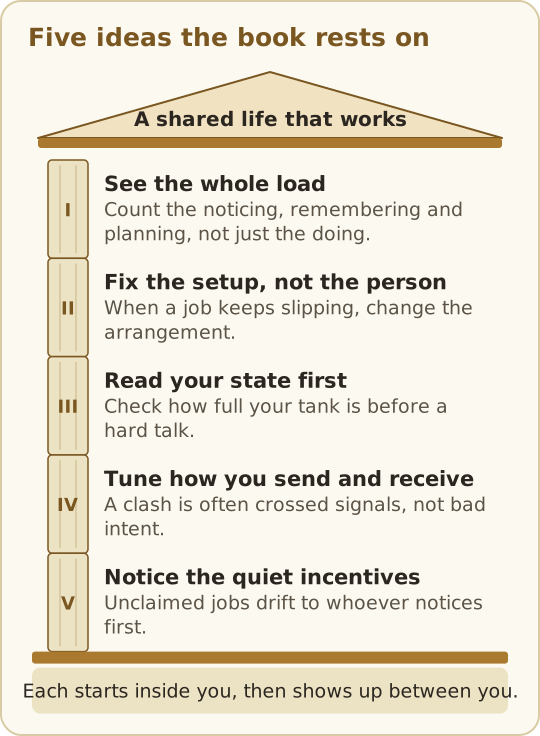
The big ideas: This preface mostly teaches “See the whole load”, with help from “Notice the quiet incentives”. What are the five big ideas?
Sunday, 9pm
Someone notices the laundry is still in the washer, the school forms are due on Tuesday, and the birthday card never got posted. They also notice that nobody else has noticed. The house looks fine. That’s the problem.
Or, living alone: A widower says, “Since my wife died, I notice how many jobs she quietly carried: the birthday cards, the boiler service, knowing who to ring when someone was ill. I never saw them until they stopped getting done.”
-
Unseen work quietly adds up.
Remembering appointments, noticing the milk is low, calming a tense moment: none of it shows up on a calendar, so it rarely gets a thank-you. Over months, it piles up. The book calls this pile unbilled debt. Nobody sends a bill for it. You can thank someone for what they carried before; you just don’t bill for the past.
For example: Marcus remembers every school form, dentist visit and bit of lunch money for their two kids. His husband, Theo, sees two kids who always seem to have what they need. The work is just out of sight.
Words you could use: “Can I show you some of the things I keep track of? I’m not asking you to pay anything back. I just want you to see them.”
Try this: Tonight, write down three things you did today that nobody saw. Don’t do anything with the list yet. Just notice.
Dig deeper: the work that goes unseen -
A lot of it is thinking, not doing.
Before a job gets done, someone has to notice it, remember it, plan it and check it happened. That thinking takes real time and energy, even though nobody can see it.
For example: In a shared flat, Yasmin notices the internet deal is ending, compares plans, picks one and checks it went through. Paying took two minutes. The thinking took an evening.
Words you could use: “Doing it is the quick part. Remembering it and planning it is the part I’d love some help with.”
Try this: Pick one job at home and split it into four steps: notice, plan, do, check. Who usually does each step?
Dig deeper: the kinds of unseen work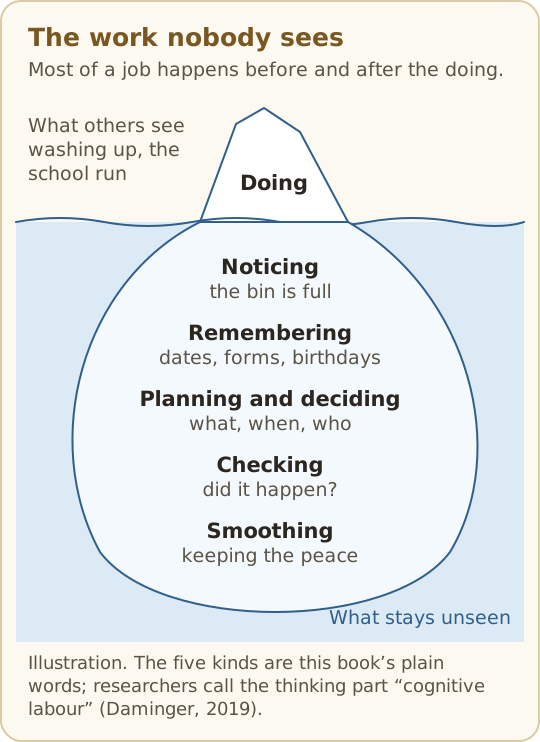
Figure 3 The work nobody sees. Most of a job happens before and after the doing, and whoever holds that part can never fully switch off. -
The other person usually just hasn’t seen it.
When this work is done well, nothing seems to happen. So the other person isn’t ignoring it. From where they stand, it looks like things take care of themselves.
For example: Edna minds her grandchildren three afternoons a week and quietly moves her own doctor visits to fit. Her daughter thinks it all “fits in easily.”
Words you could use: “I don’t think you’ve been ignoring it. I think it’s been hard to see from where you are.”
Try this: Ask one person, “What’s something you do that you think I don’t see?” Then just listen, without explaining.
Dig deeper: why it stays hidden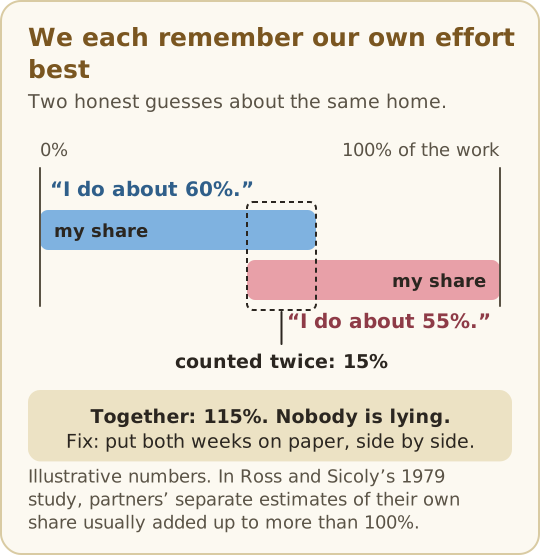
Figure 4 We each remember our own effort best. Illustrative numbers; in Ross and Sicoly’s 1979 study, partners’ estimates of their own share usually added up to more than 100 percent. -
Writing it down isn’t keeping score.
The point is for both of you to see the same picture, in the same words, at the same time. Then the talk starts from facts you share, not from two different memories.
The book calls this shared record a ledger: a plain list of who did what. It’s a way to see, not a bill.
For example: Two coworkers sharing one job each list a week of tasks. Every client call landed on one person. They don’t argue about last year; they swap Friday calls.
Words you could use: “I’m not trying to win anything. I’d like us both to be looking at the same list.”
Try this: Before you show anyone a list, ask yourself: is this to plan next week, or to prove a point? Share it only if the answer is “plan.”
Dig deeper: why a ledger isn’t a grudgeFilled-in example 1 Who did what Marcus and Theo, a couple Who did what
- Person A
- Marcus
- Person B
- Theo
- Week beginning
- 5 October 2026
Part A: Who did what, this week
Day Task noticed or done Who did it Minutes (rough) How it came up: asked for, noticed, or thinking time? Mon Plan the week’s meals Theo 20 Thinking and planning Mon Cook dinner Marcus 45 Asked for Tue Book the boiler service Theo 15 Noticed and handled Tue Dishes Marcus 20 Asked for Wed Laundry, wash to put away Theo 60 Noticed and handled Thu Remember Marcus’s mum’s birthday card Theo 10 Thinking and planning Fri Bins and recycling out Marcus 10 Noticed and handled Sat Big food shop Both 70 Asked for This week’s totals
- Marcus
- 110 minutes (44%), of which 10 noticed and handled without being asked
- Theo
- 140 minutes (56%), of which 105 noticed and handled without being asked (30 of them thinking and planning)
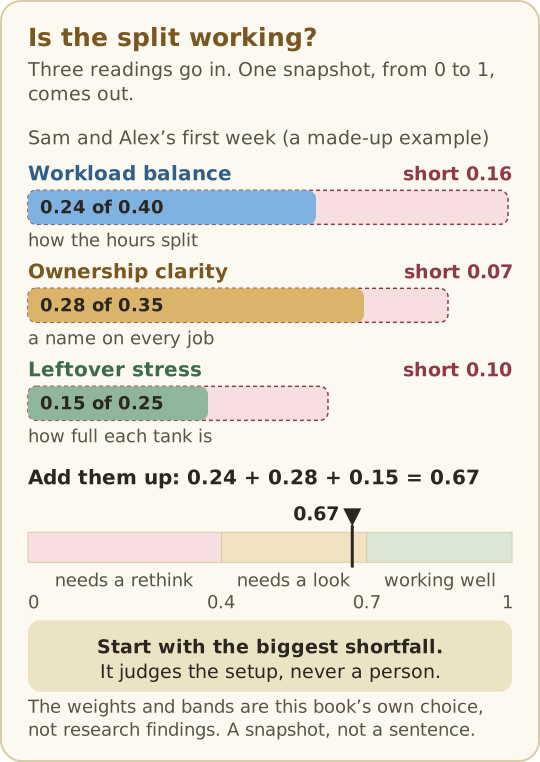
- Workload balance score
- 0.88. It describes how the logged work was split this week, not anyone in it.
- Unasked-for work
- Theo did 91% of the work that was noticed and handled without anyone asking. This is the work that is easiest to miss. Say it out loud, and give the jobs that repeat a named owner.
Part B (optional): Kind ways to say no
Left blank this week.
A made-up example. Names and details are invented.
Fill in your own: Who did what (spreadloveandacceptance.com/
workpapers/ fill/ wp-01) -
Each of you writes only your own side.
Nobody fills in anything for the other person. You each note what you did, then read the two lists together. That keeps it fair and keeps it kind. Each of you also adds the context only you have, like what the week was like, so you both understand rather than judge.
For example: Arran, Dani and Sol are three partners sharing a home. Each writes only their own list. Reading them together, Sol learns Arran has been calling the landlord every month.
Words you could use: “I’ve written my side. Would you like to write yours, in your own words, when you’re ready?”
Try this: Add one line of context to your own list, like “long week at work” or “the kids were ill.” It helps the other person understand, not judge.
Dig deeper: your side, their side -
The borrowed words are there to take the blame away.
The book uses a few terms from accounting and science because they describe what’s happening without saying whose fault it is. Each one is explained in plain words, and you never need them to use anything here.
For example: Two brothers share their mum’s care. Instead of “you never help,” one says, “There’s some unseen work here we haven’t looked at.” That’s much easier to hear.
New together? If words like “ledger” or “debt” feel heavy a few months in, use your own. “Our list” and “the stuff nobody sees” work just as well. The idea stays the same: two people looking at one honest picture, kindly, so nobody has to guess.
Words you could use: “Let’s look at how it’s set up, not at each other.”
Try this: Swap one blaming phrase you use, like “you never,” for a plain one, like “this job keeps landing on me.”
Dig deeper: why the book borrows these words -
One small step at a time.
Each chapter adds one idea and one tool. One week of notes is enough to start. Later come a 90-second daily check-in about how much you were carrying today, a weekly catch-up and a monthly look-back. If you use the monthly look-back later, a few lines a week is all it needs.
For example: A nurse on nights and a partner on days hardly see each other awake. They start with one week of notes on the fridge. No changes yet.
Words you could use: “Could we just try one week of notes and see what we notice? We don’t have to change anything yet.”
Try this: Pick a start day this week and set one reminder on your phone. That’s the whole first step.
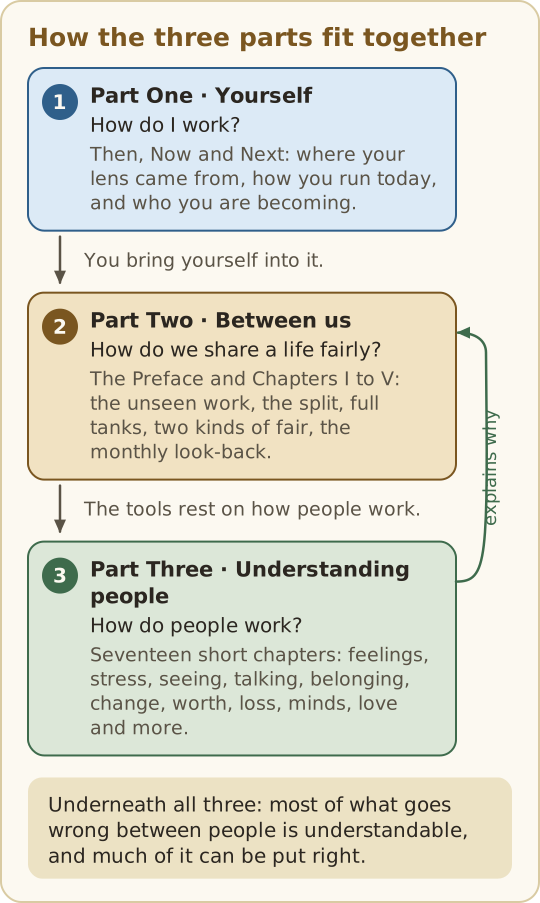
Dig deeper: how the book fits together -
It can help in many kinds of shared life.
Partners, family, roommates, co-parents and coworkers all share unseen work. The examples often use a couple at home, but the ideas fit anyone who shares a load.
For example: A foster carer tracks family visits, social worker calls and school meetings. A teenager in the home quietly cooks for the younger ones twice a week. Both count.
Words you could use: “Whatever we are to each other, we share some work. Could we look at it together?”
Try this: Name one shared load in your life that isn’t a couple: a family group chat, a shared flat, a team at work.
Dig deeper: who this book is for
Friday, after work
“You didn’t have to do all that,” they say, and they mean it kindly. You think: someone did. The list only ever lived in your head, so to them it looked like it took care of itself.
The mental load: what the research says
Many people call the thinking side of home life the mental load: the noticing and planning that come before a job gets done, and the checking after. Knowing the baby needs the next size of clothes. Remembering the form, the jab, the party present. It’s real work, even when it doesn’t look like any.
Studies of couples find some patterns, on average. In couples of a man and a woman, women tend to do more of the noticing and checking (Allison Daminger, 2019). After a first baby, a gap often opens: in one study of working couples, mothers took on most of the new childcare while keeping their paid hours (Jill Yavorsky and colleagues, 2015). Arlie Hochschild called the home work that starts after paid work ends “the second shift.”
There is a fair point on the other side too. Sometimes the parent who knows how things are done holds on to that, without meaning to. Researchers call it gatekeeping. When a parent openly invites the other in, and lets them do it their own way, the other parent tends to do more of the care (Sarah Allen and Alan Hawkins, 1999; Sarah Schoppe-Sullivan and colleagues, 2008).
These are averages across many homes, not a verdict on yours. In your home it may be the other way round, or already even, or shared between two men or two women. That’s why the book asks you to look at your own week on paper, instead of guessing.
For example (made up): Hollie and Gareth have a toddler and a baby, and Gareth works shifts. Their week’s minutes come out nearly even. But Hollie did almost three-quarters of the jobs nobody asked anyone to do. Their week is in Chapter II (page 69).
Words you could use: “You do lots of the doing. It’s the remembering I’d love you to take some of: whole jobs, start to finish.” Or, the other way round: “Show me once how you like it done, then let me do it my way.”
Dig deeper: the mental load, fairly
Inside you, and between you
- In you: Notice everything you carry, including the thinking and feeling work you have never counted. Notice, too, the work others do that you may have missed.
- Between you and others: Put both lists on one shared, fair page, so nobody has to argue about whose work “counts.” Jobs nobody claims tend to drift to whoever notices first, and a specific thank-you helps keep things steady.
Words you could use: “I want to see what you carry, too, not just what I carry.” “Could we put both our weeks on one page?”
On your own: your own unseen work
You don’t need anyone else to start seeing the unseen. For one week, notice the jobs only you remember: the appointments, the restocking, the smoothing-over. Write them down for yourself, not as a bill.
- Count it, don’t charge it. The point is to see your real load, so you can plan your energy.
- Notice which jobs are yours by choice and which just landed on you.
- Pick one job you could hand back, drop or do less often, and say so kindly.
For example: Nicola, divorced, has the children every other week. On paper, she sees she still buys presents for both sides of the family. She hands his side back, kindly, in one message.
Words you could use: “I’ve noticed I’ve been doing this for both of us. From next month, could you take it on?” Or, to yourself: “That was real work, even if nobody saw it.”
Try this: Circle one job on your list that is yours by choice. Enjoy it. Then circle one that just landed on you, and decide what you’ll do about it. More for people living alone or after a breakup: On my own (spreadloveandacceptance.com/
In the individual program: Step 1: check your battery (spreadloveandacceptance.com/
The fields behind this chapter
Christian, who wrote this book, worked as a government auditor and is a polymath: someone who studied thirteen fields deeply (psychology, philosophy, behavioural science, neurobiology, economics, business, finance, holistic therapies, aromatherapy, the art of debating, politics, music and the healing power of laughter). This chapter grows from 5 of them:
- Finance (See the whole load): The idea of an unbilled hour: work that was done and logged, but never invoiced, so the client never sees it.
- Economics (See the whole load): Attention is limited. Every reminder you hold in your head takes up some of it.
- Psychology (See the whole load): We remember our own effort best.
- Philosophy (See the whole load): Telling what we know from how things look. In Plato’s Cave, people mistake shadows for the real thing.
- Business (Notice the quiet incentives): Work that belongs to everyone belongs to no one, and it lands on whoever notices first.
Two fields, one idea: Finance + Psychology. In double-entry bookkeeping, every amount is recorded in two places, and the two must agree. And we each remember our own effort best. Put together: each person keeps their own record, and the two records are read side by side.
See how all the fields connect, in the full version (spreadloveandacceptance.com/
Where this comes from: the polymath way
This book is built on a polymath’s habit: looking at very different fields and noticing that the same few roots keep turning up. Those roots are balance, signal and noise, feedback loops, limited capacity, ownership, quiet incentives, and state and setting. A ledger, a nervous system and a conversation look nothing alike, yet each one has a limit, each one can lose a message in the noise, and each one stays steady only when what goes out is matched by what comes back.
Christian saw those roots across thirteen fields. The four newest to the list are the art of debating, politics, music and the healing power of laughter. They shape the gentler parts of the book: how to disagree without a fight, how a small group decides fairly, how tone and tempo change what lands, and how a shared laugh can repair a hard moment.
Read the polymath way · See how every field connects to every other
In real life
- Partners: One of you keeps track of birthdays, presents and thank-you notes for both families. The other has never had to think about it.
- Family: One grown-up child handles a parent’s appointments and prescription refills each week. The others see a parent who is “doing fine.”
- Roommates: One roommate always buys the toilet paper and the dish soap. Nobody asked them to. It just keeps happening.
- Coworkers: One person books the meetings, takes the notes and follows up afterwards. It isn’t in anyone’s job description.
Words you could use: “I didn’t know you did that. Thank you.” “Can we look at who does the remembering, not just the doing?”
More kinds of shared life
Unseen work turns up wherever people share something:
- Two mums: one holds the baby’s dates and forms in her head; the other does lots of hands-on care.
- More than two partners: a job nobody owns lands on whoever notices first. More than two (spreadloveandacceptance.com/
more-than-two) - Friends: one friend always makes the plans and sends the “how are you?” Friends (spreadloveandacceptance.com/
friends) - Teens: walking the dog and minding a sister feels like a lot to them, and like “helping a bit” to adults. For teens (spreadloveandacceptance.com/
teens) - Grandparents and grown-up children: childcare comes with planning work, too. Grown-up children (spreadloveandacceptance.com/
grown-up-children) - Adult siblings: one sorts a late parent’s paperwork for months. Family rifts (spreadloveandacceptance.com/
family-rifts) - Co-parents and carers: packing the right kit for two homes; meetings and reports on top of care. Co-parenting (spreadloveandacceptance.com/
co-parenting) · Foster and kinship (spreadloveandacceptance.com/foster-and-kinship) - Housemates, coworkers and business partners: one person always notices the bathroom, or chases the invoices. Sharing a room (spreadloveandacceptance.com/
sharing-a-room) - Illness, different hours, distance, two faiths: the one at home more, or the one who is well, becomes the default; the ill partner manages unseen pain and energy. When one is ill (spreadloveandacceptance.com/
when-one-is-ill) · Different hours (spreadloveandacceptance.com/different-hours) · Long distance (spreadloveandacceptance.com/long-distance) · Two faiths (spreadloveandacceptance.com/two-faiths)
Words you could use: “I don’t need it to be even. I need it to be seen.”
Find your own starting point: Help by relationship (spreadloveandacceptance.com/
Your situation, in this part of the book
Some situations get their own section in Part Two:
- Faith, culture, elders and in-laws: Chapter I (page 47)
- Small children or a new baby: Chapter II (page 69)
- Two homes after a split, and step-parents: Chapter III (page 91)
- Money between you: Chapter IV (page 112)
- A couple and a housemate: Chapter IV (page 113)
- New together, or about to move in: Chapter V (page 130)
- Grandparents raising a grandchild: Chapter V (page 131)
Common mix-ups
- “If it mattered, they would have asked for help.” Unseen work is often hidden from the person doing it, too, until it’s written down.
- “Writing it down means I’m angry.” It means you want you both to see the same picture.
- “It has to be exactly 50/50.” The goal is a split you can both see and both agree to, not a perfect half.
- “Mental work doesn’t count, only chores do.” Remembering, planning and checking take real time and energy. Put them on the list.
- “We should start by going over the last ten years.” Start with one ordinary week. You can thank someone for the past without trying to settle it.
- “The one doing less doesn’t care.” Usually they just can’t see it yet. Nobody here is the villain. Once you’ve both seen it, what you do next is a choice you make together.
Words you could use: “I don’t think either of us is the bad guy here. We just haven’t seen the same picture yet.”
Try this: Each of you, on your own, list the things you did this week that nobody saw. Then swap lists.
Next, read the other list slowly and say one thing on it you hadn’t noticed before.
Then pick one item from their list and say thank you for it, in a specific way.
If writing things down isn’t your style, a ten-minute talk over a cup of coffee with the same questions works too.
Keep it light. This is a first look, not a verdict. The fixing comes later in the book.
Limits and cautions
These tools only work when each person feels free to say no, to ask for a pause, or to keep their own notes private. If talking about the split ever feels unsafe, or one of you feels you can’t say no, stop using the tools and talk with a trained counsellor on your own. When someone is afraid of their partner, counselling together isn’t advised. Not safe at home? (spreadloveandacceptance.com/
A list should never be demanded, checked over your shoulder, or used to keep track of where you go or what you spend. If that is happening, it isn’t a ledger. It’s control, and it’s not your fault. Signs to look out for. If you are a counsellor or group leader using this book with others, see For counsellors (spreadloveandacceptance.com/